
Ajax’s rapid growth since the 1990s means thousands of homes here are now carrying original hot water tanks that are well past their reliable lifespan, and David sees failed or near-failed units in Ajax’s Westney Heights, Pickering Village, and Central West neighbourhoods every week. David covers all of Ajax and the rest of Durham Region, call and he picks up, same day.
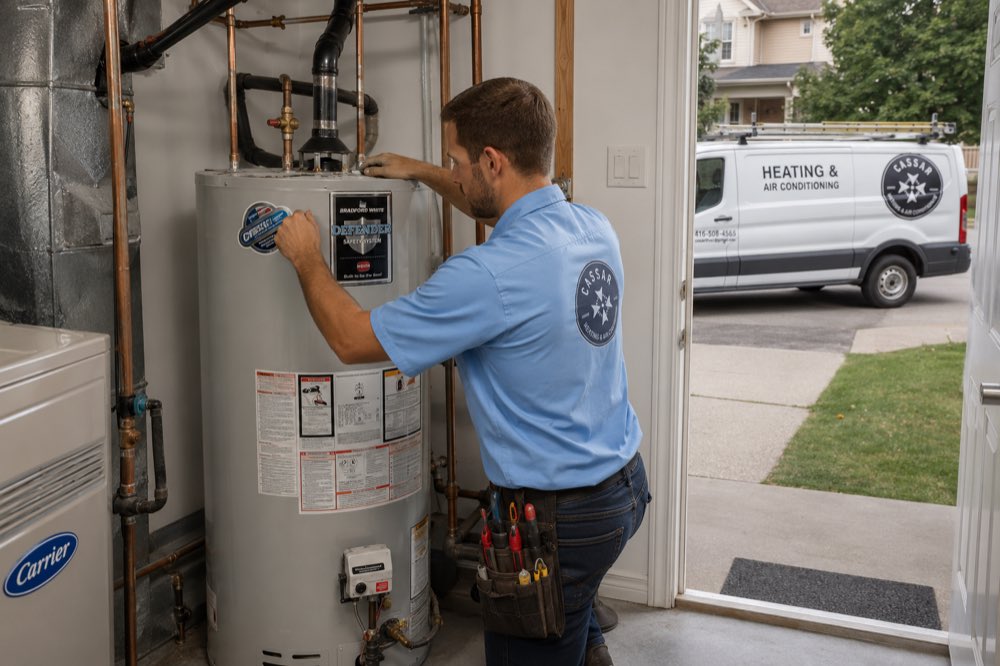
From a first-time install in a new Ajax townhome to an emergency swap-out on a Saturday morning, David handles it.
David installs natural gas and electric hot water tanks in Ajax homes, sizing the unit correctly for the household before any work starts. Many Ajax homes built in the 1990s and early 2000s were fitted with 40-gallon tanks that no longer match the family inside, David recommends the right size, not just the standard swap. Every installation meets Ontario’s current code requirements and David pulls the necessary permits.
David diagnoses and repairs hot water tank problems the same day in most cases. Faulty thermostats, failed heating elements, worn anode rods, and malfunctioning pressure relief valves are all fixable, and David won’t recommend a new tank if a repair makes more sense. He carries common replacement parts on the truck, so most Ajax calls don’t require a second visit.
When a tank is beyond repair or pushing 12-plus years, replacement is the smarter call. David removes the old unit, disposes of it properly, and installs a new one, all in a single visit for most Ajax homes. He’ll tell you plainly if the old tank can survive another season or if you’re better off replacing it now before it fails at the worst possible time.
An annual maintenance visit extends tank life significantly. David checks the anode rod, flushes sediment from the tank floor, inspects the T&P valve, and verifies proper venting. Skipping this step is why so many tanks fail earlier than they should. Scheduling maintenance before winter is the right time, demand spikes when temperatures drop, and a stressed tank on a cold January night isn’t a fun phone call to make.
Moving from a standard 60% EF tank to a modern power-vent or direct-vent model cuts your water heating costs noticeably. David helps Ajax homeowners compare the numbers honestly, upfront cost versus monthly savings, payback period, and whether the existing venting can support the upgrade or needs modification. There’s no pressure to go high-efficiency if the math doesn’t work for your household.
A leaking or failed hot water tank can’t wait until Monday. David takes emergency calls across Ajax and responds the same day. Ajax’s older subdivisions near Harwood Avenue and Salem Road North carry a lot of aging equipment that tends to go when temperatures swing hard, David knows this area and stocks parts for the brands most common here. Call (416) 508-4585 and he’ll pick up.
I’ve been working in Ajax homes since 2011, and one thing I see constantly is tanks that a rental company talked homeowners into replacing before they needed to, or repairs that were brushed off as “not worth it” just to sell a new unit. That’s not how I work. I’ll tell you what I’d do if it were my own home, and that’s the advice you’ll get.
Most conventional storage hot water tanks last between 8 and 12 years, though 10 years is a reasonable planning horizon for a gas tank in Ontario. Electric tanks can stretch to 12-15 years in some cases, depending on water quality and how hard the tank has been worked. If your tank is past 10 years and showing any symptoms, inconsistent temperatures, a slight rusty tint, or small amounts of water around the base, it’s worth having it assessed rather than waiting for a full failure.
Several factors shorten that lifespan. A tank that was undersized for the household runs its heating elements or burner more frequently, wearing components faster. A tank that’s never had its anode rod replaced will corrode from the inside out, the anode rod is specifically designed to sacrifice itself so the tank lining doesn’t corrode, and once it’s gone the tank walls start taking the damage. Durham Region’s water carries moderate hardness, and the mineral buildup on the tank floor insulates the burner from the water, which means longer heating cycles and more wear.
Annual flushing pushes the needle toward the longer end of that range. It’s not complicated, connecting a hose to the drain valve and letting the tank run until the water clears takes about 20 minutes, and it’s worth doing before each heating season. Ontario’s colder winters push hot water demand up, and a tank running heavy sediment load heading into December is working harder than it should be.
A standard natural gas hot water tank replacement in Ajax, supply and installation included, typically runs between $1,200 and $1,800 for a conventional 40 or 50-gallon unit. Electric tank replacements sit in a similar range, sometimes slightly lower on the equipment side depending on the brand and efficiency rating. Power-vent and direct-vent models with higher energy factors cost more upfront, often $1,600 to $2,400 installed, but carry lower operating costs over their lifespan.
What drives variation is mostly the type of unit, whether any venting modifications are needed, and whether the existing gas or electrical connection needs updating to meet current code. If the old tank is tucked into a tight mechanical room or requires additional shut-off work, that adds time. Repairs sit in a much wider range: a thermocouple or thermostat swap might be $150 to $300, while a more involved repair involving a leaking fitting or a failed element on an electric tank might reach $400 to $500. At some point the repair cost crosses into replacement territory, and David will tell you plainly when that line is close.
Every job David quotes is free and carries no obligation. The number he gives you before starting is the number on the invoice when he’s done. The best way to know what your specific job will cost is to get a free quote from David, no pressure, no obligation.
Ajax grew rapidly through the late 1980s, 1990s, and into the 2000s, and the bulk of the town’s housing stock reflects that. Subdivisions like Pickering Village, Westney Heights, and the areas around Rossland Road were built primarily between 1988 and 2005. That means a large portion of Ajax homeowners are now sitting on original or once-replaced hot water tanks in the 10-to-15-year range. The wave of replacements David handles in Ajax is concentrated in these areas, and it’s almost predictable by street.
Many of these homes used atmospheric-vent gas tanks that draw combustion air from the mechanical room. Ontario’s building code now requires better venting separation in many scenarios, and when David replaces one of these older units he checks whether the installation still meets code before simply swapping equipment. Installing a new tank the same way as the old one, without checking, is a shortcut that creates problems down the road.
Ajax also has a growing number of newer infill townhomes and stacked towns near the waterfront and along Kingston Road, where mechanical rooms are compact and tank sizing has to account for limited space and shared walls. David’s worked in enough of these units to know the common clearance and venting constraints before he arrives, which keeps the job on schedule.
The clearest sign is running out of hot water faster than you used to. If a household that always had plenty of hot water starts struggling after a few showers, sediment buildup is the most likely cause, it displaces water volume and insulates the burner, reducing effective capacity and recovery speed. This is common in Ajax homes where the tank hasn’t been flushed in several years.
Discoloured water, especially a rusty or brownish tint at the hot tap, points to internal tank corrosion. Once the lining goes, water gets into the steel and the tank is deteriorating from the inside. That’s a replacement conversation, not a repair. A dripping temperature and pressure relief valve is a different kind of warning: it means the tank is running at elevated pressure or temperature, which can point to a failing thermostat or a partially blocked expansion. Don’t dismiss a dripping T&P valve as a minor nuisance.
Durham Region’s water hardness accelerates the rumbling and popping sounds that come from a sediment-heavy tank. When the burner fires and water percolates through a thick layer of mineral deposits, the noise can be loud enough to hear through floors. In Ajax homes built in the 1990s with original or near-original tanks, David hears this on a regular basis. A flush can help a tank that’s otherwise in good shape, but if the tank is already past 10 years, the sediment has often done its damage and replacement makes more sense.
Durham Region’s winters are cold enough that the cold water entering your tank in January can be 5-8°C, compared to 15°C or more in summer. That temperature gap means the tank works harder every winter, running more cycles to reach setpoint. Setting the thermostat to 60°C (140°F) is the right balance, hot enough to prevent Legionella bacteria growth, low enough to avoid scalding and excessive energy use. A lot of tanks David services in Ajax are set too low, at 49°C or below, which is both a comfort and a safety concern.
Insulating the first metre of hot water pipe leaving the tank reduces standby losses, particularly in unheated mechanical rooms or basements with exterior walls. It’s a straightforward DIY job with foam pipe insulation from any hardware store and it takes less than 30 minutes. If the tank itself sits against a cold exterior wall, a tank insulation blanket adds measurable savings, though most modern tanks already carry reasonable jacket insulation.
The biggest mistake Durham Region homeowners make is ignoring the anode rod for the life of the tank. Most manufacturers recommend checking it every 3-5 years and replacing it before it depletes. A tank with a live anode rod can run well past its nominal lifespan. David checks the anode rod on every maintenance visit, it’s a five-minute inspection that extends the tank’s life considerably.
In Ontario, any installation or replacement of a gas hot water tank requires a contractor holding a TSSA gas contractor licence. This isn’t optional, it’s the law, and it exists because improper gas connections and venting create carbon monoxide risks. David’s TSSA licence number is #000398183, which you can verify directly on the TSSA public registry. If a contractor can’t give you their TSSA number, don’t let them touch your gas appliances.
Carbon monoxide is the primary safety concern with atmospheric-vent gas tanks. A blocked or deteriorated flue, a cracked heat exchanger, or a backdrafting condition can push CO into living spaces without any visible or audible warning. Every Ajax home with a gas hot water tank should have a working CO detector on the same floor as the mechanical room, and David checks venting conditions on every service call as a standard step, not an add-on.
Ontario’s Enbridge and the federal government have both offered rebates on high-efficiency water heating equipment in recent years. Eligibility and amounts change, so it’s worth asking David when you’re pricing a replacement, he keeps current on what’s available and can tell you whether the equipment you’re considering qualifies. Moving to a power-vent or condensing unit can qualify for rebates that meaningfully offset the higher equipment cost.
Checking the simple things before calling saves time for everyone, run through these steps first.
The temperature dial on your tank may have been turned down accidentally, especially after maintenance visits. Try turning it up and waiting 30 minutes.
Electric tanks have a dedicated breaker that trips occasionally. Gas tanks have a pilot light, if it’s out, follow the relight instructions on the label.
A dripping T&P valve is a warning sign, not normal. Turn down the thermostat and call Cassar, don’t ignore a dripping relief valve.
Loud rumbling or popping usually means sediment has built up on the tank floor. Flushing may help on newer tanks; on older ones it often signals time to replace.
The shutoff valve on the cold water inlet to the tank must be fully open. It sometimes gets partially closed during plumbing work nearby.
If none of the above solve it, the tank needs a licensed technician. David serves all of Ajax and Durham Region and picks up the phone himself.
Most gas hot water tanks in Durham Region last 8 to 12 years, with 10 years being the point where you should start paying attention even if the tank is still running. Electric tanks can push to 12-15 years, though water quality plays a bigger role with electric units because scaling on the elements degrades performance over time. Durham Region’s water carries moderate mineral hardness, which accelerates sediment buildup on the tank floor and shortens the effective heating cycle, the tank has to run longer to get water to temperature, which adds wear on every component. Annual flushing is the single best thing you can do to push toward the longer end of that range. Skipping it for five or six years is why so many tanks fail earlier than the nameplate suggests they should. If your tank is past 10 years and starting to show symptoms, inconsistent temperature, discoloured water, visible moisture around the base, call David for an honest assessment before it fails on a February night.
The answer depends on three things: the age of the tank, the cost of the repair, and whether the failure is a symptom of a deeper problem. A tank under 7 years old with a failed thermocouple or heating element is almost always worth repairing, parts are cheap and the tank has most of its life ahead of it. A tank that’s 11 or 12 years old with a leaking tank body or significant internal corrosion is almost always worth replacing, because the underlying structure is failing and a repair is just delaying the inevitable. The grey zone is a 7-to-10-year-old tank with a mid-range repair cost, say $300 to $500. David looks at the condition of the anode rod, the extent of sediment buildup, and whether there are any signs of corrosion before making a recommendation. If the tank is in otherwise solid shape, he’ll repair it. If it looks like it’s heading toward failure regardless, he’ll tell you that clearly so you can make the call with full information. He won’t push a replacement to generate a bigger invoice.
A standard natural gas tank replacement in Durham Region, including the unit and installation, typically runs between $1,200 and $1,800 for a conventional 40 or 50-gallon model. Electric tanks are in a similar range. Power-vent models, which are quieter and more efficient and can vent horizontally through an exterior wall, run $1,600 to $2,400 installed depending on whether the venting needs to be modified. What moves the number up is usually venting work, gas line updates to meet current code, or a difficult mechanical room that requires more time to access safely. What moves it down is a straightforward like-for-like swap in an accessible location with no code upgrades needed. Every quote David gives is free and there’s no obligation. The best way to know what your specific job will cost is to get a free quote from David, no pressure, no obligation.
Buying almost always costs less over the lifespan of the equipment, and most Ajax homeowners who run the numbers wish they’d bought sooner. Rental agreements from the major utility companies typically run $30 to $50 per month, and many of them carry automatic renewal clauses that are difficult to exit, some homeowners discover buyout fees of $500 to $1,500 when they try to switch. Over 10 years, you’ve paid $3,600 to $6,000 for a tank that would have cost $1,400 to $1,800 to purchase and install outright. The rental model makes sense in a very limited set of circumstances: if you’re in a condo or rental unit where you have no say in the equipment, or if you genuinely can’t manage the upfront cost and the monthly payment is the only viable option. If you own your Ajax home and have the ability to purchase, David will give you a straight comparison so you can decide. He owns and installs the equipment, he doesn’t offer rentals or have any financial reason to push one direction over the other.
A straightforward hot water tank replacement in an Ajax home typically takes 2 to 3 hours from arrival to completion. David drains and disconnects the old tank, removes it, installs the new unit, reconnects the gas or electrical and water lines, verifies venting, tests the unit through a full heating cycle, and cleans up the work area before he leaves. If there are complications, venting that needs modification, a gas shutoff that requires additional work, or a particularly tight mechanical room, it can run to 3.5 or 4 hours. New installs in a location that previously didn’t have a tank take longer because the gas line and venting run need to be roughed in from scratch. David gives you a realistic time estimate before the job starts so you can plan your day accordingly.
Turn off the cold water supply valve on the inlet to the tank immediately, it’s typically located directly above the tank on the pipe feeding it. This stops water from continuing to fill the tank. If it’s a gas tank, turn the gas valve to the pilot position rather than fully off, so the pilot stays lit but the burner stops firing. If you’re not sure how to do that safely, turn the gas off at the main valve for the tank. For an electric tank, flip the breaker for the water heater. Once you’ve stopped the water and the heat source, call David at (416) 508-4585. A leak from the tank body itself, not a fitting or a connection, usually means the tank needs replacing, because the steel has corroded through and it won’t hold a repair. A leak from a fitting or the T&P valve is often repairable. David will be able to tell you which you’re dealing with when he arrives, and he serves Ajax with same-day availability in most cases.
Yes, David removes and disposes of the old tank as part of every replacement job in Ajax. He disconnects it, drains the remaining water, and takes it with him, you don’t have to arrange disposal separately or figure out what to do with a 150-pound piece of equipment in your mechanical room. Old hot water tanks are steel and can be recycled through metal recycling, and David handles that process. There’s no separate fee for removal, it’s included in the replacement quote. The only exception would be a tank in an extremely unusual or inaccessible location that requires specialized equipment to move safely, and David would flag that in the quote before any work starts rather than surprise you with it afterward.
David installs Bradford White, Rheem, and Giant as his primary brands, all of which carry solid reputations for reliability and parts availability across Ontario. Bradford White is manufactured in North America and David’s found them to be consistently well-built, particularly the commercial-grade residential models. Rheem is widely available and carries good warranty terms on both the tank and the parts. Giant is Canadian-made and a solid option for homeowners who want domestic manufacturing. David doesn’t push one brand over another based on margin, he’ll tell you which model makes sense for your household size, your budget, and your existing venting setup. If an Ajax homeowner has a strong preference for a specific brand, David can source it. What he won’t install is a brand with known reliability issues just because it’s cheaper on the supply side, because that cost shows up later as a repair call.
“Tank failed overnight and by noon the next day we had a new one running. No cold showers in our Ajax house.”
“David came out to our place in Westney Heights and told us straight up the tank was repairable, said we had another three or four years in it if we did the maintenance. I appreciated that he didn’t just push for the replacement sale. He fixed the thermocouple, showed me the anode rod condition, and was gone in under two hours.”
“Got quotes from two other contractors before calling Cassar. Both were vague on the final price. David gave me a number before touching anything, stuck to it exactly, and left the mechanical room cleaner than he found it. That’s all I needed.”
David covers Ajax and every community across Durham Region, same-day service, one phone call.
Same-day service available. TSSA certified. Honest pricing. Call or book online.