
Pickering’s mix of 1980s and 1990s subdivisions in Brock Ridge, Dunbarton, and Rougemount means a large share of the city’s hot water tanks are hitting or well past their expected lifespan, and David sees a steady stream of after-hours calls from homeowners who woke up to cold showers without any warning. David covers all of Pickering and the rest of Durham Region, with same-day and emergency service available seven days a week.
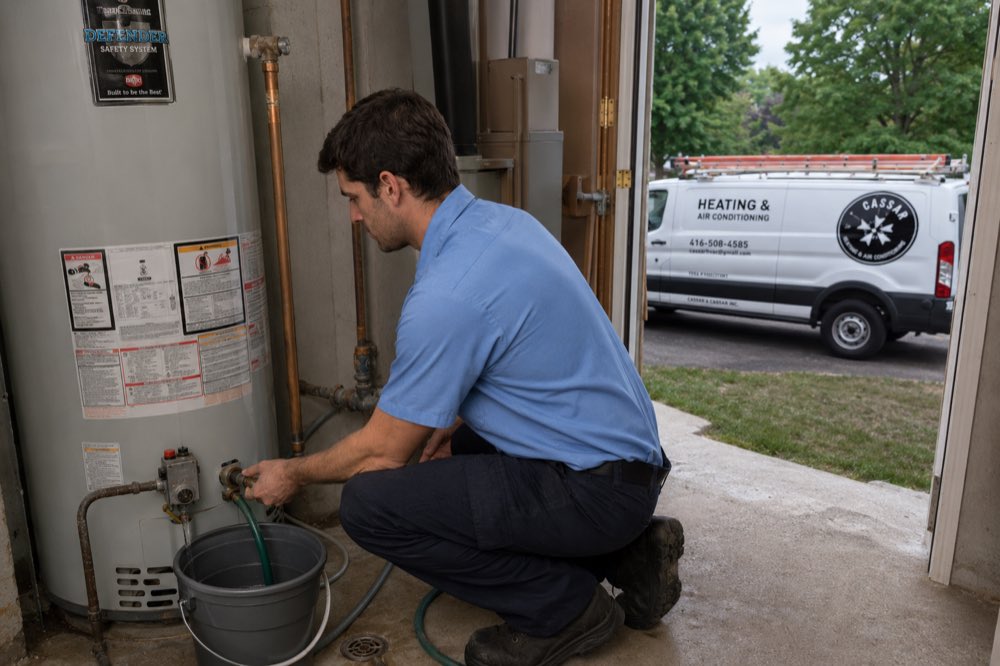
From a first-time installation in a new Seaton-area home to an emergency replacement in an older Dunbarton property, David handles every job personally.
David sizes the tank to the home before quoting, not after. Many Pickering homes built in the 1980s in Rougemount or West Shore were set up with 40-gallon tanks that no longer cut it for today’s larger households. He’ll tell you what size actually fits your usage before any work starts.
A failing element, a tripped thermostat, or a worn-out dip tube are all fixable without replacing the whole unit. David diagnoses the problem before recommending anything, and he’ll tell you straight if a repair makes more sense than a replacement.
When a tank is past repairing, David carries common sizes on his truck so most Pickering replacements happen the same day you call. He removes the old unit, handles the permit paperwork where required under TSSA regulations, and leaves the mechanical room clean.
Flushing sediment, testing the anode rod, and checking the T&P valve once a year adds years to any tank’s service life. David schedules maintenance visits across Pickering and can combine a water heater check with a furnace or A/C service call if you want both done in one trip.
Upgrading from a standard 6-year tank to a high-efficiency or power-vent model cuts energy costs noticeably over the life of the unit. David walks you through the payback period honestly so you can decide whether the upgrade makes financial sense for your household, not just his invoice.
When you call about a leaking or completely dead tank, you reach David directly. He covers all of Pickering, from the waterfront communities on the south end to the newer subdivisions in the Seaton development area to the north, and he responds the same day. There’s no dispatcher between you and the person doing the work.
I’ve been working in Pickering homes since 2011 and I still see the same thing regularly: a tank that’s 14 or 15 years old, sitting in a utility room that was clearly never set up for easy access, and a homeowner who had no idea it was in that condition. I’d rather find that during a tune-up than at 10 PM on a Friday night when it’s already failed. Every job I take in Pickering gets the same straightforward process: look at what’s there, tell you what I actually think, quote it before I touch anything, and leave the place cleaner than I found it.
Most conventional storage-tank water heaters last between 8 and 12 years in Ontario homes. Some make it to 14 or 15 years with proper maintenance; others start causing problems at 9 or 10. The realistic midpoint is about 10 to 11 years, which means if your tank is past that mark you should be budgeting for a replacement rather than hoping for another few years.
Ontario’s water quality plays a direct role. Durham Region sits on moderately hard water, and the mineral scale that builds up on heating elements and the tank floor gradually reduces efficiency and accelerates corrosion. Flushing the tank annually removes that sediment before it does lasting damage. An anode rod check every two to three years catches corrosion early, when it’s still fixable rather than terminal.
Cold-climate cycling also shortens tank life. Ontario winters mean incoming cold water temperatures drop significantly from November through March, which forces the burner or element to work harder and cycle more frequently. A tank that might last 12 years in a warmer climate often lands closer to 10 in a Durham Region home simply because of that seasonal workload.
For a standard natural gas water heater installation in a Pickering home, you’re typically looking at $1,400 to $2,200 all in, including the unit and labour. Electric tank installations run somewhat less on the equipment side but can add cost if the electrical panel needs attention. A high-efficiency or power-vent model will sit at the higher end of that range, starting around $1,800 to $2,600 depending on venting requirements and the specifics of your mechanical room.
Repair costs vary more widely. A heating element replacement on an electric tank runs roughly $200 to $400. A thermocouple or gas valve repair on a gas unit is typically $150 to $350. If a repair quotes out at more than half the cost of a new unit on a tank that’s already 9 or 10 years old, David will tell you to put that money toward a replacement instead.
Every job gets a free upfront quote before any work starts. The best way to know what your specific job will cost is to get a free quote from David, no pressure, no obligation.
Pickering’s housing stock is unusually varied for a Durham Region city. The older neighbourhoods along the waterfront, including West Shore, Dunbarton, and Bay Ridges, have homes from the 1960s and 1970s that sometimes still have original mechanical rooms designed around oil heat conversions. David regularly finds cramped utility rooms in these areas where a standard 50-gallon tall tank won’t fit without modifications, and a shorter medium-profile unit is the only practical option.
The large 1980s and 1990s subdivisions, particularly Brock Ridge, Liverpool, and parts of Rougemount, have homes with more standardised mechanical rooms but a significant number of tanks that are now approaching or past the 20-year mark. These are the calls that come in as emergencies because the tank failed with no prior warning. In several of these homes, the original builder-grade tank was never replaced. If your home was built in this era and you’ve never replaced the water heater, it’s worth a look before it decides for you.
The newer Seaton development area in northern Pickering presents a different set of questions. These homes are recent builds with modern mechanical rooms, but some were set up with builder-spec tanks sized for a smaller household. As families grow into these homes, the 40-gallon tank that came with the build often starts running out during morning routines, and an upgrade to a 50 or 60-gallon unit resolves it completely.
The most obvious sign is running out of hot water faster than you used to. If a tank that previously handled your household’s morning showers without issue now runs cold partway through, the cause is usually one of three things: a failing heating element, heavy sediment buildup reducing effective tank capacity, or simply a tank that’s reached the end of its working life. All three are diagnosable in one visit.
Discoloured or rust-tinted hot water points directly to internal tank corrosion. Once the tank lining fails and rust starts entering the water supply, the unit can’t be repaired, it needs replacing. Durham Region homeowners sometimes confuse this with pipe corrosion, which is a different problem, but if the discolouration only affects the hot side and not the cold, the tank itself is almost always the source.
Pooling water around the base of the tank, even small amounts, means the tank is leaking and needs to come out. A slow seep from the bottom of the tank body is internal corrosion that will worsen. Don’t let this sit, water damage to a Pickering home’s basement or utility room floor compounds quickly and costs far more to fix than the tank replacement itself.
The single most effective maintenance step for Ontario homeowners is annual flushing. Durham Region’s water introduces enough mineral scale over the course of a year that skipping this step noticeably shortens tank life. Connecting a hose to the drain valve and flushing until the water runs clear takes about 20 minutes. It’s worth doing in the fall before the heavy winter heating season puts extra demand on the unit.
Setting the thermostat between 49°C and 60°C (120°F to 140°F) is the right range for Ontario homes. Below 49°C risks Legionella growth in the tank. Above 60°C increases scale buildup, puts stress on the tank lining, and raises your gas or electricity costs without a practical benefit. Most tanks leave the factory set at 60°C; turning it down to 49°C or 55°C is a reasonable and safe adjustment for most households.
Insulating the first metre of the cold and hot water pipes connected to the tank reduces standby heat loss, which matters more in Ontario’s colder months when uninsulated pipes in an unheated utility room or basement lose heat quickly. Pipe insulation sleeves are inexpensive and take ten minutes to install. On a gas tank, leaving the first few centimetres of the flue uninsulated is important for safety.
Ontario requires all gas appliance work, including hot water tank installation and replacement, to be performed by a TSSA-licenced technician. This isn’t administrative detail, improper venting of a gas water heater is one of the leading causes of carbon monoxide incidents in residential homes. David’s TSSA Licence #000398183 is publicly verifiable and covers all gas appliance work across Durham Region, including Pickering.
The T&P (temperature and pressure) relief valve on every hot water tank is a critical safety device. It releases if tank pressure or temperature reaches a dangerous level. A valve that drips intermittently isn’t functioning normally, it’s signalling that something is wrong, either with the thermostat, the expansion tank, or the valve itself. Never cap or plug a dripping T&P valve. Call David and he’ll find the actual cause.
On the efficiency side, the Canada Greener Homes Grant and Enbridge rebate programs have periodically offered incentives for upgrading to high-efficiency or heat-pump water heaters. Eligibility and amounts change year to year, but David can tell you what’s currently available when he quotes your job so you’re not leaving money on the table. A heat-pump water heater, in particular, uses roughly 60 to 70 per cent less electricity than a standard electric resistance tank, which translates to a real reduction in Hydro One bills for Pickering homeowners on electric heat.
Checking the simple things before calling saves time for everyone.
The temperature dial on your tank may have been turned down accidentally, especially after maintenance visits. Try turning it up and waiting 30 minutes.
Electric tanks have a dedicated breaker that trips occasionally. Gas tanks have a pilot light, if it’s out, follow the relight instructions on the label.
A dripping T&P valve is a warning sign, not normal. Turn down the thermostat and call Cassar, don’t ignore a dripping relief valve.
Loud rumbling or popping usually means sediment has built up on the tank floor. Flushing may help on newer tanks; on older ones it often signals time to replace.
The shutoff valve on the cold water inlet to the tank must be fully open. It sometimes gets partially closed during plumbing work nearby.
If none of the above resolved it, the tank needs a licensed technician. David serves all of Durham Region and picks up the phone himself.
Most hot water tanks in Durham Region last between 8 and 12 years, with the average landing around 10 to 11. That range is shorter than you’ll see advertised on some manufacturer spec sheets, and the reason is Ontario’s water quality. Durham Region has moderately hard water, which accelerates mineral scale buildup inside the tank. That scale reduces heating efficiency, forces the burner or element to work harder, and corrodes the tank lining from the inside. Annual flushing removes the bulk of that sediment and genuinely extends service life. An anode rod replacement every three to four years protects the tank lining further. Skip both consistently and a 10-year tank may not make it to 8. Do both and a quality unit can reach 12 to 14 years. When a Pickering customer calls me about a tank that’s past 11 or 12 years old, I’ll usually tell them to start budgeting for a replacement even if it’s still technically running, because a failure at that age is a when question rather than an if question.
The answer depends on the age of the tank, the cost of the repair, and what’s actually failed. If the tank is under 7 years old and the issue is a heating element, thermostat, thermocouple, or gas valve, repairing it almost always makes sense. Those parts are inexpensive relative to a new unit and the repair adds several more years of life. If the tank is 10 years or older and the repair quote is more than $400 to $500, I’ll usually recommend replacement instead, you’re spending real money to extend a unit that’s likely to have another problem within a year or two. If the tank body itself is rusted, leaking from the base, or producing rust-coloured water, it can’t be repaired. There’s no fix for a failed tank lining. The one thing I won’t do is recommend a replacement just because it’s easier or more profitable. If a repair is the right call financially, that’s what I’ll tell you. I’ve worked on enough Pickering homes to know what a reasonable repair looks like versus a tank that’s done.
For a standard natural gas hot water tank installation in Durham Region, you’re typically looking at $1,400 to $2,200 all in. That range covers the unit, labour, disposal of the old tank, and any standard connections. What pushes a job toward the higher end: upgrading to a larger tank that requires modified connections, switching from electric to gas or vice versa, difficult access in an older utility room, or choosing a power-vent or high-efficiency model that needs additional venting work. Electric tank installations tend to run $100 to $200 less on the equipment side, but if the electrical panel or wiring needs upgrading to support the new unit, that cost comes back. High-efficiency and power-vent units start around $1,800 to $2,600 installed. Every job I quote in Pickering or anywhere in Durham Region is free and upfront before I touch anything, the number I give you before the job is the number on the invoice after. The best way to know what your specific job will cost is to get a free quote from David, no pressure, no obligation.
Buy it. Renting a water heater in Ontario costs between $25 and $50 per month depending on the rental company and the unit, which adds up to $300 to $600 a year. Over the 10-year life of a tank, that’s $3,000 to $6,000 in rental fees for a unit that would cost $1,400 to $2,200 to purchase outright. The math doesn’t work in the renter’s favour at any point after the first two or three years. Rental companies also control the replacement schedule, they’ll replace your tank on their timeline, not when it’s most convenient for you, and there are often service fees on top of the monthly payment for anything beyond a basic maintenance call. The main argument for renting is that you pay nothing upfront, which matters if cash flow is genuinely tight. But if you can cover the purchase price, owning the unit saves you money from year three onward and gives you full control over the equipment, the service provider, and the replacement timing. I’ve helped a number of Pickering homeowners buy out their rental contracts and replace with a purchased unit, and in every case the break-even point was well within the tank’s remaining service life.
A standard hot water tank replacement in a Pickering home typically takes two to three hours from arrival to completion. That includes draining and disconnecting the old unit, positioning and connecting the new tank, testing all connections, relighting the pilot or powering up the element, and confirming the unit is heating correctly before I leave. If the mechanical room is tight, if there’s an unusual venting configuration, or if I find corroded fittings that need replacing while I’m in there, it can run to three and a half or four hours. I’ll tell you before I start if anything I find is going to add time or cost. The hot water itself takes about 45 minutes to an hour to heat up to temperature after the new tank is running, so most Pickering homeowners have hot water back by the time I’ve packed up and left. I carry the most common tank sizes on the truck specifically to avoid a scenario where you wait an extra day for a part or unit that needs to be ordered in.
First, figure out where it’s leaking from, that determines how urgent the situation is. A drip from the T&P relief valve means turn down the thermostat and call me. Don’t cap it. A small drip from a pipe connection at the top of the tank may just be a loose fitting that can be tightened. Water pooling at the base of the tank, coming from the tank body itself, means the lining has failed internally and the tank needs to come out, this one doesn’t wait. Turn off the cold water inlet valve (it’s on the pipe going into the top of the tank), turn the thermostat to the lowest setting or switch off the breaker for electric tanks, and call me. If the leak is significant and you can’t control it with the shutoff valve, locate your home’s main water shutoff and close that. A leaking tank in a Pickering basement can damage flooring, drywall, and anything stored nearby very quickly. The repair cost for a flooded utility room almost always exceeds what a tank replacement costs, so don’t let it go overnight hoping it’ll slow down on its own.
Yes, removing and disposing of the old unit is included with every replacement job I do in Pickering and across Durham Region. You don’t need to arrange disposal separately or get the old tank out of the house yourself. I disconnect it, drain it, and take it with me. The disposal is handled through proper channels, old tanks contain materials that shouldn’t go to curb pickup. Some homeowners in Pickering ask about donating or reselling older tanks that still technically function, and that’s possible in certain cases, but I’ll give you an honest assessment of whether the unit has enough useful life left to be worth anything to someone else versus just being removed. The City of Pickering has specific guidelines around large appliance disposal, and handling it as part of the installation job means none of that lands on you. When I leave your home, the old tank is gone and the new one is running.
I install tanks from Bradford White, Rheem, Giant, and AO Smith, which cover the range of what makes sense for most Pickering homes. Bradford White is built in North America and parts availability in Ontario is excellent, which matters when something needs attention years after installation. Rheem offers strong warranty coverage across their residential line and I’ve found their units reliable over the long term in Durham Region homes. Giant is a Canadian manufacturer with good support infrastructure. I don’t push one brand over another based on margin, I’ll tell you which unit fits your household size, your fuel type, and your mechanical room configuration, and then give you the option that makes the most sense for your budget. If you’ve already done research on a specific model or brand and want that unit installed, I’m happy to discuss whether it’s a good fit for your situation. The goal is that you end up with a tank that does its job reliably for the next 10 to 12 years without surprises.
“Tank blew out on a Thursday evening in our Brock Ridge house. David had a new one running by Friday afternoon. Cold water for less than 24 hours total.”
“I called expecting to leave a voicemail and David picked up on the second ring. He came out to our place in Dunbarton the same morning, looked at the old tank, and told me it was the anode rod causing the smell, not something that needed a replacement at all. He fixed it, showed me what he did, and charged me exactly what he quoted on the phone. That kind of straight talk is rare.”
“The price I got before the job was the price I paid after, which honestly surprised me given what I’ve dealt with from other contractors. He put something down on the floor before dragging the old tank out, and the utility room looked the same when he left as it did when he arrived. For a job in my Liverpool neighbourhood home I was expecting more disruption than that.”
David covers all of Durham Region, if you’re near Pickering, chances are he’s already in your area.
Same-day service available. TSSA certified. Honest pricing. Call or book online.