
Pickering’s mix of 1980s and 1990s subdivisions in Rougemount and Dunbarton means a lot of homes have older standing-pilot gas fireplaces that haven’t been touched in years, and David sees more failing thermocouples and cracked ceramic logs in this city than almost anywhere else in Durham Region. He’s available same-day across all of Pickering and the surrounding communities, and he picks up the phone himself.
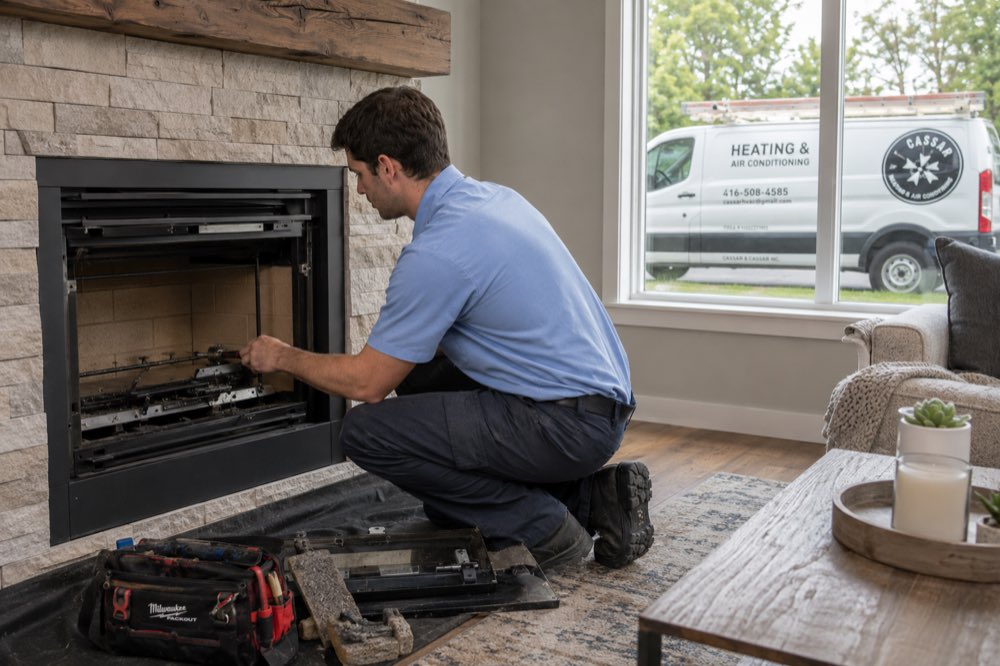
From a first-time gas fireplace install in a new Seaton build to a twenty-year-old unit in Rosebank that won’t stay lit, David handles it all.
David installs gas fireplaces in both existing Pickering homes and new construction, including the growing Seaton community in the city’s north end where builders often rough-in gas lines but leave the fireplace install to the homeowner. He handles the gas connection, venting, and TSSA-compliant sign-off from start to finish. Every installation gets an upfront quote before work begins.
A fireplace that won’t light, won’t stay lit, or flames that look wrong are the most common calls David gets from Pickering homeowners. He diagnoses the problem on the spot and carries the parts that handle most repairs in a single visit. There’s no booking a follow-up trip to get a part ordered.
When a fireplace is beyond repair or simply too inefficient to justify keeping, David will tell you plainly what the honest call is. He won’t push a replacement if a repair makes more financial sense. If a new unit is the right move, he’ll match you with an appropriately sized, efficient model for your home’s layout and your actual usage patterns.
An annual service on a gas fireplace takes about an hour and covers the burner, pilot assembly, thermocouple or thermopile, gas valve operation, glass seal, and venting. David cleans the ceramic logs and inspects the firebox for cracks or corrosion. Ontario’s cold winters mean fireplaces run hard from October through March, so a pre-season tune-up each fall is the most cost-effective thing you can do.
Older standing-pilot fireplaces common in Pickering’s 1980s-era Rougemount and Bay Ridges neighbourhoods consume gas continuously through the pilot even when the fireplace isn’t in use. Upgrading to an electronic ignition or intermittent pilot system eliminates that waste. David can assess whether your existing unit is upgradeable or whether a full replacement with a high-efficiency model makes better financial sense long-term.
A gas smell near your fireplace or a unit that’s venting improperly inside the home needs attention right away, not a booking next week. David takes emergency calls across all of Pickering and responds the same day. He holds TSSA Licence #000398183, so the work he does on your gas appliance is legal, traceable, and done correctly.
I’ve been working on gas fireplaces in Pickering since 2011, and the pattern I see most often is homeowners who’ve lived with an underperforming or intermittently failing fireplace for two or three winters because they weren’t sure who to call or whether the repair was worth it. Most of those jobs are straightforward fixes. I give you a straight answer before any work starts, and the price I quote is the price you pay.
A gas fireplace in good working order typically lasts 15 to 25 years, though the range depends heavily on usage, maintenance history, and the quality of the original installation. Units that get an annual service, have their venting inspected, and run on properly adjusted gas pressure routinely hit the upper end of that range. Units that have never been serviced often fail in their twelfth or thirteenth year with problems that could have been prevented for a few hundred dollars.
Ontario’s climate shortens fireplace lifespans in one specific way: the high humidity during spring and fall causes condensation inside the firebox and venting if the unit sits unused for months and then gets fired up cold. That moisture accelerates corrosion on the burner tray and the gas valve components. The fix is straightforward, run the fireplace for fifteen minutes a month even in the off-season, and get the venting inspected every two or three years.
Electronic ignition systems tend to outlast standing pilot systems when both are serviced regularly, but standing pilot units that are maintained properly can run well past twenty years. The most common reason a fireplace gets replaced before its time isn’t mechanical failure, it’s that the homeowner didn’t know the issue was fixable.
A standard gas fireplace repair in Pickering typically runs between $150 and $450 depending on what’s failed. Thermocouple and thermopile replacements sit at the lower end. Gas valve replacements or igniter module failures push toward the higher end. Parts cost varies by brand, and labour on a straightforward job usually takes under two hours. Emergency or after-hours calls carry a service call premium.
A new gas fireplace installation in an existing Pickering home, including the unit, venting, and gas connection, generally falls between $2,500 and $5,500. The main variables are the type of unit (direct-vent, B-vent, or vent-free), the complexity of the venting run, and whether a gas line extension is needed. New builds with a rough-in already in place come in toward the lower end. An insert into an existing wood-burning fireplace has its own cost range, typically $1,800 to $3,500 installed, depending on firebox dimensions and insert model.
Annual maintenance visits run $120 to $200 for a standard gas fireplace service. The best way to know what your specific job will cost is to get a free quote from David, no pressure, no obligation.
Most of Pickering’s established residential neighbourhoods, including Bay Ridges near the waterfront, Rougemount, Dunbarton, and Woodlands, were built between the late 1970s and the mid-1990s. Gas fireplaces in those homes are typically standing-pilot units manufactured by Valor, Regency, or Napoleon, and a significant number of them haven’t been serviced since installation. By the time David gets a call, the pilot’s been going out repeatedly each season and the homeowner has been relighting it manually for two or three winters running.
The City of Pickering’s newer development areas, particularly the Seaton community in the north end near Whites Road and Taunton Road, tell a different story. Those homes are newer builds, often with builder-grade direct-vent fireplaces installed between 2015 and 2024. The units are more efficient, but the installations are sometimes rushed during construction, and David occasionally finds venting terminations that don’t meet current TSSA clearance requirements when he does initial inspections on those homes.
Pickering also has a range of older semi-detached and townhome stock, particularly near the Pickering Town Centre corridor. Fireplaces in attached housing require additional attention to shared-wall venting configurations. A horizontal vent terminating too close to a neighbour’s window or a shared soffit is a code violation that creates real safety concerns. If you’re in a townhome or semi and haven’t had the venting checked recently, it’s worth a look.
A pilot light that won’t stay lit without you holding the button for longer than usual is the earliest sign of a failing thermocouple. The thermocouple sits in the pilot flame and generates a small electrical signal that keeps the gas valve open. When it starts to degrade, the signal weakens and the valve closes. Pickering homeowners with older standing-pilot units, particularly those in homes built in the 1980s, should treat a struggling pilot light as a repair call rather than an inconvenience to work around.
Yellow or orange flames on a gas fireplace indicate incomplete combustion. A clean gas flame burns blue with a stable shape. Yellow tips or an entirely orange flame mean the air-to-gas ratio is off, which produces carbon monoxide as a byproduct. CO has no smell and no colour. If your fireplace flames look wrong and your CO detector goes off, shut the fireplace off and open windows. That’s an emergency call, not a scheduled service.
A sulphur or rotten-egg smell near the fireplace is a gas leak until proven otherwise. Turn off the gas at the shutoff valve, leave the house, and call from outside. Durham Region has seen a handful of incidents over the years tied to gas connections that degraded after years of thermal cycling. That’s not a DIY situation under any circumstances.
Durham Region’s heating season runs roughly from late October through April, with the coldest sustained stretches in January and February when temperatures regularly drop to minus 15 or colder. A gas fireplace running during those months works harder than its thermostat might suggest, because the firebox heats and cools repeatedly over the course of each day. That thermal cycling stresses ceramic components, glass seals, and the firebox lining more than steady use would.
The single most useful thing Pickering homeowners can do before the heating season is schedule a pre-season tune-up in September or October. David checks the gas pressure, tests ignition reliability, inspects the venting for any blockages (bird nests in direct-vent terminations are a real issue in the spring and can still be present in fall), and cleans the burner and logs. A fireplace that’s been serviced in September runs cleaner and more reliably all winter.
In spring, when most homeowners stop using the fireplace for the season, close the gas valve if it’s a standing-pilot unit. There’s no reason to burn gas continuously through a pilot from May to September. On electronic ignition units, this isn’t an issue, the pilot only runs when the fireplace does. Either way, running the unit briefly every month during the off-season keeps the gas valve from seizing from disuse.
In Ontario, gas fireplace work falls under TSSA jurisdiction. Any work that involves connecting, disconnecting, or modifying a gas line must be done by a licensed gas contractor. David holds TSSA Licence #000398183, which you can verify directly on the TSSA public registry. This isn’t a bureaucratic detail, it matters for your home insurance and for the legal validity of a work permit if one is required. An unlicensed technician doing gas work creates liability that lands on you as the homeowner.
Carbon monoxide is the primary safety concern with any gas appliance. Every Ontario home with a gas fireplace should have a CO detector within ten feet of the appliance and on every level of the home. CO detectors expire, most have a seven-to-ten-year lifespan, and the expiry date is printed on the back. If yours predates 2016, it’s likely past its reliable working life and should be replaced. This is a $30 purchase that belongs on every Pickering homeowner’s fall checklist.
On the efficiency side, Ontario’s Enbridge Gas has offered rebate programs for high-efficiency heating equipment upgrades in recent years. Eligibility and amounts change seasonally, so it’s worth checking the current Enbridge Home Efficiency Rebate Plus program before committing to a replacement fireplace purchase. David can advise on which replacement units qualify and walk you through what documentation you’ll need to submit a claim.
Checking the simple things before calling saves time for everyone.
Most fireplace issues start with the pilot light going out. Follow the manufacturer’s relight instructions on the unit, usually hold the pilot button for 30–60 seconds. If it relights and holds, you’re done. If it goes out again within a few minutes, the thermocouple is the likely culprit.
These small sensors sit in the pilot flame and generate the signal to keep the gas valve open. If they’re worn, the pilot lights but won’t stay on. This needs a technician, it’s not a DIY repair, but it’s one of the most common and straightforward fixes David makes on Pickering service calls.
There’s usually a shutoff valve behind or beneath the fireplace. Make sure it’s fully open, these sometimes get turned off accidentally during cleaning. The valve handle should be parallel to the gas line when it’s open, perpendicular when it’s closed.
Most modern gas fireplaces use a remote or wall switch. Weak batteries cause intermittent ignition failures before failing completely. Try fresh AA or AAA batteries in both the remote and the receiver unit, it’s a two-minute fix that solves the problem more often than you’d expect.
Heavy soot or white mineral deposits on the glass can affect some sensor-based ignition systems. Clean glass also improves efficiency significantly. Use a ceramic glass cleaner specifically formulated for fireplace glass, standard window cleaner can etch the surface and void the glass warranty on newer units.
If none of the above solves it, the fireplace needs a licensed technician. David serves all of Pickering and Durham Region and picks up the phone himself.
A gas fireplace installation in Durham Region typically costs between $2,500 and $5,500 for a complete job, unit, venting, and gas connection included. The spread is wide because the variables genuinely matter. A direct-vent unit with a short horizontal vent run through an exterior wall in a main-floor living room is a straightforward half-day job. A B-vent installation requiring a vertical run up through the interior of a two-storey home takes longer and uses more material. If you need a gas line extension from your nearest branch line, that adds cost depending on the distance. Pickering homes built before 1990 sometimes have gas piping in less accessible locations, which can add time. The fireplace model itself varies widely in price, an entry-level Napoleon unit starts around $900, while premium Valor or Heat & Glo models with ember bed lighting and remote thermostats run $2,000 and up before installation. The best way to know what your specific job will cost is to get a free quote from David, no pressure, no obligation.
It depends on the type of fireplace, and here’s exactly what the options are. A direct-vent gas fireplace draws combustion air from outside and exhausts through a sealed coaxial pipe that exits through an exterior wall or roof. It’s the most common type installed in Pickering today and doesn’t require a chimney. A B-vent fireplace draws combustion air from inside the room and vents through a vertical flue, this type does need a dedicated vertical vent run, though not necessarily a masonry chimney. A vent-free fireplace uses no venting at all, but it burns oxygen from the room and produces combustion byproducts inside the house, which is why Ontario has restrictions on their use and sizing. Direct-vent is what David installs in the vast majority of Pickering homes because it’s the most flexible, the most efficient, and the safest option for most residential applications. If you have an existing masonry fireplace with a chimney, an insert that uses the existing flue liner is another route worth discussing.
Yes, some gas fireplaces are designed to function as a primary heat source, but most decorative units sold for ambiance aren’t built for that purpose and won’t do the job reliably through a Durham Region winter. The distinction comes down to BTU output and heat distribution. A heating-rated gas fireplace with a convection blower and an output of 25,000 BTU or higher can effectively heat a well-insulated open-concept main floor in a mid-size Pickering home. What it won’t do is circulate heat to upper floors or closed rooms the way a forced-air furnace does. If you’re considering a gas fireplace as a primary source because you’re heating a cottage, a zone addition, or a home without existing ductwork, David can help you calculate whether the output matches the heat loss for that space. In most Pickering homes, a gas fireplace works best as supplemental heat, running it in the rooms you use most lets you turn the furnace thermostat down a few degrees, which makes a real difference on January heating bills.
Once a year is the right answer for most Ontario homeowners, and fall is the best time. A fireplace that runs through a full heating season accumulates dust in the burner, deposits on the ceramic logs, oxidation on the pilot components, and sometimes debris in the vent termination from insects or birds that nested over the summer. An annual service covers all of that, David checks gas pressure, tests the ignition sequence, inspects the thermocouple or thermopile, examines the venting for blockages and corrosion, cleans the glass and burner, and verifies that the unit is producing a complete, clean flame. In Pickering, many homeowners skip the annual service for years and only call when something fails. That’s understandable, but a $150 tune-up every fall prevents the $400 repair call in January when the fireplace stops working on the coldest week of the year. If your fireplace hasn’t been serviced in more than two years, it’s worth getting it looked at before the season starts.
Start with the basics before calling anyone. First, check whether the pilot light is out, on a standing-pilot unit, follow the relight instructions printed on the label inside the access panel. Hold the pilot button down for a full 30 to 60 seconds before releasing, to give the thermocouple time to heat up and hold the valve open. If the pilot lights but goes out when you release the button, the thermocouple is likely failing. Second, check that the gas supply valve behind or beneath the unit is fully open. Third, if your fireplace uses a remote or wall switch, replace the batteries, weak batteries are a surprisingly frequent cause of no-start calls. Fourth, if it’s an electronic ignition unit and you can hear clicking but no flame, there may be a problem with the igniter module or the gas valve itself. Those last two require a technician. If you’ve worked through the checklist and it’s still not lighting, call David at (416) 508-4585, he covers all of Pickering and can usually get there the same day.
A fireplace insert is a self-contained unit designed to slide into an existing masonry or prefab fireplace opening. If you have an old wood-burning fireplace in your Pickering home that you want to convert to gas, an insert is almost always the most cost-effective route, it uses the existing firebox structure and vents through a liner dropped into the existing flue. A built-in gas fireplace (sometimes called a zero-clearance or direct-vent fireplace) is a standalone unit installed into a framed wall cavity. It doesn’t need an existing fireplace, David frames it in, installs the unit, runs the direct-vent coaxial pipe through the exterior wall, and connects the gas line. This is what goes into new construction or room additions. A log set is a burner-and-log assembly designed to sit inside an existing masonry firebox with a working chimney and damper. It’s the lowest-cost gas conversion option, but it’s also the least efficient because it relies on a traditional open chimney for venting, which loses a significant amount of heat. For most Pickering homeowners, an insert or a built-in delivers better heat output and better efficiency than a log set.
David works on all major gas fireplace brands sold in Canada, including Napoleon, Valor, Heat & Glo, Regency, Majestic, Lennox, and Kingsman, as well as older units from manufacturers like Continental and Comfort Flame that show up frequently in Pickering homes built in the 1980s and 1990s. For repairs, the brand matters less than getting the right replacement parts, David carries common components for the most frequently serviced units and can source parts for less common models. For new installations, he’ll recommend a brand and model that suits your budget, your home’s layout, and your actual usage patterns rather than steering you toward whichever unit carries the highest margin. If you’re not sure whether he services a specific brand, call (416) 508-4585 and ask, he’ll give you a straight answer on the spot rather than booking a diagnostic visit he’s not confident will lead anywhere.
A properly functioning, sealed direct-vent gas fireplace can be left running overnight without the safety concerns that apply to a wood-burning fireplace. The combustion happens in a sealed chamber that draws outside air, so it doesn’t consume oxygen from the room and doesn’t introduce smoke or combustion gases into the living space. That said, “properly functioning” is doing a lot of work in that sentence. A fireplace with a cracked glass panel, a degraded door gasket, or a venting issue is a different situation entirely, combustion byproducts can enter the room, and CO has no smell or colour. Before leaving any gas fireplace running unattended for extended periods, it needs to be in verified good working order with an annual service on record. Every Pickering home with a gas fireplace should also have a working CO detector on the same level as the fireplace. If your CO detector alarm sounds while the fireplace is running, don’t pause to investigate, shut the unit off, get everyone out, and call from outside. That’s a non-negotiable.
“Our gas fireplace in Pickering had been relighting on its own about once a week for two winters. David came out, replaced the thermocouple, and it’s run perfectly ever since.”
“I called David because our fireplace in Bay Ridges had started making a popping noise when it heated up and the flames were looking more orange than I remembered. He came the same day, checked the burner and the gas pressure, adjusted the air shutter, and walked me through exactly what had caused the issue. He didn’t try to sell me a new unit, he just fixed what was wrong and explained how to spot it again if it started drifting.”
“The price David quoted on the phone was the price on the invoice. He put down a drop cloth before opening the firebox panel, cleaned up every bit of soot and dust before he left, and was out in under ninety minutes. For a fireplace that hadn’t been serviced since 2009, it was well worth the call.”
David covers all of Durham Region for fireplace installation, repair, and maintenance.
Same-day service available. TSSA certified. Honest pricing. Call or book online.