
When you call David, you get a straight answer about whether your heat pump needs a repair, a tune-up, or a full replacement, and a firm price before any work begins. He’s been doing this work across Oshawa, Whitby, Ajax, Pickering, Clarington and the surrounding communities since 2011.
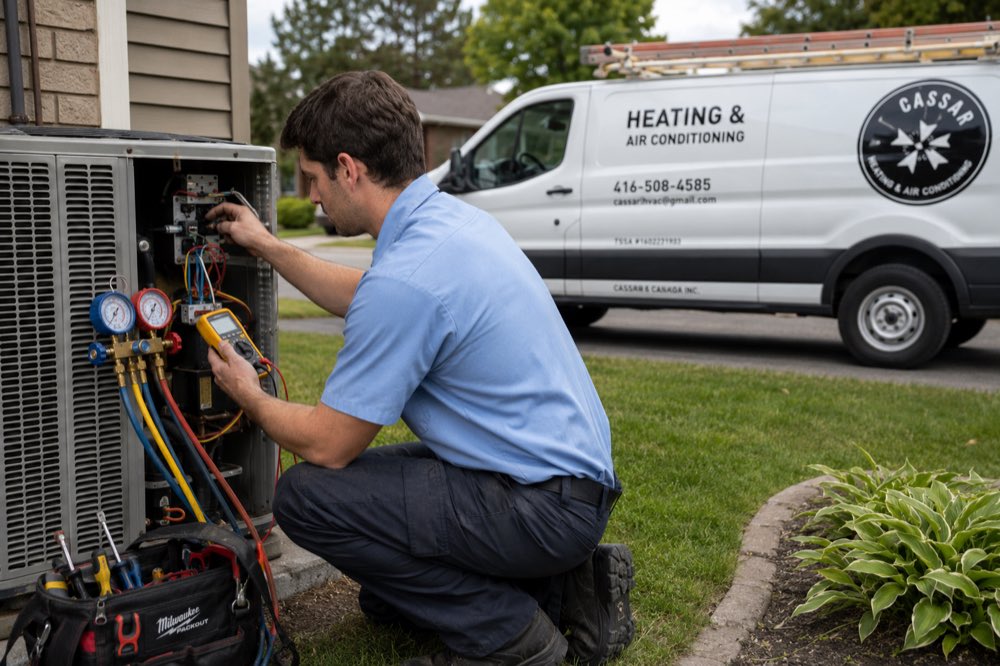
From a new installation to an emergency repair, David handles every part of the job himself, no subcontractors, no handoffs.
A proper heat pump installation starts with a Manual J load calculation, sizing the unit to your home, not just picking the nearest round number. David handles everything from disconnecting old equipment and setting the new outdoor unit, to commissioning the refrigerant circuit and verifying airflow across every zone. You’ll know the system’s running correctly before he leaves.
Most heat pump problems trace back to a handful of causes: a refrigerant leak, a failed reversing valve, a dirty coil, or a capacitor that’s given out. David carries common replacement parts on his truck so many repairs get finished in one visit. He’ll diagnose the root cause first, not just swap parts until something works.
When a repair stops making financial sense, usually when the compressor fails on a unit over 12 years old, a replacement is the honest recommendation. David’ll walk you through what’s changed in efficiency ratings since your current unit was installed, explain what rebates your project qualifies for, and give you a firm installed price before anything gets removed.
A heat pump tune-up covers both heating and cooling functions in one visit, refrigerant pressure check, coil cleaning, defrost cycle test, electrical connections, and airflow verification. Skipping annual maintenance is the fastest way to void a manufacturer warranty and reduce efficiency by 10 to 15 percent. David checks the full system, not just the items on a quick-lube checklist.
When a heat pump fails in January in Whitby, it’s not a situation that waits until the next available appointment. David offers emergency service across all of Durham Region and answers the phone himself, you’ll know right away whether he can be there same-day or first thing the next morning. No dispatch queue, no callback window.
Upgrading from a standard single-stage heat pump to a variable-speed inverter-driven unit can cut your heating and cooling costs by 30 to 40 percent, particularly in Durham Region’s shoulder seasons when outdoor temps sit between 0°C and 10°C. David’ll show you the efficiency numbers for your specific home and run the payback math before you decide anything.
David answers the phone directly, you’ll describe what your heat pump is doing, and he’ll ask the right questions to understand the situation before he arrives. If it sounds like an emergency, he’ll tell you what to do in the meantime.
David runs a full diagnostic on your heat pump, measuring refrigerant pressures, checking electrical components, testing the reversing valve and defrost controls. You’ll get a specific diagnosis and a firm quote before any repair or replacement work starts.
David completes the repair or installation himself, no handoffs to a junior tech once the diagnosis is done. He tests the system through a full heating and cooling cycle before closing up, so you’re not finding out about a second problem a week later.
Before he leaves, David walks you through what was done, what he found, and whether there’s anything to watch for. He’ll leave the space the way he found it, and you’ll have his number if anything comes up.
David’s been doing heat pump work in Durham Region since 2011, long enough to know which issues show up repeatedly in Clarington’s older slab homes, which brands hold up in Ontario winters, and when a repair genuinely makes more sense than a new unit. He works without a dispatcher between you and the answer.
David Cassar started this company because he’d seen too many homeowners get pushed into replacements they didn’t need by contractors who were working for commissions, not for the customer. He set up Cassar Heating & Air Conditioning in 2011 with a simple idea: give people the same advice you’d give a neighbour, charge a fair price, and do the work yourself.
On heat pump jobs specifically, David does things differently. He won’t quote a new unit until he’s run a proper load calculation and confirmed the existing ductwork can handle the airflow a modern variable-speed unit demands. A lot of Durham Region homes were built in the ’80s and ’90s with duct systems sized for older equipment, putting a high-efficiency heat pump on undersized ducts means it’ll never perform the way the spec sheet says it should.
He treats customers’ homes the way he’d want his own treated. That means drop cloths down before he starts, no scuffed baseboards, and everything back where it was when he leaves. It’s why people in Pickering and Whitby who called him once in 2014 still call him when something else needs attention.
“Heat pump stopped switching to heating mode mid-October. David diagnosed a failed reversing valve and had it fixed the same afternoon.”
“I called David about replacing my old heat pump and he actually talked me out of it, told me the compressor was fine and that a refrigerant recharge and a coil clean would get me another three or four years. He was right. That was two years ago and it’s still running well. Appreciate that he was straight with me.”
“Price came in exactly where he quoted, not a dollar over. He put down a mat at the front door, wore boot covers the whole time, and cleaned up the utility room before he left. Didn’t realize that was something you could expect from an HVAC guy.”
Seven questions Durham Region homeowners ask before they commit to a heat pump installation or replacement. Straight answers below.
A heat pump moves heat rather than generating it, in heating mode, it extracts heat from outdoor air and transfers it inside, even when it’s cold outside. Traditional heat pumps started losing efficiency around 0°C, which made them impractical as a primary heat source in Ontario. That changed significantly with modern cold-climate models, which maintain useful heating output down to -25°C or -30°C. For Durham Region winters, where temperatures regularly hit -15°C to -20°C but rarely stay there for extended periods, a properly sized cold-climate heat pump covers most of your heating season without a backup. For the coldest weeks, many homeowners use a dual-fuel setup pairing the heat pump with an existing gas furnace. David’ll assess your home’s heat loss and tell you exactly what configuration makes sense.
It can, but whether it should depends on a few specific factors. Your home’s insulation level matters a lot, a poorly insulated 1970s bungalow in Clarington has a much higher heat loss than a well-sealed newer build in Ajax, which means the heat pump has to work harder and your backup system kicks in more often. Ductwork sizing also matters: older homes often have ducts designed for gas furnaces, which move air differently than a heat pump’s air handler. If the ducts are undersized for heat pump airflow, you’ll get poor distribution and wasted energy. David checks both before recommending a full replacement. In many cases, a dual-fuel system, where the heat pump handles the majority of the heating season and the furnace takes over below a certain outdoor temperature, gives the best efficiency and the lowest operating cost.
A standard central heat pump installation in Durham Region runs between $4,500 and $10,000 installed, before rebates. What drives the range: the unit’s size (measured in tons of capacity), its efficiency rating (HSPF2 and SEER2), the brand, and how much existing equipment needs to be modified or replaced. A straightforward swap on a home with compatible ductwork and an existing air handler sits toward the lower end. A full dual-fuel conversion with a new air handler and electrical upgrades sits toward the higher end. Cold-climate premium models from brands like Bosch or Mitsubishi carry a higher upfront cost but earn back the difference over time through lower operating costs and better performance in Ontario winters. After Ontario rebates through Enbridge or the Canada Greener Homes Grant, the net installed cost can drop by $2,000 to $5,000 depending on the system. The best way to know what your specific job will cost is to get a free quote from David, no pressure, no obligation.
As of 2024, there are two main programs worth knowing about. The Canada Greener Homes Grant offers up to $5,000 for eligible heat pump installations, but it requires a pre-retrofit energy audit by a registered NRCan energy advisor before work begins. Enbridge Gas offers rebates ranging from $250 to $2,500 for homeowners adding an air-source heat pump alongside an existing gas system, with higher rebates for cold-climate rated units. Some municipalities in Durham Region also have supplementary rebate programs, it’s worth checking with your local municipality before you commit. Program terms and availability change, so David’ll confirm what’s currently running and which programs your specific equipment and situation qualify for before you sign anything.
An air conditioner only moves heat in one direction, out of your home in summer. A heat pump does the same thing in summer, but it also runs the refrigeration cycle in reverse in winter to pull heat from outdoor air and bring it inside. Mechanically, a heat pump and a central air conditioner look almost identical on the outside, the key difference is the reversing valve inside the unit that switches the direction of refrigerant flow. If you’re replacing a central air conditioner, upgrading to a heat pump instead often makes financial sense, because you’re buying heating capacity at the same time. The incremental cost over a standard AC is usually $1,000 to $2,500, and rebates often close most of that gap.
A well-maintained heat pump typically lasts 15 to 20 years in Ontario’s climate. The outdoor unit takes the most wear, it runs year-round rather than just one season like an air conditioner, so annual maintenance matters more for a heat pump than it does for a conventional AC. The things that shorten a heat pump’s life fastest are running it with low refrigerant charge (usually from a slow leak), skipping coil cleaning, and ignoring airflow problems that make the compressor work harder than it should. David’s seen units in Whitby and Pickering push 18 to 20 years with consistent maintenance, and others fail at 10 from neglect. When a compressor fails on a unit over 12 years old, replacement usually makes more financial sense than repair, David’ll always give you the honest math on which way it goes.
For a heat pump in Ontario, the two ratings that matter most are HSPF2 (Heating Seasonal Performance Factor, second-generation test method) and SEER2 (Seasonal Energy Efficiency Ratio, second-generation). HSPF2 measures heating efficiency over a heating season, a higher number means lower operating costs in winter. Look for an HSPF2 of at least 8.5 for a standard heat pump, and at least 9.5 for a cold-climate model rated for Ontario winters. SEER2 measures cooling efficiency, a minimum of 15 is a reasonable threshold for Durham Region’s cooling season. COP (Coefficient of Performance) tells you how much heat output you’re getting per unit of electricity at a specific outdoor temperature; at -15°C, a cold-climate heat pump should maintain a COP of at least 1.5 to be worth the investment at current electricity rates. David will compare specific models against your current heating costs so you can see the actual payback period, not just a spec sheet number.
Still not sure? Call David at (416) 508-4585
Book your heat pump tune-up in September or early October, before the first cold snap hits. David checks refrigerant pressure, cleans the outdoor coil, tests the defrost cycle, and verifies the reversing valve switches correctly, the things that determine whether your heat pump handles a Durham Region winter or gives out in February. Getting it done before the weather turns means you’re not calling for emergency service when every HVAC contractor in the region is already booked out.
Some frost on the outdoor unit is normal in winter, the defrost cycle should clear it within 30 to 40 minutes. Ice that builds up and doesn’t clear, or a unit that’s iced over completely, means the defrost cycle has failed and the system is working against itself. Other warning signs worth a call: the system running almost constantly but the house staying cold, unusual clicking or grinding sounds from the outdoor unit, or the backup heat running far more than it used to. Catching these early usually means a repair rather than a replacement.
Spring is the lowest-pressure window to plan a heat pump replacement or upgrade. Contractors aren’t yet in the summer rush, equipment is typically in good supply, and you’ve got time to get an energy audit done if you’re applying for Greener Homes funding. If your heat pump struggled through the past winter, running constantly, not keeping up, or cycling off on very cold days, a spring assessment gives you the whole summer to plan rather than making a rushed decision in November.
In cooling mode, a heat pump works exactly like a central air conditioner, so everything that matters for AC performance matters here too. Keep at least two feet of clearance around the outdoor unit and make sure the coil fins aren’t bent or clogged with cottonwood or grass clippings. Check your air filter monthly in peak cooling season; a clogged filter forces the system to work harder and can cause the indoor coil to ice up. If you notice the system cooling less effectively than last summer, a refrigerant check before the next heating season is worth doing while the weather’s still warm.
David covers all of Durham Region for heat pump installation, repair, and maintenance. Find your community below for local information.
Same-day service available across all of Durham Region. TSSA certified. Honest pricing. No surprises.