
Ajax’s rapid growth through the 1980s and 1990s left the town with a large inventory of two-storey detached homes that were built for gas heat, and many of those homeowners are now asking whether a cold-climate heat pump makes sense as gas prices climb. David covers all of Ajax and the surrounding Durham Region communities, with same-day and emergency availability seven days a week.
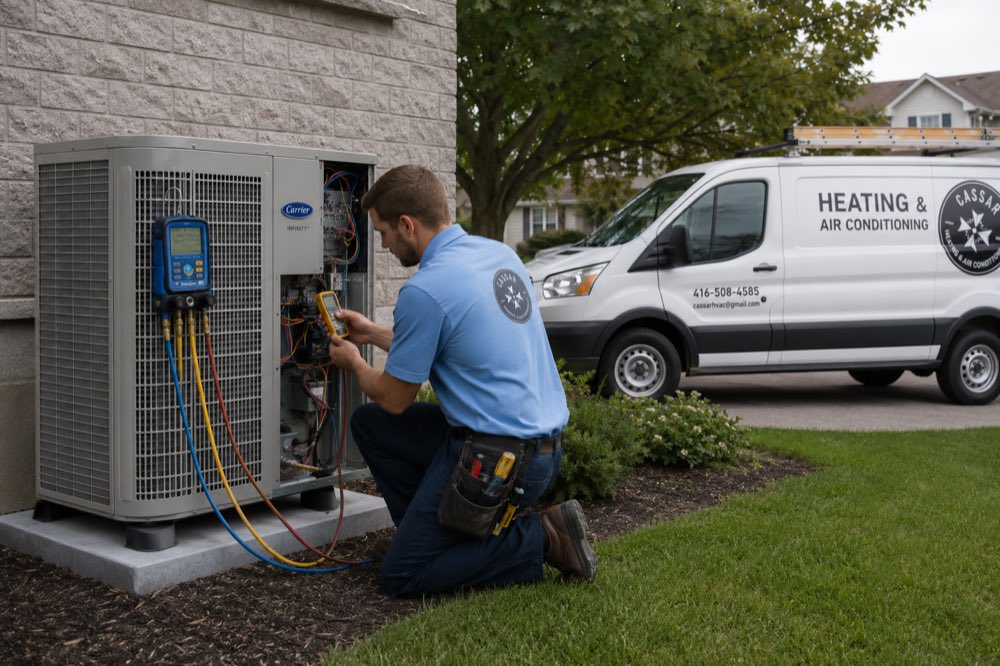
David handles every stage of heat pump ownership, from the first installation through annual tune-ups to the day something stops working. Here’s what’s available in Ajax.
Many Ajax homes built between 1985 and 2000 have existing forced-air ductwork that’s compatible with a ducted heat pump, which means David can often replace the furnace and A/C with a single heat pump system without touching the duct layout. He sizes the unit to your home’s actual heat load, not to what was there before. You get a free upfront quote before any work begins.
A heat pump that’s blowing cold air in heating mode, short-cycling, or icing over isn’t something you want to leave over a winter weekend. David stocks common components, capacitors, reversing valves, contactor switches, so most repairs wrap up on the first visit. He’ll tell you exactly what failed and why before touching anything.
When a repair bill approaches half the cost of a new unit, or the system’s pushing 15 years old, replacement usually makes more sense. David gives you both numbers honestly so you can decide without pressure. He’ll also flag any available Ontario rebates that apply to your replacement, which can meaningfully offset the upfront cost.
A heat pump works harder than a furnace or A/C alone because it runs year-round. Annual maintenance means David checks refrigerant charge, inspects electrical connections, cleans coils, and tests the defrost cycle before winter. Catching a low refrigerant charge in September costs far less than diagnosing a failed compressor in January.
If your current heat pump is a standard 8 or 9 HSPF unit installed before 2015, upgrading to a cold-climate model rated at HSPF2 9+ delivers noticeably lower heating bills through an Ajax winter. David can assess whether the existing refrigerant line set is reusable and what the payback period looks like given current electricity rates in Ontario.
When the heat goes out on a January night in Ajax, you need someone who answers the phone and can actually show up, not a booking portal that schedules you three days out. David takes emergency calls directly at (416) 508-4585 and covers all of Ajax, from Westney Heights to Pickering Village, with same-day response.
Since 2011, David has worked on heat pump systems across Ajax, from the newer builds near Ravenscroft Road to older split-levels off Harwood Avenue where the original ductwork wasn’t sized for modern equipment. He’s seen what goes wrong with rushed installations and he’s fixed the work of contractors who sold Ajax homeowners oversized units that short-cycle all winter. When you call, David picks up, comes out, and gives you a straight answer.
A well-maintained heat pump in Ontario typically lasts 15 to 20 years. The outdoor unit takes the most abuse, it runs in both summer heat and winter cold, which puts stress on the compressor and refrigerant circuit. Units that get annual maintenance and timely repairs routinely hit the top of that range. Units that get ignored tend to fail closer to the 10-year mark.
Ontario’s freeze-thaw cycle is hard on outdoor units. Water gets into electrical connections, ice builds up on the coil, and fan blades accumulate debris from spring and fall. The defrost cycle handles normal frost, but if it’s not working correctly, ice builds faster than it clears, and compressor damage follows. Catching a defrost issue in a tune-up costs a fraction of what a compressor replacement does.
Annual maintenance matters more for a heat pump than for a furnace or central air conditioner because the system runs year-round. Scheduling a check-up in September, before heating season, means David can confirm the refrigerant charge, test defrost, and inspect the reversing valve while there’s still time to order parts if anything needs attention.
A standard ducted heat pump installation in Ajax typically runs between $4,500 and $9,000 installed, depending on the unit’s efficiency rating, whether the existing air handler is reused, and whether any ductwork needs adjustment. Cold-climate models with higher HSPF2 ratings sit at the upper end of that range but qualify for larger rebates. A ductless mini-split for a single zone generally runs $2,500 to $4,500 installed for a single head unit.
Repairs range from under $300 for a capacitor or contactor replacement up to $1,200 to $1,800 for a reversing valve or refrigerant recharge with a leak repair. Annual maintenance tune-ups typically run $150 to $200. What drives the variation on installations is mostly brand, efficiency tier, and whether the existing equipment, line sets, air handler, thermostat wiring, can be reused.
Every job in Ajax gets a free upfront quote from David before any work starts. The best way to know what your specific job will cost is to get a free quote from David, no pressure, no obligation.
Ajax grew quickly from the mid-1980s through the early 2000s, and the town’s housing stock reflects that. Most of the detached and semi-detached homes in Ajax Central, Pickering Village, and the Nottingham neighbourhood were built with gas furnaces and central air conditioning as separate systems. That’s actually a straightforward starting point for a heat pump retrofit, the ductwork is already there, and in most cases it’s sized well enough to work with a properly matched heat pump.
Where David does see issues is in homes where a previous owner added square footage, a finished basement with a secondary return, or a rear addition that relies on a single supply register. Heat pumps are more sensitive to airflow balance than gas furnaces are, so an unbalanced duct system that “worked fine” with a furnace can cause comfort problems after a heat pump goes in. David checks airflow as part of every installation assessment, not as an upsell.
The newer townhome and semi-detached developments near Rossland Road and Salem Road North were often built with builder-grade heat pumps already installed. These units are now reaching the 10 to 15 year mark, and David’s replaced a number of them in Ajax over the past few years. If your home was built between 2005 and 2015 and came with a heat pump, it’s worth having it assessed before it fails mid-season.
The clearest sign is a system that’s running constantly but not hitting the thermostat setpoint. In a well-functioning heat pump, the unit cycles normally and keeps the home at temperature even when it’s minus ten outside, provided it’s a cold-climate model. A heat pump that runs for hours without reaching setpoint usually has a refrigerant charge problem, a dirty coil, or a failing compressor. In Durham Region’s climate, this tends to show up first in late November when overnight lows drop below minus five.
Short-cycling, where the unit starts, runs for a minute or two, and shuts off, points to a different set of causes: an oversized unit, a failing capacitor, a refrigerant pressure issue, or a dirty filter triggering a safety shutoff. Each cause has a different fix and a different cost, which is why David diagnoses before quoting. Ice on the outdoor unit beyond a light frost coating is another sign worth calling about. Some frost is normal in winter. A unit that’s fully encased in ice has a defrost problem that will damage the compressor if left alone.
Unusual noises deserve attention too. A grinding or screeching sound from the outdoor unit usually means a failing fan motor bearing. A bubbling or hissing sound from the refrigerant lines often indicates a refrigerant leak. Both get worse with time and both are cheaper to address early.
Durham Region sits in a climate zone where average January lows reach minus 10 to minus 15, with occasional dips below minus 20 during cold snaps. A standard heat pump loses efficiency below minus 8 or so and needs supplemental heat below minus 15. A cold-climate heat pump rated for minus 25 or lower handles a Durham Region winter without backup heat in all but the most extreme conditions. If you’re buying new, that’s the spec worth paying attention to.
Keeping the outdoor unit clear of snow and ice matters more than many homeowners realize. The unit draws air through the coil, and if snow drifts block the sides or the fan discharge on top, efficiency drops and the system strains. Clear a path around the unit after heavy snowfalls and make sure the discharge direction isn’t blocked by a fence or deck overhang. Don’t cover the unit in winter, it runs in winter and needs airflow.
Setting the thermostat to a steady temperature rather than large setbacks overnight also helps in heating mode. Heat pumps recover from large temperature drops more slowly than furnaces do, and repeatedly asking the system to recover from a significant setback can trigger the emergency heat backup, which runs on electric resistance and costs more to operate. A two or three degree setback overnight is fine; a ten-degree setback usually isn’t worth it.
Heat pumps don’t produce combustion gases, so there’s no carbon monoxide risk from the heat pump itself. If your home uses a dual-fuel setup with a gas furnace as backup, that furnace still requires annual inspection and a working CO detector on every level. The TSSA governs natural gas equipment in Ontario, and any work on the gas side of a dual-fuel system requires a licensed technician. David holds TSSA Licence #000398183 and handles both sides of a dual-fuel installation.
On the efficiency side, Ontario’s Enbridge Home Efficiency Rebate Plus program and the Canada Greener Homes Grant have offered rebates of $2,500 to $7,100 for qualifying heat pump installations, depending on the equipment and the pre and post energy assessments. Eligibility and rebate amounts change as programs are updated, so David can walk you through what’s currently available when you get your quote. The rebates are meaningful and worth factoring into your decision.
Refrigerant handling in Ontario requires certification under federal regulations. David carries the necessary certifications to purchase and handle refrigerants legally. When someone offers a heat pump installation or repair at an unusually low price, unregistered refrigerant handling is often how the cost gets cut, and it creates liability for the homeowner. The TSSA licence number is public record: you can verify #000398183 directly at tssa.org.
Checking the simple things before calling saves time for everyone, here’s what to look at first.
Heat pumps require the thermostat to be set to Heat, and the temperature must be above what the room currently is. Also confirm the system mode isn’t set to Emergency Heat unless needed. Emergency Heat bypasses the heat pump and runs electric resistance only, which is expensive and often a sign someone switched it by accident.
Heat pumps have two circuit breakers, one for the air handler inside and one for the outdoor unit. Both must be on. A tripped breaker on just the outdoor unit will leave the air handler running but blowing unheated air. Reset it once. If it trips again, there’s a fault that needs diagnosis before you reset it a second time.
Some frost on the outdoor unit is normal in winter. A unit completely encased in ice is not, this indicates a defrost issue. The compressor will be working against the ice and can fail if left running. Don’t chip at it; call Cassar. Trying to break ice off the coil with tools damages the aluminium fins and makes the problem worse.
A blocked filter forces the heat pump to work harder and can trigger safety shutoffs on both the air handler and the outdoor unit. Pull the filter out and hold it up to a light, if you can’t see light through it, replace it. A clogged filter is one of the most common reasons a heat pump performs poorly, and it’s a five-minute fix.
If your heat pump is blowing cool air in heating mode, the reversing valve may be stuck or the thermostat may be sending the wrong signal to the outdoor unit. The reversing valve is what switches the system between heating and cooling mode. A stuck valve is a legitimate repair, it can’t be reset manually, and it needs a licensed technician to diagnose and replace.
If none of the above steps got things running, it needs a licensed technician. David serves all of Ajax and Durham Region and picks up his own phone, you’ll speak to the person showing up at your door.
Yes, a cold-climate heat pump works in Ontario winters, including the cold snaps Durham Region sees in January and February. The key word is cold-climate. A standard heat pump loses most of its heating capacity below minus 8 Celsius. A cold-climate model rated for minus 25 or lower keeps delivering around 75 to 80 percent of its rated capacity at minus 15, which covers the vast majority of heating hours in a Durham Region winter. The days when temperatures drop below minus 20 happen maybe a handful of times per year, and on those days a dual-fuel backup, or the emergency heat strip built into most air handlers, handles the gap. What matters is matching the equipment to the climate, and that means specifying a cold-climate unit if you’re in Ajax or anywhere in Durham Region. David won’t install a standard-efficiency heat pump in this region and call it a year-round solution.
That depends on three things: the age of your current gas equipment, your electricity rate, and whether you want one system doing both heating and cooling. If your furnace is under 10 years old and your air conditioner is the same age, replacing both with a heat pump is harder to justify on cost alone right now. If your A/C is aging out and you’re thinking about replacing it anyway, a heat pump does the same job and adds heating capability, so the incremental cost over a straight A/C replacement is much smaller. Gas prices in Ontario have risen significantly since 2021, and the gap between running a high-efficiency heat pump and running natural gas heat has narrowed. For many Ajax homeowners replacing older equipment, a cold-climate heat pump is the more cost-effective long-term choice, especially with the Ontario and federal rebates currently available. David gives you the real numbers for your specific home, he’s not going to push a heat pump if a furnace replacement genuinely makes more sense for your situation.
A ducted heat pump installation in Durham Region typically runs between $4,500 and $9,000 installed. The lower end covers a mid-efficiency ducted unit in a home where the existing air handler and line set are reusable. The upper end covers a cold-climate high-efficiency unit with a new air handler. Ductless mini-split installations for a single zone start around $2,500 and run to $4,500 for a single indoor head. Multi-zone ductless systems, two or three indoor heads connected to one outdoor unit, run $6,000 to $11,000 depending on the number of zones and the efficiency rating. What drives the variation is the unit’s HSPF2 rating, whether the existing infrastructure can be reused, and any electrical panel upgrades required. Available rebates from Enbridge’s Home Efficiency Rebate Plus program and the Canada Greener Homes Grant can reduce the net cost by $2,500 to over $7,000, depending on the equipment and the pre/post energy assessments. The best way to know what your specific job will cost is to get a free quote from David, no pressure, no obligation.
There are two main rebate streams for Ontario homeowners replacing heating equipment with a heat pump. The Canada Greener Homes Grant offers up to $5,000 for qualifying heat pump installations, though it requires a pre-installation energy audit and a post-installation audit to claim the full amount. The Enbridge Home Efficiency Rebate Plus program has offered rebates of $2,500 to $7,100 for air-source heat pumps meeting specific efficiency thresholds, and it doesn’t always require an energy audit for the base rebate tier. Both programs have eligibility requirements based on equipment specs, the heat pump has to meet a minimum HSPF2 or COP rating to qualify. Program details, funding availability, and rebate amounts change, so David checks current eligibility when he quotes an installation rather than quoting off outdated program information. The rebates are significant and can change the payback math considerably, it’s worth asking about them when you get your quote. The best way to know what’s currently available for your specific equipment is to get a free quote from David, no pressure, no obligation.
Most heat pump installations in Ajax take one full day, typically six to eight hours for a standard ducted replacement where the existing air handler and ductwork are being reused. If a new air handler is going in alongside the outdoor unit, or if the refrigerant line set needs to be replaced, add two to four hours. Ductless mini-split installations for a single zone are usually faster, often completing in four to five hours. Multi-zone ductless systems with two or three indoor heads take a full day and sometimes carry into a second morning for the commissioning and refrigerant charge verification. David doesn’t book multiple jobs in a row on installation days, he finishes what he starts before leaving the site. You’ll know the realistic time window when you book, not after the crew shows up.
Start with the thermostat, confirm it’s set to Heat mode, not Cool, and that the set temperature is above the current room temperature. It sounds basic, but a mode switch is one of the most common calls David gets in Ajax at the start of heating season. Next, check both circuit breakers: the one for the indoor air handler and the one for the outdoor unit. Both need to be on. After that, look at the outdoor unit, if it’s completely encased in ice rather than just lightly frosted, the defrost cycle isn’t working and the unit’s output will be near zero. Replace the air filter if it’s been more than three months since the last change, because a severely clogged filter can trigger a thermal shutoff on the air handler. If the outdoor unit is running but the system is blowing cool air, the reversing valve is the likely culprit, it may be stuck in cooling mode or receiving the wrong signal from the thermostat. That’s a service call, not a DIY fix. If you’re in Ajax and none of those steps resolve it, call David at (416) 508-4585.
Yes, and that’s the only type David installs for primary heating in Ajax and throughout Durham Region. A standard heat pump loses the bulk of its heating capacity at minus 8 Celsius and below, which means it can’t carry a Durham Region home through a typical January night without running the electric resistance backup constantly. A cold-climate heat pump, models from Mitsubishi, Bosch, Daikin, and others rated for minus 25 or lower, maintains meaningful heating output down to temperatures Ajax actually sees in winter. David specs cold-climate equipment on every installation where the heat pump is the primary heating source. He’ll also assess whether your electrical panel has capacity for the increased draw of a heat pump, since some Ajax homes built in the late 1980s still have 100-amp panels that need an upgrade before a heat pump installation. That gets flagged and quoted upfront, not discovered after the equipment arrives.
Yes, a heat pump cools your home in summer exactly the way a central air conditioner does, because it’s the same refrigeration cycle running in reverse. In cooling mode, the heat pump moves heat from inside your home to the outdoor unit and releases it outside. The efficiency ratings for cooling are directly comparable to a central A/C unit, a heat pump rated at 18 SEER2 in cooling mode performs the same as a standalone 18 SEER2 air conditioner. For Ajax homeowners who need both a new furnace and a new air conditioner, this is one of the biggest practical arguments for a heat pump: you replace two aging systems with one unit that handles both jobs. Summer cooling in Ajax can be demanding, humid July and August days push air conditioning hard, and a properly sized heat pump handles it without any operational difference from a dedicated central A/C unit. David sizes for both heating and cooling loads when specifying a unit, since the two calculations occasionally point to different capacities and the right answer has to work well in both seasons.
“The outdoor unit on our Ajax home was completely iced over in January. David diagnosed a failed defrost board, replaced it same day, and the system’s been running properly ever since.”
“I called three contractors about replacing the heat pump in our Pickering Village home and two of them quoted a unit without even asking about the existing ductwork. David came out, measured the house, checked the supply registers, and explained why the previous unit had been oversized for our layout. He installed a properly matched cold-climate unit and the difference in comfort through last winter was noticeable. He answered every question I had and didn’t make me feel rushed.”
“Got the quote on Tuesday, installation done by Thursday afternoon. Price matched exactly what was quoted, nothing added on. He put down floor covers in the utility room and cleaned up the old refrigerant lines before he left. Our Ajax townhouse has heated more evenly this winter than it did with the old system.”
David covers all of Durham Region, if you’re near Ajax, he serves your community too.
Same-day service available. TSSA certified. Honest pricing. Call or book online.