
Bowmanville’s housing stock covers a wide spread of eras, from older bungalows near the historic downtown core to newer subdivisions along Green Road and Longworth Avenue, and the right heat pump setup varies considerably between them. David Cassar serves Bowmanville and all of Clarington with same-day and emergency heat pump service, and he’s reachable directly at (416) 508-4585.
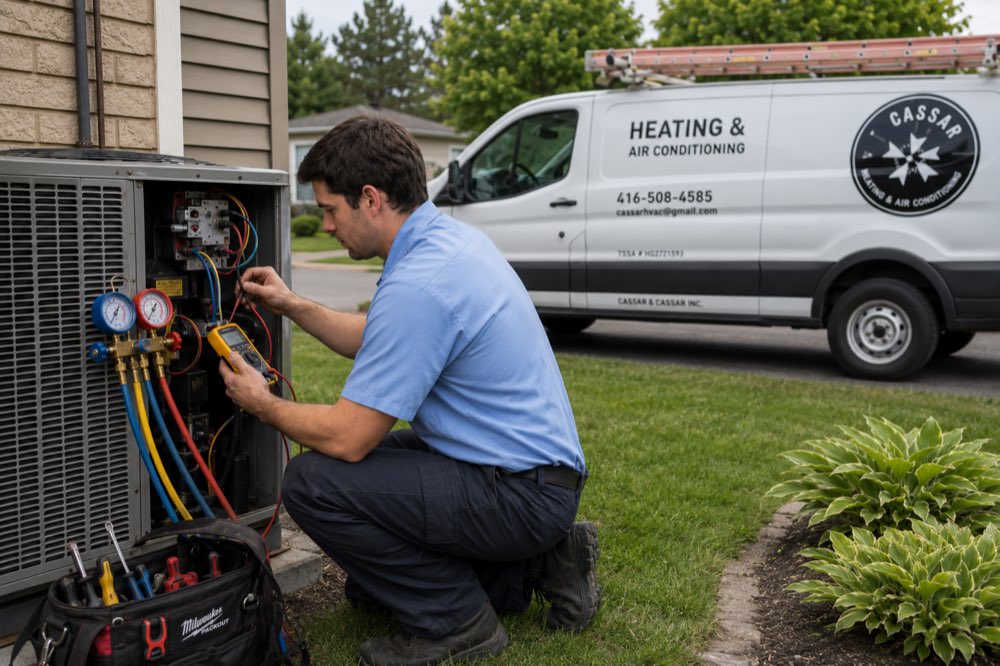
Every job, whether it’s a new install or an emergency repair, gets David’s direct attention from the first phone call to the final test run.
Bowmanville’s newer subdivisions on the east side of town, built through the 2000s and 2010s, often have ductwork sized for mid-efficiency gas furnaces. Before David quotes any installation, he checks whether the existing duct system can handle a heat pump’s airflow requirements, because an undersized duct run will kill efficiency regardless of the equipment you buy. Every installation comes with a free pre-install assessment and a written price before any work starts.
When a heat pump stops heating or starts making noise in the middle of a Durham Region winter, waiting three days for a technician isn’t an option. David stocks common components for the brands he services, so most repairs get finished in a single visit rather than leaving you with a parts-on-order gap. Call (416) 508-4585 and you’ll reach David, not a dispatcher.
If your heat pump is pushing 15 years or repair costs are stacking up, replacement often makes more financial sense than another fix. David gives you a straight answer on which way to go. He won’t push a replacement if a repair is the right call, and he won’t keep repairing a system that’s going to fail again in six months.
A heat pump that hasn’t been serviced in a couple of years works harder, costs more to run, and is more likely to fail on the coldest day of January. David’s annual tune-up covers coil cleaning, refrigerant level checks, electrical connection inspection, and a full system test across both heating and cooling modes. Scheduling it in the fall means you’re not calling for emergency service in February.
Upgrading from an older single-stage heat pump to a variable-speed cold-climate unit can cut your heating costs significantly in Durham Region’s climate, where temperatures regularly drop below the threshold where standard heat pumps struggle. David sizes the replacement correctly for your home’s heat load, so you get the efficiency the manufacturer advertises rather than a system that runs flat-out all winter.
Heat pump failures don’t follow business hours. David covers Bowmanville for emergency calls and picks up the phone himself. Because Bowmanville sits at the eastern edge of Durham Region, David routes his day to stay accessible to Clarington homeowners, and he’s not relying on a central dispatch to pass your address down the line. Call (416) 508-4585 any time you need him.
I’ve worked on heat pump systems in Bowmanville’s older brick homes near the historic downtown and in the newer builds out near the 115 corridor, and the problems I see are usually the same ones: systems that were sized wrong at install, refrigerant that’s never been checked, or outdoor units sitting on unlevel pads after a few freeze-thaw cycles. I’m not a franchise with a call centre. You call me, I answer, and I’m the one who shows up.
Cassar HVAC has served Durham Region since 2011, and Bowmanville and the rest of Clarington are a regular part of my schedule.
A well-maintained heat pump in Ontario typically lasts between 15 and 20 years. The low end of that range is usually the result of skipped maintenance, a system that was improperly sized at installation, or refrigerant that ran low for years without anyone noticing. The high end is achievable when the system gets an annual service, the filter stays clean, and the outdoor unit has adequate clearance and airflow year-round.
Ontario’s climate puts a heat pump through its paces in a way that milder regions don’t. Summers are hot and humid, winters drop well below freezing, and the shoulder seasons throw rapid temperature swings at the defrost controls. A system that gets skipped on annual maintenance in Ontario will decline faster than the manufacturer’s spec sheet suggests, because the operating conditions here are harder than the averages those specs are based on.
The single most effective thing you can do to extend a heat pump’s life in Ontario is keep the outdoor coil clean and make sure the defrost cycle is working correctly every fall before heating season starts. A coil that’s blocked with cottonwood, debris, or compacted dirt from a wet summer forces the compressor to work harder, and compressors are the most expensive component on the system to replace.
A standard central heat pump installation in Bowmanville runs roughly $4,500 to $8,500 installed, depending on the size of the unit, the brand, and whether your existing ductwork and electrical service need modifications. Cold-climate models with variable-speed compressors sit toward the upper end of that range but often qualify for Ontario rebates that bring the net cost down. Ductless mini-split installations for a single zone typically land between $3,000 and $5,500 installed.
What drives the variation is less about brand preference and more about the specifics of the install: the distance from the outdoor unit to the indoor air handler, whether the electrical panel needs a new dedicated breaker or a service upgrade, and how much refrigerant line set has to be run through the wall or along the exterior. An older Bowmanville home with a full basement and accessible utility space is a different job from a newer build with a finished mechanical room and tight clearances.
Repair costs range from around $200 for a capacitor replacement to $1,200 or more for a reversing valve job. Refrigerant recharges vary depending on the amount needed and the refrigerant type. Every job gets a written quote before David touches anything. The best way to know what your specific job will cost is to get a free quote from David, no pressure, no obligation.
Bowmanville’s housing stock is more varied than a lot of Durham Region communities. The older part of town, centred around King Street and the historic downtown, has a concentration of homes built between the 1940s and 1970s. Many of these have older duct systems with smaller trunk lines that weren’t designed for the airflow a modern heat pump needs. Installing a correctly sized unit without addressing duct restrictions in these homes often means the homeowner never gets the comfort or efficiency the system is capable of.
The newer subdivisions east of Green Road and south of Concession Road 3, developed heavily from the late 1990s through the 2010s, have more standardized ductwork and electrical panels, making heat pump retrofits more straightforward. That said, a number of these homes were built with builder-grade gas furnaces and A/C packages, and the outdoor condenser placement was chosen for cost rather than heat pump efficiency, which sometimes means the linesets need to be re-routed on replacement.
Bowmanville also sits at Clarington’s western edge, close enough to Lake Ontario’s influence to see some humidity loading in summer that homeowners farther north don’t deal with as much. A heat pump doing double duty for heating and cooling in this area needs to be sized for the latent load as well as the sensible load, something David calculates before recommending a unit size rather than defaulting to whatever the previous equipment was rated at.
The most common sign that something’s wrong is a heat pump that’s running continuously without reaching the set temperature. In a Bowmanville winter, a system that’s cycling on and off at short intervals and never satisfying the thermostat usually points to a refrigerant issue, a dirty coil, or a defrost control problem. These aren’t self-resolving; they get worse the longer the system runs in that condition.
Unusual noise is another reliable indicator. A grinding sound from the outdoor unit usually means the fan motor bearings are going. A clicking or clanking noise at startup points to a loose fan blade or a compressor starting to fail. Hissing from the refrigerant lines often means a leak. None of these sounds appear without cause, and the earlier they’re caught, the cheaper the repair tends to be.
Durham Region homeowners sometimes dismiss ice on the outdoor unit in winter as normal, and light frost is indeed part of the defrost cycle. A unit that’s completely encased in ice after a day or two of operation is not normal. It means the defrost cycle has failed, and continuing to run the system in that state can damage the compressor. If you’re seeing a solid block of ice around your outdoor unit in Clarington this winter, that’s a call to make today, not next week.
Durham Region’s climate swings from humid 30-degree summers to stretches below -15°C in January and February. A heat pump designed for southern Ontario’s moderate climate, but not the coldest days, will fall back on its backup heat strips during those extreme cold snaps, which costs significantly more to run than the heat pump itself. Choosing a cold-climate unit rated to -25°C or -30°C means the heat pump carries the load itself across almost every day of a Durham winter, not just the mild ones.
Setback thermostats work differently with heat pumps than with furnaces. Dropping the temperature significantly overnight and then asking the heat pump to recover five degrees in the morning often triggers the backup heat strips to kick in, negating any savings from the setback. A gradual, small setback works better with heat pump systems. If you’ve got a smart thermostat, David can help you configure it correctly for heat pump operation rather than the furnace logic most thermostats default to.
Keeping the area around the outdoor unit clear is something homeowners often overlook in winter. Snow and ice can restrict airflow to the coil and interfere with the defrost cycle. Clearing a radius around the unit after heavy snowfall and making sure the unit is elevated enough that it won’t be buried takes five minutes and can prevent a service call. David recommends checking the outdoor unit clearance every time there’s a significant Bowmanville snowfall.
Heat pumps don’t produce combustion gases, so carbon monoxide isn’t a risk from the heat pump itself. However, many Bowmanville homes run heat pumps alongside a gas furnace in a dual-fuel configuration, and the furnace side of that system still requires proper combustion safety checks. David holds TSSA Licence #000398183, which covers gas-fired equipment as well as heat pump systems, so a dual-fuel system gets a complete inspection under one visit.
Ontario’s Enbridge Home Efficiency Rebate program and the Canada Greener Homes Grant have both offered incentives for heat pump installations in recent years. Rebate amounts and eligibility requirements change, so David recommends checking current availability with Natural Resources Canada and the IESO before committing to a purchase. What doesn’t change is that qualifying for most rebates requires installation by a licensed HVAC contractor, which is another reason the TSSA licence number matters rather than just being a credential on a website.
From an efficiency standpoint, Ontario homeowners should look for a heating season performance factor (HSPF2) of at least 8.5 and a SEER2 of at least 15 when choosing new equipment. Units meeting these thresholds are typically eligible for available rebates and will perform efficiently through Durham Region’s shoulder seasons, when the mild temperatures are where heat pumps earn the bulk of their efficiency advantage over gas heating.
Checking the simple things before calling saves time for everyone.
Heat pumps require the thermostat to be set to Heat, and the temperature must be above what the room currently reads. Also confirm the system mode isn’t set to Emergency Heat unless you genuinely have a problem that requires it, since Emergency Heat bypasses the heat pump entirely and runs expensive electric resistance strips.
Heat pumps have two circuit breakers: one for the air handler inside and one for the outdoor unit. Both must be on. A tripped breaker on the outdoor unit will leave the air handler running and blowing unconditioned air, which can look like a refrigerant or valve problem until you check the panel.
Some frost on the outdoor unit is normal in winter, and the defrost cycle is designed to clear it periodically. A unit completely encased in ice is not normal, this indicates a defrost issue that needs a technician. Don’t chip at it, as the fins and coil are fragile. Call Cassar at (416) 508-4585.
A blocked filter forces the heat pump to work harder and can trigger safety shutoffs that look like a system failure. Pull the filter, check if it’s blocked, replace it if needed, and see if performance improves over the next 20 minutes. A filter change costs a few dollars and occasionally saves a service call.
If your heat pump is blowing cool air in heating mode, the reversing valve may be stuck or the thermostat may be sending the wrong signal. This is a common fault on heat pumps that have been in service for several years. It’s not a DIY fix. A technician needs to diagnose whether it’s the valve itself, the solenoid, or a wiring issue at the thermostat.
If none of the above resolved it, it needs a licensed technician. David serves all of Bowmanville and Durham Region and picks up the phone himself.
Yes, and the answer is more useful than that. Modern cold-climate heat pumps, models from Mitsubishi, Bosch, Daikin, and several others, are rated to extract heat from outdoor air at temperatures as low as -25°C or -30°C, which covers virtually every day of a Durham Region winter including the worst stretches. The older concern that heat pumps don’t work in Canadian winters was accurate for standard heat pumps built ten or fifteen years ago. It’s not accurate for the current generation of variable-speed compressor units. That said, what matters as much as the equipment spec is correct sizing. A unit that’s too small for your home’s heat loss will still struggle when it’s -18°C in Bowmanville in February, regardless of what the spec sheet says. David calculates the heat load before recommending a size, which is the step that makes the difference between a system that performs and one that doesn’t.
It depends on a few things David looks at specifically for your home, and the honest answer isn’t always the same. If your gas furnace is newer and your A/C is due for replacement anyway, a heat pump in a dual-fuel configuration, where the heat pump does most of the work and the furnace handles the coldest days, often makes financial sense. You get the efficiency of a heat pump for the majority of the heating season and the reliability of gas for the extreme cold. If your home runs on electric baseboard heat and you’re looking at replacing it, a heat pump is almost always a significant improvement in both comfort and operating cost. If you’ve got a relatively new gas furnace with years of life left in it, David might recommend waiting and adding a heat pump as a replacement for your A/C unit when that comes due. The right answer depends on your current equipment age, your home’s heat loss, and your energy costs. Call David at (416) 508-4585 and he’ll give you a straight assessment, not a pitch for the most expensive option.
A central heat pump installation in Durham Region typically runs between $4,500 and $8,500 installed, and ductless mini-split systems for a single zone usually land between $3,000 and $5,500 installed. Cold-climate variable-speed models sit toward the upper end of those ranges, but they’re also the ones that qualify for most Ontario rebates. What drives the variation is the size of the unit required for your home’s heat load, whether your existing ductwork needs modification, the length and routing of refrigerant lines from the outdoor unit to the air handler, and whether the electrical panel needs a new breaker or a service upgrade. Homes in older parts of Bowmanville with smaller panels or knob-and-tube wiring in the attic sometimes need electrical work completed before a heat pump can be installed, and that cost has to be factored in. Every job David quotes gets a written price before any work starts. The best way to know what your specific job will cost is to get a free quote from David, no pressure, no obligation.
Ontario homeowners have access to a few rebate streams for heat pump installations, and the amounts and eligibility requirements change more often than is convenient. The Canada Greener Homes Grant has offered up to $5,000 for heat pump installations, though availability has varied. The Enbridge Home Efficiency Rebate program covers homeowners with natural gas service and has offered rebates for heat pumps as part of a broader home efficiency upgrade. The IESO’s rebate programs have also covered heat pumps in certain configurations. To access most of these programs, installation must be completed by a licensed HVAC contractor, which means David’s TSSA Licence #000398183 is a prerequisite, not just a credential. Requirements also typically include a pre- and post-installation home energy assessment. David recommends checking current program availability directly with Natural Resources Canada and the IESO before committing to a timeline, since program funding can be exhausted or paused. He can walk you through what’s currently available when you call for a quote.
Most standard central heat pump installations take one day, typically six to eight hours from David arriving at your door to the system running through its test cycle. A straightforward replacement of existing central equipment, where the ductwork and electrical are already in good shape, is usually on the shorter end of that range. Installations that involve new refrigerant linesets through walls, electrical panel work, or ductwork modifications take longer and may require a second visit if an electrician is involved. Ductless mini-split installations for a single zone are usually faster, often four to six hours for a single indoor head with an accessible exterior wall. David gives you a realistic timeline when he quotes the job rather than a best-case estimate that creates problems on install day. He’ll also tell you what you need to do beforehand, whether that’s clearing access to the mechanical room or arranging for the electrical panel work to be done first, so the day runs without delays.
Start with the thermostat: confirm it’s set to Heat mode and that the set temperature is above the current room temperature, since heat pumps won’t activate if the room is already at or above the setpoint. Then check both breakers at the electrical panel, the one for the air handler and the one for the outdoor unit, because a tripped outdoor breaker leaves the air handler running without the heat pump doing any work. Check your air filter next, since a completely blocked filter can cause the system to trip a safety shutoff. Then go look at the outdoor unit. If it’s heavily iced over rather than showing light frost, the defrost cycle has failed and running the system further risks compressor damage. That’s a call to make. If none of those checks identify the issue and the system is blowing cool air in heating mode, the most likely causes are a refrigerant shortage, a stuck reversing valve, or a compressor issue, and all of those need a licensed technician. Call David at (416) 508-4585 and he covers Bowmanville and Clarington with same-day availability.
Yes, and for most Bowmanville homeowners replacing an older heat pump or a gas furnace and A/C combination, a cold-climate model is what David recommends. Standard heat pumps lose efficiency rapidly below -8°C and may stop extracting useful heat around -15°C, which means they rely on backup electric strips for a meaningful portion of a Durham Region winter. Cold-climate models with variable-speed compressors maintain heating capacity down to -25°C or colder, which covers almost every hour of a Clarington winter without falling back on expensive backup heat. The efficiency gap between a standard and cold-climate model, over a full heating season in Bowmanville’s climate, is significant enough that the higher upfront cost typically pays back within a few years on operating costs alone, before factoring in any available rebates. David installs models from several manufacturers and sizes each system for the specific home rather than defaulting to whatever’s easiest to stock. Call (416) 508-4585 to discuss options for your home.
Yes, that’s one of the core advantages of a heat pump over a gas furnace and separate A/C setup. A heat pump runs the refrigerant cycle in reverse for cooling, pulling heat out of your home and rejecting it outside, which is exactly what a central air conditioner does. In fact, a heat pump is a central air conditioner with a reversing valve added. For Bowmanville homeowners replacing an older A/C unit, adding a heat pump instead of a straight air conditioner gives you efficient cooling in the summer and heat pump-based heating for the shoulder seasons and most of the winter, with backup heat available for the coldest stretches. The cooling performance of a properly sized heat pump is identical to a dedicated A/C unit of the same capacity. If your existing ductwork was set up for central air conditioning, it’ll work for heat pump cooling without modification. David checks the duct system as part of any installation to make sure the airflow is adequate for both modes before recommending equipment.
“Our heat pump stopped heating on a Friday night in January. David was at our Bowmanville house Saturday morning and had the reversing valve diagnosed and the part ordered by noon.”
“I called about a new heat pump install and wasn’t sure what size I needed. David came out, looked at the house, it’s one of the older semis near downtown Bowmanville, and explained that the existing duct trunk was too narrow for what I’d been quoted elsewhere. He sized it correctly, installed it, and the thing’s been running perfectly since. He answered every question himself, never passed me to anyone else.”
“The price David quoted me was the price on the invoice. Nothing added at the end, no ‘additional labour’ line I hadn’t agreed to. He also put down drop sheets before he started and took them when he left. Small thing, but it meant something. Good experience start to finish for our Bowmanville home.”
David covers all of Durham Region for heat pump installation, repair, and maintenance.
Same-day service available. TSSA certified. Honest pricing. Call or book online.