
Bowmanville’s been growing fast, and a lot of the newer subdivisions west of Green Road went up with builder-grade furnaces that are now hitting the 10-to-15-year mark and showing it. David Cassar covers all of Bowmanville and Clarington with same-day and emergency service, seven days a week.
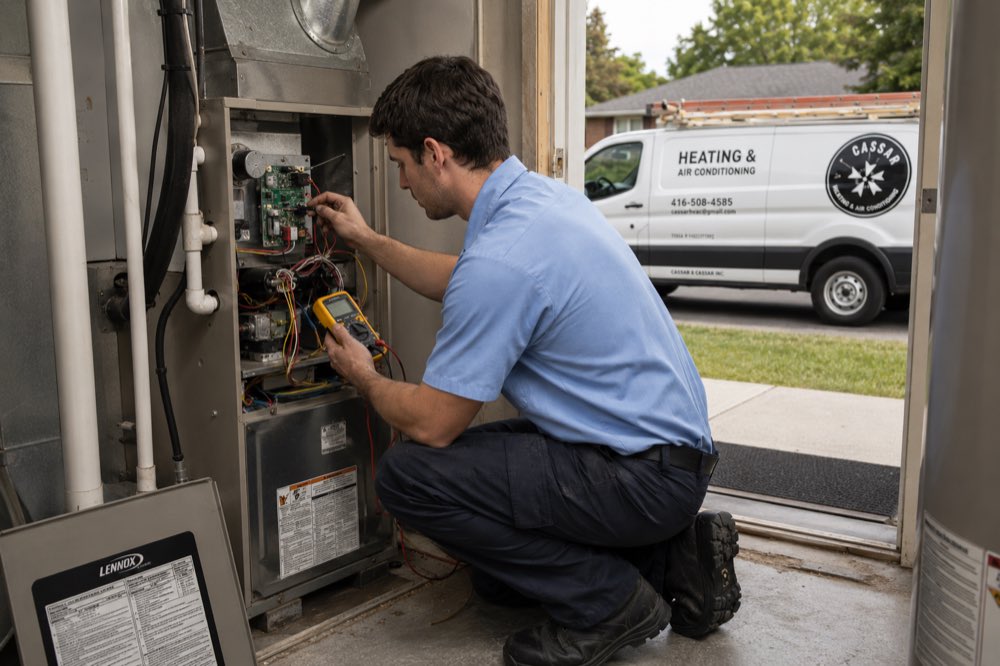
From a first-time installation in a new Bowmanville build to an emergency repair on a 20-year-old unit, David handles it all personally.
Many Bowmanville homes built in the 2000s and 2010s were fitted with mid-efficiency 80% AFUE furnaces sized by builders, not by load calculations. David measures your home properly before recommending any equipment. You get the right unit for your square footage, not the most convenient one to stock.
David carries a broad range of common parts on the truck, which means most repairs get finished the same visit. He’ll tell you what failed, why it failed, and whether it’s worth fixing given the age of the unit. No upselling, no inflated diagnoses.
A lot of the older semi-detached homes near Bowmanville’s historic downtown still have original furnaces from the 1990s. When a repair bill starts approaching 40-50% of what a new unit costs, replacement usually makes more financial sense. David walks you through the math so the decision is yours.
An annual service visit covers burner inspection, heat exchanger check, igniter test, flue inspection, and filter review. David books these in the fall before the first cold snap hits Clarington. A tuned furnace runs more efficiently and flags small problems before they become expensive ones.
Stepping from an 80% to a 96% AFUE furnace can cut your gas bill noticeably over a Bowmanville winter. The upgrade requires proper venting through PVC pipes to the exterior, which David handles as part of the installation. Ontario’s Enbridge rebate programs may also reduce your upfront cost.
When the heat stops at 11 p.m. in January, you reach David directly, not a call centre. He covers Bowmanville and all of Clarington for emergency calls and works to get there the same night when it’s a genuine no-heat situation. Call (416) 508-4585 and he picks up.
Since 2011 I’ve worked on furnaces across Bowmanville from the older brick homes near King Street to the newer subdivisions out past Clarington Fields. What I see most often out here is equipment that was installed during the building boom without proper sizing or that’s been neglected because finding a reliable technician willing to come this far east in Durham Region isn’t always easy. I’m local to this area and I keep my schedule open for Bowmanville calls.
Every job starts with an honest look at what you actually need. I won’t push a new furnace if a repair makes sense financially.
Most gas furnaces in Ontario last between 15 and 25 years, with the realistic average sitting around 18 to 20 years for a unit that’s received annual maintenance. Furnaces that never get serviced tend to land closer to the 12-to-15-year end of that range. A heat exchanger crack or a failed inducer motor at year 14 on a poorly maintained unit usually means it’s time to replace, not repair.
Ontario’s climate shortens lifespan relative to milder provinces. A furnace here runs hard from November through March, and that sustained load puts real wear on the heat exchanger and the blower motor. Keeping the filter clean is the single highest-return maintenance task a homeowner can do. A clogged filter forces the blower to work harder, raises operating temperatures, and cracks heat exchangers faster than almost anything else.
If your furnace is over 18 years old and needs a repair costing more than $600, it’s worth getting an installation quote alongside the repair estimate. David gives both numbers so you can decide with full information.
A standard gas furnace installation in Bowmanville runs between $3,500 and $6,500 for most homes, including the equipment, labour, new venting if needed, and disposal of the old unit. High-efficiency 96% AFUE models sit toward the upper end of that range. Mid-efficiency 80% units with atmospheric venting sit lower, though they’re less common in new installs now that condensing furnaces have come down in price.
Repair costs vary widely depending on what failed. A thermocouple or igniter replacement is typically $150 to $350 all-in. A new inducer motor runs $400 to $700. A heat exchanger replacement, if the unit is otherwise in good shape, can hit $800 to $1,200. David quotes the repair before any work starts so there’s no ambiguity.
Annual maintenance visits run $120 to $180 and cover a full inspection plus any adjustments. The best way to know what your specific job will cost is to get a free quote from David, no pressure, no obligation.
Bowmanville has two distinct housing eras that create two different sets of furnace issues. The older neighbourhoods near the historic downtown, Scugog Street, and Liberty Street North have homes built from the 1950s through the 1980s. These properties often have original ductwork that was sized for lower-output equipment or that’s been modified informally over the decades. Dropping a modern high-output furnace into one of these systems without reassessing the duct sizing can cause pressure problems, noise, and uneven heating.
The newer subdivisions that expanded through the 2000s and 2010s, particularly in areas like Brookhill, north of Highway 2, and the developments near Bowmanville Creek, were built with mid-efficiency furnaces as a standard builder package. Many of those units are now 12 to 18 years old. David sees a pattern in these homes where the original furnace was undersized relative to the finished basement square footage, because the basement was unfinished at time of installation and never accounted for. If your finished basement runs cold, that’s worth discussing before you blame the furnace.
Bowmanville also has a fair number of homes with combination systems where the furnace handles both forced-air heating and the air handler for central air. When replacing a furnace in these setups, the coil compatibility and refrigerant line sizing need to be assessed at the same time, not as an afterthought.
Short-cycling, where the furnace fires up, runs for a minute or two, shuts off, and starts again repeatedly, usually points to a dirty flame sensor, a clogged filter triggering a high-limit shutoff, or an oversized furnace that’s burning through its heat too fast. In Bowmanville’s colder months, short-cycling leaves rooms partially heated and burns through the igniter faster than normal operation.
A persistent yellow or orange flame instead of a steady blue one indicates incomplete combustion, which can mean a dirty burner or, more seriously, a cracked heat exchanger allowing combustion gases to mix with the air supply. If you see this, call immediately. Durham Region has had CO-related incidents tied to cracked heat exchangers in aging furnaces, and it’s not something to monitor and revisit.
Unusual sounds matter too. A high-pitched squeal usually means a failing blower motor bearing. A rumbling or banging on startup often points to delayed ignition from a dirty burner. A rattling or vibrating panel usually means something minor, but it’s worth having a technician check that it’s not a loose heat exchanger component.
Durham Region’s winters are cold enough and long enough that a poorly maintained furnace costs real money in wasted gas. Replacing your filter every 60 to 90 days during heating season, rather than the once-a-year habit many homeowners default to, is the most impactful thing you can do between annual service visits. During the sustained cold snaps Bowmanville gets in January and February, a clean filter can be the difference between a furnace that keeps up and one that runs continuously without reaching setpoint.
High-efficiency furnaces with PVC exhaust pipes need those pipes checked each fall for insect nests, debris, and, once winter starts, for ice buildup near the termination point. The exhaust on a condensing furnace produces water vapour, and in extreme cold that condensate can freeze and block the pipe, triggering a safety shutoff. It’s a 30-second check that prevents a call on the coldest night of the year.
Setting your thermostat to a consistent temperature rather than large swings between day and night setback also reduces strain. Dropping 5 to 7 degrees at night is efficient. Dropping 15 degrees and then demanding a rapid recovery strains the system and keeps it running longer than a steady lower-output cycle would.
In Ontario, all gas furnace work must be performed by a TSSA-licensed technician. This isn’t administrative box-ticking. The TSSA (Technical Standards and Safety Authority) sets the standards for safe gas appliance installation and repair, and their licensing process verifies that the technician knows the code. David’s TSSA Licence #000398183 is publicly verifiable. If a contractor can’t give you a licence number, that’s a serious red flag.
Carbon monoxide is the primary safety risk from a gas furnace, and it comes from a cracked heat exchanger or a blocked flue, not from normal operation. CO is odourless, so a working CO detector on every level of your home is non-negotiable. David checks the heat exchanger at every annual maintenance visit using a combustion analyzer, not just a visual inspection. A visual check alone misses micro-cracks that still allow exhaust gases to enter the air stream.
On the efficiency side, Ontario homeowners replacing a furnace should ask about the Enbridge Home Efficiency Rebate program. Upgrading to a qualifying high-efficiency furnace can qualify for a rebate that meaningfully offsets the installation cost. David can confirm current eligibility during a quote visit, as program terms change periodically.
Checking the simple things first saves time for everyone, and one of these fixes the problem more often than you’d think.
Make sure it’s set to Heat, the temperature is above room temperature, and the batteries are fresh. This resolves more calls than you’d expect.
Your furnace has a dedicated circuit breaker in your electrical panel and usually a wall switch nearby. Check both are on.
A clogged filter restricts airflow and can trigger a safety shutoff. If you can’t see light through it, replace it before calling.
High-efficiency furnaces have plastic pipes exiting near the foundation. Snow or ice blocking these causes an automatic shutoff, clear them and restart.
Many furnaces have a safety switch that cuts power if the access panel isn’t fully closed. Make sure it’s secured properly.
If none of the above gets your heat back, it needs a licensed technician. David covers all of Bowmanville and Durham Region and picks up the phone himself.
Once a year, in the fall before you start using it regularly, is the right answer for Ontario. Clarington winters are hard on furnaces. A service visit covers the burner, heat exchanger, igniter, blower, flue, and filter, and it’s the only way to catch a cracked heat exchanger or a failing igniter before it becomes a no-heat emergency at midnight in January. Homeowners who service annually spend less on repairs over the life of their equipment. A neglected furnace develops small problems that compound. The igniter gets weak and fails early. Dirty burners run inefficiently and accelerate heat exchanger fatigue. An annual visit typically runs $120 to $180 and pays for itself. If you’ve moved into a Bowmanville home recently and don’t know when the last service was, booking one now is the right first step regardless of how the furnace is running.
The honest answer depends on three things: the age of the unit, the cost of the repair, and the efficiency of what you’re running. A furnace under 10 years old is almost always worth repairing unless the heat exchanger has cracked, which is a write-off regardless of age. Between 10 and 15 years, it depends on the repair cost. A $200 igniter replacement on a 14-year-old furnace that otherwise runs well makes sense. A $900 inducer motor on the same unit is harder to justify when a new high-efficiency furnace is $3,500 installed and will cut your gas bills. Over 15 years, David recommends getting an installation quote alongside the repair estimate so you can compare the five-year cost of each option honestly. A furnace running at 80% efficiency costs meaningfully more to operate than a 96% AFUE unit, and that gap compounds over years. For Bowmanville homeowners with aging equipment, that math often tips toward replacement sooner than people expect. The best way to know what your specific job will cost is to get a free quote from David, no pressure, no obligation.
For most Durham Region homes, a 96% AFUE condensing furnace is the right choice. Durham Region’s heating season runs from roughly late October through April, and during January and February, Bowmanville regularly sees temperatures that drop below -15°C with wind chill. That’s a long, cold heating season where the difference between 80% and 96% efficiency shows up on your gas bill every month. An 80% AFUE furnace is still available and still code-compliant, and it costs less upfront. It makes sense in specific situations, such as a house that’s being sold soon or a rental property where the math on operating savings doesn’t pencil out the same way. But for a homeowner planning to stay in their Bowmanville home for five years or more, the 96% unit typically recovers the price premium within three to five heating seasons through reduced gas consumption. The 96% units also qualify for Enbridge Home Efficiency Rebates, which reduces the gap further. David will go through the numbers with you at the quote stage so you can decide based on your specific situation.
Most furnace installations in Bowmanville take between three and five hours from start to finish, assuming the ductwork and gas line are in reasonable shape. A straightforward swap where the new furnace is similar in configuration to the old one, same venting location, same gas connection, no duct modifications needed, usually lands in the three-to-four-hour range. Jobs that involve converting from atmospheric venting to PVC condensate venting, modifying duct connections, or addressing surprises in the existing setup take longer. David doesn’t rush to hit a time target if there’s extra work that needs doing correctly. Before he leaves, he runs the system through a complete startup cycle, checks combustion, verifies the thermostat is controlling properly, and walks you through the new equipment. You’re not left alone with a manual and a phone number. If you’re booking in advance, most Bowmanville installations can be scheduled within a few days. Emergency replacements, where you have no heat and need it resolved today, get prioritized the same day when David has availability.
Yes. David services all major gas furnace brands including Carrier, Lennox, Trane, York, Goodman, Rheem, American Standard, Bryant, and Napoleon, among others. The core components, burners, heat exchangers, igniters, flame sensors, inducer motors, and control boards, are similar across manufacturers even when the specific parts differ. David has been working on the full range of brands found in Bowmanville and Durham Region homes since 2011, so there’s no brand he’ll show up to and be unfamiliar with. He stocks common repair parts on the truck for the brands most frequently found in this area, which keeps most repairs to a single visit. For less common or older units where parts need to be ordered, he’ll tell you at the diagnostic visit, give you a timeline, and be upfront if the lead time on a part makes emergency repair impractical versus a faster replacement option.
Cold air from a running furnace points to a few specific problems. The most common is that the furnace is blowing air but not igniting, either because the igniter has failed, the flame sensor is dirty and keeps shutting the burner off as a safety measure, or the gas valve isn’t opening. Check your thermostat and filter first as described in the troubleshooting section above. If those are fine, the furnace is likely cycling through a startup attempt, failing to sustain a flame, and defaulting to “fan only” mode to clear the heat exchanger. A dirty flame sensor is one of the more affordable repairs, usually $150 to $250 for a service call and cleaning. Another cause is an overheated furnace that’s tripped its high-limit switch. This happens when airflow is restricted and the heat exchanger gets too hot. The furnace shuts the burner off but keeps the fan running to cool down. If it’s happening repeatedly, restricted airflow is the likely cause. Check your filter and make sure all your supply and return vents are open. If the problem persists, call David, running a furnace in high-limit lockout repeatedly causes long-term damage.
If you smell gas near your furnace, leave the house immediately without touching any light switches, electronics, or the furnace itself. A spark from any electrical contact can ignite accumulated gas. Once outside, call Enbridge Gas at 1-866-763-5427 from your cell phone. They respond to gas leaks at any hour and will confirm whether it’s safe to re-enter before anyone else does. Do not re-enter the house until Enbridge has cleared it. After Enbridge has assessed the leak and made the gas supply safe, David can come out to inspect the furnace, identify the source of the leak if it’s on the appliance side, and repair or replace what’s needed. A faint smell of gas near the furnace that comes and goes is also worth taking seriously. It’s sometimes a small leak at a fitting rather than a large one, but there’s no version of a gas smell that should be monitored and revisited later. In Clarington and Durham Region, Enbridge’s response time is generally quick, and David can coordinate the follow-up repair once they’ve cleared the property.
Yes, financing options are available for furnace installations in Bowmanville. A new furnace is a significant expense, typically $3,500 to $6,500 depending on the equipment and what the job involves, and not everyone wants to absorb that cost in a single payment. David works with financing partners that can spread the cost over monthly payments, making a quality installation accessible without having to defer it and run an unreliable furnace through another Clarington winter. Financing terms, rates, and approval processes vary, so the specifics depend on the lender and your situation. It’s worth asking about when you book your quote visit. Ontario homeowners replacing an older low-efficiency furnace with a qualifying high-efficiency unit may also be eligible for an Enbridge Home Efficiency Rebate, which reduces the net cost before financing even comes into play. The best way to know what your specific job will cost is to get a free quote from David, no pressure, no obligation.
“Furnace quit on a Thursday night in February. David was at our Bowmanville house by 9 a.m. Friday, found a cracked heat exchanger, and had a new unit running the same afternoon.”
“I called about a furnace that kept short-cycling and David picked up right away. He came out to our place off Scugog Street, cleaned the flame sensor, and explained exactly what had been happening and why. Didn’t try to sell me anything I didn’t need. That was refreshing.”
“Got three quotes for a furnace replacement in our Bowmanville home. David’s was the clearest, itemized, no vague allowances, no line items that doubled later. He put covers down before he started and the utility room was cleaner when he left than when he arrived. That’s the whole job right there.”
David covers all of Bowmanville and extends across Durham Region for furnace installation, repair, and maintenance.
Same-day service available. TSSA certified. Honest pricing. Call or book online.