
Bowmanville’s rapid growth has brought thousands of new builds to Clarington, and many of them came with builder-grade tank heaters that owners are now swapping out for tankless units as those tanks reach the end of their life. David Cassar covers all of Bowmanville and surrounding Clarington communities and picks up the phone the same day you call.
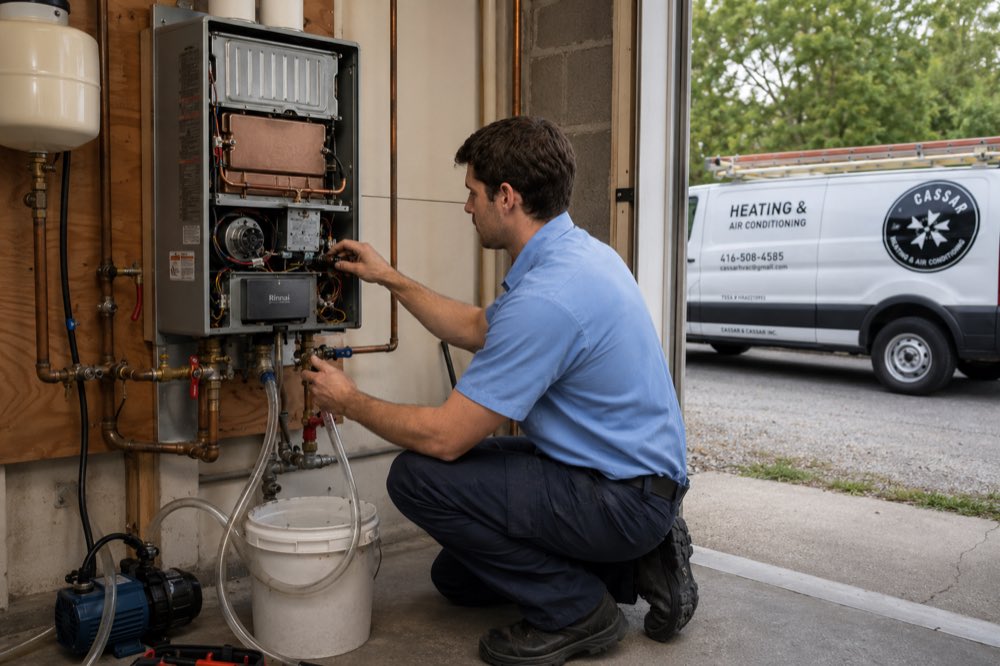
From a first-time tankless install to an urgent repair on a freezing January morning, David handles it personally.
Many of Bowmanville’s newer subdivisions east of Green Road were built with 40-gallon builder tanks that are now failing right on schedule, 10 to 12 years after occupancy. David sizes the replacement unit to the actual household demand before quoting, so you don’t end up with a unit that can’t keep two showers running simultaneously. Every install includes a proper gas line assessment and a vented exhaust path through the exterior wall.
A fault code on the display, a persistent ignition failure, or fluctuating water temperature all have specific causes David has repaired hundreds of times since 2011. He stocks common igniter assemblies, flow sensors, and heat exchanger cleaning supplies in the truck, so most repairs finish the same visit. You won’t wait a week for a part that was available locally all along.
If your unit is beyond economic repair, David gives you a straight answer on what a replacement will cost before he pulls anything off the wall. He’ll match the new unit to your existing gas supply and venting configuration wherever possible to keep installation costs down. If an upgrade makes sense, he’ll say so and explain why.
Ontario’s hard water accelerates scale buildup inside tankless heat exchangers faster than most manufacturers’ literature accounts for. A yearly descaling flush, inlet filter clean, and burner inspection keeps the unit running at rated efficiency and catches developing faults before they become no-hot-water emergencies. David schedules annual visits across Bowmanville and Clarington throughout the spring and fall.
Upgrading from a conventional storage tank to a condensing tankless unit typically delivers 20 to 30 percent savings on water heating costs. David reviews your current gas bill, household size, and peak hot water usage before recommending a specific model, so the efficiency claim reflects your actual usage pattern rather than a best-case spec sheet number.
Bowmanville sits at the eastern end of David’s Durham Region coverage, and he factors that drive time into his scheduling so emergency calls here don’t get deprioritised. When you call (416) 508-4585, David answers, not a dispatcher who takes a message. He’ll tell you on that first call whether it sounds like something you can address temporarily yourself or whether he needs to get there today.
I’ve been working in Bowmanville since 2011, and the calls I get here have a pattern: a tank heater fails in a home that was built during the big Clarington subdivision boom of the late 2000s and early 2010s, and the homeowner wants to know whether they should replace like-for-like or finally make the switch to tankless. I give them the honest answer based on their household size and gas supply, not the answer that sells the most expensive job. You reach me directly when you call, and I’m the one showing up at your door.
A well-maintained tankless unit lasts 18 to 25 years in Ontario residential use. That’s roughly double what you’d get from a conventional storage tank, and it’s the main reason the upfront cost difference often makes financial sense over the full ownership period of a home.
What shortens that lifespan here specifically is scale. Durham Region’s municipal water supply runs moderately hard, and Bowmanville’s water, drawn from Lake Ontario and treated at the Bowmanville water treatment facility, carries enough dissolved calcium and magnesium to build up inside the heat exchanger over time. Without an annual descaling flush, that buildup narrows the water passages, forces the burner to work harder, and can crack the heat exchanger within 8 to 10 years.
What extends lifespan is simple: a yearly service visit that includes a vinegar or citric acid flush through the heat exchanger, a cold water inlet filter clean, and a burner inspection. Homeowners who do this reliably hit 20-plus years without major component failure. Those who skip it often call David at year 10 with a unit that’s borderline uneconomical to repair.
A straightforward tankless installation in Bowmanville, where an existing tank heater is removed and a new condensing tankless unit goes in with minimal gas line or venting changes, typically runs between $2,800 and $4,200 installed. That range covers labour, the unit itself, and standard permits where required. Higher-capacity units for larger homes, or installs that need a gas line upgrade from 1/2-inch to 3/4-inch supply, push closer to $4,500 to $5,500.
Repair costs vary more sharply because they depend entirely on what’s failed. A flow sensor or igniter replacement usually lands between $180 and $380 including labour. Heat exchanger replacement is a different conversation: depending on the unit’s age and brand, that cost can approach what a new unit runs, and that’s where David gives you the honest comparison rather than just booking the work.
Annual maintenance visits run $120 to $180 depending on the unit and the degree of scale buildup found. Every job gets a free upfront quote before David starts anything. The best way to know what your specific job will cost is to get a free quote from David, no pressure, no obligation.
Bowmanville has one of the more varied housing stocks in Durham Region. The older neighbourhoods north of King Street, particularly around the historic downtown core, have homes built from the 1890s through the 1960s. These properties often have older copper supply lines and in some cases still-original cast iron drains, and the utility areas are tighter than what you’d find in a newer build. Running new concentric venting through an exterior wall in a century-home utility room takes more care and planning than a standard suburban install.
The larger portion of Cassar’s Bowmanville calls, though, come from the subdivisions developed since 2000 along Concession Street East, the Stevens Road corridor, and the newer phases east of Green Road toward Highway 35/115. These homes were built with builder-grade 40-gallon natural gas tanks. Many of those tanks are now 12 to 16 years old, which puts them squarely in replacement territory. The gas supply in these homes is usually 1/2-inch at the appliance, which works fine for most mid-capacity tankless units but needs upgrading for the higher-BTU condensing models that work best in larger households.
Bowmanville also sees a meaningful number of homes with combination heating systems, where a high-output tankless unit serves both domestic hot water and a hydronic radiant floor system. Sizing and balancing these installs correctly requires a proper heat loss calculation for the home. David has done enough of these in Clarington to know that undersizing the unit in a combined system is the single most common mistake that leads to a dissatisfied homeowner within the first winter.
The clearest sign is a fault code on the display. Modern tankless units log specific error codes for ignition failure, overheating, inadequate water flow, and venting blockage. If you see a code and your unit’s stopped producing hot water, write it down before calling David, it tells him what to bring and what to expect before he arrives in Bowmanville.
Fluctuating water temperature during a shower, where it runs hot and then suddenly goes cold, usually points to a flow sensor that’s reading incorrectly or a partially blocked inlet filter. In Bowmanville’s hard-water environment, that inlet screen can clog faster than most manufacturers anticipate, especially in homes with older supply lines that shed sediment. It’s a five-minute fix if caught early, and an ignition system problem if left long enough to starve the unit of flow repeatedly.
Reduced hot water output, where the unit runs but the water never quite reaches the temperature you used to get, is almost always scale buildup on the heat exchanger. Durham Region water accelerates this process, and homes in the newer Clarington subdivisions that haven’t had a professional descale since installation are overdue by year four or five. Hearing a knocking or rumbling sound from inside the unit confirms it.
Ontario winters hit tankless units differently than storage tanks. When the incoming cold water supply drops to 2 or 3 degrees Celsius in January, the unit has to work significantly harder to raise it to 49 degrees than it does in July when the groundwater comes in closer to 12 degrees. This means a unit that performed perfectly in August can struggle to keep up with simultaneous demand in February. Sizing the unit to your winter peak demand, not your average demand, is the correct approach for Durham Region homes.
Freeze protection is built into most modern condensing tankless units, but it only protects the unit itself, not the supply pipes leading to it. Homes in Bowmanville where the utility area is on an exterior wall with minimal insulation should have the supply line to the unit insulated. David’s seen freeze damage to the cold water inlet on units installed in unheated garages that got pressed into service as utility rooms during renovations, it’s preventable with the right pipe insulation before the cold arrives.
Running a yearly maintenance visit in the fall, before the heating season increases household hot water demand, means any issues get caught before they matter. A descaling flush in October rather than February makes life considerably easier for everyone involved.
Gas-fired tankless water heaters fall under TSSA jurisdiction in Ontario. Any installation, replacement, or gas line modification requires a licensed gas contractor. David holds TSSA Licence #000398183, which you can verify directly on the TSSA public licence registry. An unlicensed install voids the manufacturer warranty, isn’t covered by home insurance, and can’t be permitted, all three of which become problems the moment you try to sell the home.
Carbon monoxide risk with tankless units is low when installed and maintained correctly, but it’s real when the venting system develops a problem. Condensing tankless units use sealed combustion with dedicated intake and exhaust through the exterior wall. If that venting gets blocked by a bird nest, ice formation, or physical damage, the unit should fault and shut down rather than vent into the living space. David checks the venting integrity on every service call because a blocked vent that the unit doesn’t catch properly is a CO situation.
On the rebate side, the Canada Greener Homes Grant program has offered incentives for high-efficiency water heaters in the past, and the Enbridge Gas Home Efficiency Rebate program currently offers rebates on qualifying condensing tankless units replacing older storage tanks. Eligibility depends on the unit’s energy factor rating and the existing equipment being replaced. David can identify qualifying models when putting together your quote so you’re not leaving money on the table.
Checking the simple things before calling saves time for everyone.
Tankless units have self-diagnostic displays. Write down the error code and call Cassar, this tells David exactly what’s wrong before he arrives, so he can bring the right parts rather than making a second trip.
There’s a small mesh filter screen on the cold water inlet that catches debris. It blocks up over time and restricts flow enough to prevent ignition. In Bowmanville’s moderately hard water, this screen can clog faster than you’d expect. Turn off the water supply, unscrew the filter cap, rinse the screen under the tap, and reinstall it.
Make sure the gas shutoff valve behind the unit is fully open. It can get partially closed during other work in the utility area, a plumber snaking a drain, an HVAC tech servicing the furnace nearby. A valve that’s 80 percent open looks open but starves the burner enough to cause ignition faults.
Running multiple hot water fixtures simultaneously can exceed the unit’s flow capacity, causing a cold burst. Try running one fixture at a time to test. If the unit performs fine with a single fixture but struggles with two, the unit may be undersized for your household, David can assess this on a visit.
Tankless units vent through the wall or roof. Check that the intake and exhaust pipes are clear, undamaged, and properly connected. In winter, ice can partially block the exhaust termination on units vented through the side of a home. Clear any ice or debris from the vent termination caps before calling it a failed unit.
If none of the above resolves it, the unit needs a licensed technician. David covers all of Bowmanville and Durham Region and picks up the phone himself.
Yes, for most Durham Region homeowners, a tankless unit makes financial and practical sense. The efficiency advantage is real: a condensing tankless heater operates at 94 to 98 percent thermal efficiency, compared to 60 to 65 percent for an aging storage tank. On a typical Durham Region gas bill, water heating accounts for roughly 20 percent of annual energy spend, so that efficiency gap translates to meaningful savings over the unit’s 18-to-25-year life. The upfront cost is higher than a tank replacement, typically $1,000 to $1,800 more installed, but the longer lifespan and lower operating costs close that gap within 6 to 9 years for an average household. There’s also the space saving: a tankless unit mounts on the wall and frees up the floor area a 40-gallon tank occupied. For households that run out of hot water with a storage tank, the unlimited supply a tankless unit delivers is reason enough on its own. The calculation changes if your gas supply line can’t support a high-BTU tankless unit without a costly upgrade, that’s a conversation David has with every Bowmanville homeowner before any decision gets made.
A standard tankless installation in Bowmanville, swapping out a failed tank heater for a new condensing tankless unit with minimal changes to the gas supply and venting, runs between $2,800 and $4,200 installed. That includes the unit, labour, and standard permits. What pushes the cost toward the higher end is a gas line that needs upsizing from 1/2-inch to 3/4-inch supply, which adds $300 to $700 depending on the run length. Homes in Bowmanville’s older downtown neighbourhoods sometimes need new venting path work through an exterior wall, which also adds to the total. High-capacity units for large households or combination domestic and radiant heating systems start closer to $4,500 and can reach $6,000 for a complex combined install. Repair costs are separate: flow sensor or igniter replacements typically run $180 to $380. Annual maintenance visits run $120 to $180. The best way to know what your specific job will cost is to get a free quote from David, no pressure, no obligation.
It depends on the unit’s flow rate capacity and the number of simultaneous fixtures, and getting that sizing right before you buy is the whole ballgame. A standard mid-capacity condensing tankless unit rated at 8 to 9 gallons per minute handles two showers running simultaneously without issue in most Bowmanville homes. A household running two showers plus a dishwasher at the same time is drawing closer to 5 to 6 GPM of hot water simultaneously, which is within range for a properly sized unit but at the edge of a smaller or undersized one. Where Bowmanville homeowners get into trouble is buying a mid-range unit on price and then discovering in February, when cold incoming water temperatures reduce the unit’s effective output, that it can’t sustain two showers on a cold morning. David sizes the unit to your actual peak demand and your January groundwater inlet temperature, not the manufacturer’s summer test conditions. If you’ve got a large household, the answer might be a higher-capacity 10-GPM unit or, for very large homes, two units plumbed in parallel. He’ll tell you which before you spend anything.
Most condensing tankless water heaters require between 120,000 and 199,000 BTU of gas input at full demand. A standard 1/2-inch gas supply line, which is what most Bowmanville homes built before 2010 have running to their water heater location, supports approximately 100,000 BTU at typical residential supply pressures and run lengths. That means a 1/2-inch line is borderline for many mid-capacity tankless units and undersized for high-capacity ones. Whether you need an upgrade depends on the run length from the meter to the unit, the number of other gas appliances sharing that line, and the specific BTU rating of the unit being installed. In Clarington, David frequently upsizes to 3/4-inch supply for tankless installs, particularly in the newer subdivisions where the furnace, fireplace, and water heater all branch off the same main. The upgrade typically adds $300 to $700 to the install cost. David checks the gas supply configuration on every pre-install quote so there are no surprises once the old unit’s disconnected.
A straightforward swap-out, removing the old tank and installing a new tankless unit in the same utility area with existing gas and venting routes, takes David between three and five hours from arrival to completion. That covers the old unit disconnect and removal, the new unit wall mount, gas connection, venting installation, water supply hookup, and startup commissioning including the flow and temperature check. Jobs that involve a gas line upgrade, new venting path through an exterior wall, or an older home with less accessible utility areas take five to eight hours. Combined domestic and radiant heating installs take a full day, sometimes longer if the radiant system needs balancing after the new unit goes in. In nearly every case, you’ll have hot water running before David leaves. He books Bowmanville installs with enough schedule room to complete the job in a single visit rather than leaving you without hot water overnight.
Cold water from a tankless unit has a handful of specific causes, and the fix is usually straightforward once you know which one it is. The most common is an ignition failure: the unit detects water flow, tries to fire the burner, fails, and delivers cold water rather than nothing at all. This shows up as a specific fault code on the display, write it down. The second most common cause in Bowmanville homes is a clogged cold water inlet filter, which reduces flow below the unit’s minimum activation threshold so it never fires properly. Check that screen first before calling anyone. Third is a gas supply issue: a partially closed valve or a sudden drop in supply pressure from Enbridge work on the local distribution line. If your furnace is also running rough or refusing to ignite, that confirms it’s a supply pressure issue. A fourth possibility, particularly in winter, is an iced-over exhaust vent termination that’s triggering the unit’s safety shutoff. Check the vent termination on the exterior wall if it’s below freezing outside. If none of those solve it, it’s most likely a faulty flow sensor, igniter, or gas valve, all of which David can diagnose and repair on the same visit.
Once a year is the right interval for Bowmanville and Clarington homes. Durham Region municipal water runs moderately hard, and that mineral content deposits inside the heat exchanger over time. A yearly descaling flush removes that buildup before it becomes a performance or reliability problem. Skipping annual service is the single most common reason David sees premature heat exchanger failure in units that should have years of life left. What a proper annual service includes: a full descaling flush with a citric acid solution circulated through the heat exchanger, a cold water inlet filter clean, a burner and igniter inspection, a venting check for blockages or damage, and a temperature and pressure relief valve test. The whole visit runs 60 to 90 minutes. If the unit’s under manufacturer warranty, most warranties explicitly require documented annual maintenance to remain valid. David schedules preventive maintenance visits across Clarington in the fall, before the heating season pushes hot water demand up and before any developing problems become emergencies.
Yes. David installs and services all major residential tankless brands, including Navien, Rinnai, Noritz, Bradford White, Rheem, and Bosch, among others. He’s familiar with the specific failure patterns each brand tends to develop and stocks common repair parts for the brands he sees most frequently in Durham Region homes. If you’ve got an older or less common unit, he’ll source the parts, it may take a day or two longer for unusual components, but he won’t tell you a unit needs replacing because he can’t be bothered to track down a part. When it comes to new installs in Bowmanville, David doesn’t push a single brand. He’ll recommend the unit that suits your household’s demand, budget, and existing gas and venting configuration. If you’ve got a preference for a specific brand based on a neighbour’s recommendation or a Consumer Reports review, he’ll work with that too and give you his honest read on whether it’s the right fit for your specific home.
“Our old tank gave out on a Thursday morning in Bowmanville and we had a new tankless unit running by Friday afternoon. No sales pitch, just the job done.”
“I called about a fault code I’d never seen before on my Navien unit. David picked up, asked me to read it out, and told me on the spot it was probably the flow sensor and that he’d bring one. He was right, and it took him less than an hour at my place in Bowmanville. I appreciated that he didn’t try to turn it into something bigger.”
“The quote I got was exactly what I paid. I’ve had contractors add things on at the end before, so I was watching for it. Didn’t happen. David put down a mat in the utility room before he started and cleaned up everything before he left. My Bowmanville neighbour recommended him and I’d do the same.”
David covers all of Durham Region, if you’re near Bowmanville, you’re in the service area.
Same-day service available. TSSA certified. Honest pricing. Call or book online.