
Whitby’s rapid growth through the 1990s and 2000s left many detached homes in areas like Pringle Creek and Rolling Acres with gas furnaces that are now aging out, making them strong candidates for a cold-climate heat pump upgrade. David Cassar covers all of Whitby and the surrounding Durham Region communities with same-day and emergency service, seven days a week.
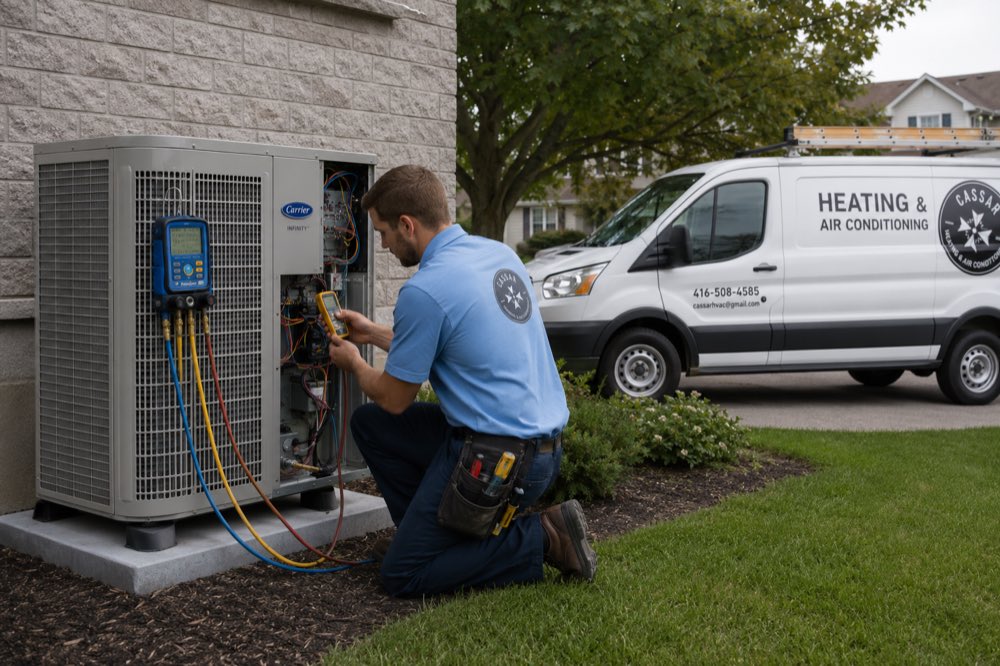
From new installations in Whitby’s growing north-end subdivisions to emergency repairs on systems that quit overnight, David handles every job himself.
David sizes the system to your home’s actual heating and cooling load, not a rough square-footage guess. Many Whitby homes built between 1995 and 2010 have ducts that’ll work well with a ducted heat pump, but he’ll confirm that before any equipment goes on order. You get a written quote before anything’s scheduled.
David diagnoses the fault, tells you what it’ll cost to fix, and gives you his honest opinion on whether the repair makes sense given the age and condition of the unit. He stocks common parts in the van so a lot of repairs wrap up the same day he arrives.
When a repair no longer makes financial sense, David walks you through replacement options that fit the home and the budget. He won’t steer you toward a premium unit if a mid-range model does the job. He’ll also flag whether your existing electrical panel can handle the new load before you commit to anything.
A heat pump tune-up once a year keeps efficiency up, catches small problems before they become expensive ones, and satisfies most manufacturer warranty requirements. David checks refrigerant charge, cleans coils, tests the defrost cycle, and inspects electrical connections. Book it in the shoulder season before everyone else calls.
Older heat pumps installed in Whitby homes a decade or more ago are often running at HSPF ratings well below what today’s cold-climate models deliver. Upgrading to a current unit can cut heating costs noticeably, and Ontario rebate programs can reduce the upfront cost. David’ll run the numbers with you so you can see what the payback period actually looks like.
When the heat pump stops working in January and the forecast is below minus fifteen, you need someone who picks up. David answers his own phone and covers Whitby with emergency response. He’s not dispatching a crew, he’s coming himself, which means you know exactly who’s showing up at your door.
I’ve worked in Whitby since 2011 and I see the same patterns: a lot of the split-level and two-storey homes in the Brooklin and Winchester areas were built with undersized ductwork for the original gas furnace, and whoever sized the original system didn’t leave much margin. When those homeowners call about a heat pump, I check the duct system first, because installing a heat pump on top of a duct system that can’t move the right airflow just means a poorly performing system that you’ll be calling about again. I’d rather tell you that upfront than take your money and leave you cold.
Most heat pumps installed in Ontario homes last between 15 and 20 years when they’re properly sized and maintained. Systems that are oversized, undersized, or neglected tend to wear out earlier, compressor failures in the 10- to 12-year range are common in units that never had a refrigerant charge check or coil cleaning done. The equipment itself is only part of the equation; how it’s installed and what happens in the years after determines a lot of the lifespan.
Ontario’s climate puts heat pumps through a genuine workout. The swing from a January low of minus twenty to a July humidity day above thirty degrees means the equipment cycles hard in both directions. The defrost cycle, the sequence the unit runs to clear frost off the outdoor coil in winter, takes a beating in a Durham Region climate. If that cycle isn’t working correctly, the compressor works harder than it should, and that shortens the life of the unit.
An annual tune-up extends the lifespan and keeps the warranty valid. Most manufacturers require documented maintenance to honor warranty claims. Skipping it for three or four years and then expecting a warranty repair to go smoothly usually doesn’t work out.
A new heat pump installation in Whitby typically runs between $4,500 and $9,000 for a ducted central system, depending on the size of the home, the efficiency rating of the unit, and whether any electrical panel work or duct modifications are needed. Cold-climate units designed to operate efficiently below minus fifteen cost more upfront but can qualify for larger rebates and deliver better performance in a Durham Region winter. Ductless mini-split systems for a single zone start around $2,800 to $4,500 installed.
Repairs vary widely. A refrigerant top-up and leak repair might run $300 to $600. A reversing valve replacement is typically $500 to $900 in parts and labour. A compressor replacement on an older unit can approach $1,500 or more, at which point David’ll usually have a conversation with you about whether a new unit makes more economic sense than putting that money into aging equipment.
Every job gets a written quote before work starts. The best way to know what your specific job will cost is to get a free quote from David, no pressure, no obligation.
Whitby’s housing stock is younger than much of Durham Region. A significant portion of the detached and semi-detached homes were built during the building boom that ran from roughly 1988 through 2008, with large subdivisions going up around areas like Pringle Creek, Lynde Creek, and the north end near Taunton Road. Those homes generally have forced-air systems with reasonable ductwork, which makes them good candidates for ducted heat pump installs. The duct sizing, though, was often designed around a standard 80% AFUE gas furnace, and a heat pump moves air differently. David checks static pressure in the duct system before recommending a ducted setup to make sure the airflow’s adequate.
Older Whitby homes closer to the downtown core and along the waterfront area in Whitby’s south end sometimes have original ductwork from the 1970s or earlier, or no ductwork at all. In those cases, a ductless mini-split system is usually the cleaner solution. They’re also increasingly popular in Whitby’s newer homes for additions, finished basements, or detached garages.
Brooklin, which sits in the northern part of the Town of Whitby, saw substantial new construction from about 2005 onward. Many of those homes have two-stage or variable-speed gas furnaces already, and some homeowners want to add a heat pump for the air conditioning function and partial heating with the gas furnace as backup. That dual-fuel setup works well in Brooklin’s colder winters and is worth discussing if your furnace is in good shape.
The most obvious sign is a unit that’s running constantly without reaching the set temperature. In a Durham Region winter, a heat pump will run longer cycles than a gas furnace would, that’s normal. But if it’s running non-stop and the house is still five degrees below where the thermostat’s set, something’s wrong. Low refrigerant charge and a failing compressor both produce this symptom. So does an outdoor coil that’s completely iced over because the defrost cycle has failed.
Unusual sounds deserve attention immediately. A grinding or clanking from the outdoor unit usually means a failing fan motor or loose component. A gurgling or hissing sound from inside the air handler can indicate a refrigerant leak. Heat pumps don’t tend to give much warning before a compressor fails, so anything that sounds different from the unit’s normal operating noise is worth a call.
In Whitby specifically, David sees a pattern in the early spring: heat pumps that struggled through the winter on low refrigerant, because the homeowner noticed the problem but put it off, often fail completely when the system switches over to cooling mode in May. The refrigerant is the same circuit for heating and cooling, so a leak that was marginal in heating mode becomes a non-functioning unit in summer. Don’t wait on refrigerant issues.
Durham Region’s winters regularly push below minus fifteen, and older heat pump models lose efficiency fast below zero. If you have a cold-climate unit rated to minus twenty-five or better, it should carry the heating load through most of the winter without needing a backup electric strip or gas furnace to kick in. If your unit is more than ten years old, it likely isn’t rated for that kind of low-temperature performance, and it’s worth having David take a look at how it’s performing against what it should be delivering.
Keep the area around the outdoor unit clear year-round. In winter, snow can pack around the unit and restrict airflow or block the drainage that the defrost cycle depends on. In summer, overgrown shrubs and grass clippings clogging the coil reduce efficiency noticeably. A quick inspection every season takes a few minutes and keeps the unit working the way it should.
Set the thermostat to a consistent temperature rather than making large manual adjustments throughout the day. Heat pumps are designed to maintain a steady indoor temperature efficiently. Turning the thermostat way down overnight and then cranking it back up in the morning forces the backup heat to run, which costs more. A programmable or smart thermostat with a heat pump mode, one that uses smaller, gradual setbacks, works much better.
Heat pumps don’t produce combustion gases, so there’s no carbon monoxide risk from the heat pump itself. If you’re running a dual-fuel setup with a gas furnace as backup, that furnace still requires annual inspection and a working CO detector on every level of the home. Ontario’s building code requires CO alarms in any home with a fuel-burning appliance, and that requirement doesn’t change just because a heat pump is doing most of the heating work.
In Ontario, the Greener Homes Grant has provided up to $6,500 for heat pump installations, though the federal program has evolved over time. The Canada Greener Homes Loan program has offered interest-free financing for energy upgrades including heat pumps. Ontario also runs its own energy rebate programs through Enbridge and Ontario Energy Board programs. Eligibility depends on your current heating source, the efficiency rating of the unit you’re installing, and whether you complete a pre-installation home energy audit. David can point you toward the current programs when you get your quote.
For TSSA purposes, the refrigerant handling and the gas work involved in a dual-fuel setup require a licensed technician. David holds TSSA Licence #000398183, which covers this work and is verifiable directly through the TSSA’s public licence registry. You shouldn’t let anyone handle refrigerant or gas connections without asking for their licence number first.
Running through the basics before you call saves time for everyone and sometimes solves the problem outright.
Heat pumps require the thermostat to be set to Heat, and the temperature must be above what the room currently is. Also confirm the system mode isn’t set to Emergency Heat unless needed. Emergency Heat bypasses the heat pump and runs only the backup element, which costs significantly more to operate.
Heat pumps have two circuit breakers, one for the air handler inside and one for the outdoor unit. Both must be on. A tripped breaker for the outdoor unit will leave the air handler running but blowing unconditioned air, which is confusing. Reset it once, if it trips again, call David before resetting it a second time.
Some frost on the outdoor unit is normal in winter. A unit completely encased in ice is not, this indicates a defrost issue. Don’t chip at it; call Cassar. Forcing ice off the coil can damage the fins and the refrigerant lines, turning a repair into a much larger job.
A blocked filter forces the heat pump to work harder and can trigger safety shutoffs. Pull the filter out and hold it up to a light, if you can’t see light through it, it needs replacing. Replace it and give the system 15 to 20 minutes to recover before deciding the problem’s still there.
If your heat pump is blowing cool air in heating mode, the reversing valve may be stuck or the thermostat may be sending the wrong signal. This isn’t a fix you can do yourself, the valve controls which direction refrigerant flows and requires a licensed technician with the right tools to diagnose and replace it properly.
If none of the above resolved it, a licensed technician needs to take a look. David covers all of Whitby and Durham Region and picks up his own phone, you’ll reach the person who’s actually going to fix it.
Yes, modern cold-climate heat pumps work effectively in Ontario winters, including Durham Region’s coldest stretches. Current cold-climate models from manufacturers like Mitsubishi, Bosch, and others are rated to deliver full heating capacity at minus fifteen Celsius and partial capacity down to minus twenty-five or colder. That covers the vast majority of winter days in Whitby without any backup heat running. Ten years ago that wasn’t the case, and older heat pumps do struggle below minus ten, but that’s a technology issue, not an inherent limitation of how heat pumps work. If someone tells you a heat pump won’t heat a house in an Ontario winter, they’re either thinking of older equipment or they’re selling you something else. The key is getting a cold-climate unit that’s properly sized for your home, not the cheapest unit on the spec sheet.
It depends on the age of your furnace, your current energy costs, and what you’re trying to accomplish. If your gas furnace is under ten years old and working well, replacing it now with a heat pump is harder to justify purely on economics, you’d be retiring equipment that still has useful life. The better option in that case might be a dual-fuel setup: add a heat pump alongside the furnace, use the heat pump for most of the heating season, and let the furnace handle the coldest days when a heat pump is less efficient. If your furnace is 15 to 20 years old and you’re also looking at replacing the air conditioner, a heat pump does both jobs in one system and can make a lot of sense. David’ll look at your current setup and give you a straight answer rather than steering you toward the more expensive job. The honest answer is that it’s a case-by-case calculation, and he’s happy to walk through it with you.
A ducted central heat pump installation in Durham Region typically costs between $4,500 and $9,000, depending on the size of the home, the efficiency rating of the unit, and whether any supporting work, electrical panel upgrades, duct modifications, or line set runs, is needed. Cold-climate units with higher HSPF ratings sit at the upper end of that range but often qualify for larger rebates that bring the net cost down. A ductless mini-split for a single zone generally runs $2,800 to $4,500 installed. Multi-zone ductless systems for whole-home coverage start around $6,000 and go up depending on the number of indoor heads and the complexity of the refrigerant line routing. These ranges are honest starting points, the actual number for your home depends on specifics David needs to see in person. The best way to know what your specific job will cost is to get a free quote from David, no pressure, no obligation.
Ontario homeowners have access to a few rebate streams depending on the type of system and the current program status. The Canada Greener Homes Grant offered up to $6,500 for heat pump installations, and the Canada Greener Homes Loan provided interest-free financing up to $40,000 for eligible upgrades. These federal programs have evolved and have had application backlogs, so it’s worth checking their current status at the time you’re planning the install. On the utility side, Enbridge Gas has run rebate programs for homeowners switching to high-efficiency heat pump systems. The eligibility criteria for rebates generally require a pre-installation home energy audit, a minimum efficiency rating on the unit being installed, and installation by a licensed contractor. David can walk you through what’s currently available when you get your quote, programs change, and the numbers he gives you will reflect what’s actually in place at that time, not outdated program details.
A standard ducted heat pump installation in a Whitby home takes one full day in most cases, typically six to eight hours. That covers removing the old outdoor unit if there is one, setting the new outdoor unit, connecting the refrigerant lines, installing or connecting the air handler or coil, running the electrical connections, commissioning the system, and testing. More complex jobs, homes that need new electrical circuits run from the panel, significant duct modifications, or multi-zone ductless installs with several indoor heads, can take a day and a half to two days. David won’t rush the commissioning step to get out the door faster. Verifying refrigerant charge, checking static pressure, and confirming the defrost cycle works correctly at the end of the job is as important as any other part of the install. You’ll know the system is working properly before he leaves.
Start with the thermostat: confirm it’s set to Heat mode, that the temperature setting is above what the room currently is, and that it’s not set to Emergency Heat. Then check both circuit breakers, the one for the air handler and the one for the outdoor unit. A tripped breaker on the outdoor unit will leave the system appearing to run while producing no useful heat. Next, look at the outdoor unit for a filter that needs replacing or a coil that’s completely iced over rather than just lightly frosted. If all of those check out and the system is still not heating, the most common causes are low refrigerant charge, a stuck reversing valve, or a fault in the defrost control board. Those all need a licensed technician with the right diagnostic equipment. Call David at (416) 508-4585, he covers all of Whitby and he’ll tell you over the phone whether what you’re describing sounds like something you can check yourself or whether he needs to come out.
Yes. Cold-climate heat pumps are what David recommends for Whitby and the rest of Durham Region specifically because of how far temperatures drop in January and February. A standard heat pump rated to around minus eight or minus ten loses most of its capacity right at the point of the season when you need it most. Cold-climate units rated to minus twenty-five or colder maintain much better performance through a Durham winter and mean the backup heat strip or gas furnace runs a lot less often. David’ll discuss the specific models that make sense for your home’s size and budget, and he’ll be clear about what efficiency you’re getting for the price difference between a standard and cold-climate unit. He doesn’t push the most expensive option if a more modest cold-climate unit does the job.
Yes, and that’s one of the strongest arguments for a heat pump over a standalone furnace-plus-air-conditioner setup. A heat pump is essentially a central air conditioner that can also run in reverse to produce heat, so summer cooling is built in. The cooling performance of a heat pump is comparable to a traditional central air conditioner of the same capacity, you’re not trading cooling ability for the heating function. In Whitby, where July and August humidity regularly makes it feel like it’s well above thirty degrees, having a properly sized heat pump delivering the right airflow through the ducts matters. David sizes the system for both the heating and cooling loads, not just one or the other. If your home has had issues with the upstairs being too hot in summer while the main floor stays comfortable, that’s often a ductwork distribution problem, not a unit size problem, and it’s worth talking through before assuming you need a larger system.
“The heat pump David installed in our Whitby home last fall has run without a single issue through the whole winter. Our gas bills dropped more than we expected.”
“Called David on a Thursday morning because our heat pump was blowing cold air and the temperature was supposed to drop that night. He walked me through a couple things to check on the phone, figured out it was the reversing valve, and had it fixed that afternoon. He explained exactly what the valve does and why it fails, which I appreciated, I didn’t feel like I was just being handed a bill. Good experience from start to finish, and our Whitby neighbours have already asked for his number.”
“Quoted me fairly, showed up on time, put down covers before he touched anything, and the price didn’t change between the quote and the invoice. Three other contractors I called in Whitby gave me ranges so wide they were meaningless. David gave me a number and stuck to it.”
David covers all of Durham Region, if you’re near Whitby, he’s near you.
Same-day service available. TSSA certified. Honest pricing. Call or book online.