
Whitby’s rapid growth over the past two decades means thousands of homes here are now approaching the point where their original builder-grade tanks are due for replacement, and when one fails, it tends to fail fast, without much warning. David Cassar covers all of Whitby and the rest of Durham Region, with same-day and emergency service available when you can’t afford to wait.
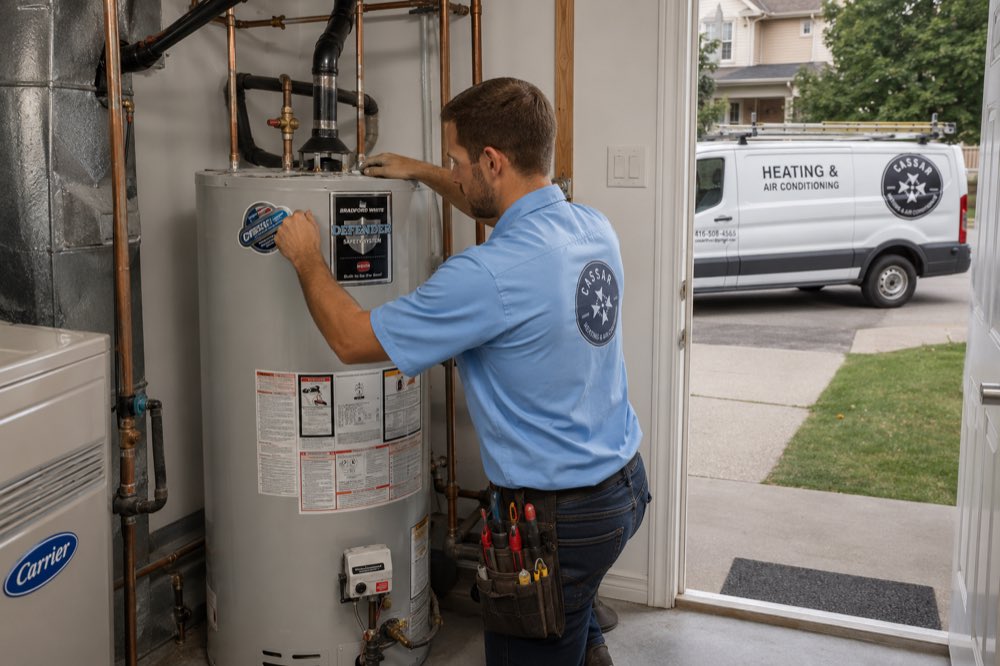
From a failed tank in a Lynde Creek townhouse to a high-efficiency upgrade in a Pringle Creek detached, David handles the full range of hot water tank work across Whitby.
David installs gas and electric hot water tanks across Whitby, sizing the unit to match your household’s actual demand rather than defaulting to whatever’s cheapest to source. Many Whitby homes built in the 1990s and early 2000s still have 40-gallon tanks that no longer suit a growing family. Getting the right capacity installed from the start means you won’t be running cold mid-shower two years later.
A tank that’s stopped heating, making unusual noises, or producing discoloured water may only need a component replaced, not a whole new unit. David diagnoses the actual cause before recommending anything, and if a repair is the sensible call, that’s what you’ll hear. He carries common parts on the truck so many repairs wrap up the same visit.
When a tank is past the point of repair, David replaces it the same day in most cases. He handles the full job: draining and disconnecting the old unit, installing and testing the new one, and leaving the utility room tidy. Old tanks don’t get left in your driveway, David takes them away.
A yearly maintenance visit includes flushing sediment from the tank floor, checking the anode rod, testing the T&P valve, and inspecting the flue connection on gas units. Most homeowners skip this step until something fails, a short annual visit is significantly cheaper than an emergency replacement. David keeps the visit quick and doesn’t invent problems that aren’t there.
Upgrading from a standard-efficiency tank to a high-efficiency power-vent or condensing unit can cut water heating costs noticeably over time. If you’re already replacing a failed unit, it’s worth knowing the difference in payback periods before you commit to a model. David gives you the numbers for your specific situation and lets you decide.
A tank that’s actively leaking or flooded can cause serious water damage quickly. David covers all of Whitby and picks up the phone himself, you won’t reach a dispatcher who has to relay messages. If you’re in Whitby’s downtown core or out in the newer subdivisions near Taunton Road, he can get to you the same day, often within a few hours.
I’ve worked on hot water tanks in homes across Whitby since 2011, from the older bungalows near the waterfront to the newer builds along Rossland Road, and the most common thing I see is homeowners who were pushed into a full replacement when the heating element or thermostat was all that needed swapping. You get straight advice here. If a repair fixes it, I’ll tell you that. If the tank’s genuinely done, I’ll tell you that too, and explain exactly why.
Most conventional storage tanks last between 8 and 12 years, though well-maintained units in homes with good water quality sometimes push past 14 years. The main factors that shorten a tank’s life are hard water mineral buildup, a neglected anode rod, and temperature settings that are too high. Ontario’s municipal water supplies, including Whitby’s, which draws from Lake Ontario, carry moderate mineral content that accelerates sediment accumulation on the tank floor over time.
The single most effective thing you can do to extend a tank’s life is flush it annually and replace the anode rod every four to six years. The anode rod is a sacrificial magnesium or aluminum rod that corrodes in place of the tank walls, when it’s spent, the tank itself starts to rust from the inside. Most homeowners have no idea it exists until the tank leaks. A quick annual flush also removes sediment before it hardens into a thick layer that permanently reduces efficiency and creates the rumbling noise many people notice before a tank fails.
Ontario’s cold winters matter more for tanks located in uninsulated or semi-conditioned spaces, a utility room next to an attached garage, for example, works harder in January than one in a heated basement. If your tank lives in a cold spot, an insulation blanket helps. David can advise on the right approach during a maintenance visit or installation call.
A standard 40-gallon natural gas tank installation in Whitby typically runs between $1,200 and $1,800 all in, including the unit, labour, disposal of the old tank, and any minor adjustments to the gas or venting connections. A 50-gallon unit adds roughly $100 to $200 to those numbers. Electric tank replacements run slightly lower on the equipment side but can vary depending on the electrical panel configuration. High-efficiency power-vent models start closer to $1,800 and can reach $2,400 depending on the venting path required in your home.
What drives variation most is the venting setup. Replacing a tank with the same type, same fuel, same vent location, is the most straightforward job. Switching from a natural draft to a direct-vent or power-vent unit means new venting materials and additional labour. Homes where the utility room is on the second floor or in an awkward location also take longer. Repairs are a different matter: replacing a thermostat or heating element usually falls in the $150 to $350 range depending on the part and how accessible the tank is.
Every job gets a free upfront quote before any work starts. The best way to know what your specific job will cost is to get a free quote from David, no pressure, no obligation.
Whitby’s housing stock is heavily weighted toward homes built between the mid-1980s and the mid-2000s, when the town expanded rapidly as part of Durham Region’s broader growth. A large portion of these homes are two-storey detached or semi-detached builds with natural gas systems, furnace, water heater, and sometimes a fireplace, all running off the same gas line. Many of the original hot water tanks in these homes are now 15 to 20 years old, well past their expected service life, and David sees a steady pattern of them failing in the colder months when demand is highest.
The newer subdivisions, areas north of Taunton Road like Williamsburg and the developments around Coronation Road, tend to have more recent equipment, but they also tend to have larger households and higher hot water demand. Builder-installed 40-gallon tanks that were adequate when the home was occupied by a couple are often undersized once a family moves in. Upgrading to a 50-gallon or 60-gallon tank, or switching to a tankless system, is a conversation worth having during any replacement job.
Older homes in Whitby’s downtown and Lynde Shores areas sometimes have original atmospheric-vent setups that can’t simply be swapped with a modern direct-vent unit without modifications to the flue. David checks the existing venting configuration before quoting so there are no surprises when the job starts.
The most obvious warning sign is running out of hot water faster than you used to. This usually points to one of three things: a failing heating element (electric tanks), a faulty thermocouple or gas valve (gas tanks), or sediment buildup thick enough to displace a significant volume of usable water. In Whitby, where many tanks are aging into their second decade, the sediment issue is common and the rumbling or knocking sound it produces gets mistaken for a plumbing noise rather than a tank problem.
Discoloured water, specifically rust-brown or yellow-tinted hot water, almost always means the interior of the tank is corroding. That’s a replacement situation, not a repair. A dripping temperature and pressure relief valve is a different warning: it’s either responding to genuinely dangerous pressure or temperature levels inside the tank, or the valve itself has worn out and needs replacing. Either way, it’s not something to tape up and ignore. A wet spot or puddle under or around the base of the tank means the tank’s inner lining has failed and it’s time to replace it.
In Durham Region’s climate, tanks that sit in cooler spaces work harder in winter, which means wear accumulates faster. If your tank is approaching 10 years old and you’re noticing any of the above, it’s worth having David take a look before it decides to fail on a January night.
Durham Region winters push household hot water demand up considerably, longer showers, more laundry, and the simple fact that incoming cold water is much colder in January than in July. That temperature gap means your tank’s heating elements or burner run longer each cycle, which accelerates wear over time. Setting your thermostat to 49°C (120°F) balances hot water availability with reduced energy use and lower mineral scaling rates. Temperatures above 60°C significantly increase sediment buildup and shorten the tank’s functional life.
Insulating the first two metres of hot water pipe leaving the tank is a simple job that reduces standby heat loss, particularly in utility rooms adjacent to unheated garages. In older Whitby homes with longer pipe runs between the utility room and bathrooms, a small recirculation pump can eliminate the wait for hot water while also reducing the amount of cold water you run down the drain before the heat arrives.
Annual flushing is the maintenance task with the highest return on investment in Ontario. Durham Region water isn’t particularly hard compared to some Ontario municipalities, but enough mineral content accumulates over years to matter. Two or three centimetres of hardened scale on the tank floor is enough to force the burner to work substantially harder to heat the water above it. Flushing before scale hardens is easy. Removing hardened scale after the fact often isn’t possible without damaging the tank.
In Ontario, any work on a natural gas appliance, including hot water tank installation and replacement, must be performed by a TSSA-licensed gas contractor. This isn’t paperwork for its own sake: gas connections done improperly are a carbon monoxide risk. CO has no odour, and the symptoms of low-level exposure are easy to mistake for fatigue or a cold. David holds TSSA Licence #000398183, which you can verify directly with TSSA. Every gas connection gets leak-tested before the job is signed off.
The T&P (temperature and pressure) relief valve is the tank’s primary safety device. It opens automatically if pressure or temperature inside the tank exceeds safe limits, releasing water rather than allowing the tank to rupture. The discharge pipe from this valve must terminate close to the floor and must never be capped or plugged. David checks this configuration on every installation and replacement job, it’s a detail some installers rush past.
Ontario homeowners replacing aging equipment may qualify for rebates through the Canada Greener Homes Grant or Enbridge’s Home Efficiency Rebate program, depending on the model installed and the home’s current efficiency profile. High-efficiency condensing water heaters and heat pump water heaters are among the qualifying upgrades. David can walk you through what applies to your situation at the time of the quote.
Checking the simple things before calling saves time for everyone, here’s where to start.
The temperature dial on your tank may have been turned down accidentally, especially after maintenance visits. Try turning it up and waiting 30 minutes to see if the water heats back up before calling.
Electric tanks have a dedicated breaker that trips occasionally. Gas tanks have a pilot light, if it’s out, follow the relight instructions printed on the label. Most modern tanks have an electronic igniter that makes relighting straightforward.
A dripping T&P valve is a warning sign, not normal. Turn down the thermostat and call Cassar, don’t ignore a dripping relief valve. It’s either responding to a real pressure issue or the valve itself has failed, and either needs attention.
Loud rumbling or popping usually means sediment has built up on the tank floor. Flushing may help on newer tanks; on older ones it often signals time to replace. Either way, the noise won’t resolve itself.
The shutoff valve on the cold water inlet to the tank must be fully open. It sometimes gets partially closed during plumbing work nearby, even a half-closed valve can reduce your hot water supply noticeably.
If none of the above resolves it, it needs a licensed technician. David serves all of Whitby and Durham Region and picks up the phone himself, no dispatcher, no call centre.
Most conventional storage tanks in Durham Region last between 8 and 12 years, with well-maintained units occasionally reaching 14 years. The key variables are water quality, maintenance frequency, and where the tank is located in the home. Durham Region’s Lake Ontario water supply carries enough mineral content to build sediment on the tank floor over time, that sediment layer forces the burner to work harder, shortens the element life on electric tanks, and reduces overall capacity. Annual flushing is the most effective thing you can do to push a tank toward the longer end of that range. The anode rod, the sacrificial metal rod inside the tank that prevents internal corrosion, should be inspected and replaced every four to six years. Most homeowners in Whitby have never had this done, and it’s one of the main reasons tanks fail earlier than they should. If your tank is past ten years old and you’re starting to notice performance changes, it’s worth having David take a look before you’re dealing with a flooded utility room.
Repair usually makes sense when the tank is less than eight years old, the problem is a single failed component like a heating element, thermostat, or thermocouple, and there’s no rust or corrosion on the tank body. A thermostat or element replacement typically runs $150 to $350 and can extend the tank’s life by several years. Replacement makes more sense when the tank is already past ten years old, the repair cost approaches or exceeds half the cost of a new unit, you’re seeing rust-coloured hot water (which means internal corrosion), or the tank is actively leaking from the bottom, that’s always a replacement situation, since it means the tank wall has failed. David diagnoses the actual problem first and tells you honestly which way the math points. He’s replaced plenty of tanks that needed replacing, and he’s also fixed plenty that other contractors quoted for replacement when a $200 part was all that was needed. You’ll get a straight answer either way.
A standard 40-gallon natural gas tank installation in Durham Region, including the unit, labour, disposal of the old tank, and any minor gas or venting adjustments, typically runs between $1,200 and $1,800. A 50-gallon unit adds roughly $100 to $200. Electric tank replacements vary depending on the panel configuration but are generally comparable. High-efficiency power-vent models start closer to $1,800 and can reach $2,400 depending on how much new venting is required. What moves the price most is the venting setup: replacing a tank with the same type in the same location is the most straightforward job. Switching from atmospheric vent to power-vent means new materials and additional labour. Repairs land in the $150 to $350 range for most common component failures. Every job gets a firm quote before work starts, what David quotes is what you pay, nothing added on the invoice. The best way to know what your specific job will cost is to get a free quote from David, no pressure, no obligation.
Buying is almost always the better financial decision for Whitby homeowners who plan to stay in their home for more than a few years. Rental programs, offered primarily through Enbridge and various rent-to-own companies, charge monthly fees that add up to significantly more than the cost of ownership over a ten-year period, and they often include contractual penalties if you switch providers or sell the home. A purchased tank that costs $1,400 to $1,800 installed is fully paid off in year one. A rental at $35 to $55 per month costs that same amount every two to three years indefinitely. Rental contracts also get complicated at the point of home sale, the buyer either continues the rental or faces a buyout fee, and that can become a negotiating issue. The main argument for renting is avoiding upfront cost, but if you can cover the installation price, ownership is the straightforward choice. David installs tanks you own outright, with no ongoing fees attached to the equipment.
A straight swap, same tank type, same fuel, same vent configuration, takes two to three hours from arrival to completion in most Whitby homes. That includes draining and disconnecting the old unit, removing it, installing and connecting the new tank, testing the gas connections or electrical hookup, checking the T&P valve discharge configuration, and bringing the water back up to temperature. Jobs that involve switching fuel types, running new venting, or dealing with tight utility rooms take longer, typically three to four hours. David will give you a realistic time estimate when he quotes the job. He carries common tank sizes on the truck so in most cases there’s no delay waiting for equipment to arrive. From the time you call to the time hot water is flowing again, same-day completion is the norm rather than the exception for standard replacement jobs in Whitby.
Turn off the cold water supply valve on the inlet pipe at the top of the tank, it’s usually a gate valve or ball valve directly above the unit. If it’s a gas tank, turn the gas control valve to the “Pilot” position. If it’s an electric tank, switch off the dedicated breaker at the panel. These steps stop the situation from getting worse while you wait for David to arrive. A leak from the T&P relief valve on the side of the tank is different from a leak at the base, the T&P valve may just need replacing, while a leak at the base almost always means the tank wall has failed and it needs to go. Don’t try to patch a leaking tank body. Call David at (416) 508-4585, he covers all of Whitby and can typically get to you the same day. The longer a leaking tank runs, the greater the water damage risk to your utility room floor and any adjacent structure.
Yes, always. Removing the old unit is part of every replacement job David does in Whitby and across Durham Region. The old tank gets drained, disconnected, and loaded out, it doesn’t end up in your driveway or backyard for you to arrange disposal later. This is included in the job price, not billed as a separate line item. Old tanks are heavy and awkward to move, particularly out of basement utility rooms with narrow stairwells or tight hallways. David’s done this enough times that it goes quickly and without damaging walls or door frames. Floors get protected before the move. If you’ve already got an old tank sitting in your garage from a previous job that you need taken away, call and ask, David can often accommodate that as part of a visit for another reason.
David installs tanks from several reputable manufacturers, Bradford White, Rheem, and John Wood are among the brands he works with regularly, depending on availability, the specific application, and what makes sense for your home. He doesn’t push one brand exclusively, and he’s not locked into a supply arrangement that limits your options. What matters more than brand loyalty is getting the right tank type, the right capacity, and the right efficiency tier for your household. A 40-gallon Bradford White and a 40-gallon Rheem are both solid units, the bigger decisions are whether you need 40 or 50 gallons, whether a power-vent or natural-draft configuration suits your venting setup, and whether it’s worth stepping up to a high-efficiency model given your usage and how long you plan to stay in the home. David walks through those choices with you at the time of the quote so you’re making an informed decision, not just accepting whatever happens to be on the truck.
“Our tank failed on a Wednesday morning and David had a new one installed and running the same afternoon. No cold showers, no overnight wait.”
“I called thinking we needed a full replacement, the tank was making a loud rumbling sound and the water was lukewarm at best. David came out, told me it was the lower heating element and sediment buildup, flushed it, swapped the element, and that was it. He could have easily sold me a new tank. I appreciated that he didn’t.”
“Price was exactly what he quoted, nothing added on when the bill came. He put down a mat before moving the old tank out and the utility room looked the same as when he walked in, just with a new water heater. That kind of care isn’t something I’ve come to expect from trades. Good work, Whitby should know about this guy.”
David covers all of Durham Region, if you’re near Whitby, he’s near you.
Same-day service available. TSSA certified. Honest pricing. Call or book online.