
Durham Region’s rapid growth over the past two decades means thousands of homes built in the 1990s and early 2000s are now running tanks that are well past their best years, and David sees failed tanks in Oshawa, Whitby, Ajax, and Pickering almost every week. He covers all of Durham Region and picks up the phone himself, including evenings and weekends when the hot water stops on the worst possible night.
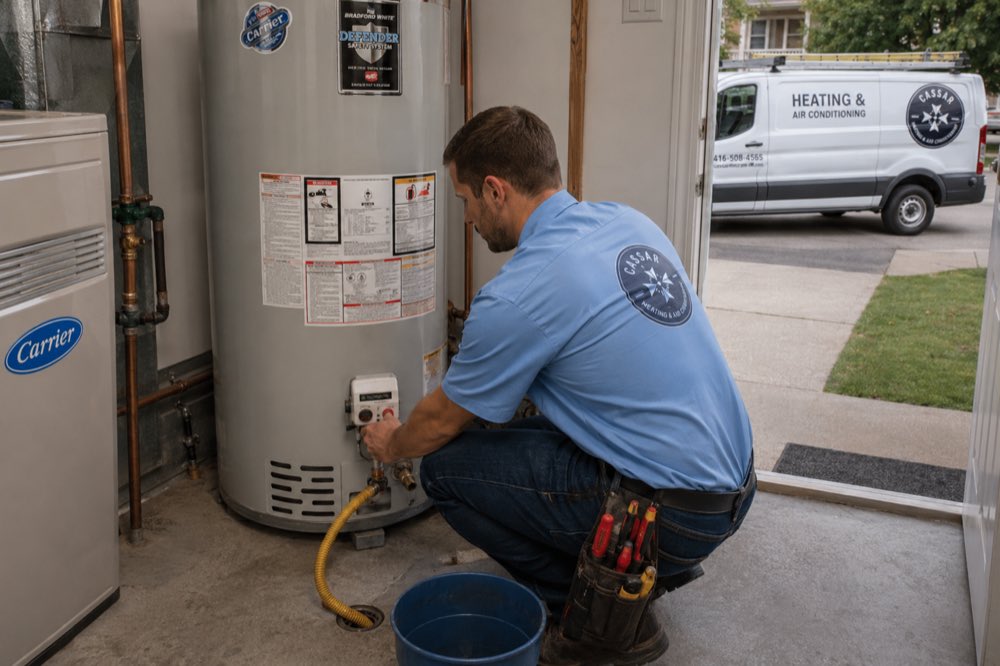
Every job below is handled by David personally, TSSA Licence #000398183, not a subcontractor you’ve never met.
David installs gas and electric tanks from leading manufacturers across all of Durham Region’s communities. He sizes the tank to your household, a four-bedroom Pickering home has different demands than a Courtice bungalow, and he handles every permit and inspection requirement so you don’t have to.
Thermostats, heating elements, T&P valves, gas valve issues, pilot assembly problems, David diagnoses the real cause before quoting a repair. If a repair makes more sense than a replacement, that’s what he’ll tell you, even when replacement would make him more money.
Many Durham Region homes still have rental tanks from Reliance or Direct Energy that homeowners didn’t realize they could replace. David removes the old unit, handles the buyout paperwork if needed, and installs a tank you own outright, saving you the monthly rental fee every year going forward.
An annual flush and inspection catches anode rod wear, sediment buildup, and early thermostat drift before they turn into a cold shower at 6 a.m. David checks the T&P valve, inspects the flue connection on gas units, and leaves you with a clear picture of how many good years the tank has left.
If your current tank is costing you more to run than it should, David can walk you through the upgrade options, higher-efficiency power-vent models, heat pump water heaters, or tankless systems if your gas line and space support it. He’ll give you honest numbers, not a sales pitch, so you can decide what actually makes sense for your home.
A tank that’s leaking actively can cause serious water damage within hours. David covers all of Durham Region for emergency calls, Oshawa to Clarington, Ajax to Bowmanville, and aims to get there the same day you call. When you dial (416) 508-4585, David answers, not an answering service.
Since 2011, David has replaced and repaired tanks in just about every neighbourhood across Durham Region, from the older Lakeview homes in Oshawa to the newer subdivisions in north Whitby and the rural properties in Clarington where longer run times mean tanks work harder than average. He quotes every job in writing before touching anything, and the number on that quote is the number on the invoice.
Most conventional storage tanks last between 8 and 12 years in Ontario, with the range driven mainly by water quality, maintenance history, and how hard the tank works day to day. A well-maintained tank with a flushed-out sediment bed, a healthy anode rod, and a properly calibrated thermostat can push toward the top of that range. One that’s never been touched since it was installed is often done by year nine.
Ontario’s cold groundwater temperatures put extra strain on tanks through the winter months. Water entering the tank from the municipal supply in January can be close to 5°C, which means the heating element or gas burner runs significantly longer per cycle than it would in summer. That added run time wears components faster and shortens the window between repairs. A simple annual flush in the fall costs very little and genuinely extends the life of the unit.
Anode rod condition is the single biggest factor most homeowners overlook. That sacrificial magnesium rod corrodes so the steel tank walls don’t. Once it’s gone, the tank corrodes from the inside. Checking it every three to five years, and replacing it when it’s depleted, is the best investment you can make in a tank you want to keep running past the 10-year mark.
A standard gas hot water tank replacement in Durham Region, including the tank, labour, permits, and disposal of the old unit, typically runs between $1,400 and $2,200. Electric tank replacements tend to come in slightly lower, in the $1,100 to $1,800 range, because the installation is simpler, no gas line, no venting modifications. High-efficiency power-vent models cost more upfront but may qualify for rebates through Enbridge or your local utility.
What moves the number up or down is mostly the tank size, whether the venting needs to change, and whether the installation involves any complications like a cramped mechanical room, an older gas line that needs upgrading, or a buyout of an existing rental tank. Repair costs vary widely depending on the component, a thermocouple or thermostat swap is typically in the $150 to $350 range, while a leaking T&P valve or failed heating element usually runs $200 to $400 including parts and labour.
Every job David quotes is written down before any work starts. The best way to know what your specific job will cost is to get a free quote from David, no pressure, no obligation.
Durham Region’s housing stock is remarkably varied. Oshawa has a large number of homes built between the 1950s and 1980s, many of them in Lakeview, Vanier, and the O’Neill neighbourhoods, where original mechanical rooms were designed around atmospheric-vent tanks. When those tanks fail and a power-vent replacement is the obvious efficiency upgrade, the venting has to be rerouted to an exterior wall, a job that’s straightforward in a detached bungalow but more complicated in the semis and older row housing common in south Oshawa.
Ajax and Pickering saw enormous growth through the 1990s and early 2000s, which means large swaths of those communities have tanks that are now between 20 and 25 years old and still haven’t failed, but are living on borrowed time. David regularly gets calls from Ajax and Pickering homeowners whose tank is still technically functional but clearly rusting from the inside. At that age, waiting for the emergency is the costlier choice.
Clarington municipalities including Bowmanville, Newcastle, and Courtice include a mix of rural properties on well water and newer subdivisions on municipal supply. Well water tends to be harder and more mineral-heavy, which means faster sediment accumulation and more aggressive anode rod wear. Homeowners on well water in Clarington often need to flush their tanks more frequently and replace anode rods closer to the three-year mark rather than five.
Running out of hot water faster than you used to is the most common sign, and it usually means one of three things: the thermostat has drifted down, a heating element has partially failed, or sediment buildup has reduced the tank’s effective capacity. In Durham Region’s older homes where tanks haven’t been flushed in years, sediment is almost always the culprit, and by the time you notice it, there’s often enough buildup to justify replacement rather than maintenance on an aging unit.
Rusty or discoloured water coming from the hot tap only (not the cold) points to corrosion inside the tank. That’s a tank telling you it’s on its way out. A sulphur smell, rotten egg odour, usually means bacteria reacting with a magnesium anode rod, which is fixable by replacing the anode with an aluminum version. A loud rumbling or banging sound during heating cycles is sediment on the tank floor boiling under the heat, which accelerates wear significantly.
Any moisture around the base of the tank, even a small amount, warrants a same-day call. Tanks don’t develop small, manageable leaks. What starts as a weeping seam becomes a failure, often without much warning. Durham Region homes with finished basements, in particular, can sustain thousands of dollars in water damage before the leak becomes obvious upstairs.
Durham Region winters are real. Groundwater temperatures drop sharply between November and March, and your tank’s recovery time lengthens as the incoming cold water temperature falls. Setting your thermostat to 49°C (120°F) balances energy efficiency against bacteria risk, lower than that and Legionella becomes a concern; higher and you’re burning more gas or electricity for marginal benefit while increasing the risk of scalding.
Insulating the first two metres of the hot water pipe leaving your tank makes a measurable difference in a cold mechanical room or unheated basement. Heat loss from uninsulated pipe is constant, not just when the tap is running, and in a Durham Region winter that idle heat loss adds up on your gas bill. Pre-cut pipe insulation sleeves cost almost nothing and take fifteen minutes to install.
Flushing a cup or two of water from the drain valve every few months keeps sediment from hardening on the tank floor. It’s not a substitute for a full annual flush, but it slows accumulation between service visits. If your tank is more than seven years old and has never been flushed, call David first, flushing a heavily silted tank that’s already weakened can sometimes accelerate a failure.
In Ontario, all gas appliance installations must be performed by a TSSA-licensed contractor. That’s not a formality, it’s a legal requirement tied directly to safety. Gas line connections, flue venting, and combustion air supply all have to meet specific code standards. An improperly installed tank creates carbon monoxide risk. David’s TSSA Licence #000398183 is verifiable through the public registry, which means you’re not taking anyone’s word for it.
The T&P (temperature and pressure) relief valve is the tank’s primary safety device. It opens if the tank over-pressurizes or overheats. A valve that drips intermittently either means the tank temperature is set too high, there’s a thermal expansion issue on the cold water supply side, or the valve itself has failed and needs replacement. Homeowners sometimes tape it shut or cap it, that’s extremely dangerous and something David sees occasionally in Durham Region homes where a previous landlord or DIYer made a bad call.
On efficiency, the Canada Greener Homes Grant has ended for most applications, but Enbridge Gas rebates for high-efficiency water heating equipment are still available depending on the product and timing. A heat pump water heater, for example, can reduce hot water energy costs by 60% compared to a standard electric tank. David can tell you whether your home’s space and electrical service support one, and whether the current rebate programs make the higher upfront cost worth it for your situation.
Checking the simple things before calling saves time for everyone, here’s where to start.
The temperature dial on your tank may have been turned down accidentally, especially after maintenance visits. Try turning it up and waiting 30 minutes.
Electric tanks have a dedicated breaker that trips occasionally. Gas tanks have a pilot light, if it’s out, follow the relight instructions on the label.
A dripping T&P valve is a warning sign, not normal. Turn down the thermostat and call Cassar, don’t ignore a dripping relief valve.
Loud rumbling or popping usually means sediment has built up on the tank floor. Flushing may help on newer tanks; on older ones it often signals time to replace.
The shutoff valve on the cold water inlet to the tank must be fully open. It sometimes gets partially closed during plumbing work nearby.
If none of the above get the hot water back, it needs a licensed technician. David serves all of Durham Region and picks up the phone himself.
Most tanks in Durham Region last between 8 and 12 years, though I’ve seen well-maintained units push past 14. The biggest factors are water quality, whether the anode rod has ever been replaced, and how often the tank has been flushed. Durham Region’s municipal water supply is generally moderate in hardness, but properties in Clarington on well water tend to see faster sediment accumulation and more aggressive internal corrosion, those tanks often need attention sooner. If your tank is past the 10-year mark and hasn’t had any maintenance, it’s worth having David take a look before it fails on a January weekend. An inspection takes about 20 minutes and tells you exactly where you stand.
The honest answer depends on the tank’s age, the nature of the problem, and how close it is to the end of its expected lifespan. If your tank is under eight years old and the issue is a failed thermostat, a worn-out element, or a bad thermocouple, repair almost always makes sense, you’re looking at $150 to $400 to fix a tank that has years of life left. If it’s past 10 years and it’s leaking from the tank body, producing rusty water, or failing repeatedly, replacement is the better investment. David doesn’t push replacement when repair makes sense. He’ll tell you what he sees and what he’d do in your position, then let you decide. The one situation where he always recommends replacement regardless of age is active tank body corrosion, that’s a failure, not a repair.
A standard gas hot water tank installation in Durham Region, including the tank, labour, permits, and removal of your old unit, typically runs between $1,400 and $2,200. Electric replacements usually come in between $1,100 and $1,800. The variation depends on tank size, whether the venting configuration has to change (common when switching from an atmospheric-vent to a power-vent model in an older Oshawa or Whitby home), and whether there are any complications like a rental tank buyout or a gas line that needs attention. Repair costs are separate and much lower, most common repairs fall in the $150 to $400 range for parts and labour. The best way to know what your specific job will cost is to get a free quote from David, no pressure, no obligation.
Buying your own tank almost always costs less over time. Rental fees in Ontario typically run $25 to $50 per month depending on the company and the tank age, that’s $300 to $600 per year, every year, for a unit you’ll never own. Over 10 years you’ve paid for the tank two or three times over. The one argument for renting is that repair and replacement costs are covered by the rental company, but that math only works in your favour if the tank fails very early. If you’re buying a home in Durham Region with an existing rental tank from Reliance or Enercare, David can walk you through the buyout process. It’s often simpler than people expect, and you start saving money from the moment the rental contract ends.
A straightforward replacement, same tank type, same venting configuration, no complications, takes David about two to three hours from arrival to hot water flowing. That includes draining and removing the old tank, making the new connections, lighting and testing the new unit, and doing a full safety check before he leaves. Installations that involve venting changes, gas line modifications, or unusual access (tight mechanical rooms are common in Durham Region townhomes and semis) can take three to four hours. David stocks the most common tank sizes on the truck, so most jobs don’t wait on a parts order. He’ll give you a realistic time estimate when he quotes the job.
First, identify where it’s leaking from, the location tells you a lot. A drip from the T&P valve on the side of the tank means the valve is releasing pressure, which could indicate the thermostat is set too high or the valve itself has failed. That’s a repair call. Water pooling at the base of the tank and coming from the tank body is a different situation, that’s internal corrosion, and no repair fixes it. Turn off the cold water supply valve going into the tank, shut off the gas or electricity to the unit, and call David. Don’t try to catch a leaking tank with a bucket and wait, an actively corroding tank can go from a drip to a failure within hours, and a finished basement in an Ajax or Whitby home can sustain serious damage very quickly.
Yes, David takes the old tank with him on every replacement job across Durham Region. There’s no separate disposal fee, it’s included in the installation price he quotes you upfront. He drains the tank on-site, disconnects it, loads it onto his truck, and it’s gone. Some rental tanks require the rental company to pick up their own unit, in which case David will coordinate that timing or advise you on how the handoff works, he’s dealt with the Reliance and Enercare removal process many times and knows what to expect. You won’t be left with an old tank sitting in your garage waiting for a pickup that may or may not arrive.
David installs tanks from several reputable manufacturers including Rheem, Bradford White, and John Wood, among others. The brand he recommends for a given job depends on the configuration, the available gas line capacity, the venting setup, and what he’s found to be reliable in Durham Region’s conditions over the years since 2011. He’s not tied to a single supplier or pushed to move a specific brand, which means his recommendation is based on what he’d put in his own home. If you have a strong preference for a specific brand or model, bring it up when you call, David’ll tell you honestly whether it’s a good fit for your setup or whether there’s a reason to consider an alternative.
“Our tank failed on a Friday night in Whitby, David had a new one installed by Saturday afternoon. No cold showers, no weekend of waiting.”
“I called David thinking I needed a full replacement, the tank was making a terrible rumbling sound and we were running out of hot water by the second shower. He came out to our Ajax home, diagnosed it as a failed lower element and a sediment problem, and repaired it for a fraction of what I was expecting to pay. He was upfront that the tank has maybe three or four years left and told me what to watch for. That kind of honesty is rare.”
“The quote David gave me over the phone matched the invoice exactly. He put covers down on the floor, worked in a tight mechanical room without complaint, and the whole job was done in under two and a half hours. I’ve had contractors in this Oshawa house who left the place a mess. Not this time.”
David covers every community across Durham Region, find your town below for local service information.
Same-day service available. TSSA certified. Honest pricing. Call or book online.