
Whitby’s rapid residential growth along the Dundas Street corridor has filled the town with two-storey colonials and newer detached homes where gas fireplaces are a standard feature, and when one stops lighting on a January evening, David picks up the phone. He covers all of Whitby and the surrounding Durham Region communities, with same-day and emergency service available seven days a week.
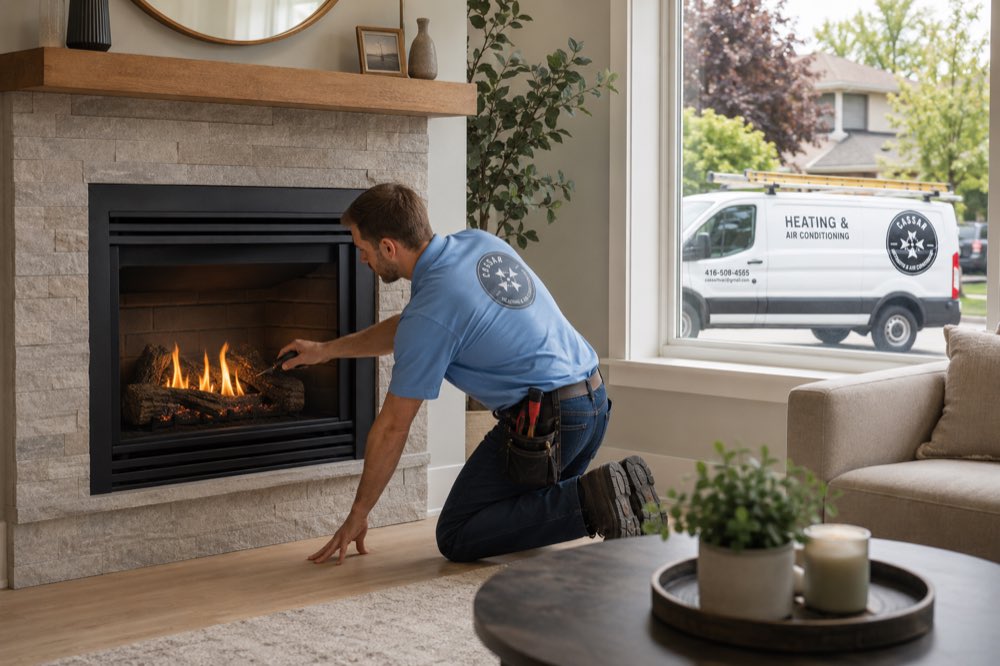
From new installs in Whitby’s growing north-end subdivisions to repairs on gas fireplaces that haven’t been touched since the house was built in the early 2000s, David handles it.
David installs gas fireplaces in Whitby homes from the ground up, including venting, gas line connection, and final commissioning. Many Whitby builders pre-rough-in a gas line near the living room wall, so David can often work with what’s already there and keep installation costs down. Every install meets current Ontario Gas Code and TSSA requirements.
David diagnoses and repairs all common gas fireplace problems, including pilot light failures, thermocouple and thermopile faults, igniter issues, and gas valve problems. He carries common parts in the van, so most Whitby repair calls wrap up in a single visit. You won’t wait a week for a part to be ordered.
If your existing fireplace is beyond economical repair, David’ll walk you through replacement options that fit your venting setup and your budget. A lot of the gas inserts installed in Whitby homes during the 2000s construction boom are now reaching the end of a reliable service life, and replacement is often the smarter call at that point. David tells you honestly which way to go.
David’s annual service includes cleaning the burner and pilot assembly, inspecting the heat exchanger, testing the thermopile output, and checking the venting for blockages or deterioration. Ontario’s long heating season puts real hours on a gas fireplace. Skipping annual maintenance is how small problems turn into expensive ones mid-winter.
Older decorative gas fireplaces vent a lot of their heat straight outside. Upgrading to a direct-vent unit with a sealed combustion chamber and a higher AFUE rating gives you noticeably more heat from the same gas. David can assess whether your current venting can support a higher-efficiency unit or whether a liner change is needed before the swap makes sense.
If your fireplace stops working on a cold night or you smell gas near the unit, call David directly at (416) 508-4585. He serves all of Whitby, from the waterfront neighbourhoods near Port Whitby to the newer streets north of Taunton Road. You’ll reach David personally, not a call centre, and he’ll tell you straight away what the response time looks like.
Since 2011, David has worked in Whitby homes ranging from the older bungalows near downtown to the newer detached houses in Williamsburg and Rolling Acres, and the fireplace problems he sees most often come down to deferred maintenance rather than equipment failure. He’d rather show you a $150 fix than sell you a $3,000 replacement you don’t need. That approach keeps homeowners calling him back, and referring their neighbours.
A gas fireplace that’s serviced annually and used regularly should give you 20 to 25 years of reliable service. Units that sit unused for months at a time and never get a maintenance visit tend to fail faster, because condensation builds up inside the burner assembly and the pilot components corrode quietly until something stops working. The ones David sees fail earliest are usually the ones that were treated as pure decoration rather than working appliances.
Ontario’s climate is hard on anything that sits dormant from April through September and then gets called back into action when the temperature drops in October. The pilot assembly in particular benefits from being exercised and cleaned before the heating season starts. A late September or early October tune-up is the most cost-effective thing a Whitby homeowner can do to add years to their fireplace.
The heat exchanger and venting components generally outlast the electronic and burner components. If David’s replacing a thermocouple or a gas valve on a 12-year-old unit in otherwise good condition, that’s a reasonable repair. If he’s looking at a 22-year-old unit with a cracked firebox liner and a failed igniter, the math usually points toward replacement.
A standard service call and diagnostic runs $120 to $180. Replacing a thermocouple or thermopile, the most common repair David does, runs $150 to $280 including parts and labour. Gas valve replacement lands between $350 and $550 depending on the unit. Annual tune-up service runs $160 to $220. These are real numbers, not minimums designed to get David in the door.
New gas fireplace installation in a Whitby home where the rough-in is already there typically runs $2,800 to $4,500 for a mid-range direct-vent unit, installed and commissioned. If new venting needs to be run through an exterior wall, add $400 to $900 depending on the route and the wall construction. High-efficiency or premium decorative units push toward $6,000 to $8,000 installed. The range is wide because the equipment options are wide, not because the labour is unpredictable.
Every job gets a free upfront quote from David before work starts. The best way to know what your specific job will cost is to get a free quote from David, no pressure, no obligation.
Whitby’s residential growth has been one of the fastest in Durham Region since the early 1990s. The bulk of the town’s housing stock consists of detached and semi-detached two-storey homes built between 1990 and 2015, primarily in subdivisions like Pringle Creek, Williamsburg, Rolling Acres, and the areas north of Highway 2. These homes were built during the period when gas fireplaces shifted from optional luxury to standard feature, so the vast majority of them have at least one gas fireplace, usually a decorative B-vent or direct-vent unit in the main living area.
The fireplaces installed in Whitby homes built in the 1990s and early 2000s are now 20 to 30 years old. That puts a large portion of Whitby’s fireplace stock at or near the end of its reliable service life. David sees more full replacements in Whitby than in the older parts of Durham Region precisely because so many units hit that age threshold at the same time. If your home was built between 1992 and 2008 and the fireplace has never been serviced, it’s worth having David assess it before it decides to stop working in February.
Whitby also has a growing number of townhouses and infill builds in areas closer to downtown and near the GO station, where space constraints sometimes affect venting options. In these tighter configurations, a direct-vent unit that draws combustion air from outside through a concentric pipe is usually the right solution, and David can confirm whether your wall placement supports that setup before you commit to any equipment purchase.
The most common warning sign David hears about from Whitby homeowners is a pilot light that keeps going out. This almost always points to a worn thermopile or thermocouple, the small sensor that sits in the pilot flame and tells the gas valve to stay open. It doesn’t happen all at once. You’ll notice the pilot going out more frequently over a few weeks before it stops staying lit at all. Don’t wait until it fails completely mid-winter to call.
White or grey residue on the inside of the glass is another sign that something’s off. Some mineral deposit from normal combustion is expected, but heavy buildup suggests incomplete combustion, which can mean a dirty burner, an air mixture issue, or a partially blocked vent. In Whitby homes near the lake or in areas with older gas infrastructure, David has also occasionally seen pressure fluctuations that affect burner performance, something that shows up as uneven flame height or a flame that repeatedly snuffs itself out.
Any smell of gas near the fireplace is a different category entirely. That’s not a troubleshooting situation. Turn the unit off, leave the area if the smell is strong, and call David or Enbridge Gas directly. A faint smell that appears only during startup and disappears quickly can be normal on some units, but if you’re uncertain, call and ask, David would rather answer a quick question than have someone ignore a real problem.
Durham Region’s heating season runs roughly from late October through April, with the coldest sustained periods typically hitting in January and February. A gas fireplace used as a supplemental heat source during those months can meaningfully reduce the load on your furnace, particularly if you turn the thermostat down a degree or two and let the fireplace handle the living area. The efficiency gain is real, provided the fireplace itself is in good working order and the vent isn’t leaking heat back out of the house.
The shoulder seasons are where maintenance timing matters. Getting your fireplace serviced in September means you’re going into October confident it’ll fire up reliably. Waiting until December, when David’s schedule fills up fast, means you might spend a few cold weeks without it if a part needs ordering. Book the annual service before the rush.
In summer, David recommends leaving the pilot lit on older millivolt-system fireplaces rather than shutting it off entirely. Relighting after a full summer of inactivity puts more wear on the igniter and the pilot assembly than continuous operation does. On newer electronic ignition units, turning the pilot off in summer is fine and saves a small amount of gas.
In Ontario, any work on a gas fireplace, including installation, replacement of gas-side components, and venting changes, must be performed by a TSSA-licensed technician. David’s TSSA licence is #000398183. This isn’t a technicality. It’s the regulatory framework that makes gas appliance work safe and legal, and it’s what your home insurer expects to see if you ever need to make a claim related to the appliance.
Carbon monoxide is the specific safety risk that comes with gas fireplaces. A blocked or deteriorating vent can push combustion gases back into the living space rather than exhausting them outside. CO is odourless, so a CO detector within 15 feet of the fireplace is the only reliable way to catch this before it becomes a health issue. David checks the vent for back-drafting and blockage during every annual service call. If there’s a CO detector in the room that’s more than seven years old, replace it, the sensors degrade over time and stop reading accurately.
Ontario’s Enbridge Home Efficiency Rebate program has offered rebates on high-efficiency heating equipment, though the availability and amounts change from year to year. A new high-efficiency gas fireplace insert with a sealed combustion chamber and a blower may qualify if it’s replacing an older decorative unit. David can tell you what documentation you’d need to submit a rebate claim after installation.
Checking the simple things before calling saves time for everyone, and one of these fixes the problem more often than you’d expect.
Most fireplace issues start with the pilot light going out. Follow the manufacturer’s relight instructions on the unit, usually hold the pilot button for 30 to 60 seconds. If it won’t stay lit after three attempts, you’re past the self-fix point.
These small sensors sit in the pilot flame and generate the signal to keep the gas valve open. If they’re worn, the pilot lights but won’t stay on. This needs a technician. David carries both components in the van and replaces them in a single visit.
There’s usually a shutoff valve behind or beneath the fireplace. Make sure it’s fully open, these sometimes get turned off accidentally during cleaning. The handle should run parallel to the pipe when it’s open, perpendicular when it’s closed.
Most modern gas fireplaces use a remote or wall switch. Weak batteries cause intermittent ignition failures before failing completely. Swap in fresh AA or AAA batteries in both the remote and the receiver unit before assuming something’s mechanically wrong.
Heavy soot or white mineral deposits on the glass can affect some sensor-based ignition systems. Clean glass also improves efficiency significantly. Use a fireplace-rated glass cleaner, not regular window spray, and make sure the unit’s fully cool before you open the glass panel.
If none of the above get it going, it needs a licensed technician. David covers all of Whitby and Durham Region and picks up the phone himself.
A gas fireplace installation in Durham Region typically runs $2,800 to $4,500 for a mid-range direct-vent unit in a home where the gas rough-in is already in place. If the venting needs to be run through an exterior wall for the first time, add $400 to $900 depending on wall construction and the route to the outside. High-efficiency or premium decorative units push toward $6,000 to $8,000 fully installed. The main variables are the unit itself, what venting work is needed, and whether any drywall or finish work is required around the surround. Labour rates in Whitby and across Durham Region are consistent in David’s work, so most of the price variation comes from equipment selection. The best way to know what your specific job will cost is to get a free quote from David, no pressure, no obligation.
Most modern gas fireplaces use direct-vent technology, which means they don’t need a traditional masonry chimney at all. A direct-vent unit draws combustion air from outside and exhausts through a concentric pipe that goes through an exterior wall or up through the roof, a much simpler installation than a wood-burning fireplace requires. B-vent fireplaces, which are older technology, need a vertical vent to the outside but still don’t need a full masonry chimney. If you’re adding a fireplace to a Whitby home that doesn’t have an existing flue, David will assess your wall placement, the route to the exterior, and any clearance requirements before recommending a venting approach. In most cases, a direct-vent solution works well and keeps the installation cost predictable.
A gas fireplace can carry a significant portion of your heating load, but whether it can serve as your primary source depends on the unit’s BTU output, your home’s insulation, and how your house is laid out. A well-sized direct-vent insert with a blower can heat an open-concept main floor effectively through a Durham Region winter. Where it gets harder is in multi-storey homes with closed-off bedrooms upstairs or basement areas that the fireplace heat can’t reach. Most Whitby homeowners who rely heavily on their gas fireplace run it in the main living area and drop the furnace thermostat by two or three degrees, rather than turning the furnace off entirely. That hybrid approach cuts gas bills noticeably without asking the fireplace to do more than it’s designed for. David can look at your specific unit and layout and tell you honestly what’s realistic.
Once a year, before the heating season starts. The TSSA and most manufacturers recommend annual maintenance, and in Ontario’s climate, that means September or early October is the right time to book it. A full service includes cleaning the burner assembly and pilot, testing the thermopile output, inspecting the heat exchanger and venting, and checking the glass seal. Many Whitby homeowners skip this for several years in a row and don’t notice a problem until the fireplace fails on a cold night, at which point a part that would have cost $60 to catch early turns into an emergency call. If your Whitby fireplace hasn’t been serviced in two or more years, it’s worth getting David in before the season rather than hoping it holds.
Start with the pilot light, if it’s out, follow the relight instructions on the unit label and hold the pilot button for 30 to 60 seconds. If the pilot lights but goes out when you release the button, the thermocouple or thermopile is likely worn and needs replacing. If the pilot won’t light at all, check that the gas supply valve behind or beneath the unit is fully open and that the remote or wall switch has fresh batteries. A lot of fireplace calls David gets in Whitby turn out to be dead batteries in the remote receiver, which is a two-minute fix. If you’ve worked through all of those and it still won’t fire up, there’s either a gas valve fault or an electronic igniter failure, both of which need David to diagnose properly with a multimeter and a manometer.
A fireplace insert slides into an existing masonry or prefab fireplace opening and converts it to gas. It’s the right solution when you have an older wood-burning or non-functional fireplace that you want to make efficient and usable without rebuilding the surround. A built-in gas fireplace is a self-contained unit installed into a framed wall opening from scratch, which is what most new Whitby homes have. It doesn’t require an existing fireplace, just a framed cavity, a gas line, and a venting path. A gas log set is a burner and decorative log assembly dropped into an existing fireplace opening, which is the lowest-cost option but also the least efficient because it still relies on an open flue. For Whitby homes with an existing masonry fireplace they want to convert, an insert is usually the right recommendation, David can assess your opening and tell you what will fit and what it’ll cost.
David services all major gas fireplace brands, including Napoleon, Valor, Regency, Heat & Glo, Majestic, Fireplace Xtrordinair, and others. He carries commonly needed parts for the most popular units in Whitby and Durham Region. For repairs on older or less common units, he’ll source the part and confirm availability before quoting the job, so you know upfront whether same-day repair is realistic or whether a part needs to come in. For new installations, David works with reputable suppliers and can help you select a unit that fits your venting configuration, your heat load, and your budget, rather than whatever one supplier happens to be pushing that month.
A properly installed and maintained direct-vent gas fireplace is designed to run for extended periods and is safe to leave on overnight if your CO detector is working and the unit is in good condition. The sealed combustion chamber on a direct-vent model means it’s drawing combustion air from outside and exhausting gases outside, so it doesn’t compete with your indoor air the way an older B-vent or open-fireplace setup would. That said, David wouldn’t leave any gas fireplace running overnight if the vent hasn’t been checked recently, if there’s any irregular flame behaviour, or if the CO detector in the room is old or hasn’t been tested. Running it on a timer so it shuts down after a few hours is a reasonable middle-ground approach. If you’re not sure whether your specific unit is designed for extended operation, call David and he can look at the model and give you a straight answer.
“Our gas fireplace in Whitby had been dead for two winters. David came out, replaced the thermopile, and it was working before he packed up his tools.”
“I called David because our fireplace kept shutting off after a few minutes. He walked me through what was likely happening on the phone before he even came out, then confirmed it in person, worn thermocouple. He had the part in the van, explained exactly what he was doing and why, and the whole thing took maybe 45 minutes. Really appreciated not being kept in the dark about what I was paying for.”
“Got three quotes for a new gas fireplace install in our Whitby home. David’s price was fair and his quote didn’t change when the job was done. He put down drop cloths, cleaned up after himself, and the install passed inspection without any issues. That’s all I wanted.”
David covers all of Durham Region, if you’re near Whitby, he can get to you.
Same-day service available. TSSA certified. Honest pricing. Call or book online.