
Ajax’s rapid growth over the past two decades has left a lot of homes, particularly the townhouses and detached builds in Westney Heights, Pickering Village, and along Bayly, without the ductwork to support a central system, making ductless heat pumps the practical choice for year-round comfort. David Cassar covers all of Ajax and Durham Region, takes same-day and emergency calls, and answers the phone himself.
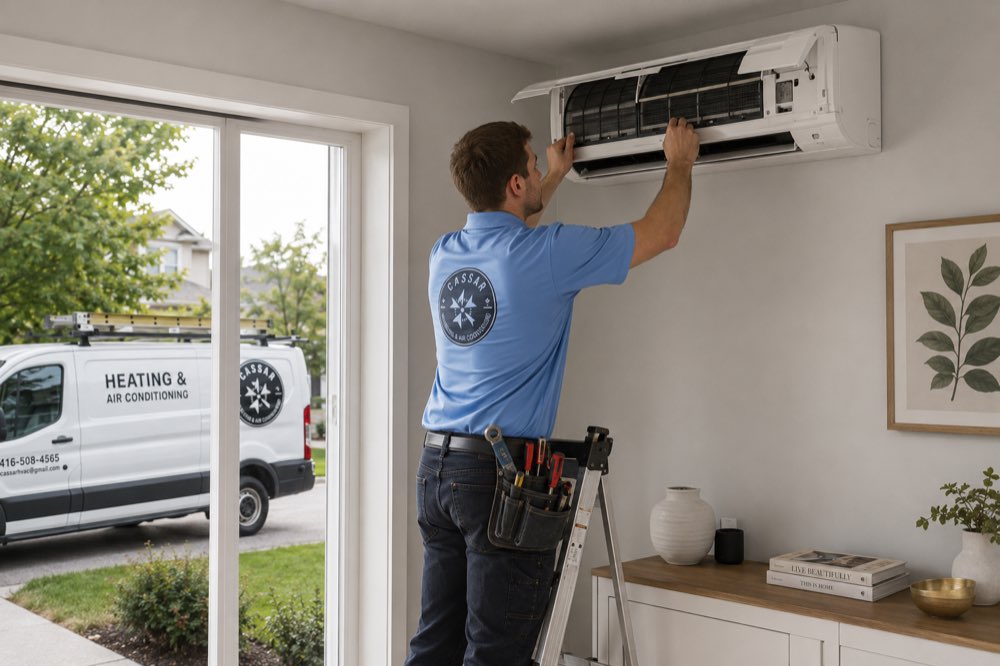
From new installations in homes that never had central air to emergency repairs when a unit stops heating mid-January, David handles every ductless job across Ajax himself.
Ajax townhouses built between 2000 and 2015, particularly in the Riverside and Pickering Village corridors, often have a single-zone gas furnace with no cooling and nowhere to add ducts without major renovation. David sizes and installs single or multi-zone ductless systems that fit the actual layout of the home, not a standard template. You get a fixed price before a single hole is drilled.
When a wall unit stops blowing warm air or the outdoor compressor won’t start, David diagnoses the actual fault rather than suggesting a replacement as the default answer. Common Ajax calls include refrigerant leaks on units a few years past warranty, failed capacitors on outdoor units after a hard winter, and boards that trip error codes. David stocks common parts and can often repair on the same visit.
If a repair isn’t worth the cost, David will tell you that directly, give you a replacement quote on the spot, and explain why. He won’t recommend a new system to hit a sales target. Replacements include full removal of the old equipment, correct refrigerant disposal, and a clean installation with no exposed line-set running across exterior walls unless it’s the only option and you’ve agreed to it.
A ductless system that doesn’t get serviced will drop efficiency and eventually fail early. David’s annual tune-up covers filter cleaning, coil inspection, refrigerant level check, electrical connection tightening, and a drain line flush. Catching a low refrigerant charge in spring costs a fraction of what a compressor replacement costs in January. David books maintenance visits across Ajax and schedules around your availability.
Older ductless units, particularly first-generation single-zone systems installed in Ajax homes around 2010, run at COP ratings well below what current cold-climate heat pumps deliver. Upgrading to a system rated for operation down to -25°C means lower hydro bills and real heat output on the coldest Ajax nights, not just a unit running at reduced capacity. David can assess whether your current installation is worth upgrading or if the linesets and electrical are already sized for a new unit.
If your ductless system is your primary heat source and it stops working in January, that’s an emergency. David takes urgent calls across Ajax and responds the same day. You reach him directly, there’s no dispatcher, no call centre routing your problem to whoever is closest. He’ll tell you on the phone what he thinks is happening, give you an honest read on how fast he can be there, and show up when he says he will.
Since 2011, I’ve worked in Ajax homes from the older bungalows near the lakefront to the newer builds off Hardwood Avenue, and the one thing I keep seeing is homeowners who got sold a system that was either oversized, undersized, or installed without thinking about where the condensate drains or how the lineset looks from the street. I fix those problems, and I won’t create new ones. When I quote a job in Ajax, that price doesn’t change when I show up.
A well-maintained ductless heat pump installed in an Ontario home typically runs for 15 to 20 years before the compressor or key electrical components make replacement more practical than repair. Units that get annual maintenance routinely hit the top end of that range. Units that never see a technician from installation to breakdown tend to fail much earlier, usually around year 10 or 11, and often from causes that would have cost under $200 to catch at a tune-up.
Ontario’s climate is genuinely hard on ductless systems. The freeze-thaw cycling through March and April stresses defrost boards and outdoor coil fins. Summer humidity pushes drain systems harder than in drier climates. A unit in Ajax running as a primary heat source through a full winter works the compressor more hours per year than the same unit in a milder climate, so compressor longevity is directly tied to whether refrigerant levels are checked and the coil stays clean.
The single biggest lifespan factor in Ontario is keeping the outdoor coil clear and allowing the defrost cycle to complete properly. Stacking snow against the outdoor unit or clearing ice manually with a sharp tool can damage fins and coil tubing permanently. David’s annual maintenance visits include a full coil inspection and advice on outdoor unit placement or clearance if something’s been installed too close to a fence or under a deck eave.
A single-zone ductless heat pump installation in Ajax typically runs between $3,500 and $6,000 installed, depending on the unit capacity, the brand, whether the electrical panel needs a new circuit, and how far the lineset needs to run from the indoor unit to the outdoor compressor. Multi-zone systems, where one outdoor unit serves two or three indoor heads, generally range from $7,000 to $12,000 or more, depending on how many zones and the complexity of routing linesets through finished walls or ceilings.
Repair costs vary widely. Replacing a capacitor or cleaning a blocked drain line sits at the low end, typically $150 to $350. A refrigerant recharge runs $250 to $500 depending on the system charge size and whether a leak repair is also needed. Control board replacements on mid-range units commonly land between $400 and $700. If the compressor fails on a unit that’s 12 years old, replacement usually makes more financial sense than a $1,200 compressor swap.
Every Ajax job David quotes gets a written price before any work starts. The quote you receive is what you pay. The best way to know exactly what your job will cost is to get a free quote from David, no pressure, no obligation.
Ajax grew very quickly from the late 1980s through the 2000s, and the result is a housing stock that’s heavily weighted toward attached townhouses and semi-detached homes, particularly in the northeast quadrant of town around Audley Road and Salem Road. These homes were built with gas furnaces and no central air. The ductwork, where it exists, was sized for heating only and often runs in a configuration that makes adding cooling through ducts impractical without major work. Ductless heat pumps solve this directly, and David has installed more of them in Ajax townhouse complexes than anywhere else in Durham Region.
One thing that comes up regularly in Ajax townhouses is lineset routing. When the interior walls are shared party walls with no exterior access, the lineset has to come out through an exterior wall on the front or back of the unit, which means the installation needs to be planned so it doesn’t look like an afterthought bolted to the side of a house. David plans the routing before the job starts and uses proper line covers on exterior runs. Strata and condo rules vary across Ajax communities, so it’s worth confirming with your property manager before booking any work on a unit you own.
Ajax also has a pocket of older homes near the lakeshore and the original downtown core, bungalows and two-storeys built from the 1950s through the 1970s, where ductless heat pumps are increasingly replacing aging oil systems or supplementing undersized electric baseboard setups. These older homes sometimes have knob-and-tube or early aluminum wiring that needs assessment before adding a 240V circuit for a heat pump. David flags those situations during a quote visit rather than discovering them on installation day.
The clearest sign something’s wrong is a wall unit that runs continuously without reaching the set temperature. In Ajax winters, where overnight lows regularly drop below -15°C in January and February, a ductless system struggling to keep a room at 20°C when it used to hold 22°C without effort usually points to a low refrigerant charge, a dirty indoor coil, or an outdoor unit that’s icing over and not completing its defrost cycle properly. These are fixable problems, but they get more expensive the longer they run.
Unusual sounds are a reliable early warning. A soft gurgling or hissing from the indoor unit often indicates refrigerant moving through a partial restriction or a developing leak. A grinding or rattling from the outdoor unit in cold weather can mean a fan motor bearing is worn. An indoor unit that drips water below the front panel indicates a blocked drain line, which happens more often in humid Durham Region summers than homeowners expect and can cause water damage to walls if left too long.
Error codes on the remote display are worth taking seriously. Most ductless systems throw a code before they fail completely. David can often diagnose the fault over the phone based on the code and the unit brand, and that saves a diagnostic trip if it turns out to be something the homeowner can clear themselves. Call (416) 508-4585 if you’re seeing a code and aren’t sure what it means.
Durham Region gets proper winters. January and February regularly see sustained temperatures below -15°C, and modern cold-climate heat pumps are rated to operate at full capacity down to about -15°C and continue heating (at reduced output) to -25°C or lower. If your unit is an older model rated only to -5°C or -10°C, it’s likely running inefficiently or not heating at all on the coldest nights, which is when you need it most. Upgrading to a cold-climate rated unit makes a measurable difference on a Durham Region heating bill.
In terms of daily use, leaving the ductless system at a consistent temperature rather than cycling it off overnight and back on in the morning is generally more efficient in Ontario’s climate. Heat pumps work most efficiently when they’re maintaining temperature rather than recovering a cold room from scratch. This is different from how gas furnaces are often operated, and it catches some homeowners off guard when their hydro bills shift.
Fall maintenance timing matters in Durham Region. Booking a tune-up in September or October, before the heating season starts in earnest, means any issues get caught before the first hard freeze. Waiting until the unit isn’t working in December means competing with every other homeowner in the same situation for a service appointment. David’s fall maintenance slots across Ajax book up, so scheduling early is worth it.
Ductless heat pumps don’t produce combustion gases, which removes the carbon monoxide risk associated with gas heating equipment. That said, electrical connections on ductless systems do carry real risk if wiring is done incorrectly. Ontario requires that ductless heat pump installations be performed by a licensed contractor. TSSA Licence #000398183 is David’s verifiable credential, you can check it on the TSSA public registry at tssa.org. Work done without a licensed technician can void manufacturer warranties and create insurance complications if a claim arises.
On efficiency, Ontario homeowners can access rebates through the Canada Greener Homes Grant and Enbridge’s Home Efficiency Rebate Plus (HER+) program for qualifying cold-climate heat pump installations. Rebate amounts change, but qualifying systems can attract between $2,500 and $6,500 depending on the equipment and your home’s energy audit status. David can point you toward the current programs during a quote visit. The rebate application is the homeowner’s responsibility, but knowing which units qualify is part of choosing the right system.
From a pure efficiency standpoint, a modern inverter-driven ductless heat pump delivers between 2 and 4 units of heat energy for every unit of electrical energy it consumes, depending on outdoor temperature. That ratio drops as temperatures fall but stays above 1.0 even at -15°C on a quality cold-climate unit, which means it’s still more efficient than electric resistance heating at Ontario’s hydro rates. David can walk through the numbers for your specific home size and Ajax heating load if you want to compare operating costs before deciding.
Checking the simple things before calling saves time for everyone, run through these quickly before picking up the phone.
Confirm the mode is set to Heat, the temperature is set above room temperature, and the remote has fresh batteries. Wrong mode is the most common ductless issue.
Ductless systems have separate breakers for the indoor air handler and outdoor compressor. Check both in your electrical panel.
Ductless filters are inside the indoor wall unit behind the front panel. Slide it out and rinse it under water, these block up faster than furnace filters.
Clear any snow, ice, or debris blocking the outdoor unit. A fully iced-over unit needs a technician, don’t attempt to remove ice manually.
Ductless remotes have many modes. Confirm the display shows the heat icon, not a water droplet (dry mode) or fan symbol.
If none of the above resolves it, the system needs a licensed technician. David serves all of Ajax and Durham Region and picks up the phone himself.
Yes, and current cold-climate models work well even at Durham Region’s lowest winter temperatures. Modern inverter-driven heat pumps from manufacturers like Mitsubishi, Daikin, and LG are rated to operate at full capacity down to around -15°C and continue providing heat at reduced output to -25°C or colder. That covers the vast majority of Ajax winter nights, including the cold snaps that push overnight lows into the -20s in January and February. The technology has changed substantially in the last decade, older units rated only to -5°C gave heat pumps a reputation for struggling in Ontario winters that current equipment doesn’t deserve. If your existing ductless unit is older than eight or ten years, it may genuinely not perform well in the cold. A newer cold-climate system will. David can assess your current unit and tell you whether it’s the equipment or something else causing the heating shortfall.
A single-zone ductless heat pump installation in Durham Region typically runs between $3,500 and $6,000 installed. Multi-zone systems serving two or three rooms from one outdoor unit generally range from $7,000 to $12,000 or higher depending on the number of indoor heads and how complex the lineset routing is. Several factors move the number up or down: the brand and efficiency rating of the equipment, whether your electrical panel needs a new 240V circuit, how far the lineset has to run from the indoor unit to the outdoor compressor, and whether any wall penetrations require patching or sealing. Ajax townhouse installations sometimes add cost if interior routing is blocked by shared walls and the lineset needs to be run along an exterior wall with a line cover. Every job David quotes in Durham Region gets a written price before work starts, and that number doesn’t change on the invoice. The best way to know what your specific job will cost is to get a free quote from David, no pressure, no obligation.
The right number of indoor heads depends on your home’s layout, insulation level, window area, and how you actually use the space. A single well-positioned head can typically condition 500 to 800 square feet of open-plan space effectively. A multi-storey Ajax home where the bedrooms are on a different floor from the living area usually needs at least two zones to handle both comfortably. Older Ajax bungalows near the lakeshore with minimal insulation and large windows may need a unit sized up from what the square footage alone suggests. David does a proper load assessment on every installation quote rather than just counting rooms and guessing. One thing to know: a single outdoor unit can serve multiple indoor heads on a multi-zone system, which keeps the footprint of the outdoor equipment small, important on properties with limited yard space or HOA restrictions on visible equipment.
Yes, and this is one of the primary reasons Ajax homeowners choose ductless systems. A ductless heat pump runs in both heating and cooling modes, so you’re buying one system that replaces what would otherwise require both a furnace supplementation plan and a central air conditioner. In cooling mode, a ductless unit functions like a very efficient air conditioner, it pulls heat out of the room and rejects it outside. In heating mode, it reverses that process, extracting heat energy from outdoor air and bringing it inside. The switch between modes takes one button press on the remote. For Ajax townhouses that have gas heat but no central cooling, this is typically the most cost-effective way to add cooling without touching the existing ductwork. David has installed ductless systems in Ajax specifically for cooling-only use as well, particularly in upper floors that existing ducts don’t reach adequately.
Ontario homeowners can currently access rebates through two main programs for qualifying ductless heat pump installations. The Canada Greener Homes Grant offers up to $5,000 for qualifying cold-climate heat pumps, with the amount tied to your home’s pre- and post-retrofit energy model, which requires a registered energy advisor assessment. The Enbridge Home Efficiency Rebate Plus (HER+) program offers rebates for homeowners switching from gas heating to a heat pump system, with amounts that vary based on the equipment and your existing heating setup. Rebate programs change their terms and available funding periodically, so the exact amounts available when you’re booking your installation may differ from what’s listed here. David can point you to the current program details during a quote visit. The application itself is the homeowner’s responsibility, but knowing which systems qualify matters when you’re choosing equipment, and David factors that into his recommendations. The best way to find out what applies to your specific Ajax home is to get a free quote from David, no pressure, no obligation.
A standard single-zone ductless installation in an Ajax home takes most of one day, typically four to six hours from arrival to a running system. That includes mounting the indoor air handler, positioning and securing the outdoor unit, running and connecting the lineset through the wall, making the electrical connections, vacuuming the refrigerant lines, and commissioning the system to confirm it’s operating at the correct pressures and temperatures. Multi-zone installations with two or three indoor heads take longer, usually six to eight hours or a full day and a half depending on how complex the routing is. Homes with difficult lineset paths, through finished basements, across attic spaces, or along exterior walls requiring line covers, add time. David gives you a realistic time estimate during the quote so you know what to plan for. He’ll confirm the appointment time the day before and show up when he says he will.
Start with the remote: confirm the system is in Heat mode and the set temperature is above the current room temperature. Wrong mode is the most common cause of a ductless unit that runs but doesn’t heat. Next, check both circuit breakers, the one for the indoor air handler and the separate one for the outdoor compressor, since tripping one while the other stays on creates a system that appears to be running without actually heating. Clean or rinse the indoor filter, because a clogged filter can cause the unit to go into a protective low-airflow shutdown. Then look at the outdoor unit: if it’s completely encased in ice and the defrost light is flashing, it needs a technician. In Ajax in winter, outdoor units can ice over if the defrost cycle is malfunctioning, and that’s not something to try to solve manually. If you’re seeing an error code on the display, call David at (416) 508-4585, he can often narrow down the fault on the phone based on the code and the unit brand, which saves a trip if it turns out to be something simple.
David installs and services ductless systems from all major brands, including Mitsubishi, Daikin, LG, Fujitsu, Carrier, and Lennox. He also repairs and maintains existing systems regardless of who installed them or what brand they are. For new installations, David recommends equipment based on what actually suits the home and the budget, he’s not locked into a single brand relationship that would push him toward one manufacturer regardless of fit. If you already have a brand preference or a unit you’ve researched, he’ll give you an honest read on it. For Ajax homeowners looking for cold-climate performance at a competitive price point, he’ll usually point toward a few specific models that have shown reliability through Durham Region winters, and he’ll explain exactly why those and not something else. Call (416) 508-4585 or book online to talk through what makes sense for your home.
“The ductless unit in our Ajax townhouse stopped heating in January. David diagnosed a failed defrost board and had it fixed the same day.”
“I called David about adding a ductless system to our second floor, we have gas heat downstairs but the bedrooms have always been brutal in summer. He came out to Ajax, looked at the layout, and pointed out that the lineset would need to run along the back exterior wall, showed me exactly what the cover would look like, and gave me a fixed price on the spot. No surprises on install day, which I honestly wasn’t expecting after dealing with other contractors.”
“Quoted me less than two other Ajax contractors, showed up on time, put down mats before bringing anything through the front door, and the price on the invoice matched what he told me on the phone. The whole installation was done by early afternoon.”
David covers all of Durham Region, if you’re near Ajax, he’s near you.
Same-day service available. TSSA certified. Honest pricing. Call or book online.