
Pickering’s housing stock runs the full range, from 1970s and 80s builds in Rosebank and Dunbarton with oversized duct systems to newer subdivisions in Duffin Heights where builders are already spec’ing cold-climate heat pumps, and David’s been sizing and servicing equipment across all of it since 2011. He covers all of Pickering and the rest of Durham Region, picks up the phone himself, and can often get there the same day.
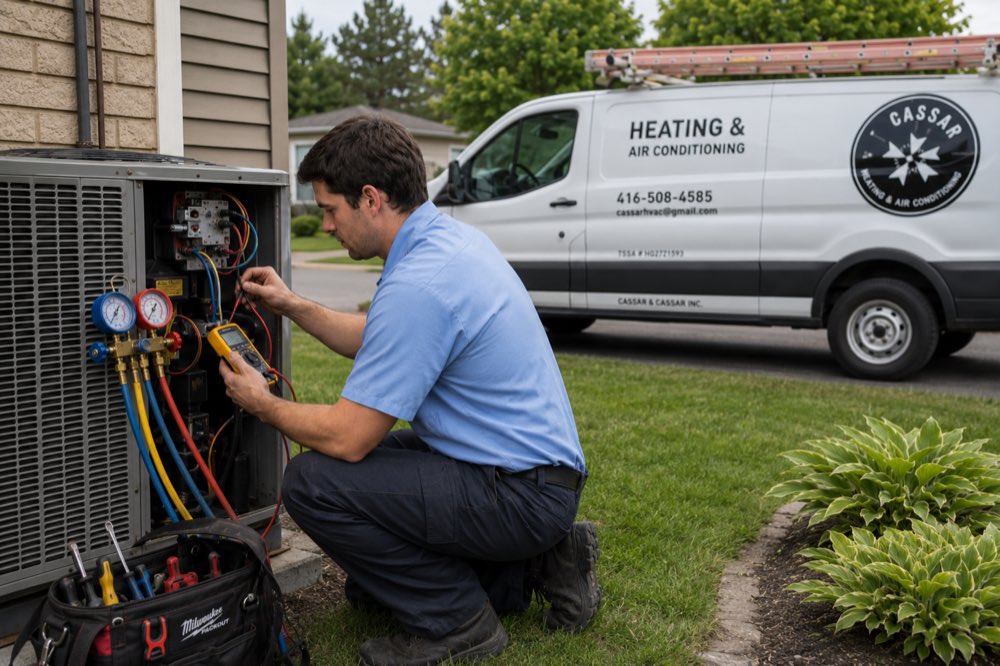
From a first-time installation to an emergency call on a February morning, David handles every stage of heat pump work across Pickering.
David sizes every system to the actual load of your home, not just the square footage on the listing sheet. Duffin Heights new-builds often benefit from cold-climate models rated down to -25°C, while older homes in the Liverpool area sometimes need duct modifications before the system performs correctly. You get a written quote before anything is touched.
When a heat pump stops heating or cooling, David diagnoses it the same visit. He carries common parts, so most repairs don’t require a return trip. If the fix is straightforward, he explains it clearly. If the unit’s at the end of its life, he’ll tell you that too, without steering you toward a replacement you don’t need.
When it’s time to replace, David helps you choose the right unit for Pickering’s climate, not just whatever’s in stock at the distributor. He handles the full swap, including refrigerant recovery on the old unit, proper disposal, and commissioning the new system. He’ll also flag any rebates you qualify for through the Canada Greener Homes Grant or Enbridge programs before the job starts.
A heat pump that runs year-round accumulates wear faster than a system used only seasonally. David’s annual tune-up covers coil cleaning, refrigerant charge verification, electrical connection checks, and a full run-through of the defrost cycle. It keeps efficiency where it should be and catches problems before they become breakdowns in January.
Pickering homeowners switching from gas or electric baseboard to a modern heat pump can see meaningful reductions in monthly heating costs, especially with Ontario’s electricity rates and available federal rebates. David walks through the numbers with you before you commit. An upgrade only makes sense if it actually pays off for your household.
Heat pump failures don’t schedule themselves. When yours stops working on a cold night, David picks up the phone. He serves all of Pickering and gets to most calls the same day. You won’t reach a call centre or a dispatch queue, you’ll reach David directly, and he’ll tell you honestly whether it’s something you can address right now or whether it needs a part.
I’ve worked on heat pumps in pretty much every neighbourhood in Pickering since 2011, from the waterfront townhomes near the GO station to the detached homes on Bay Ridges and the newer subdivisions being built out west near Seaton. What I see consistently is that homeowners want straight answers, not a sales pitch. That’s what I give you, a clear diagnosis, a written price, and work done the way I’d want it done in my own house.
I’m TSSA licensed (#000398183) and insured. You can verify that licence on the TSSA website before you call.
A well-maintained heat pump in Ontario typically lasts between 15 and 20 years. The range depends on the brand, how hard it runs, and whether it gets annual maintenance. A unit that runs year-round as a sole heating and cooling source degrades faster than one supplemented by a gas furnace in a dual-fuel setup.
Ontario’s climate shortens lifespan in specific ways. The freeze-thaw cycling we get through late fall and early spring puts repeated stress on the defrost system and outdoor coil. Units that never get their coils cleaned accumulate debris that forces the compressor to work harder than it should. That compressor is the most expensive component in the system, and it’s the one that ends the unit’s life when it fails.
The single biggest thing you can do to extend lifespan is annual maintenance before the heating season. That means coil cleaning, checking refrigerant charge, and verifying the defrost cycle runs correctly. A heat pump that gets that attention regularly will hit 18 to 20 years. One that doesn’t often starts causing problems at year 10 or 11.
A heat pump installation in Pickering typically runs between $4,500 and $9,000 for a standard ducted system, depending on the size of your home, the unit’s efficiency rating, and whether the existing ductwork needs modification. Cold-climate models with higher HSPF ratings sit at the upper end of that range but qualify for larger rebates, which can shift the math significantly.
Repair costs are a different picture. A refrigerant recharge and leak fix might run $300 to $700. Replacing a reversing valve, which is one of the more common repair jobs, runs $400 to $900 including labour. A failed compressor is expensive, typically $1,200 to $2,000 installed, and at that price point it’s worth comparing the repair cost to what a new unit would cost and what rebates you’d qualify for.
Annual maintenance sits around $150 to $200 for a standard tune-up. Every job David quotes starts with a free visit and a written price. The best way to know what your specific job will cost is to get a free quote from David, no pressure, no obligation.
Pickering’s housing stock is unusually diverse by Durham Region standards. The Bay Ridges and Liverpool areas contain a large proportion of 1970s and early 1980s builds, many with duct systems sized for the lower airflow requirements of older furnaces. Installing a modern heat pump without evaluating the duct sizing first leads to a unit that can’t deliver rated capacity, particularly on the coldest days. David runs a duct assessment before any installation in these neighbourhoods.
The Duffin Heights and Seaton areas are on the opposite end. New-build homes there were often constructed with higher insulation values and tighter envelopes than older Pickering homes, which changes the load calculation substantially. A heat pump sized for a 1980s split-level in Dunbarton would be significantly oversized for a 2020 build in Seaton. Oversized systems short-cycle, which reduces efficiency and wears out components faster.
The waterfront townhomes and condos near the Pickering GO station present a third scenario. Many are electric-only, with no gas connection, which makes heat pumps particularly practical. Some of these units also have limited mechanical room space, which affects what models physically fit. David’s worked in enough of these buildings to know what fits and what doesn’t before ordering equipment.
The most common early warning sign is a heat pump that runs constantly without reaching the set temperature. In Durham Region winters, a heat pump working harder than usual is sometimes normal below -10°C, but if it’s struggling at 0°C, something is wrong. The usual culprits are a low refrigerant charge from a slow leak, a dirty coil reducing heat transfer, or a reversing valve that’s partially stuck.
Ice on the outdoor unit beyond a light frost is another one. Some frost accumulation is built into how heat pumps work, and the defrost cycle clears it automatically. A unit that’s completely encased in ice hasn’t been defrosting properly. That’s often a failed defrost board, a bad outdoor temperature sensor, or a refrigerant issue. Leaving it running in that state puts the compressor at risk.
Unusual sounds, a grinding from the outdoor fan, a rattling on startup, or a repeated clicking that doesn’t result in the system running, all point to specific mechanical problems. Don’t ignore sounds that weren’t there last season. Pickering homeowners who catch these things early almost always pay less for the repair than those who wait until the unit stops entirely in January.
Durham Region’s winters average well below -10°C on the coldest nights, and while modern cold-climate heat pumps handle that, efficiency drops as the temperature falls. If you have a dual-fuel setup with a gas furnace as backup, setting the switchover point at around -10°C to -15°C tends to balance efficiency and comfort well. Running the heat pump below its rated threshold just to avoid using gas usually costs more, not less.
Keep the outdoor unit clear of snow and ice buildup. A heat pump that can’t pull air through the outdoor coil can’t transfer heat. After a heavy snowfall, clear snow from around the base of the unit and make sure the exhaust isn’t blocked. Don’t put a cover on the unit in winter, it needs to run, and covers trap moisture.
Filter changes matter more with a heat pump than they do with a furnace, because the system runs in both heating and cooling seasons. A blocked filter in August is just as damaging as one in February. Check the filter monthly and replace it at least every three months during heavy-use periods. It’s the cheapest maintenance task and the one that has the most immediate impact on performance and energy use.
Heat pumps themselves don’t produce combustion gases, so carbon monoxide isn’t a direct concern with the heat pump unit. If you have a dual-fuel setup with a gas furnace, the CO risk lives with the furnace, not the heat pump. Make sure your CO detector is within 15 feet of the sleeping area as Ontario’s Fire Code requires, and have the furnace inspected annually even if the heat pump is doing most of the heating work.
On the efficiency side, Ontario homeowners can access meaningful rebates. The Canada Greener Homes Grant offers up to $5,000 for heat pump installations, provided you complete a pre- and post-retrofit EnerGuide evaluation. Enbridge also offers rebates for homes transitioning away from natural gas. These programs change, so confirm current amounts before you plan the budget, but most Pickering homeowners installing a new cold-climate heat pump qualify for something.
Under Ontario regulations, any technician handling refrigerants must hold the appropriate TSSA certification. David holds TSSA Licence #000398183, you can verify this directly on the TSSA public register. Hiring an unlicensed technician to handle refrigerant isn’t just a safety issue; it voids most equipment warranties and can create liability problems if something goes wrong.
Checking the simple things before calling saves time for everyone.
Heat pumps require the thermostat to be set to Heat, and the temperature must be above what the room currently reads. Also confirm the system mode isn’t set to Emergency Heat unless you actually need backup, Emergency Heat bypasses the heat pump entirely and runs on the more expensive backup element.
Heat pumps have two circuit breakers: one for the air handler inside and one for the outdoor unit. Both must be on for the system to run. A tripped breaker on just one side can leave the indoor unit running but produce no heating or cooling. Reset any tripped breaker once. If it trips again immediately, stop and call.
Some frost on the outdoor unit is normal in winter. A unit completely encased in ice is not. This indicates a defrost issue, not something that will clear on its own. Don’t chip at the ice. Turn the system off and call Cassar. Running the unit while it’s fully iced forces the compressor to work against blocked airflow.
A blocked filter forces the heat pump to work harder and can trigger safety shutoffs that shut the whole system down. Pull the filter, hold it up to the light. If you can’t see through it, replace it. Then run the system again and see if performance improves. This is the most common avoidable service call David gets.
If your heat pump is blowing cool air in heating mode, the reversing valve may be stuck in cooling mode, or the thermostat may be sending the wrong signal. This isn’t something you can fix yourself. It needs a technician to test the valve solenoid and check the control wiring. It’s a known failure point on heat pumps that have been running for several years.
If none of the above sorted it, it needs a licensed technician. David covers all of Pickering and Durham Region, picks up the phone himself, and can often come the same day.
Yes, modern cold-climate heat pumps work well in Ontario winters, including the coldest nights Durham Region gets. Older heat pump technology lost efficiency quickly below 0°C and was essentially useless below -10°C. That’s not true of current cold-climate models rated for operation down to -25°C to -30°C. These units maintain meaningful heating output even when temperatures drop into the low minus teens, which covers the vast majority of Pickering’s winter nights. Where you do lose efficiency compared to summer conditions is on those extreme nights below -15°C. In a dual-fuel setup, the gas furnace handles those hours and the heat pump does everything else. For an all-electric home, a cold-climate unit with a resistance backup element handles the full heating load. The economics still work out well for most homeowners, particularly with current electricity rates and available rebates. I’ve been installing and servicing these systems across Durham Region since 2011 and the performance gap between old-generation and current equipment is significant.
It depends on three things: your current equipment’s age, your heating costs, and whether you want to eliminate gas or keep it as a backup. If your furnace is under 10 years old and running well, the math on replacing it with a heat pump right now often doesn’t pencil out unless you’re also replacing an aging central air conditioner. In that case, a heat pump does both jobs, which changes the calculation entirely. If your furnace is approaching 15 or 20 years old and you’re also in the market for air conditioning, a heat pump replacement is worth taking seriously. A dual-fuel setup, where you keep a gas furnace as backup for the coldest nights and let the heat pump handle everything else, is a common and practical solution for Pickering homeowners who want the efficiency benefits without fully committing to electric heat. For all-electric homes near the Pickering waterfront or in newer Duffin Heights builds with no gas connection, a heat pump is often the best option already available. I’m happy to walk through the numbers for your specific home before you decide. The best way to know what your specific job will cost is to get a free quote from David, no pressure, no obligation.
For a standard ducted heat pump installation in Durham Region, you’re typically looking at $4,500 to $9,000 installed, before rebates. The main factors that move the price are the size of the unit (measured in tons of capacity, based on your home’s heating and cooling load), the efficiency rating (higher HSPF and SEER2 ratings cost more upfront but qualify for larger rebates), and whether your existing ductwork needs modifications. Homes in Pickering’s older Liverpool and Bay Ridges neighbourhoods sometimes need duct work to handle the airflow a heat pump requires, which adds cost. Homes in newer subdivisions like Duffin Heights often have duct systems that work as-is. After federal rebates through the Canada Greener Homes program, the net cost for qualifying installations can drop by $2,500 to $5,000. That math changes the comparison to a standard air conditioner or furnace significantly. Every quote David provides is written and specific to your home, not a ballpark based on square footage. The best way to know what your specific job will cost is to get a free quote from David, no pressure, no obligation.
Ontario homeowners installing a qualifying heat pump can access rebates from two main sources right now. The Canada Greener Homes Grant offers up to $5,000 for heat pump installations, but it requires a pre-retrofit EnerGuide home evaluation before the work starts and a post-retrofit evaluation afterward. If you skip the pre-evaluation, you lose eligibility. The process takes some planning, but for an installation that costs $6,000 to $8,000, getting $5,000 back makes it worth doing properly. Enbridge also offers rebates for homeowners transitioning away from natural gas, which can add several hundred to over a thousand dollars depending on the specific program terms at the time of application. Both programs have eligibility requirements around the unit’s efficiency rating, so not every heat pump qualifies. David checks current eligibility before every installation quote so you know exactly what you’re getting back before you commit. Rebate amounts and program terms change, so confirm the current figures when you call. The best way to know what your specific job will cost is to get a free quote from David, no pressure, no obligation.
Most heat pump installations take one full day, typically six to eight hours. That covers removing the old equipment if there is any, setting the outdoor unit, connecting the refrigerant lines, wiring the system, and commissioning it to confirm everything runs correctly before David leaves. Installations that involve duct modifications or electrical panel upgrades take longer, sometimes spilling into a second day. The refrigerant line set needs time to be properly purged, pressurized, and leak-checked before the system gets charged, and that process can’t be rushed. David books installations with enough time to do the job properly rather than squeezing it into a half-day slot. He’ll give you a realistic timeline when he quotes the job, and if anything changes on site, he’ll tell you before it affects the schedule. He also cleans up thoroughly before he leaves, including any packaging and old equipment removed from your home.
Start with the thermostat: confirm it’s set to Heat mode and the set temperature is higher than the current room temperature. Then check both circuit breakers, the one for the indoor air handler and the one for the outdoor unit. Both need to be on. Next, look at the outdoor unit. If it’s completely encased in ice rather than just lightly frosted, the defrost cycle has failed and the unit won’t heat properly until that’s resolved. Check your air filter while you’re at it, a completely blocked filter can trigger a safety shutoff that stops the system entirely. If none of those fix it, and the system is running but blowing cool air in heating mode, the reversing valve is the likely culprit. It either hasn’t switched fully to heating mode or the thermostat isn’t sending the right signal to it. That requires a technician to diagnose properly. For Pickering homeowners, David can usually get there the same day. Call (416) 508-4585 and you’ll reach him directly.
Yes, cold-climate heat pumps are what David installs for most Pickering homeowners who want to heat through the winter without a gas backup. These are units rated for operation down to -25°C to -30°C, which means they deliver useful heat on every night Pickering actually gets rather than giving up at the first cold snap. Brands like Mitsubishi’s Hyper Heat, Bosch, and Carrier’s Greenspeed line are among the options David works with, sized and selected based on your home’s actual heat loss calculation, not a generic square footage estimate. Cold-climate models sit at the higher end of the price range, but they also qualify for the maximum rebate tiers under the Canada Greener Homes program. For a home in Duffin Heights or a newer Pickering build with a well-insulated envelope, these units often cover the full heating load without any gas backup at all. David will tell you honestly whether that applies to your home or whether a dual-fuel setup makes more sense.
A heat pump cools your home in summer exactly the way a central air conditioner does, because mechanically it’s the same process run in reverse. The reversing valve switches the refrigerant flow direction so the indoor coil absorbs heat from your home and the outdoor unit rejects it outside. Cooling performance is rated in SEER2, just like a standard air conditioner, and modern heat pumps hit efficiency ratings that match or exceed standalone central air units. For Pickering homeowners who are replacing an aging central air conditioner anyway, this is one of the strongest arguments for choosing a heat pump over a standard AC. You get the same summer cooling you’d get from an AC, plus full heating capacity in winter, from one piece of equipment. The only real caveat is that heat pumps don’t drop below a certain outdoor temperature efficiently during cooling mode either, but Pickering summers rarely push that limit. On the hottest days, a properly sized cold-climate heat pump handles the cooling load without issue.
“Our heat pump stopped defrosting and the outdoor unit was completely iced over. David came out to our Pickering home the same afternoon, diagnosed a failed defrost board, and had it fixed before dinner.”
“I called David because my heat pump was running but barely keeping the house warm. He came out to our place in Duffin Heights, checked the refrigerant charge, found a small leak at one of the fittings, and repaired it on the spot. He explained exactly what he was doing and what it would cost before he touched anything. That kind of straightforwardness is hard to find.”
“Got three quotes for a new heat pump installation in my Liverpool area home. David’s quote was the only one that actually broke down what I was paying for. The price he quoted was the price on the invoice. He laid tarps on the floor before bringing equipment in and left the utility room cleaner than he found it. That level of care matters when someone’s working in your house.”
David covers all of Durham Region, including these communities.
Same-day service available. TSSA certified. Honest pricing. Call or book online.