
Orono’s mix of 1970s and 1980s rural homes and newer infill builds on the village edges means heat pump sizing and ductwork compatibility vary a lot from one street to the next, David’s seen it all since 2011 and he sizes every job to the actual house. He serves all of Clarington and Durham Region, picks up the phone himself, and can often get to you the same day you call.
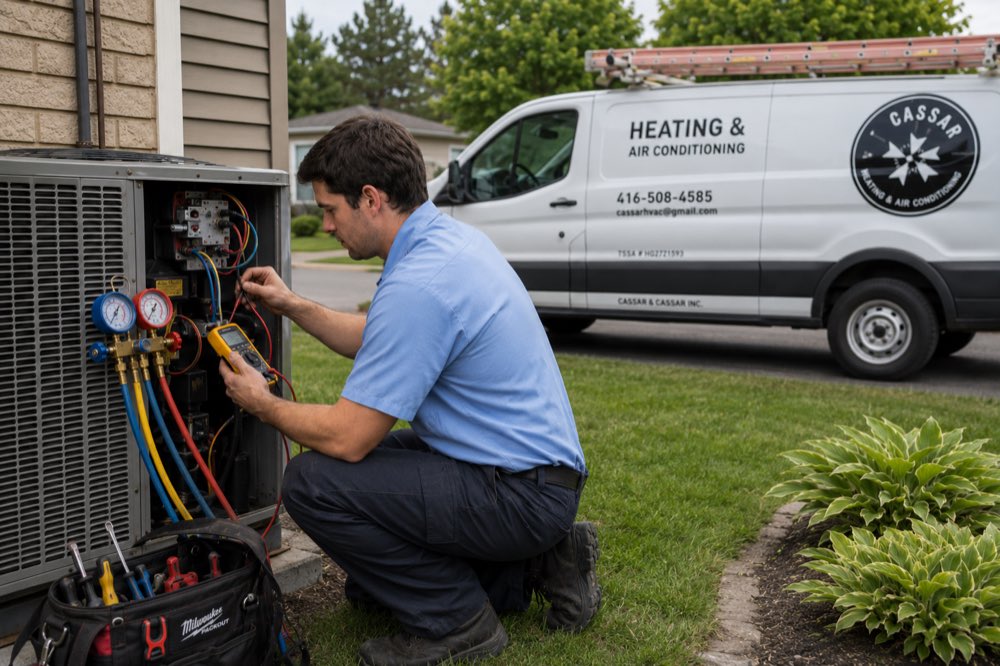
From new installations to emergency repairs, David handles every heat pump job in Orono personally, no subcontractors, no surprises.
David sizes every installation to the actual house, not a square-footage rule of thumb. Many of Orono’s older village homes have undersized duct runs originally built for a mid-efficiency furnace, and a mismatched heat pump installation creates airflow problems from day one. He’ll calculate the load, confirm the ductwork capacity, and install a unit that actually fits.
When your heat pump stops doing its job mid-January, you need someone who picks up the phone, not a call centre. David diagnoses the problem himself, carries common parts on his truck, and repairs most issues on the first visit. If your system needs a part he doesn’t have with him, he’ll source it fast and get back to you without delay.
If your heat pump is ten or more years old and starting to cost you more in repairs than it’s worth, replacement may save you money over the next few years. David will give you an honest read on whether repair or replace makes more financial sense before anything gets priced. He won’t recommend a new unit if the old one has a few good years left.
A heat pump that hasn’t been serviced in two or three years loses efficiency quietly, you won’t notice it until the hydro bill climbs. David’s annual tune-up covers coil cleaning, refrigerant checks, electrical connections, defrost cycle testing, and filter inspection. Most Orono homeowners book in the fall before the heating season starts.
Upgrading to a cold-climate heat pump that maintains rated output down to minus 25°C makes a real difference in Clarington winters. David installs models from proven manufacturers and walks you through the available Ontario rebates before you decide. A modern unit can cut your heating costs significantly compared to a standard electric system or older heat pump.
Orono sits at the north end of Clarington where January temperatures regularly drop to minus 20°C or colder, a heat pump failure overnight isn’t something you wait on until Monday. David takes emergency calls personally. You’ll speak to him directly, he’ll talk you through what he’s likely looking at, and he’ll get there as quickly as the roads allow.
I’ve been doing heat pump work in Orono since 2011, and I’ve noticed that a lot of homes here still have original ductwork from when natural gas was the only game in town, running a heat pump through those ducts without checking static pressure first is a mistake that shows up in your comfort and your hydro bill. I check before I commit to anything. Every quote I give is the price you pay.
A well-maintained heat pump typically runs reliably for 15 to 20 years. The lower end of that range usually applies to units that skipped annual servicing, ran for years with a dirty coil or restricted airflow, or were installed without a proper load calculation, meaning they cycled on and off more than they should have and wore out their components faster. The upper end is achievable if the system was properly sized from the start and got a tune-up every year or two.
Ontario’s climate puts heat pumps through a wider swing of conditions than most, long cold winters with extended periods below minus 15°C, humid summers, and freeze-thaw cycles that stress refrigerant lines and outdoor unit housings. That means defrost cycle performance matters more here than it does in milder climates. If the defrost cycle isn’t clearing ice properly each winter, the coil takes a beating and refrigerant pressures climb outside their design range. David checks defrost operation as part of every tune-up specifically because Ontario winters demand it.
If your heat pump is approaching 12 to 14 years old and you’re starting to see higher repair bills, it’s worth having a conversation about whether continuing to repair makes sense. David will give you an honest read based on the condition of the unit, not on what generates the bigger job.
A new heat pump installation in Orono typically runs between $4,500 and $9,500, depending on the size of the unit, the efficiency rating, whether ductwork modifications are needed, and how accessible the installation site is. A straightforward swap of an existing heat pump on an already-compatible air handler sits at the lower end. A first-time heat pump installation in a home that previously ran a gas furnace only, requiring electrical panel upgrades and new refrigerant line sets, pushes toward the higher end.
Repairs vary widely. A capacitor or contactor replacement is a few hundred dollars. A refrigerant recharge runs $300 to $700 depending on the quantity needed. A reversing valve replacement, one of the more involved heat pump repairs, can reach $800 to $1,200 with labour. If a compressor fails on an older unit, that repair often costs more than a replacement, which is why David always walks you through the numbers before you decide.
Annual maintenance runs $150 to $200 and is the single best way to avoid a repair bill that’s ten times that. Every job, installation, repair, or tune-up, gets a free upfront quote from David before anything starts. The best way to know what your specific job will cost is to get a free quote from David, no pressure, no obligation.
Orono is a small village within Clarington with a housing stock that skews older, a meaningful portion of the homes here were built between the late 1960s and the mid-1980s, when natural gas heating was the standard and ductwork was sized accordingly. Those duct systems were designed for furnaces with higher static pressure tolerance. Heat pumps, especially modern variable-speed units, work best with lower static pressure and good airflow distribution. Running a new heat pump through an older duct system without checking the numbers first creates uneven heating, reduced efficiency, and potential coil icing in shoulder-season temperatures.
There’s also a segment of Orono’s housing stock that has no ductwork at all, older homes heated with baseboards or radiant systems. For those properties, a ductless mini-split heat pump is the practical answer. David installs both ducted and ductless systems and can advise which configuration suits the house. He won’t recommend a ducted installation in a home where the existing duct system would compromise performance.
The village’s rural location at the north edge of Clarington also means slightly colder average winter temperatures than areas closer to the lakeshore. That makes cold-climate heat pump specifications important here, a unit rated to deliver full capacity only down to minus 8°C will underperform during Orono’s coldest stretches. David specifies equipment that’s rated for the actual climate conditions where you live.
The most common early warning sign is a change in how the system sounds. A healthy heat pump runs with a consistent, relatively quiet hum. Grinding or rattling from the outdoor unit usually means a failing fan motor bearing or a piece of debris caught in the fan blade assembly. A hissing or bubbling sound from the refrigerant lines often means a leak. Either of these gets worse quickly if left alone.
In Orono’s winters, watch for the outdoor unit completely encasing in ice and not clearing during the normal defrost cycle. Some frost on the outdoor coil is normal and expected, the unit goes into defrost mode periodically to melt it. A unit that stays iced over for hours or doesn’t defrost at all has a problem, either with the defrost control board, the reversing valve, or a refrigerant issue affecting operating pressures. Durham Region’s wet, cold winters make this the single most common heat pump complaint David sees between December and February.
Short cycling, the system turning on and shutting off again every few minutes without completing a full heating cycle, usually points to a refrigerant charge issue, a failing compressor, or an airflow restriction. Short cycling accelerates compressor wear, so it’s worth a call sooner rather than later. If your heating bill has climbed noticeably without a corresponding drop in outdoor temperature, that’s often the first sign something is working harder than it should be.
Durham Region’s winters regularly test heat pumps in ways that more temperate climates don’t. The most important thing you can do is keep the outdoor unit clear. Snow accumulation around the base of the unit restricts airflow and can push the system into a fault state. After heavy snowfall, clear a 30cm perimeter around the unit and make sure the top is free of ice build-up. Don’t use a sharp tool to chip ice off the coil, let the defrost cycle do the work or call David if it isn’t clearing.
Filter changes matter more than most homeowners realize. A clogged filter doesn’t just reduce comfort, it reduces airflow across the indoor coil, which drives up operating pressures and makes the compressor work harder. In a heating climate like Durham Region’s, a blocked filter in January means the system may switch to emergency heat mode, which is far more expensive to run. Checking the filter monthly during peak heating season costs nothing.
If your system has a dual-fuel setup pairing a heat pump with a gas furnace backup, confirm your switchover temperature is set correctly. Most dual-fuel systems in Ontario should hand off to the gas furnace somewhere between minus 10°C and minus 15°C, depending on the heat pump’s rated cold-weather output. A switchover set too high means the gas furnace kicks in unnecessarily; set too low and the heat pump runs outside its efficient operating range. David sets this correctly during installation and can adjust it on a service call if the original setting doesn’t match the unit’s specs.
Heat pumps themselves don’t produce combustion gases, so there’s no carbon monoxide risk from the heat pump unit directly. If your system uses a gas furnace as a backup heat source in a dual-fuel setup, that furnace still requires annual safety inspection and working carbon monoxide detectors on every level of the home. Ontario’s Building Code requires CO detectors in all homes with attached garages or fuel-burning appliances, if you’re unsure yours are positioned correctly or still working, check them when you book your annual heat pump tune-up.
All heat pump installation and refrigerant handling in Ontario requires a TSSA-licensed contractor. Refrigerant work done without proper licensing puts you in a difficult position with your home insurer and creates a liability gap on any warranty claim. David holds TSSA Licence #000398183, you can verify it directly on the TSSA website before you book anything.
Ontario’s Greener Homes Grant program has offered rebates of up to $6,500 for eligible heat pump installations, and the Canada Greener Homes Loan provided additional financing. Program details and availability change, so confirm current offerings at canada.ca/greener-homes before you commit to a purchase. Enbridge Gas also offers rebates for certain heat pump systems paired with gas backup. David can walk you through what’s currently available and what documentation you’ll need to claim it, rebate paperwork is something he deals with regularly and it’s not complicated if you know what to gather upfront.
Checking the simple things before calling saves time for everyone, run through these before you pick up the phone.
Heat pumps require the thermostat to be set to Heat, and the temperature must be above what the room currently is. Also confirm the system mode isn’t set to Emergency Heat unless needed.
Heat pumps have two circuit breakers, one for the air handler inside and one for the outdoor unit. Both must be on. A tripped breaker on either side will stop the system from working correctly.
Some frost on the outdoor unit is normal in winter. A unit completely encased in ice is not, this indicates a defrost issue. Don’t chip at it; call Cassar.
A blocked filter forces the heat pump to work harder and can trigger safety shutoffs. Replace it and see if performance improves. In peak heating season, check it monthly.
If your heat pump is blowing cool air in heating mode, the reversing valve may be stuck or the thermostat may be sending the wrong signal. This needs a technician.
If none of the above resolved it, the system needs a licensed technician. David serves all of Durham Region and picks up the phone himself.
Yes, a cold-climate heat pump works effectively throughout an Ontario winter, including Orono’s coldest stretches. Modern cold-climate models are rated to deliver full heating capacity down to minus 25°C or lower, which covers virtually every winter day in Clarington. The technology has changed significantly in the last ten years. Older heat pump models, anything installed before roughly 2015, often lost most of their output below minus 10°C, which is why they got a reputation for being ineffective in Ontario. The newer variable-speed inverter-driven units don’t have that limitation. For Orono specifically, I’d recommend a unit rated for minus 25°C to minus 30°C operation rather than a standard heat pump, simply because you’ll see cold snaps that an under-specified unit can’t handle efficiently. A dual-fuel setup pairing the heat pump with a gas furnace backup is another solid option for homes that already have a gas connection.
It depends on three things: your current heating costs, the age and condition of your furnace, and whether your electrical panel can support a heat pump installation. If your gas furnace is under ten years old and running well, the most cost-effective move in Clarington is often a dual-fuel setup, a heat pump handles the bulk of your heating for most of the year, and the furnace takes over during the coldest nights when gas becomes cheaper per BTU than electricity. If your furnace is aging or already giving you trouble, a full switch to a cold-climate heat pump makes more sense financially because you’re not sinking money into two systems. Natural gas prices in Ontario have been volatile enough that the long-term cost calculation favours heat pumps more than it did five years ago. I’ll walk you through both scenarios with real numbers when I come out for a quote, it doesn’t take long and it makes the decision a lot easier.
Heat pump installation in Durham Region typically runs between $4,500 and $9,500 for most residential jobs. The lower end covers a straightforward replacement of an existing heat pump on compatible ductwork and an air handler that’s already in place. The higher end applies when you’re doing a first-time heat pump installation in a home that previously ran gas-only heating, which often involves new electrical circuits, an upgraded panel, new refrigerant line sets, and sometimes duct modifications. Cold-climate units with higher efficiency ratings cost more upfront but qualify for larger Ontario rebates, which can bring the net cost down considerably. The unit brand and capacity also affect the price, I work with a few manufacturers I trust and I’ll recommend the one that fits your house and budget, not the one with the best margin for me. The best way to know what your specific job will cost is to get a free quote from David, no pressure, no obligation.
Ontario homeowners installing heat pumps have access to a few rebate programs, though the specific amounts and eligibility requirements change periodically so it’s worth confirming current details before you commit. The Canada Greener Homes Grant has offered up to $6,500 for qualifying heat pump installations, and the associated Canada Greener Homes Loan provided interest-free financing for eligible upgrades. Enbridge Gas has offered rebates for heat pump installations in homes that also have a gas connection, this is specifically for customers who keep gas as a backup rather than switching entirely. The Home Efficiency Rebate Plus (HER+) program through Natural Resources Canada has also provided rebates tied to energy audits. To access most of these programs, you’ll need a pre-installation home energy audit through a registered energy advisor, which is a requirement that catches some homeowners off guard if they don’t plan ahead. I walk every Orono customer through the current rebate landscape when we talk through a new installation, the paperwork isn’t complicated and the savings are worth it. The best way to know what your specific job will cost after rebates is to get a free quote from David, no pressure, no obligation.
A straightforward heat pump replacement, swapping a failed or aging unit for a new one on an existing compatible air handler, typically takes four to six hours. You’ll have heat back the same day. A more involved installation, such as a first-time heat pump in a home that previously ran a gas furnace only, can take one to two full days depending on how much electrical work is needed and whether any duct modifications are required. If the electrical panel needs to be upgraded to support the heat pump’s circuit requirements, that adds time and requires an ESA permit, something I’ll identify upfront in the quote so it’s not a surprise on installation day. For most Orono homeowners doing a standard replacement, plan for a full day and expect to be up and running before the end of it. I’ll give you a specific time estimate when I come out to look at the job, every house is different enough that a number over the phone is just a guess.
Start with the thermostat, confirm it’s set to Heat mode and that the setpoint is above the current room temperature. Then check both circuit breakers: the one for the indoor air handler and the one for the outdoor unit. Either breaker being tripped will stop the system. Next, look at the outdoor unit. If it’s completely encased in ice and not defrosting, that’s a defrost system problem, don’t try to chip the ice off, leave it and call me. If the unit looks fine but it’s blowing cool or lukewarm air in heating mode, the reversing valve may be stuck in cooling position, which is a technician job. In Orono’s winters, a common cause I see is the outdoor unit getting buried by a snow drift or the clearance around it getting restricted, clearing 30cm around the base and making sure the top discharge is unobstructed sometimes resolves it immediately. If none of those checks point to an obvious fix, call me directly and I’ll talk you through it before I come out.
Yes, and for Orono specifically, a cold-climate unit is what I’d recommend in most cases. Orono sits at the northern edge of Clarington, and winter temperatures there regularly push past minus 20°C during cold snaps. A standard heat pump that’s only rated to deliver full capacity down to minus 8°C or minus 10°C will underperform for weeks at a stretch through a typical Clarington winter. Cold-climate heat pumps rated to minus 25°C or minus 30°C maintain their output through those conditions and are a much better fit for the actual climate where you live. I install cold-climate models from manufacturers I’ve worked with for years and trust for reliability and parts availability. I’ll specify the right capacity for your home based on a proper heat load calculation, the square footage rule of thumb that some contractors use gets it wrong often enough that I don’t use it. Every installation I do in Orono and the surrounding area is sized to the house, not estimated from a general formula.
Yes, that’s one of the reasons a heat pump is a better investment than a furnace-only upgrade. A heat pump runs the refrigerant cycle in reverse during summer to pull heat out of your home and move it outside, exactly the way a central air conditioner works. The difference is that a heat pump does this and provides heating in winter from the same equipment. For Orono homeowners who currently have a furnace and a separate central air conditioner, replacing both aging systems with a single cold-climate heat pump simplifies the equipment in the house and eliminates the separate A/C compressor and condenser. In cooling mode, a properly sized heat pump performs as well as a dedicated central air conditioner, same efficiency ratings, same comfort. During Durham Region’s hot, humid summers it handles dehumidification the same way an air conditioner does. If your home currently has a working central A/C that’s only a few years old, a dual-fuel setup, adding a heat pump for heating while keeping the A/C for cooling, is another option worth discussing when you get a quote.
“Our heat pump quit on the coldest night of January. David was at our Orono place by noon the next morning and had it running within two hours, turned out to be a failed defrost control board.”
“I called David because I wanted to replace my old furnace with a heat pump and wasn’t sure if the ductwork in my Orono house could handle it. He came out, measured everything, and told me honestly that two of the supply runs needed to be upsized before he’d be comfortable installing a new unit. He was right to flag it, we got the ducts sorted and the heat pump has worked perfectly through two winters now. I appreciated that he didn’t just take the easy installation money and move on.”
“The quote David gave me for the heat pump installation was exactly what I paid. No additions, no surprises when the invoice showed up. He also put down floor covers from the front door all the way to the mechanical room and vacuumed up before he left. For a village like Orono where word gets around fast, that kind of care matters.”
Cassar HVAC covers Orono and all of the communities across Durham Region, same licensed technician, same pricing, same direct phone line.
Same-day service available. TSSA certified. Honest pricing. Call or book online.