
Orono’s mix of older village-era homes and newer rural builds on the outskirts of Clarington means David sees everything from aging 40-gallon tanks tucked into cramped utility rooms to undersized units struggling to keep up with larger families on acreage properties. David covers all of Orono and the surrounding Clarington communities, with same-day and emergency service available when the hot water stops working.
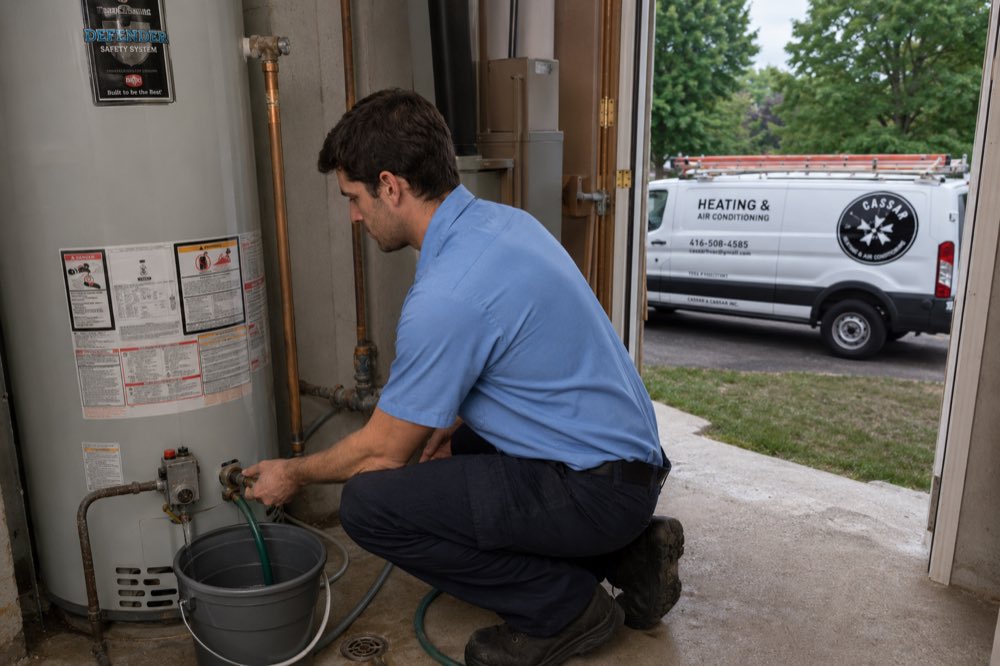
From a straightforward repair to a full replacement, David handles every job himself, no subcontractors, no surprises on the invoice.
David installs new gas and electric hot water tanks sized correctly for your household. Orono properties on well water often need extra attention to sediment buildup in the supply line, so David checks the incoming water quality before sizing the new unit. Every installation includes a full safety inspection and TSSA-compliant hookup.
A faulty thermostat, a burned-out element, a failing gas valve, these are repairs, not replacements. David diagnoses the problem first and tells you honestly whether fixing it makes financial sense given the tank’s age. If a repair costs more than half the price of a new unit, he’ll say so directly rather than take your money on a short-term fix.
When the tank’s done, David removes the old unit and installs the replacement the same day in most cases. Many Orono homes built in the 1970s and 1980s have older utility room configurations that require some extra work to bring up to current venting standards. David handles that as part of the job, it’s not an add-on charge after the quote.
A yearly tank flush and inspection catches small problems before they become expensive ones. David checks the anode rod, tests the pressure relief valve, and flushes sediment from the tank floor. Annual maintenance on a well-maintained tank can add two to four years to its working life, which matters when a new unit runs $1,200 to $2,000 installed.
If your current tank’s energy factor is below 0.60, you’re paying more each month to heat water than you need to. David can quote you on a high-efficiency power-vent or direct-vent model with an energy factor of 0.67 or higher. The upgrade typically pays for itself within three to five years in gas savings alone, and the newer units carry longer warranties.
A leaking tank or complete loss of hot water in Orono doesn’t wait for business hours. David covers Orono and the Clarington area for emergency calls, and when you phone (416) 508-4585, he’s the one who picks up. He keeps common parts and tank sizes stocked in the truck so that most emergency calls end with hot water running the same day.
Since 2011, I’ve worked in homes all across Clarington, and Orono is a community I know well. A lot of the calls I get from here involve tanks that rental companies have deferred maintenance on for years, or older units that a previous contractor told the homeowner still had life in them when they genuinely didn’t. My job is to give you a straight answer so you can make a decision with the full picture in front of you.
Most conventional storage tanks last between eight and twelve years in Ontario, though some well-maintained units push to fourteen. The wide range comes down to water quality, maintenance history, and the original build quality of the tank. A tank that’s never had its anode rod replaced and has sat with two inches of sediment on the floor for a decade won’t reach twelve years, a tank that’s been flushed annually and had the anode swapped at the five or six year mark often will.
Ontario’s cold groundwater temperatures play a role too. Incoming water in Durham Region runs colder in winter than the tank’s thermostat setting, which means the burner or element cycles more frequently from November through March. That extra workload adds wear, particularly on the lower heating element in electric tanks. If you’re on well water in the Orono area, you’ll likely see that wear pattern show up earlier than homeowners on municipal supply.
The single best thing you can do to extend a tank’s life is flush it once a year and replace the anode rod every five to six years. Most homeowners skip both, which is why the average replacement cycle in Ontario is closer to eight years than twelve. David can check both during a service call if you’re unsure when either was last done.
A standard 40-gallon gas tank installation in Orono runs between $1,200 and $1,600 fully installed, including removal of the old unit. A 50-gallon gas tank typically lands between $1,400 and $1,900 installed. Electric tank installations run slightly lower on the unit cost but can be higher overall if the electrical panel needs an updated dedicated circuit, which adds $200 to $400 depending on the panel’s condition. High-efficiency power-vent gas units, the ones that vent horizontally through an exterior wall rather than up a chimney, sit between $1,700 and $2,400 installed.
What drives variation is the venting configuration, the distance to the gas line or electrical panel, whether any code upgrades are needed to the existing installation, and disposal fees for the old tank. David won’t quote you one price over the phone and add costs once he’s at your home, he quotes after seeing the job, and that number is what you pay.
Repair costs depend on the part. A thermostat replacement on an electric tank runs $150 to $250. A gas valve runs $300 to $450 including labour. A heating element swap is typically $180 to $280. The best way to know what your specific job will cost is to get a free quote from David, no pressure, no obligation.
Orono is a small historic village in the northern part of Clarington, and much of the original village housing stock dates from the 1940s through the 1970s. These homes often have narrow utility rooms or mechanical closets that were built around the tank and furnace that were original to the house. When one of those tanks finally needs replacing, the new unit sometimes can’t go in the same way, clearances have tightened under current code, and venting requirements have changed. David accounts for this when he quotes the job, so the access and venting work isn’t a surprise charge.
There’s also a fair amount of rural residential property on the edges of Orono and along the Clarington concession roads nearby. Those properties frequently sit on well water, which is harder and higher in mineral content than the municipal supply in Bowmanville or Newcastle. Hard well water accelerates sediment buildup inside the tank, shortens anode rod life, and can cause the lower element on an electric tank to fail years earlier than expected. A water softener helps considerably, but if you don’t have one, expect to flush the tank more frequently and budget for a slightly shorter replacement cycle.
Newer builds have appeared on the rural lots outside the village core since the mid-2000s, and these homes usually have open mechanical rooms that make installation straightforward. The main consideration there is right-sizing the tank for the household, a builder-grade 40-gallon unit that shipped with the house often isn’t adequate for a family of four or five in a four-bedroom home, and David sees that mismatch frequently on calls in the area.
The most obvious sign is running out of hot water faster than you used to. If a tank that used to handle two back-to-back showers now runs cold after one, the lower heating element is likely failing or the tank has enough sediment buildup that the effective volume has been reduced. Both are worth a service call before you commit to a full replacement, sometimes a flush and element swap restores full performance for another two or three years.
Discoloured water, anything orange, rust-tinted, or carrying visible particles, usually points to tank corrosion. Once the interior lining fails and rust is entering the water supply, the tank’s done. A failing anode rod is the precursor to this; if it’s been more than five years since anyone replaced yours, that’s worth checking. Orono homeowners on well water are more susceptible to this progression because the higher mineral load accelerates rod depletion.
Unusual noise is another reliable indicator. Rumbling or loud popping during heating cycles means sediment on the tank floor is being heated along with the water. On a tank under seven years old, a thorough flush often resolves it. On a tank over ten years old in Durham Region, that noise is usually the start of the end. A dripping pressure relief valve is a different problem entirely, that’s a safety issue, not a maintenance issue, and it needs a technician’s attention the same day.
Durham Region winters push incoming water temperatures close to 5°C or lower during cold snaps, and the tank’s burner or element has to work harder during those months to maintain your setpoint temperature. Setting the thermostat to 49°C (120°F) balances energy use with safety, high enough to prevent Legionella growth, low enough that the tank isn’t working harder than it needs to. A lot of tanks David services are set to 60°C or higher, which wastes gas or electricity year-round and accelerates tank wear.
If the tank sits in an unheated or poorly insulated utility room, the ambient temperature drop in winter increases standby heat loss. Wrapping the tank with an insulation blanket rated for water heaters cuts that loss meaningfully and is a straightforward DIY job that takes about twenty minutes. Don’t cover the top of a gas tank or block any vents, just the sides and bottom.
Annual flushing matters more in Durham Region than in areas with softer water. The region’s municipal water supply has moderate hardness, and well water in the northern parts of Clarington runs harder still. A yearly flush before the heating season starts keeps sediment from accumulating to the point where it insulates the burner plate from the water, driving up gas consumption and accelerating wear on the tank lining.
In Ontario, any gas appliance installation or replacement must be performed by a contractor holding a valid TSSA licence. David’s licence is #000398183, you can verify it through the TSSA’s online registry. This matters because an unlicensed installation isn’t just a code violation; it can void your homeowner’s insurance and leave you with no recourse if there’s a gas leak or carbon monoxide incident. Carbon monoxide from a faulty gas connection is odourless and colourless, and a CO detector near the mechanical room is worth installing if you don’t already have one.
Ontario’s Enbridge Home Efficiency Rebate program occasionally includes rebates for upgrading to high-efficiency water heating equipment. The availability and amounts change, so it’s worth checking the current Enbridge rebate page when you’re budgeting a replacement, David can advise on which units qualify when he quotes the job. The Canada Greener Homes Grant has also provided rebates on heat pump water heaters, which are an option worth discussing if you’re on electric heat and want to reduce operating costs significantly.
The pressure relief (T&P) valve is the most important safety component on the tank. It’s designed to open and release pressure if the tank overheats or over-pressurizes. A dripping T&P valve means either the valve is failing or the tank’s pressure or temperature is too high, either way, it needs a licensed technician, not a bucket under the drip. David sees homeowners in the Orono area who’ve been ignoring a dripping valve for months. It’s not a normal operational condition.
Checking the simple things before calling saves time for everyone, run through these before you pick up the phone.
The temperature dial on your tank may have been turned down accidentally, especially after maintenance visits. Try turning it up and waiting 30 minutes before concluding the tank has a real problem.
Electric tanks have a dedicated breaker that trips occasionally. Gas tanks have a pilot light, if it’s out, follow the relight instructions on the label. If the pilot won’t stay lit after two attempts, call David rather than keep trying.
A dripping T&P valve is a warning sign, not normal operation. Turn down the thermostat and call Cassar, don’t ignore a dripping relief valve or place a bucket under it and carry on.
Loud rumbling or popping during heating cycles usually means sediment has built up on the tank floor. Flushing may help on newer tanks; on older ones it often signals time to replace rather than patch.
The shutoff valve on the cold water inlet to the tank must be fully open. It sometimes gets partially closed during nearby plumbing work and homeowners don’t notice until the hot water supply drops.
If none of the above resolved the problem, it needs a licensed technician. David serves all of Orono and Durham Region and picks up the phone personally.
“Our tank failed on a Thursday evening in Orono and David had a new one running by Friday afternoon. No cold weekend.”
“I called about a leaking tank and David picked up right away. He came out the same day, looked at it, and told me the tank body had corroded through so there was no point repairing it. He replaced it that afternoon, and what I appreciated was that he showed me exactly where the corrosion was before he took it out, he wasn’t just telling me what I wanted to hear to sell a new unit. That kind of honesty matters when you’re dealing with a house in Orono that’s had a few contractors take shortcuts over the years.”
“The price I got quoted was the price on the invoice, not a dollar more. He put down a mat in the utility room, worked cleanly, and took the old tank away. Some contractors I’ve dealt with leave you to sort the disposal yourself. David just handled it.”
David covers all of Durham Region from Orono, with the same same-day availability across every community below.
Same-day service available. TSSA certified. Honest pricing. Call or book online.