
Orono’s mix of older village homes and newer builds on the edge of town means David regularly encounters everything from cramped utility closets in 1970s bungalows to fresh mechanical rooms that still need proper gas line sizing before a tankless unit will run right. David covers all of Orono and the surrounding Clarington communities, and he’s available for same-day and emergency calls seven days a week.
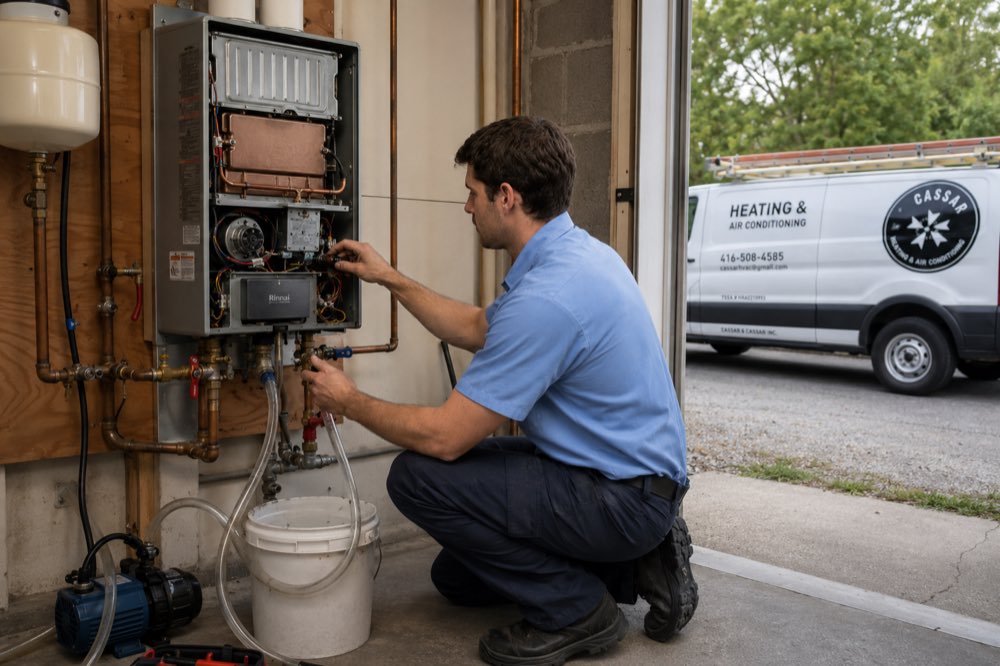
Every job below is something David handles personally, no subcontractors, no dispatchers in the middle.
David sizes and installs tankless units to match the actual demand in your home, not just the square footage on a spec sheet. Many Orono homes on the older village streets have 3/4-inch gas lines that need upgrading to 1-inch before a high-demand unit will fire correctly. David checks the gas supply before quoting so there are no surprises on installation day.
David diagnoses and repairs all major tankless brands, including Navien, Rinnai, Noritz, and Rheem. He carries the most common replacement parts on his truck, which means most repairs wrap up in a single visit. If your unit’s throwing an error code, David can often tell you over the phone what it means before he even arrives.
When a repair no longer makes financial sense, David tells you straight, explains why, and gives you a replacement quote on the spot. He won’t push a new unit if the existing one has years of life left. Orono homes that still have rental tank agreements sometimes find a buyout and replacement with a tankless unit saves money within a few years.
A tankless unit needs a descale flush every one to two years in Ontario, where water hardness accelerates mineral buildup inside the heat exchanger. David flushes the unit with a vinegar-based solution, cleans the inlet filter, checks the igniter, and tests the venting to make sure everything’s working at rated efficiency. A tune-up typically takes under two hours.
Upgrading from a conventional tank to a condensing tankless unit can cut your water heating bill significantly, since you’re only heating water when you’re actually using it. David helps you compare energy factor ratings and pick a unit sized for your household’s real peak demand, not the maximum flow the salesperson quoted you. He also handles the venting modification if your current setup needs it.
When your hot water stops in the middle of winter, you don’t want to wait two days for a technician. David answers the phone personally, including evenings and weekends, and he covers Orono as part of his regular Durham Region territory. There’s no separate emergency dispatch number, no call centre, and no fee just for picking up the phone.
I’ve worked on tankless units in Orono since 2011, and the jobs I get called to most often are units that were undersized at install or connected to a gas line that couldn’t keep up with demand. I give you the honest picture before anything gets quoted. You deal with me directly from the first call to the final invoice.
A properly maintained tankless water heater will last 20 years in most Ontario homes. That’s roughly double what you’d get from a conventional storage tank. The key word is maintained. Units that never get descaled or inspected tend to fail closer to the 12-to-15-year mark, usually because mineral buildup inside the heat exchanger forces it to work harder and harder until it cracks or burns out a heating element.
Ontario’s water hardness varies across the province, but Clarington’s municipal water supply runs moderately hard, typically in the 120-to-160 mg/L range depending on where the water originates. That’s enough to deposit scale inside a heat exchanger within 12 to 18 months of heavy use. An annual descale flush removes that buildup before it becomes a problem. It’s the single most effective thing you can do to extend the life of the unit.
The venting system also needs attention. Ontario winters are hard on the PVC or stainless concentric vent pipes that exit through the wall. Freeze-ups in the exhaust can trigger a lockout fault, and any cracking in the joints lets combustion gases migrate toward living spaces. David checks the full vent run during every maintenance call, which is something a lot of contractors skip.
A standard tankless water heater installation in Orono typically runs between $2,800 and $4,500 all-in, including the unit, labour, gas line work, and venting. That range exists because jobs vary. A straightforward swap where the gas line’s already the right size and the venting terminates cleanly through an accessible wall lands at the lower end. A job that needs a gas line upsized from 3/4-inch to 1-inch, a new venting penetration through a finished wall, or an electrical circuit added for a condensing unit will push the cost higher.
Repairs are a different story. A thermocouple or igniter replacement usually runs $250 to $450. A heat exchanger replacement, which is the most expensive internal component, can run $700 to $1,200 depending on the brand and parts availability. At that price point, David will give you an honest opinion on whether it’s worth repairing the existing unit or putting that money toward a new one.
Every job gets a free upfront quote. The best way to know what your specific job will cost is to get a free quote from David, no pressure, no obligation.
Orono is a small village within Clarington municipality, and its housing stock reflects that history. The older core along Main Street and the surrounding residential streets has a lot of homes built between the 1940s and 1980s, bungalows, two-storeys, and split-levels that were originally set up with conventional tank water heaters and 3/4-inch gas lines. Those homes often need gas line work before a tankless installation will function correctly. Running a tankless unit on an undersized gas line causes chronic ignition failures and error codes that look like the unit is faulty when the real problem is upstream.
The newer subdivisions that have pushed out toward the edges of Orono over the past 15 to 20 years are a different situation. Those homes often came with a builder-grade tankless unit already installed, and David sees a fair number of calls from homeowners in those areas who’ve never had the unit serviced since it was put in. A unit that’s been running for six or seven years without a descale flush in Ontario’s water conditions will often show reduced hot water flow or intermittent cold bursts, which homeowners sometimes mistake for a failing unit when a maintenance flush would fix it.
Orono’s rural character also means some properties sit outside the Clarington municipal gas grid and rely on propane. Tankless water heaters run on propane just as well as natural gas, but the orifice sizing and pressure regulator settings are different. David handles propane conversions and can specify propane-rated units for properties that need them.
The most obvious sign is an error code on the unit’s display panel. Every major brand uses a numeric or alphanumeric code to flag specific faults, and those codes tell David exactly what failed before he opens a panel. If your unit is showing a code and you’re not sure what it means, call and read it out, David can often walk you through whether it’s something minor or whether he needs to come out.
Inconsistent water temperature, particularly that frustrating pattern where the water goes cold 30 seconds into a shower and then hot again, usually points to one of three things: a clogged inlet filter, a flow sensor that’s reading incorrectly, or a gas pressure problem. In Clarington, David occasionally sees this in homes where the gas meter was replaced by Enbridge but the regulator wasn’t rechecked, leaving the unit running at slightly off pressure. It’s a small thing that’s easy to miss if you’re only looking at the unit itself.
Reduced hot water flow, where the unit used to keep up with two showers at once but now struggles with one, is almost always scale buildup in the heat exchanger. It narrows the internal water passages and throttles flow. Catch it early enough and a descale flush fixes it completely. Wait too long and the exchanger cracks under thermal stress, which is a much more expensive repair.
Durham Region’s winters run cold and long. When groundwater temperatures drop to 3 or 4 degrees Celsius in January, a tankless unit has to work significantly harder to raise incoming water to your set temperature than it does in August. That thermal load matters when sizing a unit. A unit that performs perfectly in summer may fall short in deep winter if it was sized too close to its rated limit. David accounts for inlet water temperature when sizing new installations.
Freeze protection is another real consideration for Orono homeowners with tankless units on exterior walls or in unheated spaces. Most modern units have internal freeze protection that activates a circulation pump or heater element when the unit detects near-freezing temperatures, but that protection only works when the unit has power. If you lose power in a winter storm, the freeze protection shuts off. David can install a recirculation pump with a battery backup for higher-risk installations, or advise you on insulating the venting pipes where they pass through unconditioned spaces.
In summer, Durham Region’s hot humid stretches can push the condensate drain on a condensing unit to work overtime. The acidic condensate needs a proper neutralizer cartridge and a clear drain path. A blocked condensate drain will lock the unit out within hours. David checks the condensate system on every maintenance visit because it’s one of the most overlooked failure points on condensing models.
In Ontario, any gas appliance installation or repair must be performed by a TSSA-licensed technician. David’s TSSA licence number is #000398183, and you can verify it directly on the TSSA public registry. This matters because an improperly installed tankless unit can produce carbon monoxide. CO is colourless and odourless, and a combustion leak that goes undetected in a utility room can migrate through the home overnight. David installs every unit to TSSA standards and tests the combustion air and exhaust for proper draw before leaving the job.
On efficiency, Ontario’s Enbridge Home Efficiency Rebate program has offered rebates on qualifying high-efficiency water heaters in the past, including certain tankless models that meet ENERGY STAR criteria. Rebate availability and amounts change periodically. David can tell you at the time of your quote whether the unit he’s recommending qualifies. It’s worth checking because the rebate can meaningfully offset the installation cost.
Modern condensing tankless units carry an Energy Factor of 0.95 or higher, meaning they convert 95 cents of every dollar of gas into usable hot water. A conventional storage tank typically runs at 0.60 to 0.67. Over a full year, that gap adds up to a real reduction in your gas bill, and in a Clarington home where the water heater is one of the two or three largest gas consumers, the savings compound year over year.
Checking the simple things before calling saves time for everyone, here’s where to start.
Tankless units have self-diagnostic displays. Write down the error code and call Cassar, this tells David exactly what’s wrong before he arrives, so he can bring the right parts on the first visit.
There’s a small mesh filter screen on the cold water inlet that catches debris. It blocks up over time and restricts flow enough to prevent ignition. Unscrew the inlet fitting, pull the screen, rinse it under the tap, and reinstall it.
Make sure the gas shutoff valve behind the unit is fully open. It can get partially closed during other work in the utility area, a plumber, an HVAC technician, or even a home inspector touching valves in the mechanical room can leave it 30 degrees off open without realising it.
Running multiple hot water fixtures simultaneously can exceed the unit’s flow capacity, causing a cold burst. Try running one fixture at a time to test. If a single shower now struggles, the problem is internal, scale buildup or a faulty flow sensor, rather than demand-related.
Tankless units vent through the wall or roof. Check that the intake and exhaust pipes are clear, undamaged, and properly connected. Bird nests and debris can block the intake, and Ontario winter ice can partially seal the exhaust terminal. Both will lock the unit out immediately.
If none of the above resolves it, the unit needs a licensed technician. David serves all of Durham Region and picks up the phone himself.
Yes, for most Durham Region homeowners a tankless water heater is worth the upfront cost, and it pays back meaningfully over time. A condensing tankless unit runs at roughly 95% efficiency compared to 60 to 67% for a conventional storage tank. In a household that spends $600 to $800 a year heating water, that efficiency gap translates to real annual savings. The break-even point for most installs I do in the Orono and Clarington area falls somewhere between six and ten years, depending on the household’s hot water usage and the cost of the unit and installation. After that, you’re ahead every year. Beyond the economics, you’re not running out of hot water. The unit heats on demand, so a long shower or back-to-back showers on a school morning don’t drain a finite tank. For families with two or three people showering in the same morning, that’s often the deciding factor. The best way to know what your specific job will cost is to get a free quote from David, no pressure, no obligation.
Most tankless installations in Durham Region, including the Orono and Clarington area, come in between $2,800 and $4,500 all-in. That covers the unit, labour, gas line work, and venting. What moves the number up or down is the condition of your existing setup. If the gas line is already 1-inch and runs close to where the unit mounts, and the venting terminates through an accessible exterior wall, the job stays toward the lower end. If I need to upsize the gas line, run a new venting penetration, or add an electrical circuit for a condensing unit, the cost climbs. Propane conversions add a bit as well. Repairs cost considerably less. An inlet filter replacement or igniter swap typically runs $250 to $450. A heat exchanger replacement, which is the most expensive internal repair, can reach $700 to $1,200, at which point I’ll give you an honest comparison with the cost of a replacement unit. The best way to know what your specific job will cost is to get a free quote from David, no pressure, no obligation.
It depends on two things: the unit’s flow rate rating and how many gallons per minute your fixtures actually demand. A typical low-flow showerhead uses 1.5 to 2.0 GPM. A standard showerhead uses 2.0 to 2.5 GPM. A 9 or 10 GPM tankless unit handles two showers running simultaneously without trouble in most homes. The problem I see in Orono and the surrounding Clarington area is homes where a builder installed a 6 GPM unit to meet minimum code while advertising “tankless” as a selling feature. That unit will struggle with two simultaneous showers, especially in winter when incoming groundwater is colder and the unit has to work harder to reach the set temperature. If you’re already experiencing cold bursts during peak morning use, the fix might be sizing the unit correctly rather than anything to do with repairs. I check the household’s actual peak demand before recommending a replacement model, so you’re not swapping one undersized unit for another. The best way to know what your specific job will cost is to get a free quote from David, no pressure, no obligation.
Most tankless water heaters need a 3/4-inch or 1-inch gas line depending on the unit’s BTU rating and the length of the run from the meter. High-efficiency condensing units commonly draw 150,000 to 199,000 BTU per hour at full fire, and a 3/4-inch line can only carry that load if the run is short and there’s no other high-draw appliance on the same branch. In older Orono homes where the original gas line was sized for a storage tank water heater and a furnace, the 3/4-inch supply is often already at capacity. Running a tankless unit on an undersized line causes the gas pressure to drop during the unit’s peak fire cycle, which triggers ignition failures and error codes. David checks the gas supply during the quoting visit so you know upfront whether a line upgrade is part of the job. It’s better to know that before the installation day than to find out after the unit’s already on the wall. The best way to know what your specific job will cost is to get a free quote from David, no pressure, no obligation.
A straightforward swap, removing an existing tankless unit and installing a new one in the same location with no gas line or venting changes, takes three to four hours. A new installation from scratch, where we’re running new gas line, cutting a new venting penetration, and potentially adding an electrical circuit, takes five to seven hours. Jobs that require a gas line run of any significant length or a venting run through multiple walls will take longer. David books a full morning or afternoon for installations so there’s no rush to get to the next job before yours is properly finished and tested. He won’t leave until the unit’s been through a full hot water draw cycle, the venting’s been checked for proper operation, and he’s shown you how to read the display and what to do if an error code appears. Most homeowners in Orono and Clarington have hot water back by the same afternoon we start.
Cold water from a tankless unit almost always traces back to one of five causes. The most common is a clogged inlet filter screen restricting flow below the unit’s minimum activation threshold, so it never fires. Second is a partially closed gas shutoff valve dropping the pressure below ignition level. Third is a flow sensor that’s reading the water demand incorrectly and failing to trigger the burner. Fourth is scale buildup inside the heat exchanger narrowing the internal passages so severely that the unit activates but can’t transfer heat efficiently. Fifth is a venting problem, either a blockage or a crack in the exhaust pipe, that causes the unit to go into safety lockout. In Clarington, I also occasionally see units that were set to an unusually low temperature by a previous occupant or technician. Check the set temperature on the display first. It sounds obvious, but I’ve gone to calls where the unit was set to 35°C. If none of those check out, call me and read me the error code off the display, that narrows it down immediately.
Once a year is the right interval for most Orono and Clarington homes. Ontario’s water hardness means scale accumulates inside the heat exchanger year-round. An annual descale flush, filter clean, igniter check, and venting inspection keeps the unit running at full efficiency and catches problems before they become expensive failures. Some homeowners stretch to every 18 or 24 months if their water is softer or their household usage is lower, but I’d consider once a year the sensible standard given what I see in this area. Skipping maintenance for three or four years is the pattern I most commonly see in homes where the previous owner installed the unit and the new owner didn’t know it needed regular service. By the time those units come to me, the heat exchanger is heavily fouled, the inlet filter is nearly blocked, and the igniter’s borderline. A couple of those cases a year could have been avoided entirely with one annual visit. A tune-up call typically runs $150 to $200, which is a small cost against the alternative of a premature replacement.
David installs and services all of the major tankless brands sold in Ontario, including Navien, Rinnai, Noritz, Rheem, Bradford White, Bosch, and Takagi. He also services units installed by builders or previous contractors, regardless of brand. For new installations, David will recommend a specific unit based on your household’s hot water demand, your existing gas and venting setup, and what he knows about parts availability and long-term reliability in this region. He won’t steer you toward a brand because of a supplier relationship. The recommendation comes from what he’s seen work in the field. If you already have a brand preference or a unit in mind, he’ll give you an honest opinion on whether it’s the right fit for your home before anything gets ordered. There are no brands he refuses to work on and no situations where he’ll tell you a perfectly serviceable unit needs replacement just because he doesn’t stock that brand’s parts.
“Our Navien unit in Orono stopped firing on a Friday evening. David came out the next morning, found a blocked inlet filter and a fault on the flow sensor, and had hot water running again before noon.”
“I called David about replacing our old tank with a tankless unit. He came by the same week, walked me through the gas line situation in our older Orono home, and was upfront that we’d need the line upgraded before anything else. He gave me the total cost before touching a single thing. The whole job took one day and the pricing was exactly what he’d quoted. Talked to him more than I’ve talked to most contractors I’ve hired.”
“I’d had two other quotes that varied by nearly $900 with no explanation why. David’s quote was detailed, the final invoice matched it exactly, and he put down floor covers in the utility room before he started. That kind of care is not common.”
David covers Orono and every community across Durham Region, here’s where else he works.
Same-day service available. TSSA certified. Honest pricing. Call or book online.