
Uxbridge’s mix of century-old farmhouses, newer estate homes on well systems, and infill builds in the village core means hot water tank sizing, venting, and water quality issues vary widely from one property to the next, and David has seen all of it since 2011. He covers all of Township of Uxbridge and the surrounding Durham Region communities with same-day and emergency service, and he answers the phone himself.
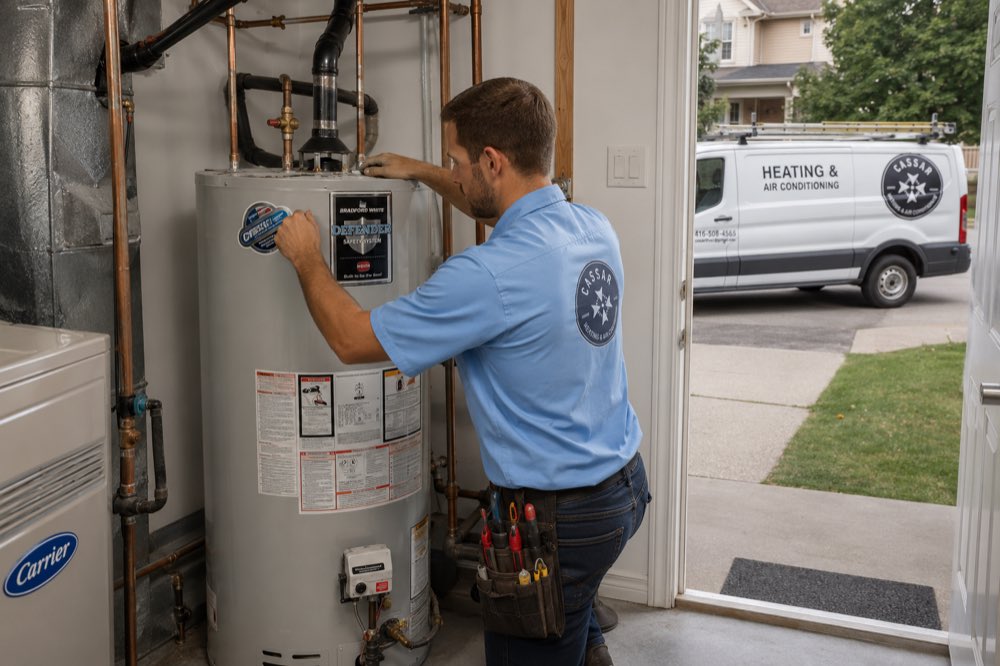
From the village to the rural concessions, David handles every hot water tank job in the Township of Uxbridge, installations, repairs, replacements, and emergencies.
David sizes and installs natural gas and electric hot water tanks across the Township, from the village of Uxbridge to properties on Concession Road 7 and beyond. He’ll confirm the right capacity for your household before any work starts, not after. Every installation includes TSSA-required inspections and a full test before he leaves.
Thermostats, heating elements, anode rods, gas valves, pressure relief valves, David diagnoses and repairs all of them. He carries common parts on the truck so most repairs wrap up on the first visit. If a repair won’t give you good value relative to the tank’s age, he’ll tell you plainly and explain why.
Many Uxbridge homes, particularly the estate builds on larger rural lots, were set up with builders’ tanks that are undersized for a family’s real usage. When it’s time to replace, David chooses a unit matched to your actual household demand, not just what fits in the space. He hauls away and disposes of the old tank as part of every replacement job.
A yearly flush and inspection extends tank life by clearing sediment buildup and catching a failing anode rod before it lets corrosion start. David checks the T&P valve, inspects the venting, and confirms the thermostat is calibrated correctly. A tank that’s serviced regularly routinely hits 14 or 15 years; one that’s never touched rarely makes it to 10.
If your current tank is hitting the end of its life, replacing it with a high-efficiency power-vent or direct-vent unit can meaningfully cut your gas bill. David walks you through the payback period honestly, sometimes a standard tank is the better financial call, and he’ll say so. He’ll also flag whether your current venting setup is compatible with a newer unit before quoting the job.
When a tank fails overnight or on a weekend, David picks up. He serves Township of Uxbridge with emergency response and carries replacement units for the most common residential sizes on standby. Uxbridge properties on well water can see accelerated tank failures due to higher mineral content, so if your tank gave out unexpectedly, it’s worth discussing a sediment filter at the same visit.
I’ve been working in Uxbridge since 2011, and a big part of what I see out here is tanks that were sized or vented for a different situation than what’s actually in the house, a 40-gallon unit feeding a four-bathroom farmhouse, or B-vent routing that was never quite right to begin with. I give you a straight answer on what the job actually needs before any work starts, and I’m the one who shows up to do it.
Most residential gas hot water tanks in Ontario last between 10 and 14 years under normal conditions. Electric tanks tend to run a little longer, sometimes reaching 15 years, because they don’t deal with the combustion stress a gas burner creates. That said, “normal conditions” is doing a lot of work in that sentence, maintenance habits, water quality, and installation quality all pull the number up or down significantly.
What shortens a tank’s life most reliably is a neglected anode rod. That magnesium or aluminum rod is the only thing standing between your tank’s steel lining and the corrosive minerals in your water supply. Most manufacturers recommend checking it every three to five years, but it rarely gets done unless a technician brings it up. By the time rust-coloured water or a sulphur smell shows up, the rod’s been gone for a while and the tank wall has already started corroding from the inside.
Ontario’s climate adds a specific wrinkle: during cold winters, incoming cold water temperatures drop significantly, sometimes below 5°C on well-supplied properties, which means the burner or element works harder to reach set temperature. That thermal cycling stress adds up over 12 or 13 years. Annual maintenance, a flush and a thermostat check at minimum, extends service life and keeps energy costs from creeping up quietly.
For a standard natural gas hot water tank replacement in Uxbridge, most homeowners pay between $1,400 and $2,200 fully installed, including removal and disposal of the old unit. That range covers the most common sizes, 40 and 50 gallon, in standard atmospheric or power-vent configurations. Electric tank replacements tend to fall in a slightly lower range, roughly $1,100 to $1,800, because the equipment cost is lower and there’s no gas line or venting complexity involved.
What moves the price inside that range: tank size, venting type (atmospheric B-vent versus power-vent versus direct-vent), whether the existing gas line and shutoff are in good shape, and whether any code upgrades are needed at the installation point. Properties in the township that have older B-vent systems occasionally need venting modifications to meet current Ontario code, which adds cost, but David identifies that before quoting, not after.
Repairs are a different matter. A thermocouple or thermostat replacement might run $150 to $350 in parts and labour. A gas valve replacement is closer to $300 to $500. If the quote for a repair is pushing above half the cost of a new unit and the tank is over nine years old, David will tell you that plainly so you can make an informed decision. Every job gets a free upfront quote. The best way to know what your specific job will cost is to get a free quote from David, no pressure, no obligation.
The Township of Uxbridge has one of the more varied housing stocks in Durham Region. The village core has a mix of Victorian-era homes, post-war bungalows, and infill builds from the 2000s onward. Outside the village, the concession roads have a mix of century farmhouses that have been updated over decades, newer rural estate homes on one-to-five-acre lots, and hobby farms where the mechanical systems are a patchwork of different eras. That variation matters when it comes to hot water tanks.
One thing David sees consistently in Uxbridge properties on well water is accelerated anode rod depletion. Well water in this part of Durham Region often carries higher concentrations of minerals and, in some areas, hydrogen sulphide, which eats through a standard magnesium anode rod faster than municipal water would. In these homes, switching to a zinc-aluminum anode rod and flushing annually makes a meaningful difference to tank longevity. If you’re on a well and your hot water smells faintly of sulphur, that’s the anode rod depleting, it’s fixable, and it’s worth addressing before corrosion starts.
The century farmhouses and older village homes often have original B-vent systems routed through interior walls or up through the attic. When replacing a tank in these homes, David inspects the existing vent run for deterioration, joint separation, and adequate clearances before committing to using the existing stack. Sometimes the vent is fine. Sometimes a power-vent unit that exhausts horizontally through the foundation wall is the cleaner solution, especially if the original chimney stack has been removed or modified.
The clearest signal is running out of hot water faster than you used to. If a household that functioned fine on a 40-gallon tank is suddenly cold by the third shower, the first suspect is sediment. Sediment builds up on the tank floor and reduces the effective volume, so you’re heating less water even though the tank looks full from the outside. On Uxbridge properties with hard or mineral-heavy well water, this builds up faster than on municipal supply and can become a real problem in five or six years on a tank that should last twelve.
Rust-coloured or faintly metallic hot water is a more urgent sign, and it almost always means internal corrosion has started, usually because the anode rod was never replaced and the steel lining is now unprotected. Once the tank is corroding internally, repair isn’t realistic. A tank in this condition should be replaced before it leaks, because a failed tank in a finished basement or utility room causes significant water damage in a short amount of time.
A dripping temperature and pressure relief valve is one people often dismiss as a minor annoyance. It’s not. The T&P valve opens when pressure or temperature inside the tank exceeds safe limits. If it’s dripping regularly, either the valve itself has worn out and needs replacing, or the system pressure is genuinely elevated and the valve is doing its job, either way, it needs a licensed technician to diagnose it. David sees this fairly often on Durham Region properties where incoming water pressure is higher than the 80 PSI threshold tanks are rated for.
Durham Region’s winters drive cold-water inlet temperatures down far enough to meaningfully increase the energy consumption of any storage tank. One straightforward adjustment that costs nothing is confirming your thermostat is set to 60°C (140°F) rather than higher. Higher settings burn more gas or electricity without any real benefit for most households, and they accelerate mineral scaling inside the tank. 60°C is the Ontario-recommended setting, hot enough to prevent legionella growth, not so hot that it’s wasteful.
Insulating the first metre or so of hot water pipe exiting the tank reduces standby heat loss, which matters more in an unheated utility room or basement that gets cold in January. A pipe insulation sleeve costs a few dollars and takes twenty minutes to install. It won’t transform your energy bill, but it’s the kind of small detail that adds up over a 12-year tank lifespan.
Flushing the tank once a year is the single most impactful maintenance task available to a homeowner. Connect a garden hose to the drain valve, run it to a floor drain, and drain until the water runs clear. On a Uxbridge property with hard well water, you might be surprised how much sediment comes out even from a relatively young tank. If the drain valve won’t fully close after flushing, a common issue on tanks that have never been drained, call David rather than leaving it partially open, because that valve seating won’t improve on its own.
In Ontario, all gas appliance installation and repair work must be performed by a TSSA-licensed technician. That’s not an administrative formality, it exists because an incorrectly installed or vented gas water heater can produce carbon monoxide in a living space, and CO is colourless and odourless. If you’re calling someone to work on a gas hot water tank in Uxbridge, ask for their TSSA licence number before they start. David’s is #000398183, and it’s verifiable on the TSSA’s public registry.
The temperature and pressure relief valve on your tank is a safety device, and Ontario’s Technical Standards and Safety Authority requires it be in working order. A T&P valve that’s been dripping for months and then seized closed is more dangerous than one that drips, a seized relief valve means there’s no pressure release path if the tank overheats. David tests the T&P valve during every service call and replaces it if there’s any doubt about its function.
On the efficiency side, Enbridge occasionally offers rebates on high-efficiency water heating equipment through their Home Efficiency Rebate program, it’s worth checking current offerings before you commit to a replacement, as eligible units can offset several hundred dollars of the equipment cost. David can confirm whether the unit he’s quoting qualifies before the job starts. Regardless of rebate eligibility, moving from a standard tank to a power-vent or high-efficiency unit typically reduces annual gas consumption by 15 to 20 percent, which adds up over the life of the equipment.
Checking the simple things before calling saves time for everyone, run through these first.
The temperature dial on your tank may have been turned down accidentally, especially after maintenance visits. Try turning it up and waiting 30 minutes before concluding something’s broken.
Electric tanks have a dedicated breaker that trips occasionally. Gas tanks have a pilot light, if it’s out, follow the relight instructions on the label. If the pilot won’t stay lit, that’s a thermocouple issue and it needs a service call.
A dripping T&P valve is a warning sign, not normal. Turn down the thermostat and call Cassar, don’t ignore a dripping relief valve. It won’t resolve on its own and it signals something that needs a licensed technician.
Loud rumbling or popping usually means sediment has built up on the tank floor. Flushing may help on newer tanks; on older ones it often signals time to replace. Don’t ignore persistent noise, it means the burner is working much harder than it should.
The shutoff valve on the cold water inlet to the tank must be fully open. It sometimes gets partially closed during plumbing work nearby. Turn it counterclockwise until it stops, then check if hot water recovers over the next 30 to 40 minutes.
If none of the above resolved it, it needs a licensed technician. David serves all of Durham Region, including Uxbridge, and picks up the phone himself.
Most gas hot water tanks in Durham Region last 10 to 14 years; electric tanks sometimes reach 15. The variation comes down to three things: water quality, maintenance history, and whether the tank was correctly sized for the household’s actual demand. Properties in Uxbridge and other parts of the township that draw from well water often see shorter lifespans, because mineral-heavy well water depletes the anode rod faster and leaves more sediment on the tank floor. A tank that’s been flushed annually and had its anode rod replaced once will typically outlast a neglected tank of the same age by three or four years. If your tank is past the ten-year mark and you’re seeing early warning signs like slow recovery, rust-coloured water, or noise, it’s worth getting David out to assess it rather than waiting for an emergency failure.
Repair if the tank is under eight years old and the problem is a component, thermocouple, heating element, thermostat, gas valve. Replace if the tank is over ten years old and the repair cost is pushing above half the price of a new unit, or if there’s any sign of internal corrosion: rust-coloured water, a metallic smell, or visible rust at the base. There’s no point putting a $400 gas valve on a 13-year-old tank that’s likely to fail from a different cause within two years. That said, I don’t push replacements on tanks that have repair life left in them, a functioning 8-year-old tank with a bad thermostat should be repaired, not replaced. I’ll give you my honest assessment when I see the unit in person, and I’ll show you the numbers so you can decide.
A standard gas hot water tank replacement, fully installed with disposal of the old unit, typically runs $1,400 to $2,200 in Durham Region. Electric replacements are generally $1,100 to $1,800. The main factors that move the price: tank size (40 versus 50 versus 60 gallon), venting type (atmospheric B-vent, power-vent, or direct-vent), whether the existing gas shutoff and line need any work, and whether any code upgrades are required. In Uxbridge specifically, older homes with B-vent systems occasionally need venting modifications, which David identifies and quotes upfront. Power-vent units that exhaust horizontally cost more in equipment but can simplify installation in homes where the original chimney stack is no longer usable. The best way to know what your specific job will cost is to get a free quote from David, no pressure, no obligation.
Buy, in almost every case. Rental looks attractive upfront because there’s no capital cost, but the monthly rental fee, typically $30 to $60 depending on the provider, adds up to $360 to $720 per year, every year, with no end point. Over a 12-year tank lifespan that’s $4,300 to $8,600 paid to the rental company, compared to $1,400 to $2,200 to own the unit outright. The rental company also owns the equipment, so if you sell your house the tank stays and the new owners inherit the contract. Rental does make sense in one specific scenario: if you’re on a very tight fixed budget and genuinely can’t cover the upfront cost. Otherwise, purchasing delivers better value. David installs purchased tanks only, he doesn’t rent equipment. If you’re buying out an existing rental contract, he can help you understand what that involves before you commit.
A straightforward replacement, same size, same venting type, existing connections in good shape, takes two to three hours from arrival to the point where you have hot water again. The tank itself needs time to heat up after installation, so you’ll have hot water within an hour of David finishing the install. Jobs that take longer are ones where the venting needs modification, the gas line needs work, or the installation location is awkward, a cramped utility room or a unit tucked into a finished space. David will give you a realistic time estimate before starting, not a vague window. On Uxbridge properties where he’s working in older farmhouses with tight mechanical rooms, he occasionally needs a bit more time to get the access right, but he’ll tell you that when he arrives rather than at the end.
Turn off the cold water supply valve to the tank immediately, it’s on the pipe entering the top of the unit, and turning it clockwise stops water flowing in. If it’s a gas tank, turn the thermostat dial to the “Pilot” or “Off” position, which shuts off the burner without requiring you to touch the gas supply. Then call David at (416) 508-4585. A leak at the base of the tank almost always means internal corrosion has compromised the tank wall, that’s a replacement, not a repair, and the sooner it’s handled the less water damage occurs. A drip from the T&P valve or from a pipe connection is a different situation and may be repairable, but it still needs a licensed technician to assess. Don’t leave a leaking tank running overnight hoping it holds, internal leaks get worse quickly once they start.
Yes, disposal of the old tank is included in every replacement job David does in Uxbridge and across Durham Region. He hauls the old unit out, loads it on the truck, and takes it for proper disposal, you don’t need to arrange anything or worry about where it goes. This is included in the quoted price, not added as a separate line item at the end. For homeowners in the Township of Uxbridge who are used to contractors leaving debris or old equipment at the curb for the municipality to deal with, that’s not how David operates. The site is left the way he found it, minus the old tank and plus the new one running correctly. If you have other old HVAC equipment you’re hoping to get rid of at the same time, ask when you book, he’ll let you know what he can take.
David installs several brands depending on what’s the right fit for the job, Bradford White, John Wood, and Rheem are the ones he installs most regularly, because they’re well-supported for parts and have solid warranty terms that are actually honoured in Canada. He doesn’t push a single brand on every job. If you’ve already purchased a unit and need installation only, he can install it as long as it meets Ontario code requirements for your specific setup. What he won’t do is install a unit he considers undersized, incorrectly rated, or unsuitable for your venting configuration, because that creates problems down the road and he stands behind his work. If you have questions about a specific brand or model you’re considering, call him at (416) 508-4585 and he’ll give you a straight answer before you buy anything.
“Our hot water tank let go on a Friday evening at our Uxbridge farmhouse. David had a new one installed and running by Saturday afternoon.”
“I called about a tank that was making a loud rumbling noise and figured I was getting sold a replacement. David came out, told me the tank was actually fine for its age, flushed it, and replaced the anode rod. He explained exactly what he was doing and why he wasn’t recommending a new unit. That kind of honesty is rare.”
“Price was exactly what he quoted on the phone, not a dollar more. He put down floor protection before he started, and when he left you wouldn’t have known he’d been there except for the new tank. Did the whole replacement at our Uxbridge place in under three hours.”
David covers all of Durham Region, if you’re near Uxbridge, he’s near you.
Same-day service available. TSSA certified. Honest pricing. Call or book online.