
Uxbridge’s mix of older farmhouses, rural properties on well water, and newer estate homes on the township’s north end means many of them were never built with central ductwork, and a ductless heat pump is often the most practical way to heat and cool them efficiently. David covers all of Township of Uxbridge and the surrounding Durham Region communities, with same-day and emergency service available when you need it.
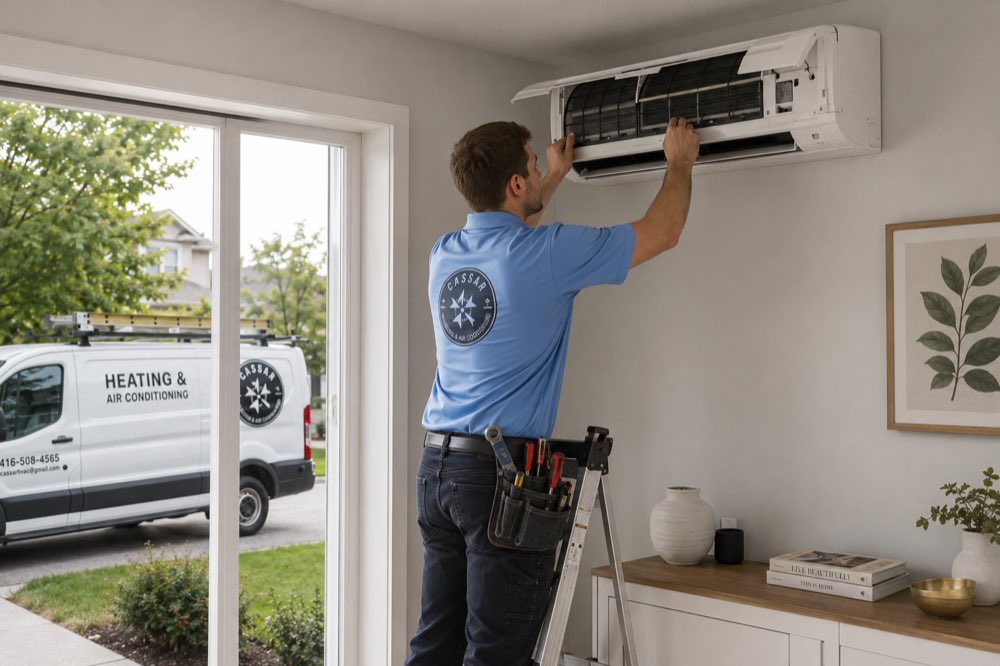
From a single-zone installation in a converted century home to a multi-zone repair on a newer build that’s lost heating to one room, David handles it all.
Many Uxbridge properties, especially the older farmhouses and century homes along Brock Street and the rural concessions, were built without any ductwork at all. David sizes the system to the room, runs the refrigerant lines properly, and commissions the unit the same day. You get a working system before he leaves the driveway.
If your indoor unit is blinking an error code, producing noise it didn’t make before, or blowing air without heating or cooling, David diagnoses it on-site. He carries the most common replacement parts, capacitors, fan motors, control boards, so most repairs finish on the first visit rather than waiting a week for parts to arrive.
When a repair genuinely doesn’t make financial sense, David tells you straight. A unit that’s over 15 years old with a failing compressor often costs more to fix than it’s worth. He’ll give you an honest comparison of repair cost versus replacement cost and let you decide. There’s no upsell pressure.
David cleans the indoor filter and evaporator coil, checks refrigerant levels, inspects the outdoor unit’s electrical connections, and confirms the drain line is clear. A ductless system that skips annual maintenance loses efficiency faster than most homeowners realize, and small refrigerant leaks turn into compressor failures if nobody catches them early.
Older single-zone units from the early 2010s often run at 14–16 SEER. Today’s cold-climate models hit 20+ SEER and keep heating reliably down to -25°C. If your older ductless unit is running constantly and your hydro bill shows it, a new cold-climate model typically pays back the difference in operating costs within a few years in Ontario’s energy pricing environment.
Uxbridge sits on the northern edge of Durham Region, and January nights out on the concessions get cold fast. If your heat pump stops working in the middle of the night or on a weekend, you reach David directly, not a call centre that books you in for three days out. He’ll tell you honestly whether it can wait until morning or whether he needs to come tonight.
I’ve been out to Uxbridge properties where a previous contractor installed the wrong capacity unit for the room volume, and the homeowner spent two winters wondering why one end of the house stayed cold. Sizing a ductless system correctly for Uxbridge’s range of home types, from a 900 sq ft bungalow to a 3,500 sq ft rural estate, takes experience and an actual heat load calculation, not guesswork. That’s what I do before every installation. Since 2011, I’ve carried TSSA Licence #000398183, and every job I quote is the price you pay.
A well-maintained ductless heat pump in Ontario typically lasts 15 to 20 years. The compressor in the outdoor unit is the component most likely to limit that lifespan, and it degrades faster when the system runs without annual maintenance, operates with a low refrigerant charge, or sits with a dirty indoor coil restricting airflow. Units from the major Japanese manufacturers, Mitsubishi, Daikin, and Fujitsu, tend to hit the upper end of that range when they’re serviced regularly. Budget-tier brands often fall short of 12 years.
Ontario’s climate shortens lifespan in ways that warmer regions don’t see. The outdoor unit goes through freeze-thaw cycles all winter, which stresses the coil and the defrost controls. Spring pollen and cottonwood season clogs the outdoor coil faster than most homeowners expect. David recommends a spring tune-up each year, specifically because cleaning the outdoor coil in May avoids the efficiency losses that build up through the cooling season and puts the unit in good shape before the next heating cycle starts.
Refrigerant leaks are the hidden lifespan killer. A small leak that drops the charge by 10% doesn’t stop the system from running, but it forces the compressor to work harder every cycle. Over two or three seasons that adds up to significant wear. Catching it at an annual check costs far less than replacing a failed compressor or buying a new outdoor unit.
A single-zone ductless heat pump installation in Uxbridge typically runs between $3,000 and $5,500 installed, depending on the unit’s capacity, efficiency rating, and the complexity of the refrigerant line run. A compact 9,000 BTU unit for a smaller room sits at the lower end. A 24,000 BTU cold-climate unit going into a larger open-concept space on a rural property where the outdoor unit sits further from the house lands closer to the top of that range. Multi-zone systems with two or three indoor heads start around $6,500 and go up from there based on the number of zones and the length of the line sets.
Repair costs vary more widely because the problem determines the part. A capacitor replacement runs $150 to $300. A fan motor is $300 to $600. A control board can hit $500 to $900. A refrigerant recharge, depending on the leak diagnosis and the amount of refrigerant needed, typically runs $300 to $700. David gives you the repair cost before he starts, so you can weigh it against the age of the unit and decide what makes sense.
The best way to know what your specific job will cost is to get a free quote from David, no pressure, no obligation.
Uxbridge’s housing stock is genuinely diverse. The older village core along Brock and Toronto Streets has century-old homes, some of them converted from single-family to multi-unit over the decades, with plaster walls, low ceilings, and no mechanical room to speak of. The concession roads outside the village have a mix of working farmhouses built in the 1950s and 60s, hobby farm properties with large attached workshops or outbuildings, and country-lot estate homes built from the 1990s onward. The township also saw a wave of newer subdivisions on the south end, particularly around Elgin Park Drive and surrounding streets, from the 2000s and 2010s.
What that means for ductless installs is that there’s no single standard job in Uxbridge. In a century-home on Brock Street, getting the refrigerant line through a stone foundation or a thick plaster wall requires patience and the right tools. On a concession road property, the outdoor unit might need to go on a pad 30 or 40 feet from the indoor head because of how the house is oriented relative to the prevailing winds off the Moraine. On a newer subdivision build, the job is often straightforward, but the electrical panel sometimes needs an additional circuit added for the outdoor unit, which David scopes before quoting.
Rural properties on the north part of the township also tend to rely on electric baseboard heat as their primary or backup system, which makes ductless heat pumps a natural fit, since they cut heating costs dramatically compared to straight electric resistance and work well as a standalone system for shoulder seasons without needing to touch the existing baseboard infrastructure.
The most obvious sign is an error code blinking on the indoor unit’s display panel. Every major brand uses a code system and most of them point clearly toward the fault, whether it’s a communication error between the indoor and outdoor units, a thermistor failure, or a refrigerant pressure alarm. Don’t ignore a blinking display and hope it clears on its own. Those codes are the unit telling you it’s already in a protection mode and running inefficiently or not at all.
Strange sounds are the second category. A gurgling sound usually means refrigerant is migrating through the system when it shouldn’t be. A rattling outdoor unit often signals a loose fan blade or a failing compressor mount. A grinding or squealing from the indoor air handler is almost always the blower motor bearing going. In Uxbridge’s winters, a failing blower motor in January means no heat until it’s fixed, and those parts take time to source if you wait until the system stops entirely.
Ice buildup on the outdoor unit in winter is normal during defrost cycles, but a unit that stays fully iced over for hours and never clears means the defrost control is failing. Durham Region winters push ductless systems hard, and defrost controls that worked fine at -5°C can fail at -20°C if they’ve started to degrade. If you see the outdoor unit completely buried in ice after a cold snap and the heat’s dropped off noticeably indoors, that’s a service call, not a wait-and-see situation.
Durham Region’s climate runs cold-climate ductless systems through their full range. Summer humidity peaks in July and August, which means the indoor coil handles significant dehumidification load on top of cooling. Keeping the indoor filter clean through summer is more important than most homeowners realise. A blocked filter at 35°C ambient doesn’t just reduce airflow, it causes the evaporator coil to ice over and the system to short-cycle, which stresses the compressor.
In winter, the most useful thing you can do is keep the area around the outdoor unit clear. Snow accumulation around the base blocks airflow and forces the defrost cycle to run more frequently. If you get a heavy snowfall, knock the snow away from the unit’s sides and top, but never chip at any ice on the coil itself. The unit’s defrost cycle handles coil ice on its own through a carefully controlled process. Manual intervention damages the fins.
Set the system to a consistent temperature rather than turning it off when you leave and cranking it on return. A ductless heat pump is far more efficient maintaining a stable temperature than recovering from a large setback, especially at -15°C when the unit has to work at maximum capacity just to catch up. Most modern units have a scheduling function in the remote or app that handles this automatically.
Ductless heat pumps don’t produce combustion byproducts, so there’s no carbon monoxide risk from the unit itself. But the refrigerant they use, typically R-410A or the newer R-32 in current models, is handled under TSSA regulations in Ontario. Only a licensed technician can legally purchase, recover, or recharge refrigerants. This matters because unlicensed technicians who top up refrigerant without finding the leak are breaking the law and leaving you with a system that’ll leak again within a season. David holds TSSA Licence #000398183 and follows proper leak detection procedure before any recharge.
On the rebate side, Enbridge Gas offers the Home Efficiency Rebate Plus program, and Hydro One has offered incentives for cold-climate heat pump installations in rural Ontario service areas, which covers much of Uxbridge’s township. The available amounts and eligibility criteria change, but a cold-climate unit with a heating seasonal performance factor above 1.8 typically qualifies. David can tell you what’s currently active when he quotes the job, and the savings can meaningfully reduce your net installation cost.
Modern inverter-driven ductless systems are significantly more efficient than the fixed-speed units installed a decade ago. A current cold-climate model at -15°C still delivers a coefficient of performance around 2.0 or better, meaning it produces two units of heat for every unit of electricity consumed. At Ontario electricity rates, that compares favourably to propane or electric baseboard on an operating cost basis, particularly for Uxbridge properties that previously relied on oil or propane heat.
Checking the simple things before calling saves time for everyone.
Confirm the mode is set to Heat, the temperature is set above room temperature, and the remote has fresh batteries. Wrong mode is the most common ductless issue.
Ductless systems have separate breakers for the indoor air handler and outdoor compressor. Check both in your electrical panel.
Ductless filters are inside the indoor wall unit behind the front panel. Slide it out and rinse it under water, these block up faster than furnace filters.
Clear any snow, ice, or debris blocking the outdoor unit. A fully iced-over unit needs a technician, don’t attempt to remove ice manually.
Ductless remotes have many modes. Confirm the display shows the heat icon, not a water droplet (dry mode) or fan symbol.
If none of the above sorted it, you need a licensed technician. David serves all of Durham Region and picks up the phone himself.
Yes, and modern cold-climate models work well in Ontario winters, including the hard cold snaps that hit Uxbridge on the Oak Ridges Moraine. Current cold-climate ductless units from Mitsubishi, Daikin, and Fujitsu are rated to heat reliably down to -25°C or -30°C, which covers the coldest nights Durham Region sees. The key is choosing the right unit for the climate. Standard-efficiency ductless systems start losing capacity around -10°C, which isn’t good enough for a Uxbridge January. A cold-climate model maintains most of its rated heating output even at -20°C because it uses a variable-speed inverter compressor that adjusts its stroke and refrigerant flow rate rather than just running full blast until a thermostat cuts it off. If you currently have an older ductless unit that struggles in cold weather, that’s likely the reason. It’s worth checking what efficiency rating and cold-weather performance spec the unit was installed with. I’ve gone out to Uxbridge properties where the previous installer put in a standard unit in a space that needed a cold-climate model, and the homeowner spent years thinking ductless heat pumps just didn’t work in Ontario. They do, when they’re specified correctly.
A single-zone installation in Durham Region, including Uxbridge, typically runs between $3,000 and $5,500 fully installed. The spread comes down to a few specific factors: the capacity of the unit (9,000 BTU for a small room versus 24,000 BTU for a large open space), whether the unit is a standard-efficiency or cold-climate model, and how complicated the refrigerant line run is from the indoor head to the outdoor unit. A straightforward install where the outdoor unit sits directly on the other side of an exterior wall runs faster and cheaper than one where the line needs to travel 40 feet around a corner on a rural property. Multi-zone systems with two indoor heads start around $6,500 and go up from there depending on zones and line set lengths. Labour is also a factor, a job that takes four hours is priced differently than one that takes a full day. The honest answer is that I can’t give you your price without seeing the job, but I can give you a firm number before any work starts and it won’t change. The best way to know what your specific job will cost is to get a free quote from David, no pressure, no obligation.
The answer depends on how your home is laid out and how even you want the temperature across different areas. A ductless system heats and cools by zone, so one indoor head covers the space it’s installed in and the connected open areas. A small bungalow with an open kitchen and living area might need only one indoor head in the right location. A two-storey home typically needs two zones, one for the main floor and one for the upper floor, because heat rises and a single head on the main floor won’t keep the upstairs comfortable in summer. A home with a finished basement that someone uses as a bedroom or office usually needs a third zone for that space. Properties in Uxbridge with large attached garages, converted barns, or separate workshops often add a dedicated zone for those outbuildings as well. The key calculation is room volume and thermal load, not just square footage. A cathedral ceiling doubles the volume of a room without doubling the floor area. A room with three exterior walls on a north-facing corner loses heat faster than the same square footage in a central location. I do a heat load calculation before recommending a configuration so you’re not paying for more zones than you need or short-changing a space that needs its own head.
Yes, every ductless heat pump David installs runs in both heat and cool mode. That’s the core function of a heat pump, it moves heat out of the space in summer and moves heat into the space in winter, using the same refrigerant circuit running in opposite directions. This is one of the reasons ductless heat pumps have become popular in Uxbridge’s rural properties, which often have electric baseboard heat for winter but no central air conditioning at all. One ductless installation solves both problems at once. You get efficient heating that outperforms electric baseboard on operating cost, and you get cooling capacity for the months when Durham Region summers push indoor temperatures up. In dehumidification mode, the unit also pulls moisture out of the air on those humid July and August days without dropping the temperature as aggressively as full cooling mode, which is useful for shoulder season humidity. The only exception worth mentioning is heating-only units, which exist but are uncommon and aren’t what David installs by default. Every system he puts in is a full heat pump that heats and cools.
Several rebate programs currently apply to ductless heat pump installations in Ontario, and Uxbridge homeowners may qualify for more than one depending on their electricity provider and home type. The Canada Greener Homes Grant has offered up to $5,000 for qualifying heat pump installations, though program availability and funding windows change and you’d need to confirm the current status at the time of your installation. Enbridge Gas runs the Home Efficiency Rebate Plus (HER+) program, which covers heat pumps and can be stacked with federal incentives in some cases. Hydro One, which serves much of Uxbridge township, has offered its own residential heat pump rebate for customers switching from electric baseboard heat. For a cold-climate unit that meets the required heating seasonal performance factor threshold, that rebate can run several hundred dollars. Some of these programs require a pre-approval or energy audit before installation and a post-installation inspection, so timing matters. When I quote a job in Uxbridge, I’ll tell you which programs are currently active, what the unit I’m recommending qualifies for, and what steps you’d need to take to capture the rebate. The best way to know what your specific job will cost is to get a free quote from David, no pressure, no obligation.
A single-zone installation on a typical Uxbridge property takes between three and five hours from start to a commissioned, running system. That includes mounting the indoor wall unit, positioning the outdoor unit on a pad or bracket, running the refrigerant lines and electrical through the wall, connecting the line set, pressure testing, evacuating the system to the required vacuum, and commissioning with the factory refrigerant charge. The job takes longer when the line set run is complex, going through a thick stone foundation wall, navigating around framing inside a finished wall, or running a longer distance across a rural property. Adding a second zone adds roughly two to three hours. If the electrical panel needs a new dedicated circuit for the outdoor unit, that adds time as well, and David scopes that before the installation day so there’s no surprise on the day of the job. By the end of the visit, you’ve got a running system and David’s walked you through the remote and the maintenance schedule.
Start with the remote. Confirm it’s set to Heat mode (not Fan or Dry), that the set temperature is above the current room temperature, and that the batteries aren’t dead. This solves the problem more often than you’d expect. Next, check both circuit breakers, the one for the indoor air handler and the separate one for the outdoor compressor. A tripped breaker on the outdoor unit shuts down heating while the indoor fan may still spin, which leads people to think the whole system is running when it’s not. Then look at the indoor filter. Slide the front panel up, pull the filter out, and check whether it’s clogged. A blocked filter in winter drops airflow enough that the indoor coil can’t transfer heat properly, and the unit goes into a protection mode. Finally, look at the outdoor unit. If it’s fully buried in ice and hasn’t cleared after an hour or two, the defrost control may have failed. In Uxbridge’s cold winters, a defrost control failure is a real repair, not something that resolves on its own. If all of those checks come back normal and the unit still isn’t heating, there’s a refrigerant, electrical, or control board issue that needs a licensed technician. Call David directly at (416) 508-4585.
David works with the major brands he’s confident in, Mitsubishi Electric, Daikin, Fujitsu, and LG. These are the manufacturers with proven cold-climate performance in Ontario conditions, solid parts availability in Canada, and warranties that are actually serviceable when something goes wrong. He can also service and repair units from brands he didn’t install, including Gree, Bosch, and other manufacturers you might find on a Uxbridge property he’s servicing for the first time. What he won’t do is install a unit he doesn’t believe in just because a homeowner found a cheaper model online. Cheap units cost less on day one and more over their lifespan, and David would rather have that conversation upfront than come back to repair a failing budget unit in three years. If you’ve already purchased a unit from a specific manufacturer and want David to install it, call him and discuss it. He’ll tell you straight whether it’s a brand he’s willing to put his name behind. The goal is a system that works reliably through a Uxbridge winter, not just one that turns on the first day.
“Our ductless unit stopped heating entirely on a cold night out here in Uxbridge. David came out the next morning, found a failed defrost control, and had it fixed before noon.”
“I’d been getting quotes on a new ductless install for our place on one of the concession roads north of the village. Most contractors just gave me a number over the phone without even asking about the house. David came out, walked the property, figured out where the outdoor unit actually needed to go given the wind exposure, and explained why the capacity he was recommending was different from what another guy had quoted me. That detail mattered. The install went exactly as he said it would, and it’s been running great through two winters.”
“What got my attention was the price didn’t change. Got the quote, booked the job, paid the quote. Nothing added on at the end. He also put down drop sheets through the whole house before he started running lines, which nobody does. The ductless system has cut our hydro bills noticeably compared to what we were spending on baseboard heat in our Uxbridge home.”
David covers all of Durham Region from his base, including every community listed below.
Same-day service available. TSSA certified. Honest pricing. Call or book online.