
Uxbridge’s rural properties and older farmhouse-style homes present real sizing and ductwork challenges that a standard heat pump quote from a big-city contractor won’t account for, David has been working in the Township since 2011 and knows what these homes actually need. He covers all of Uxbridge and surrounding Durham Region communities, picks up the phone himself, and can reach you the same day.
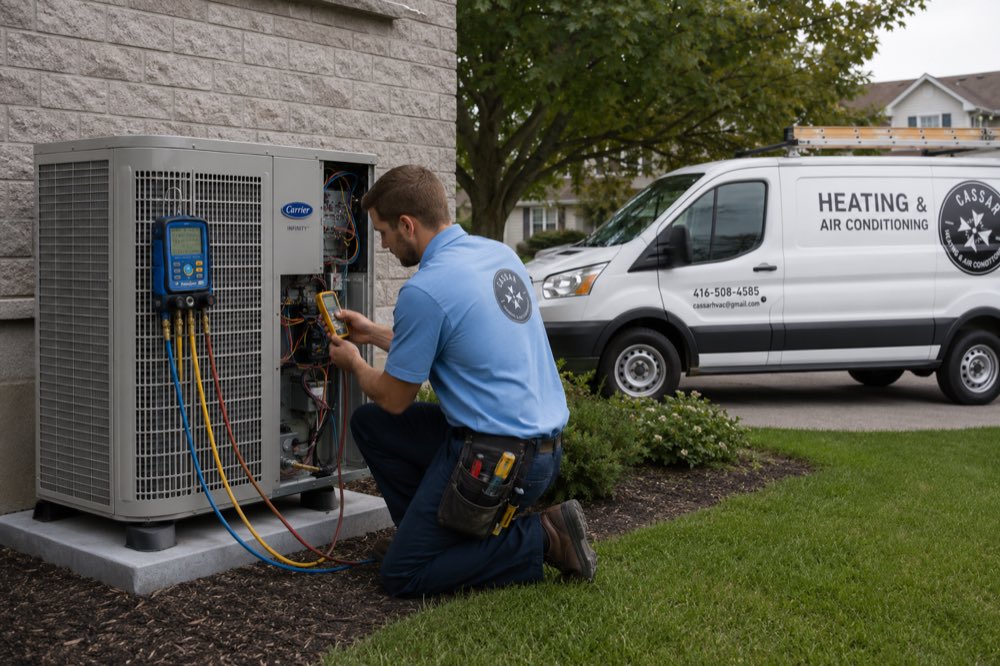
Every job below is handled by David personally, TSSA Licence #000398183, from the first call to the final walk-through.
Many Uxbridge properties sit on larger lots with older duct systems originally designed for oil or propane furnaces. David sizes every installation to the actual load, he doesn’t pull a number from a catalogue. Cold-climate models rated to operate at -25°C are available for homes in the more exposed rural parts of the Township.
David carries a broad stock of common components on the truck, so most repairs get finished on the first visit. If your heat pump stops producing heat or starts short-cycling, call directly, you’ll reach David, not a dispatcher who schedules someone for next week.
When a repair is no longer worth it, David tells you honestly, including the numbers behind that call. He won’t recommend replacement to sell equipment. Uxbridge homes that are switching away from propane heating are often great candidates for a high-efficiency cold-climate heat pump, and David can walk you through what that transition looks like in practice.
A yearly service visit keeps refrigerant charge correct, clears the coils, checks the defrost cycle, and confirms the reversing valve is switching cleanly. Skipping annual maintenance is the single biggest reason heat pumps underperform during Ontario’s deep-freeze months. David books tune-ups throughout Durham Region, including Uxbridge, in spring and fall.
Upgrading from an older propane or oil system to a modern inverter-driven heat pump can cut annual heating costs substantially, especially given Uxbridge’s rural fuel delivery costs. David sizes the unit correctly, confirms duct capacity, and helps you understand which Ontario rebate programs apply before you spend a dollar.
When it’s January and your heat pump has stopped, you can’t wait three days. David takes emergency calls across the Township of Uxbridge and responds the same day. Call (416) 508-4585 and you’ll reach him directly. He keeps common failure parts on the truck so that most emergency calls get resolved that visit.
I’ve been working in Uxbridge since 2011 and I’ve seen the same issues come up repeatedly: heat pumps installed without a proper load calculation for these larger, older rural homes, refrigerant lines run too long and undersized for the outdoor temperature range up here, and equipment sold without any conversation about how propane backup systems should integrate. That’s what I’m fixing most often, and I’d rather walk you through it before a problem starts than after. Every job in the Township gets the same standard, TSSA Licence #000398183, upfront pricing, and a clean site when I leave.
A well-maintained heat pump in Ontario typically lasts 15 to 20 years. The lower end of that range usually applies to systems that skipped annual maintenance, ran with a dirty coil for seasons at a time, or were installed slightly undersized and therefore cycled harder than they should have. A unit that’s been serviced every year and sized correctly at installation routinely hits the upper end.
Ontario’s climate puts heat pumps through a genuinely wide temperature swing, from summer humidity in the mid-30s to January nights that push well below -20°C in rural areas like Uxbridge. That range stresses the refrigerant circuit and the reversing valve more than in milder climates. Keeping refrigerant charge at the correct level and confirming the defrost cycle runs properly every fall extends lifespan significantly.
The single maintenance step that makes the biggest difference is cleaning or replacing the air filter on a regular schedule, every 30 to 90 days depending on the household, and getting David in for a full service once a year. A blocked filter makes the indoor coil run cold, which eventually causes the system to ice up and short-cycle, wearing the compressor prematurely. Compressors are the most expensive component in the system, and they’re worth protecting.
A new heat pump installation in Uxbridge typically runs between $4,500 and $10,000 installed, depending on the unit type, the size of the home, and how much ductwork needs attention. A basic single-stage unit for a well-ducted home sits toward the lower end. A cold-climate inverter-driven system in a larger rural property with duct modifications sits toward the upper end. That range is real, not a placeholder.
Repair costs vary considerably by what’s failed. A refrigerant recharge runs roughly $200 to $500 depending on the amount needed. A reversing valve replacement is typically $400 to $800 in parts and labour. Compressor failures are the expensive end, anywhere from $900 to $1,800, and David will tell you honestly if replacing the unit makes more financial sense than fixing it. He won’t push a repair just to generate a service call.
Every Uxbridge job gets a free, written upfront quote before David touches anything. The best way to know what your specific job will cost is to get a free quote from David, no pressure, no obligation.
The Township of Uxbridge has a distinctive housing mix that affects heat pump planning. A significant portion of the stock includes homes built between the 1940s and 1980s, rural farmhouses, bungalows, and two-storey century-style homes on larger lots. Many of these were originally heated with oil or propane forced-air systems, and the ductwork was sized for those heat sources, which deliver air at much higher temperatures than a heat pump does. Installing a heat pump into those ducts without recalculating airflow often results in a system that struggles to maintain temperature on cold days.
Newer development in Uxbridge, particularly around the Main Street corridor and newer subdivisions off Reach Street and Brock Street, tends to have more modern duct systems that are better suited to direct heat pump installation. Even there, David checks the duct layout and static pressure before recommending a unit, a detail that many contractors skip.
Properties further out in the rural Township sometimes lack natural gas entirely and rely on propane or oil. For those homeowners, a cold-climate heat pump that operates efficiently down to -25°C combined with a propane backup for the coldest stretch of winter is often the most cost-effective solution right now. David has done this transition several times in the Uxbridge area and can walk through the numbers with you honestly, including what the Ontario rebate programs currently cover.
The most common warning sign David sees in Uxbridge is a heat pump that starts relying on Emergency Heat mode frequently through the winter. Emergency Heat should be a backup, not a primary source, if your system is defaulting to it often, the heat pump itself isn’t keeping up. That could mean the refrigerant charge is low, the outdoor coil is restricted, or the unit is simply undersized for the home’s heat loss, which happens more often in Uxbridge’s older rural housing stock than in newer construction.
Ice buildup on the outdoor unit is worth monitoring. A light coat of frost is completely normal in heating mode, the unit runs a defrost cycle periodically to deal with it. A unit that’s completely encased in ice for hours at a time, or that never seems to defrost, points to a faulty defrost board, a bad defrost sensor, or a refrigerant problem. Don’t chip at the ice, that damages the coil fins. Call David instead.
Unusual sounds deserve attention quickly. A grinding noise from the outdoor unit usually means a failing fan motor bearing. A hissing or bubbling sound from the refrigerant lines often signals a leak. Short-cycling, where the unit runs for a minute or two, stops, then restarts, stresses the compressor and should be diagnosed before it causes a larger failure. In Durham Region’s winters, catching a problem in October is much better than discovering it in February.
Durham Region’s climate presents a wider operating range than most heat pump marketing literature acknowledges. Summer peak temperatures in the low-to-mid 30s are common, and January temperatures in Uxbridge regularly drop to -15°C or lower overnight. A modern cold-climate heat pump handles this range well, but it needs to be set up correctly. The most important thing is making sure the backup heat source is configured properly so it only activates when outdoor temperature actually drops below the heat pump’s rated balance point, not just whenever the system has a minor delay catching up.
Set your thermostat to maintain a steady temperature rather than dropping it dramatically at night and recovering in the morning. Heat pumps move heat most efficiently when they’re maintaining, not recovering, aggressive setback schedules work well with gas furnaces but make heat pumps work harder and consume more electricity during the recovery period. A modest 2°C overnight setback is fine. A 5°C or 6°C drop is counterproductive.
Keep the outdoor unit clear. Uxbridge properties on larger lots with mature trees accumulate more leaf debris in fall than urban yards. Check the area around the outdoor unit after wind events and clear any debris away from the base. Snow loading is usually less of a concern with proper installation height, but drifting snow against the unit’s sides can restrict airflow. A quick check after heavy snowfall takes two minutes and can save a service call.
Heat pumps don’t produce combustion byproducts the way a furnace or boiler does, so there’s no carbon monoxide risk directly from the heat pump itself. If your home uses a gas or propane backup furnace integrated with the heat pump, which is common in Uxbridge’s rural properties, that furnace still needs an annual inspection and working CO detectors on every level of the home. David checks the furnace side as part of any dual-fuel system service visit.
On the efficiency side, Ontario’s Enbridge Home Efficiency Rebate Plus program and the Canada Greener Homes Grant have offered meaningful rebates for qualifying heat pump installations, amounts have changed as programs evolve, but heat pump upgrades have consistently qualified. David can tell you what’s current when he provides your quote and what an energy audit requirement looks like if one applies. He won’t promise a rebate amount that might change before your job completes, but he’ll point you in the right direction.
From a regulatory standpoint, heat pump refrigerant handling in Ontario requires a certified technician. Any contractor topping up refrigerant or replacing refrigerant components without a TSSA licence is working outside the rules. David’s licence number is #000398183 and it’s publicly verifiable, you don’t have to take his word for it.
Checking the simple things before calling saves time for everyone, run through these before you pick up the phone.
Heat pumps require the thermostat to be set to Heat, and the temperature must be above what the room currently is. Also confirm the system mode isn’t set to Emergency Heat unless needed.
Heat pumps have two circuit breakers, one for the air handler inside and one for the outdoor unit. Both must be on. A tripped breaker often resets to a middle position rather than fully off, so look closely.
Some frost on the outdoor unit is normal in winter. A unit completely encased in ice is not, this indicates a defrost issue. Don’t chip at it; call Cassar.
A blocked filter forces the heat pump to work harder and can trigger safety shutoffs. Replace it and see if performance improves. If it’s visibly grey and clogged, that’s likely at least part of the problem.
If your heat pump is blowing cool air in heating mode, the reversing valve may be stuck or the thermostat may be sending the wrong signal. This needs a technician.
If none of the above resolve it, you need a licensed technician. David covers all of Durham Region including Uxbridge and picks up the phone personally.
“Our heat pump went down in February and David had it running again the same afternoon. Living out on a rural property in Uxbridge, that kind of response time actually matters.”
“David came out to look at our old propane setup and give us a heat pump quote. He spent a good twenty minutes explaining why our existing duct sizing wasn’t going to work without some changes, no sales pressure, just a straight explanation of what we’d need and why. We ended up going ahead with the install and the system’s been solid all winter.”
“The quote David gave us was exactly what we paid. I’ve had contractors in the past where the final bill had surprises on it, that didn’t happen here. He also put down floor covers and cleaned up every scrap before he left. Small things, but you notice them when someone doesn’t bother.”
David covers all of Durham Region, every community below is within his regular service area.
Same-day service available. TSSA certified. Honest pricing. Call or book online.