
Township of Brock’s rural housing stock, a lot of it built in the 1970s and 1980s on propane or oil heat, is exactly where a cold-climate heat pump can cut operating costs the most, and David’s done enough of these conversions across Beaverton, Sunderland, and Cannington to know what the ductwork usually looks like before he ever opens a panel. He covers all of Brock and the surrounding Durham Region communities, with same-day and emergency service available seven days a week.
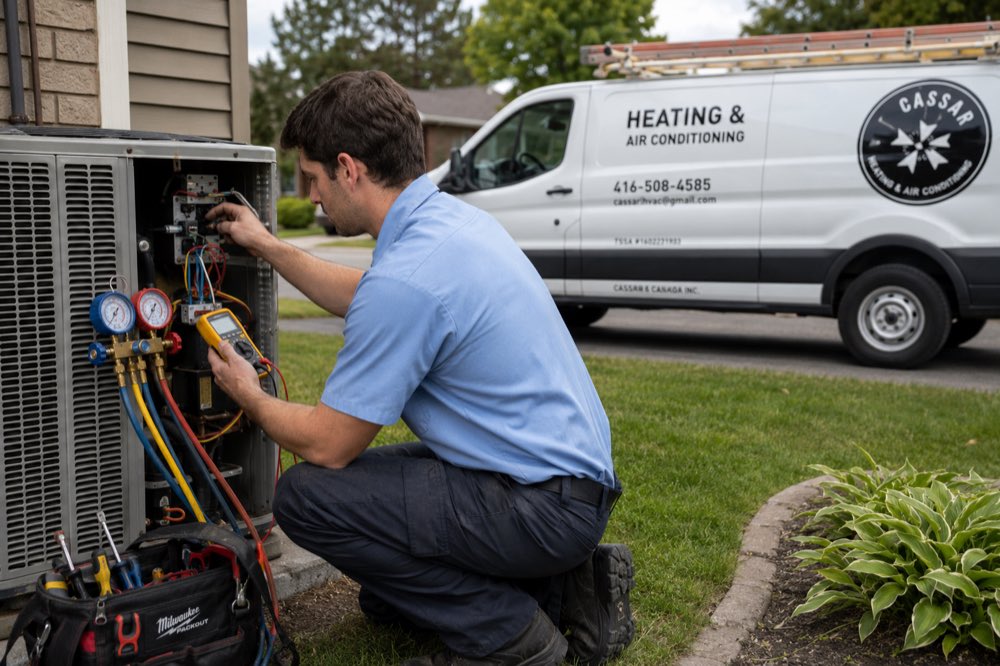
From a first-time heat pump install on a Beaverton property to an emergency repair call in Cannington, David handles every job personally.
Many Brock homes on Sunderland Road and the surrounding rural routes still run propane furnaces, and switching to a cold-climate heat pump often cuts annual heating costs significantly. David sizes the unit to the actual load of your home, not to whatever’s on the shelf. He handles the full install, from the outdoor pad to the electrical disconnect, and leaves you with a system that’s registered and TSSA-compliant from day one.
If your heat pump isn’t heating, isn’t cooling, or is making noises it wasn’t making last week, David diagnoses it on the same visit he arrives. He stocks common replacement parts in the truck, so most repairs close on the first call rather than waiting days for a part to show up. That matters more in Brock than it might in Oshawa, where you’re further from supply houses.
When a repair doesn’t make financial sense anymore, David tells you straight. He’ll walk you through the age of the unit, the cost of the repair, and what a replacement would realistically cost, and you decide. He won’t push a replacement to make a sale. If a repair extends a unit’s life another three to four years at a reasonable cost, that’s what he’ll recommend.
A heat pump tune-up covers the refrigerant charge, electrical connections, coil condition, defrost cycle, and filter check. Most heat pump failures David sees in Durham Region’s rural communities trace back to deferred maintenance, not equipment failure. Booking an annual check before the heating season starts keeps the system running efficiently and catches problems before they become emergency calls in January.
Upgrading from an older 8 or 10 HSPF unit to a modern cold-climate heat pump rated at 10 or above makes a measurable difference in Brock’s climate, where temperatures regularly drop into the minus teens. David can also walk you through the current Canada Greener Homes and Ontario rebate programs that apply to qualifying equipment, so you know what the real net cost looks like before you commit.
When the heat stops working on a February night in Cannington and the temperature outside is minus fifteen, you need someone who picks up the phone and actually comes out. David takes emergency calls across all of Brock Township. You won’t reach a call centre, you’ll reach David directly, and he’ll give you a straight answer about how soon he can get there.
Since 2011, I’ve worked in homes across Brock Township, and the pattern I see most often is a homeowner who’s been on propane or oil for twenty years, knows their bills are high, but hasn’t had anyone give them a straight answer about whether a heat pump would actually work for their setup. I give that answer on the first call, not after I’ve already sold something. Every quote I put together is the number you’ll see on the invoice.
A well-maintained heat pump in Ontario typically runs between 15 and 20 years. The outdoor unit takes the most abuse, it’s cycling through freeze-thaw conditions every winter and running through humid Ontario summers, so the 15-year end of that range is more realistic for units that don’t get annual servicing. Units that get cleaned, charged correctly, and inspected each year regularly push past 18.
What shortens a heat pump’s life faster than anything else in this climate is refrigerant running slightly low for years without anyone catching it. The compressor works harder, runs hotter, and wears out early. That’s a problem David spots on a tune-up visit, not a $6,000 compressor replacement call two winters from now. Ontario’s freeze-thaw cycling also stresses the defrost components, so checking that the defrost cycle is initiating and terminating correctly is something he prioritises on every maintenance visit.
The other factor is installation quality. A unit that’s slightly undersized for the home’s heat load will run constantly in cold weather, wearing components down faster. Getting the load calculation right at the start adds years to the system’s life, and it’s something David does before quoting any install job.
For a standard central heat pump installation in a Brock home, the installed cost typically runs between $5,000 and $10,000, depending on the size of the unit, whether it’s a straight swap-out or a new installation, and what condition the existing ductwork and electrical are in. Cold-climate models from manufacturers like Mitsubishi, Bosch, or Carrier, which hold their efficiency rating below minus 15°C, sit at the higher end of that range. That premium pays back in lower heating bills on propane or oil, usually over three to six years depending on your current fuel cost and usage.
Repair calls generally run between $200 and $800 for most common issues: a capacitor, a reversing valve, a defrost board, a refrigerant recharge. Major component failures like a compressor replacement often push close to or past the cost of a new unit, which is where David’s honest repair-versus-replace conversation comes in. He’ll tell you the numbers and let you decide.
Annual maintenance visits run roughly $150 to $200 and cover a full inspection of both the indoor and outdoor unit. The best way to know what your specific job will cost is to get a free quote from David, no pressure, no obligation.
The Township of Brock’s housing stock is predominantly rural and semi-rural, with a large portion of homes built between the 1950s and the 1990s in communities like Beaverton on Lake Simcoe, Sunderland, Cannington, and the smaller hamlets in between. Many of these homes were originally built for oil or propane heat, which means the ductwork is often sized generously, good news for heat pump retrofits, since heat pumps move more air volume at lower temperatures than a furnace does. That said, older flex duct in poor condition or uninsulated duct runs through unheated crawl spaces are common, and both undermine heat pump efficiency before you ever turn the system on.
Lakefront properties in Beaverton and along the Lake Simcoe shoreline deal with higher humidity and windier conditions than the inland townships. Outdoor units on lake-facing properties benefit from a wind baffle or strategic placement, and coil corrosion from lake air is something David checks more carefully on those properties at maintenance time.
Brock homes on larger rural lots also frequently lack natural gas service, which makes heat pump economics considerably more favourable than they’d be in an area with access to cheap natural gas. For a home currently running propane at current prices, a cold-climate heat pump often cuts the annual heating bill by 40 to 60 percent, sometimes more. That calculation changes depending on your current equipment, insulation, and electricity rate, but it’s a conversation worth having.
The most common warning sign is a heat pump that runs continuously without reaching the set temperature. In Brock’s coldest months, January and February, a heat pump will run longer cycles than it would in milder weather, and that’s normal. What’s not normal is a system that runs all night and still can’t get the house above 16 degrees. That usually points to low refrigerant, a failing reversing valve, or a unit that was undersized for the home to begin with.
Ice buildup on the outdoor unit is worth watching. Some frost is part of normal operation in winter, and the defrost cycle clears it periodically. A unit that’s completely encased in ice and stays that way means the defrost system isn’t working. In Brock’s rural properties, ice on the outdoor unit also sometimes traces back to poor drainage around the pad or debris blocking airflow, both of which David checks before assuming a component failure.
Short cycling, the system turning on and off every few minutes, is another signal that something needs attention. It can mean a refrigerant issue, a faulty pressure switch, or electrical problems. Left unaddressed in Durham Region’s winter conditions, short cycling accelerates compressor wear significantly. If you’re hearing any of these patterns, calling David before the system quits entirely is the right call.
Durham Region’s winters are genuinely cold, and Brock’s position at the northern edge of the region means temperatures regularly drop lower than what homeowners in Pickering or Ajax experience. A cold-climate heat pump rated to minus 25 or minus 30°C at full capacity handles Brock’s winters without needing to fall back on electric resistance backup heat for most of the season. If you’re shopping for a unit, that rating matters more than the SEER cooling rating for a Brock installation.
Keeping the outdoor unit clear of snow and ice in winter is something every Brock homeowner with a heat pump should stay on top of. Heavy snow packed around the base of the unit restricts airflow and can trigger the defrost cycle more frequently than necessary. A quick check and clearance after a heavy snowfall takes two minutes and protects the system. David recommends keeping at least 18 inches of clearance on all sides of the outdoor unit year-round.
In summer, the same system runs in reverse as an air conditioner. Keeping the outdoor coil clean, free of cottonwood, grass clippings, and debris, is the single biggest thing you can do to maintain cooling efficiency. A coil that’s 30% blocked delivers noticeably less cooling capacity and costs more to run. That’s part of what David cleans and inspects on an annual maintenance visit.
Heat pumps don’t produce combustion, so there’s no carbon monoxide risk from the heat pump itself. If your Brock home uses a gas or propane backup furnace in a dual-fuel system, the furnace side still requires annual inspection by a TSSA-licensed technician. David holds TSSA Licence #000398183, which covers both the heat pump work and the gas furnace side of a dual-fuel install. That matters because some contractors will do the heat pump work but aren’t licensed to touch the gas appliance, leaving you with a system that’s only half-serviced.
On the rebate side, the Canada Greener Homes Grant has wound down, but the Canada Greener Homes Loan program continues to offer interest-free financing for qualifying heat pump installations. Ontario’s Enbridge Home Efficiency Rebate program covers homes with gas backup, and some hydro utilities, including those serving parts of Durham Region, offer their own heat pump incentives. The programs change frequently, and David keeps current on what’s available so he can tell you what applies to your specific install at the time of quoting.
For efficiency, look for units with a Heating Seasonal Performance Factor (HSPF2) of 9 or above and a cold-climate designation. Units that maintain rated heating capacity at minus 15°C or below are the ones worth installing in a climate like Brock’s, anything rated only to minus 8 or minus 10 will rely heavily on electric resistance backup on the coldest nights, which erases much of the efficiency advantage.
Checking the simple things before calling saves time for everyone, so run through these before you pick up the phone.
Heat pumps require the thermostat to be set to Heat, and the temperature must be set above what the room currently is. Also confirm the system mode isn’t set to Emergency Heat unless you actually need it, running on Emergency Heat uses electric resistance strips and costs significantly more to operate.
Heat pumps have two circuit breakers, one for the air handler inside and one for the outdoor unit. Both must be on. A breaker that’s tripped often sits in the middle position rather than fully off, so look carefully. Reset it once; if it trips again immediately, stop and call David rather than resetting it a second time.
Some frost on the outdoor unit is normal in winter. A unit completely encased in ice is not, this indicates a defrost issue. Don’t chip at it; that damages the coil fins. If the ice isn’t clearing after an hour or two, call Cassar. In Brock’s cold winters, a stuck defrost cycle can ice over a unit quickly.
A blocked filter forces the heat pump to work harder and can trigger safety shutoffs. Pull the filter, hold it up to the light, and if you can’t see light through it, replace it. A clogged filter is one of the most common causes of reduced airflow complaints David gets called out on, and it’s a free fix if you catch it early.
If your heat pump is blowing cool air in heating mode, the reversing valve may be stuck or the thermostat may be sending the wrong signal. This isn’t something you can fix yourself, but knowing this is the likely cause helps David come prepared with the right parts. This needs a licensed technician to diagnose and repair.
If none of the above solved it, the system needs a licensed technician. David serves all of Brock and Durham Region, he picks up the phone himself, and he’ll tell you exactly what the next step is.
Yes, cold-climate heat pumps work in Ontario winters, including Brock’s. The key word is cold-climate. Standard heat pumps lose capacity quickly once temperatures drop below minus 5 or minus 8°C, which is a problem in a climate where January nights in Brock regularly hit minus 15 or colder. Cold-climate models, which are rated to maintain heating capacity at minus 15 to minus 25°C and below, are built specifically for this. Manufacturers like Mitsubishi, Bosch, Carrier, and Daikin all make units that hold their rated output well into the temperatures Brock sees. The installation has to be sized correctly for the home’s heat load, a unit that’s undersized will struggle in the coldest weeks. David calculates load before he quotes any install, so the unit he recommends is actually matched to your home’s heating demand, not just the square footage.
For most Brock homes, the answer depends on what you’re currently heating with. If you’re on natural gas, the economics are tighter, gas is still relatively cheap in Ontario, and a heat pump’s efficiency advantage over gas narrows compared to propane or oil. That said, a dual-fuel setup, where a heat pump handles most of the heating season and a gas furnace kicks in only on the coldest nights, often gives you the best of both worlds. If you’re on propane or oil, the case for switching to a cold-climate heat pump is much stronger. Propane in Brock’s rural areas costs enough that a heat pump typically cuts your annual heating bill by 40 to 60 percent. David will look at what you’re currently paying, what your home’s insulation situation looks like, and give you an honest answer about which direction makes more financial sense, including the impact of current rebates on the installed cost.
A standard central heat pump installation in Durham Region typically runs between $5,000 and $10,000 installed, depending on the unit’s size, the brand and efficiency rating, and the complexity of the installation. Cold-climate models sit toward the higher end of that range. Ductless mini-split systems, which are common in Brock homes that don’t have existing ductwork, run from about $3,500 for a single-zone system up to $10,000 or more for a multi-zone installation. What drives the variation is the size of the unit required for your home’s heat load, whether the electrical panel needs upgrading to handle the new equipment, and whether any ductwork modifications are needed. Rebates from the Canada Greener Homes Loan program and certain utility programs can reduce the net cost by $1,000 to $5,000 depending on eligibility and the equipment chosen. The best way to know what your specific job will cost is to get a free quote from David, no pressure, no obligation.
The main programs available to Ontario homeowners right now include the Canada Greener Homes Loan, which offers interest-free financing up to $40,000 for qualifying heat pump installations with no repayment required for the first year, it’s tied to a pre and post energy audit. Enbridge’s Home Efficiency Rebate Plus program offers cash rebates for heat pump installations in homes that use natural gas for heating, and some local utilities serving parts of Durham Region run their own heat pump incentive programs. The Ontario Energy Board’s rebate programs have changed several times in recent years, so David checks current availability at the time of quoting rather than relying on program details that may have expired. The rebate landscape shifts frequently, and what applied six months ago may have changed. He’ll tell you what you actually qualify for at the time of your install, and factor that into the quote so you’re looking at a real net number, not just a list price.
A standard central heat pump swap, replacing an existing air conditioner with a heat pump using the same air handler and ductwork, takes most of a day, typically six to eight hours. A more complex installation, like adding a heat pump to a home that previously had only a furnace and needs new refrigerant line sets run and electrical work completed, can take one to two days. Ductless multi-zone systems vary depending on how many indoor heads are being installed and how complex the routing is through the walls and attic. David will tell you exactly what to expect in terms of time when he gives you the quote, so you can plan accordingly. He works without a crew of assistants cycling in and out, which keeps the disruption to your home to a minimum. Most Brock homeowners are back to full heating or cooling by the evening of the installation day.
Start with the thermostat, confirm it’s set to Heat mode, not Cool or Fan Only, and that the set temperature is higher than the current room temperature. Then check both circuit breakers, because the heat pump has one for the outdoor unit and one for the indoor air handler, and either one can trip independently. Check the air filter; a completely blocked filter can cause the system to shut down on a safety limit. Look at the outdoor unit, if it’s completely covered in ice and stays that way, the defrost system isn’t working and you need a technician. If the outdoor fan is running but no warm air is coming from the registers, or cool air is coming out while the system is in heating mode, the reversing valve may be stuck or malfunctioning. That’s a part David stocks and can diagnose on arrival. If none of those checks turn anything up, call him directly at (416) 508-4585 and he’ll walk through it with you before deciding whether a service visit is needed.
Yes, and for Brock specifically, David only recommends cold-climate models. A standard heat pump isn’t the right tool for the north end of Durham Region where temperatures regularly hit minus 15 to minus 20 in January and February. Cold-climate units maintain their rated heating capacity well below those temperatures, which means your system is still delivering meaningful heat on the coldest nights without relying entirely on expensive electric resistance backup strips. David has installed cold-climate heat pumps from Mitsubishi, Bosch, and Carrier in homes across Brock Township, including properties in Beaverton, Cannington, and Sunderland. He’ll discuss the options, explain the differences between models in plain terms, and recommend the unit that fits your home’s load and your budget, not the most expensive option on the list.
Yes, a heat pump works as a full air conditioner in summer. It runs the refrigerant cycle in reverse, pulling heat out of your home and moving it outside, exactly the way a conventional air conditioner does. The difference is that a heat pump replaces both the furnace in winter and the air conditioner in summer with a single system. For Brock homes that currently have a furnace but no air conditioning, installing a heat pump gives you year-round comfort without needing two separate systems. The cooling efficiency is measured by SEER or SEER2 rating, and most modern heat pumps carry ratings between 15 and 20 SEER2, which is comparable to or better than a standalone central air conditioner. If your home already has an air conditioner and a gas furnace, David can walk you through whether converting to a heat pump or a dual-fuel system makes sense for your specific situation, including how the economics work out on your current heating fuel.
“Our heat pump quit heating on a Tuesday night in February up here in Cannington. David had it diagnosed and running by noon the next day, reversing valve had failed.”
“We’d been on propane for 18 years and kept putting off switching. David came out to the house in Beaverton, walked us through exactly what a cold-climate heat pump would cost to run versus what we were spending, and didn’t try to oversell us on anything. He installed a Mitsubishi unit that’s been running perfectly since last fall. The savings are real.”
“Price he quoted was the price on the invoice. Not a dollar more. He put covers down on the floors, cleaned up everything before he left, and the whole job was done in one day. For what a heat pump install cost me in Sunderland I’d expected a bigger production, it was straightforward from start to finish.”
David covers all of Durham Region, Brock is part of his regular service territory, not an afterthought.
Same-day service available. TSSA certified. Honest pricing. Call or book online.