
Many homes in the Township of Brock were built in the 1970s and 1980s with older utility rooms sized for large tank-style heaters, and switching to a tankless unit often means rerouting the gas line and upgrading the venting before the job’s done right. David covers all of Brock and surrounding Durham Region communities, with same-day and emergency availability when your hot water stops without warning.
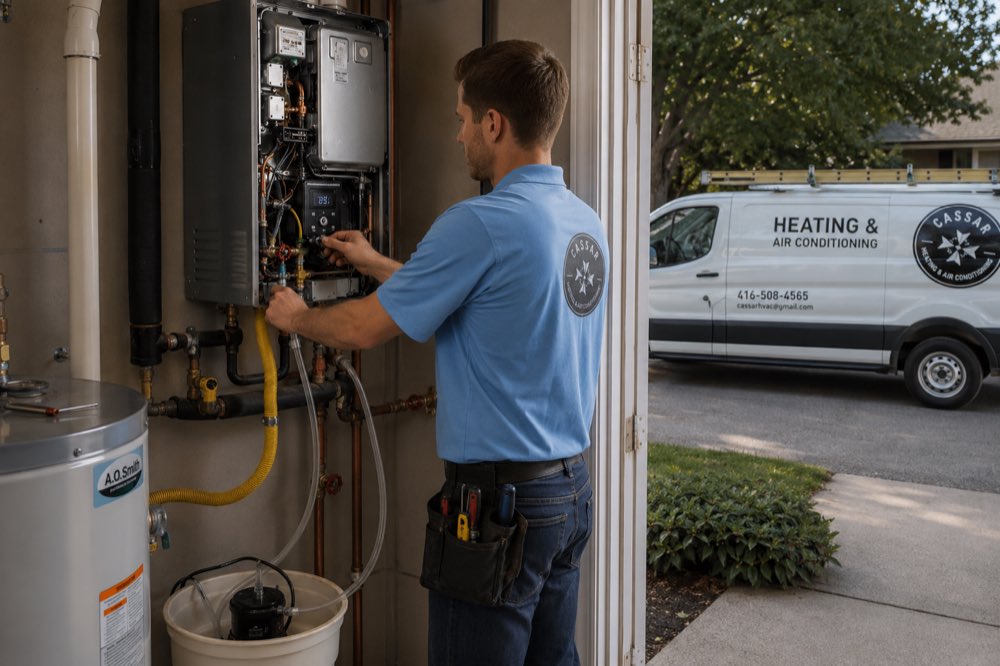
From a first-time tankless install to an emergency repair in the middle of a cold snap, David handles every part of the job himself.
Many Brock homes on rural lots run on propane rather than natural gas, and David sizes and installs propane-compatible tankless units with the correct BTU rating for the household demand. He handles the gas line work, venting, and permits so you’re not coordinating multiple trades. Every installation meets TSSA requirements under Licence #000398183.
Ignition failures, error codes, fluctuating temperatures, and flow sensor faults are the calls David gets most often from Brock homeowners. He carries the parts that fail most frequently on Navien, Rinnai, and Rheem units so he’s not leaving your home waiting on a supplier order. The quote comes before anything gets touched.
David tells you honestly whether a repair makes more sense than a replacement. If the heat exchanger has failed on a 12-year-old unit, replacement usually wins on cost. If it’s a sensor or valve on a 4-year-old unit, he’ll fix it. You get the real picture, not a sales pitch aimed at moving new equipment.
A tankless water heater needs its heat exchanger descaled, its inlet filter cleaned, and its burner assembly inspected once a year to hold efficiency and catch small problems before they become expensive ones. David schedules annual maintenance visits and sends a reminder when yours is due. Skipping this step is the single most common reason units fail before their time.
Upgrading from a conventional tank to a condensing tankless unit can cut your water heating costs by 25 to 40 percent, depending on your household’s usage. David sizes the new unit correctly for your home’s demand, installs the condensate drain line that condensing units require, and walks you through any Ontario rebates that apply to your specific model and situation.
Brock’s rural geography means the nearest HVAC company isn’t always close, and waiting two days without hot water isn’t an option in January. David takes emergency calls personally and gets out to Cannington, Sunderland, Beaverton, and surrounding Brock communities without routing you through a dispatcher. Call (416) 508-4585 and you’ll reach David directly.
I’ve been working on tankless systems in Township of Brock since 2011, and a big chunk of what I see out here are older propane setups that weren’t sized properly when tankless technology first started replacing tanks in rural areas. Getting that sizing right the first time is the difference between a unit that runs clean for 20 years and one that short-cycles and throws error codes every winter. I give you the full picture before I charge you anything.
A properly maintained tankless water heater should last 18 to 22 years in Ontario. That’s nearly double the lifespan of a conventional tank, which averages 10 to 12 years. The key word there is “maintained.” A unit that never gets descaled or serviced will start throwing heat exchanger errors and flow faults well before the 15-year mark, and heat exchanger replacements are expensive enough that you’re often better off replacing the whole unit at that point.
What shortens lifespan most in Ontario is hard water scaling. Durham Region water has moderate to high hardness, and the minerals in that water accumulate inside the heat exchanger over time. Left unchecked, scale acts as insulation against heat transfer, forcing the burner to work harder and run hotter than it was designed to. Annual descaling with a citric acid flush keeps the exchanger clear and the unit running at its rated efficiency.
Cold climate operation also puts more demand on the heat exchanger than mild-climate installs. When your incoming cold water is sitting at 3 or 4 degrees Celsius in January, the unit has to work harder to reach the setpoint temperature than it does in July. That thermal load is manageable when the unit is clean and properly sized, but compounds quickly if maintenance gets skipped year over year.
A straightforward tankless water heater installation in Brock, replacing a conventional tank in a natural gas home where the gas line capacity and venting location already work, runs between $3,000 and $4,500 installed. That range covers a mid-efficiency unit, labour, and standard venting through an exterior wall. A condensing high-efficiency unit adds roughly $400 to $700 to the unit cost but includes the condensate drain connection and typically qualifies for Ontario energy rebates that offset a portion of the upgrade.
Jobs that move the unit to a different location, require a gas line upsized from 1/2 inch to 3/4 inch, or switch from natural gas to propane add cost because there’s more trade work involved. Propane tankless installs in rural Brock homes often run $4,200 to $5,500 depending on how much gas line work is needed. Repair calls for most common faults, including igniter failures, flow sensor replacements, and valve issues, typically run $280 to $650 parts and labour.
Every Brock job gets a free upfront quote before David touches anything. The best way to know what your specific job will cost is to get a free quote from David, no pressure, no obligation.
The Township of Brock has a distinctive housing mix compared to the rest of Durham Region. Cannington, Sunderland, and Beaverton each have a core of older village-era homes built between the 1890s and the 1950s, with utility rooms that were retrofitted for modern appliances rather than built to accommodate them. These homes often have tight mechanical rooms and masonry chimneys that were used for venting, so switching to a direct-vent or power-vent tankless unit requires running new PVC exhaust and intake through an exterior wall rather than using the existing chimney stack.
A large portion of Brock’s rural residential properties run on propane rather than municipal natural gas. This matters for tankless sizing because a high-output unit, drawing 199,000 BTU at full fire, needs a supply line and regulator setup that can deliver adequate pressure without dropping below the unit’s minimum threshold when demand spikes. David checks supply pressure and line sizing before committing to a unit recommendation, because undersizing the gas delivery is the leading cause of ignition failures on propane tankless installs.
Brock also has a significant number of hobby farms and larger rural properties where multiple outbuildings need domestic hot water. A single outdoor-rated tankless unit or a two-unit recirculating setup handles these applications differently than a standard residential install, and the venting, freeze-protection, and gas supply considerations are different from a typical in-home job. David has handled these configurations across Brock since 2011 and knows what works in this township’s specific conditions.
The clearest sign is an error code on the display panel. Navien, Rinnai, and Rheem units all have self-diagnostic systems that identify the fault category, whether it’s an ignition failure, a flow sensor reading out of range, or a combustion issue. Write down the code before you call David, it tells him what parts to bring and cuts diagnostic time significantly. Ignoring a repeating error code and resetting the unit is how small problems turn into heat exchanger failures.
Fluctuating water temperature, where the shower runs hot for 30 seconds and then drops to lukewarm, usually points to a flow sensor fault, a dirty inlet filter, or a gas supply pressure issue. In Brock’s rural propane homes, low tank pressure in winter when propane vaporises more slowly at cold temperatures is a cause David checks early. Temperature instability can also come from an undersized unit struggling to keep up with simultaneous demand from multiple fixtures.
A unit that takes longer than usual to deliver hot water, or one where the recirculation pump runs constantly without actually maintaining temperature, indicates scale buildup in the heat exchanger. Durham Region’s water hardness accelerates this process, and Brock homeowners on well water with high mineral content see it faster than those on municipal supply. Annual flushing catches this early. Waiting until the unit stops working means a more involved and more expensive service call.
Ontario’s winters put tankless units through their hardest work of the year. When incoming cold water drops below 5 degrees Celsius, your unit’s flow rate capacity effectively decreases because it takes more energy to reach setpoint. A unit rated for 9 litres per minute at a 35-degree rise might only deliver 7 litres per minute at a 50-degree rise in January. David factors this into sizing recommendations so your unit delivers adequate flow year-round, not just in August.
Freeze protection is a real concern for any tankless unit installed in an unconditioned space or against an exterior wall in Brock’s climate. Most modern units have built-in freeze protection down to around minus 20 degrees Celsius, but that protection only works when the unit has power. If you lose power during a winter storm and your utility room drops below the protection threshold, the unit can freeze and crack the heat exchanger. David recommends foam insulation on exterior wall sections of the plumbing and a battery backup for the unit’s control board in exposed installations.
Summer brings its own consideration: hot incoming water. When ground temperature rises in late July and August, incoming water can reach 20 degrees or more, and the unit barely has to fire. This is actually great for efficiency but can cause comfort issues if the unit’s minimum flow rate doesn’t trigger the burner properly at very low temperature rise demands. Adjusting the setpoint slightly and ensuring the recirculation setup is calibrated correctly for summer conditions keeps the unit delivering consistent results all year.
In Ontario, any gas appliance installation or repair must be performed by a TSSA-registered contractor. This isn’t a formality, the TSSA exists because gas appliances carry real risks when installed incorrectly, including carbon monoxide leaks from improper venting and gas leaks from fittings that weren’t torqued and leak-tested properly. David’s TSSA Licence #000398183 is verifiable on the TSSA public registry. Any contractor who can’t point you to their registration number isn’t legally authorised to touch your gas appliance.
Condensing tankless units achieve efficiencies of 95 to 98 percent AFUE, meaning almost none of the gas energy you pay for goes out the exhaust pipe. Ontario’s Enbridge Gas Home Efficiency Rebate Plus program has offered rebates on qualifying high-efficiency water heating equipment in the past, and the Canada Greener Homes Grant has covered eligible upgrades for homeowners who met the audit requirements. Rebate availability changes, and David checks current program status when he gives a quote so you know what you’re actually eligible for at the time of installation.
Carbon monoxide detectors are mandatory in Ontario homes under the Fire Code, and a properly vented tankless unit with intact combustion seals produces negligible CO in normal operation. Where David sees CO risk is in units where the exhaust vent has a joint that’s worked loose, or where birds or wasps have partially blocked the intake pipe. He checks both vent pipes on every service call, intake and exhaust, because a partially blocked intake causes incomplete combustion and CO production even when everything else looks fine.
Checking the simple things before calling saves time for everyone.
Tankless units have self-diagnostic displays. Write down the error code and call Cassar, this tells us exactly what’s wrong before we arrive.
There’s a small mesh filter screen on the cold water inlet that catches debris. It blocks up over time and restricts flow enough to prevent ignition.
Make sure the gas shutoff valve behind the unit is fully open. It can get partially closed during other work in the utility area.
Running multiple hot water fixtures simultaneously can exceed the unit’s flow capacity, causing a cold burst. Try running one fixture at a time to test.
Tankless units vent through the wall or roof. Check that the intake and exhaust pipes are clear, undamaged, and properly connected.
If none of the above fixed it, the unit needs a licensed technician. David serves all of Durham Region and picks up the phone himself.
Yes, for most Durham Region homeowners, a tankless water heater is worth the upfront cost within 6 to 10 years through energy savings alone, and the unit will keep saving money for a decade or more after that. A tankless heater only fires when you open a hot tap, it doesn’t keep 40 or 60 gallons hot around the clock the way a tank does. In Ontario’s cold climate, where water heating can account for 15 to 20 percent of a home’s energy bill, eliminating that standby heat loss adds up fast. You also get the practical benefit of never running out of hot water, which matters in larger households or homes where two people are showering at similar times. For propane users in rural parts of Durham Region, the savings are even more pronounced because propane costs more per BTU than natural gas, and a tankless unit’s higher efficiency directly cuts propane consumption. The units also last nearly twice as long as a conventional tank, so you’re comparing two replacement cycles on a tank to one replacement cycle on a tankless over the same 20-year period.
In Brock, tankless water heater installation typically runs between $3,000 and $5,500, depending on the fuel type, unit efficiency, and how much gas line or venting work is needed. A natural gas install where the existing gas supply and venting location work is at the lower end of that range, around $3,000 to $4,200. A propane install on a rural Brock property, where David often needs to assess supply line sizing and regulator capacity, runs $3,800 to $5,500. Condensing high-efficiency units cost more upfront, usually adding $400 to $700 to the unit cost compared to a standard unit, but they qualify for efficiency rebates that can offset $500 to $1,000 of that. Repair calls for most common faults run $280 to $650 parts and labour. What moves the number up is gas line work that wasn’t originally sized for a tankless unit’s higher BTU demand, venting runs that need to go through multiple walls or a longer horizontal distance, and jobs that require switching fuel types or moving the unit to a different location. The best way to know what your specific job will cost is to get a free quote from David, no pressure, no obligation.
It will if it’s sized correctly for your household’s peak demand, and that sizing is the most important decision in the whole installation. A single tankless unit rated at 9 to 11 litres per minute will handle two simultaneous showers comfortably in most Durham Region homes, where a typical shower head runs at 7 to 9 litres per minute. Where homeowners run into problems is when a unit was undersized at installation, either because the installer used a cheap entry-level unit or didn’t calculate the total simultaneous flow demand across all fixtures. In Brock, where many rural homes have larger footprints with multiple bathrooms, a laundry room, and sometimes a separate utility sink all potentially drawing hot water at once, David always calculates the worst-case simultaneous demand before recommending a unit size. He’ll also check your cold incoming water temperature at its January low point, because a unit that can keep up in summer may struggle when ground temperature drops and the unit needs a larger temperature rise to hit setpoint. The right unit for a two-bathroom Brock home with typical usage is usually in the 180,000 to 199,000 BTU range for natural gas, and sized proportionally for propane.
Most homes in Ontario that were built with a conventional tank water heater have a 1/2-inch gas supply line running to the water heater location, and that line is usually adequate for a tank drawing 30,000 to 40,000 BTU. A tankless unit at full fire draws 150,000 to 199,000 BTU, which is four to five times the demand on that same gas line. Whether the existing line can supply adequate pressure and volume depends on its diameter, its total length from the meter or regulator, how many other appliances share the main supply, and the pipe material. In many cases, David needs to upsize the branch line from 1/2 inch to 3/4 inch, or in longer runs, to 1 inch. On rural Brock properties running propane, he also checks that the regulator is rated for the total BTU load of all appliances simultaneously, including the furnace if it fires at the same time as the tankless unit. This gas line assessment is part of every installation quote, and David won’t install a unit on an undersized line because it’ll fail to ignite reliably under high demand conditions. The line work adds to the installation cost, but it’s not optional if the pipe isn’t adequate.
A straightforward tankless installation where David is replacing an existing tank at the same location, with adequate gas supply and a workable venting path, typically takes 3 to 5 hours. That includes removing the old tank, installing the new unit, connecting gas, running the new direct-vent through the wall, testing ignition and temperature, and cleaning up. Jobs that require gas line work to upsize the supply add 1 to 2 hours. Installations that involve moving the unit to a different room, rerouting plumbing, or adding a recirculation pump and return line add more time still and are better planned for a full day. In Township of Brock, where David sometimes works with older homes that have unconventional utility room configurations, he factors in extra time for problem-solving on the day rather than leaving a job half-finished. He gives you a realistic time estimate before the job starts, and he stays until it’s done and tested properly. You won’t get a call at 3pm saying he’ll have to come back tomorrow to finish the venting.
Cold water from a tankless unit almost always means the burner isn’t firing, and there are several reasons that happens. The most common causes are a blocked cold water inlet filter restricting flow below the unit’s minimum activation threshold, a gas supply issue such as a partially closed valve or low propane tank pressure in winter, a failed igniter or ignition module, or an error code that’s put the unit into lockout mode after repeated fault attempts. In Brock, where a lot of homes run on propane, low tank pressure is a call David gets every January when temperatures drop and propane vaporises more slowly in cold tanks. If the unit’s display shows an error code, write it down before calling because it tells David exactly which system tripped the lockout. If there’s no error code and the unit has power and gas, the next step is checking the inlet filter and gas valve, both of which you can do yourself before calling a technician. If those check out fine and you’re still getting cold water, something inside the unit needs a licensed technician to diagnose. Call David at (416) 508-4585 and he’ll ask the right questions before driving out so he arrives with the parts most likely needed.
Annual servicing is the right interval for tankless water heaters in Brock and across Durham Region, and it’s not just a blanket recommendation. Ontario’s water hardness, combined with the temperature extremes the unit handles between summer and winter, creates descaling and inspection needs that build up meaningfully over 12 months. A service visit covers flushing the heat exchanger to remove mineral scale, cleaning the inlet filter screen, inspecting the burner assembly and igniter, checking the venting connections for any joint separation or blockage, and verifying that the pressure relief valve operates correctly. Homeowners in Brock on well water with high mineral content should consider a descale flush every 8 to 10 months rather than waiting a full year, because well water mineral loads vary significantly and some wells accelerate scaling faster than municipal supply does. Skipping annual service is the most reliable way to shorten the unit’s lifespan from 20 years to 12. David schedules annual visits and sends a reminder when yours is coming up so you’re not relying on memory to protect a significant investment in your home.
David installs and services all major tankless brands sold in the Canadian market, including Navien, Rinnai, Rheem, Noritz, Bradford White, and AO Smith. For installations, he recommends specific models based on your household’s demand, fuel type, and budget rather than pushing whatever brand carries the highest margin. The brands he installs most often in Brock are Navien and Rinnai, both of which have strong parts availability in Ontario, which matters when a repair is needed and you don’t want to wait two weeks for a component to arrive from a specialty distributor. For service calls on units he didn’t install, David diagnoses the fault first and gives you an honest assessment of whether a repair makes financial sense on that specific unit’s age and condition before ordering parts. Some brands, particularly cheaper units sold through big-box retailers, have limited parts availability after five to seven years, and David will tell you that upfront rather than letting you spend $400 on a repair that won’t extend the unit’s life meaningfully. The best way to know what your specific job will cost is to get a free quote from David, no pressure, no obligation.
“Our propane tankless unit in Cannington stopped igniting in January. David came out the same day, found a cracked igniter, and had it firing again before dinner.”
“I called about replacing our old tank with a tankless unit at our place just outside Beaverton. David came out, looked at the gas line, and was upfront that it needed to be upsized before he could install the unit safely. He explained exactly why, quoted both the line work and the installation together, and did the whole job in one day. No surprises on the bill. Appreciated that he didn’t just slap the unit in and let me figure out the ignition problems later.”
“Quoted me $420 for the repair. Invoice came in at $420. He put down a mat in the utility room before pulling anything apart and took it with him when he left. For a technician coming all the way out to our property in Sunderland, that kind of care with the home isn’t something I expected, but it made an impression.”
David covers all of Durham Region, including every community in and around the Township of Brock.
Same-day service available. TSSA certified. Honest pricing. Call or book online.