
Ajax’s rapid growth since the 1990s means a lot of homes are sitting on original builder-grade gas fireplaces that haven’t been touched in twenty years, and David sees the consequences of that neglect every winter when they stop lighting or start tripping CO detectors. He covers all of Ajax and the rest of Durham Region, and he picks up the phone himself.
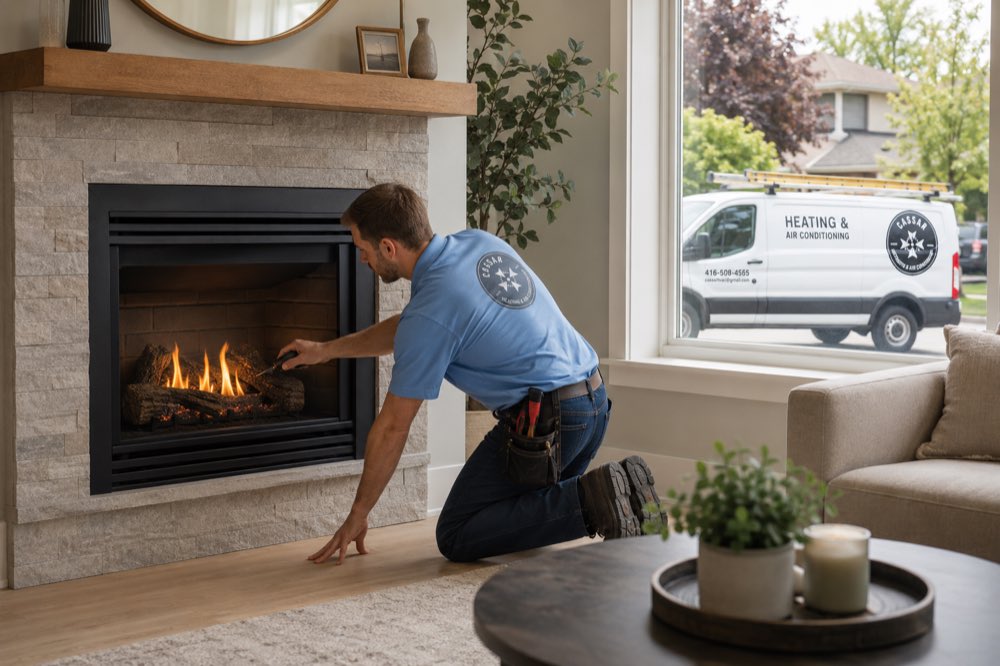
From a first install in a new Ajax townhouse to a twenty-year-old unit that stopped firing, David handles every fireplace job personally.
David installs direct-vent and b-vent gas fireplaces in Ajax homes, from newer builds near Pickering Village to older semis closer to Harwood Avenue. He sizes the unit to the room, handles the gas line connection, and completes the TSSA paperwork before he leaves. You get one visit, one quote, one technician.
Pilot lights that won’t hold, thermocouples that fail mid-winter, gas valves that stick, igniters that click but don’t fire, these are the calls David takes most often from Ajax homeowners. He carries common replacement parts, so most repairs finish in a single visit rather than requiring a return trip after a parts order.
When a repair won’t cut it, David replaces the unit and tells you why before he writes the quote. He won’t recommend replacement if a repair makes sense, that’s a principle, not a sales pitch. New direct-vent inserts can drop into an existing opening in most Ajax homes without major framing changes, which keeps the job scope and the cost predictable.
A yearly service keeps the heat exchanger clean, the thermocouple reading correctly, and the burner assembly free of dust that builds up over a summer of sitting unused. David checks the flue or vent termination, tests CO output, and cleans the glass, tasks that most homeowners don’t know to ask about until something fails.
Many Ajax homes built between 1985 and 2005 have B-vent fireplaces that send most of their heat up the flue. Upgrading to a sealed direct-vent unit with a ceramic burner and variable flame can cut your supplemental heating cost noticeably. David calculates whether an upgrade pays back within a reasonable timeline before recommending it.
A fireplace that smells like gas, trips a CO alarm, or produces visible soot around the surround needs attention the same day, not next week. David covers Ajax and all of Durham Region for emergency calls, and he answers the phone directly. You won’t reach a dispatcher or a call centre when you’re standing in front of a unit that’s throwing a CO warning.
Ajax homeowners call David because he’s done this work on their street, in their floor plan, on units their builder spec’d fifteen years ago. He’s not quoting from a price sheet, he’s quoting from experience with the same townhouse layouts, the same stacked direct-vent terminations, and the same builder-grade gas valves that show up across Ajax’s Riverside, Central West, and South East neighbourhoods. Since 2011, David has run a one-technician operation by choice, so every job gets his full attention from the first call to the cleanup.
A gas fireplace installed and maintained properly will last 15 to 25 years in an Ontario home. The burner assembly and heat exchanger hold up well when they’re serviced annually. The components that fail first are almost always the thermocouple or thermopile, the igniter, and the gas valve, all replaceable parts that shouldn’t trigger a full replacement conversation on their own.
What shortens lifespan in Ontario’s climate is the freeze-thaw cycle working on the vent termination outside the wall. Water gets into the horizontal vent cap, freezes, and expands, cracking the fitting or degrading the mesh screen that keeps debris out. David checks terminations on every maintenance visit because a blocked or damaged vent cap is one of the most common causes of pilot-light issues in Ajax homes and one of the easiest to miss.
Running the fireplace year-round for supplemental heat puts more hours on the gas valve than seasonal use. That’s fine for units rated for continuous operation, but builder-grade inserts often aren’t. If you’re running yours more than four or five hours a day through a Durham Region winter, a tune-up every year rather than every two years is the right call.
A gas fireplace tune-up and cleaning in Ajax runs between $150 and $250 depending on the unit’s condition and how long it’s been since the last service. A straightforward repair, replacing a thermocouple, cleaning a clogged burner, or reseating a pilot assembly, lands between $200 and $400 for parts and labour combined. More involved repairs involving gas valve replacement or ignition module work run $300 to $600.
New fireplace installation costs more because it includes the unit, the gas line work, venting, and any framing or finishing around the surround. A direct-vent insert going into an existing opening in an Ajax home typically runs $2,500 to $4,500 installed, depending on the unit you choose and the complexity of the vent run. A full built-in installation with a new gas line rough-in can reach $6,000 to $9,000 or more if there’s significant wall work involved.
What drives the variation is the length of the vent run, whether the gas line needs extending, and the model you choose. David gives you the exact number before anything gets touched. The best way to know what your specific job will cost is to get a free quote from David, no pressure, no obligation.
Most of Ajax’s residential growth happened in two waves: the late 1980s through the mid-1990s along the older central and south areas near Harwood and Salem, and the 2000s through to the mid-2010s in the northern sections closer to Taunton Road and the 407. Homes from the first wave commonly have B-vent fireplaces with standing pilot lights and older millivolt-controlled gas valves. These units can still perform well, but the components are increasingly hard to source, and a repair sometimes costs more than it’s worth compared to a direct-vent upgrade.
Homes from the 2000s boom typically came with builder-grade direct-vent inserts, often from mid-tier brands that used electronic ignition systems. These are easier to service, and parts are generally available, but David sees a consistent pattern of ignition control modules failing around the 12 to 15 year mark in Ajax homes, right around the age of a lot of the stock in Ajax’s northwest neighbourhoods now.
Ajax’s townhouse density in areas like Riverside and the Pickering Village-adjacent sections also creates a specific challenge: many of these units share a party wall, and the vent termination runs out the side of the building in a tight exterior clearance. Building code sets minimum clearances from windows, doors, and gas meters that some original installations got wrong, and David checks compliance during every install and replacement job in Ajax.
The most common warning sign is a pilot light that relights but won’t stay on for more than a few seconds. That’s almost always a failing thermocouple, and it points to a unit that’s been sitting through multiple Durham Region winters without a service. The thermocouple sits directly in the pilot flame and generates a tiny voltage to hold the gas valve open. When it wears down, the voltage drops below the threshold and the valve closes, cutting the pilot. It’s a safety mechanism working as designed, but it means the part needs replacing.
Yellow or orange flames instead of a consistent blue burn signal incomplete combustion, usually from a dirty burner or a disrupted air-to-gas ratio. White or grey deposits building up on the ceramic logs indicate the same thing. In Ajax homes near the waterfront areas, higher humidity levels in the shoulder seasons can accelerate this kind of buildup in fireplaces that aren’t used regularly.
A smell of gas at startup that doesn’t clear within a few seconds, soot accumulation around the fireplace surround or on the wall above the unit, and any CO alarm activation are all situations where the fireplace goes off and David comes out the same day. These aren’t warning signs to monitor. They’re stop-use situations.
Durham Region’s winters run cold from mid-November through March, with temperatures regularly dropping below -10°C overnight. A gas fireplace on that schedule sees meaningful thermal cycling stress on the heat exchanger and glass gaskets. Scheduling a tune-up in September or October, before the first cold snap, means you’re not calling for emergency service on a December evening when David’s already booked solid across Ajax and Pickering.
During the spring and summer months, the fireplace sitting unused doesn’t mean it’s resting. Dust and spider webs accumulate in the burner tray and vent termination. David has pulled active wasp nests out of exterior vent caps on Ajax homes, a blocked termination causes the unit to back-draft and can trip CO sensors the first time you fire it up in the fall. Covering the exterior vent cap with a fine mesh screen properly rated for gas appliances solves this, and it takes ten minutes.
If you use the fireplace for zone heating to take load off your furnace, run it with the room door open to let the heat circulate rather than trapping it in one room. Gas fireplaces produce radiant and convective heat, and a properly sized unit can meaningfully reduce furnace runtime in a main living area during a Durham Region cold spell, but only if the heat has somewhere to go.
Ontario’s Technical Standards and Safety Authority regulates gas fireplace installation and repair. Every technician who works on a gas appliance in your Ajax home needs a valid TSSA licence. David’s is #000398183, you can verify it directly through the TSSA’s public registry. This matters because unlicensed gas work voids your home insurance and creates liability that follows you if you ever sell. It’s not a technicality; it’s the difference between work that’s covered and work that isn’t.
Carbon monoxide is odourless and accumulates fast in a sealed home. Every gas fireplace should have a working CO detector within 1.5 metres of the unit, and Ontario’s CO alarm regulations require working detectors near sleeping areas in any home with a fuel-burning appliance. If your CO detector is more than seven years old, replace it. The electrochemical sensor inside degrades over time and won’t read accurately even if the unit still powers on.
On the efficiency side, Ontario’s Enbridge Home Efficiency Rebate program has historically included rebates for high-efficiency heating equipment, and some direct-vent fireplace upgrades have qualified depending on the equipment specs and the program year. David can tell you what’s currently available when he gives you a quote, but eligibility changes year to year so it’s worth asking at the time rather than assuming a rebate that applied last season still applies today.
Checking the simple things before calling saves time for everyone, run through these five steps first.
Most fireplace issues start with the pilot light going out. Follow the manufacturer’s relight instructions on the unit, usually hold the pilot button for 30–60 seconds. If it relights but doesn’t stay on, that points to a thermocouple issue and it’s time to call.
These small sensors sit in the pilot flame and generate the signal to keep the gas valve open. If they’re worn, the pilot lights but won’t stay on. This needs a technician, it’s not a homeowner repair, but it’s a straightforward job for David.
There’s usually a shutoff valve behind or beneath the fireplace. Make sure it’s fully open, these sometimes get turned off accidentally during cleaning. The valve handle runs parallel to the pipe when open and perpendicular when closed.
Most modern gas fireplaces use a remote or wall switch. Weak batteries cause intermittent ignition failures before failing completely. Swap in fresh AA or AAA batteries in both the remote and the receiver module before assuming there’s a mechanical fault.
Heavy soot or white mineral deposits on the glass can affect some sensor-based ignition systems. Clean glass also improves efficiency significantly. Use a cleaner rated for gas fireplace glass, standard window cleaner damages the ceramic coating on the pane.
If none of the above sorts it out, it needs a licensed technician. David serves all of Ajax and Durham Region and picks up the phone himself.
A gas fireplace installation in Durham Region typically runs between $2,500 and $9,000 depending on what the job involves. A direct-vent insert going into an existing framed opening in an Ajax home, with the gas line already roughed in nearby, sits at the lower end of that range, generally $2,500 to $4,500 installed. A full built-in installation requiring a new gas line run from the basement, new framing, and a finished surround from scratch can reach $6,000 to $9,000 or more. What drives the cost up is the length of the vent run through the wall, the distance from the gas line to the new unit, the model you select, and any finishing work around the hearth. David gives you a fixed quote before anything gets touched, so the number you hear at the start is the number on the invoice. The best way to know what your specific job will cost is to get a free quote from David, no pressure, no obligation.
Most modern gas fireplaces use direct-vent technology, which means they don’t need a traditional masonry chimney at all. A direct-vent unit draws combustion air from outside through an outer pipe and exhausts through an inner pipe, all within a single sealed coaxial vent that runs through the wall horizontally or up through the roof. This is how most installations work in Ajax’s newer homes and townhouses. If your home has an existing masonry chimney, a gas fireplace insert can be lined and vented through it, which is a common approach in Ajax’s older central neighbourhoods. B-vent fireplaces, which use indoor air for combustion and vent vertically, do require a chimney or dedicated vertical flue, but these are becoming less common in new installations because they’re less efficient than sealed direct-vent units. David assesses your home’s existing venting during the quote visit and recommends the configuration that works for your specific layout.
A gas fireplace can carry a meaningful portion of your heating load but shouldn’t replace a central furnace as your sole heat source for a full Durham Region winter. The issue is distribution, not output. A well-sized direct-vent fireplace can efficiently heat the room it’s in and adjacent open areas, but it won’t push heat into bedrooms, bathrooms, or the upper floors of a two-storey Ajax home without a separate circulation system. Where fireplaces work well as supplemental primary heat is in zone heating, running the fireplace in the main living area while turning down the furnace setpoint reduces furnace runtime and can lower your gas bill noticeably during the coldest months from December through February. For a small bungalow or a well-insulated open-plan Ajax home, a high-output direct-vent unit could theoretically carry the main floor on most days, but you’d still want the furnace as backup for extreme cold snaps when temperatures in Durham Region drop below -20°C. David can size a unit to your floor plan and give you a realistic picture of what it’ll cover.
Once a year is the right interval for most Ontario gas fireplaces, and the best time to book it is September or early October before the heating season starts. A yearly service covers the thermocouple and thermopile condition, burner cleanliness, glass seals, the exterior vent termination, CO output, and the gas valve operation. In Ontario’s climate, the vent termination deserves particular attention, freeze-thaw cycles stress the fitting and mesh, and blocked terminations are a common cause of first-fire-of-the-season failures across Ajax and the rest of Durham Region. If you run the fireplace heavily throughout the winter, meaning four or more hours a day most days, servicing it every year rather than stretching to every 18 months is the right call. If the unit sat unused for more than one season, have it serviced before you light it, David checks for debris and blockages in the vent and burner tray that accumulate during an off season.
Start with the pilot light. If the pilot is out, follow the relight sequence printed on the unit’s label, usually hold the pilot button in for 30 to 60 seconds after lighting to let the thermocouple heat up before releasing. If the pilot lights but won’t stay on when you release the button, the thermocouple or thermopile has likely worn down and isn’t generating enough voltage to hold the gas valve open. Next, check that the gas supply valve behind or beneath the unit is fully open, the handle should run parallel to the pipe. Then check the batteries in the remote or wall switch receiver; weak batteries cause intermittent ignition failures that look like a mechanical fault. If your fireplace uses electronic ignition rather than a standing pilot, also check the igniter electrode for carbon buildup or cracking. In Ajax homes that have gone through several winters without a service, the combination of a degraded thermocouple and a dirty burner is the most frequent cause of a no-light situation David gets called out for.
A fireplace insert slides into an existing masonry or factory-built fireplace opening, sealing it up and converting it to a more efficient gas appliance. It’s the right solution when you already have a framed opening and want to improve efficiency without rebuilding the surround. A built-in fireplace, sometimes called a zero-clearance fireplace, is a self-contained unit installed into a framed wall cavity, typically in a new build or a renovation where there’s no existing firebox. It gives you more design flexibility because the surround and finishes are chosen fresh. A gas log set sits inside an existing masonry wood-burning fireplace and connects to a gas line, converting the wood-burning unit to gas. It’s the simplest and lowest-cost option, but the fireplace still needs to be in good structural condition and the gas line needs to reach it. Log sets are less efficient than inserts because the masonry firebox isn’t sealed around them. David can walk you through which option fits your Ajax home’s existing setup during the quote visit.
David works on gas fireplaces from most major brands, Napoleon, Regency, Valor, Majestic, Heatilator, Heat & Glo, Kozy Heat, and others. For repairs and maintenance, the brand matters less than the type of ignition system and the age of the unit, both of which David can assess on arrival. He carries common thermocouple and thermopile assemblies, igniter electrodes, and gas valve components that cross-reference across multiple brands. For new installations, David sources from suppliers he’s used since 2011 and recommends units based on what he’s seen hold up in Durham Region homes over time, not based on what’s easiest to sell. If you have a specific brand or model in mind, let him know when you call and he’ll confirm availability before the quote visit. For older or discontinued units where parts are genuinely no longer available, he’ll tell you that directly rather than have you wait on a parts order that won’t come through.
A properly functioning, sealed direct-vent gas fireplace is generally safe to operate for extended periods, but leaving any gas appliance running unattended overnight isn’t something David recommends as a regular practice. The risk isn’t from the fireplace itself when it’s working correctly, it’s from what you might not notice while you’re asleep. A sealed direct-vent unit doesn’t pull combustion air from the room, so it won’t deplete indoor oxygen the way an older B-vent or open masonry fireplace can. But a failing glass seal, a developing crack in the heat exchanger, or a CO output reading that’s elevated for other reasons creates a situation you’d catch with a working detector but not while sleeping without one. Ontario’s CO alarm regulations require working detectors near sleeping areas in any home with a fuel-burning appliance. If yours is current, functional, and within 1.5 metres of the fireplace, and if the unit was serviced within the last year, the risk profile for extended operation is low. If it hasn’t been serviced recently, get a tune-up before you start relying on it heavily through an Ajax winter.
“Our Ajax fireplace hadn’t fired in two winters. David diagnosed a dead thermopile and had it running the same afternoon he came out.”
“I called about a pilot that wouldn’t stay lit and David answered right away. He came out to our place off Bayly and spent time actually explaining what had worn out and why, instead of just swapping the part and leaving. He showed me the thermocouple so I could see the condition it was in. Refreshing to deal with someone who treats the visit like a conversation instead of a transaction.”
“Quote came in exactly where David said it would. No extras tacked on, no surprises on the invoice. He put covers down on the floor before opening his toolbox and took everything with him when he left. My Ajax townhouse looked the same as before he arrived, except the fireplace actually works now.”
David covers all of Durham Region, find your community below.
Same-day service available. TSSA certified. Honest pricing. Call or book online.