
Ajax’s housing stock runs heavily toward two-storey detached homes built between the late 1980s and early 2000s, most of which still have the original tank water heater sitting in a cramped utility closet, and when that tank finally gives out, a tankless unit can reclaim the space and deliver unlimited hot water on demand. David Cassar covers all of Ajax and the surrounding Durham Region communities, with same-day service available when your hot water can’t wait.
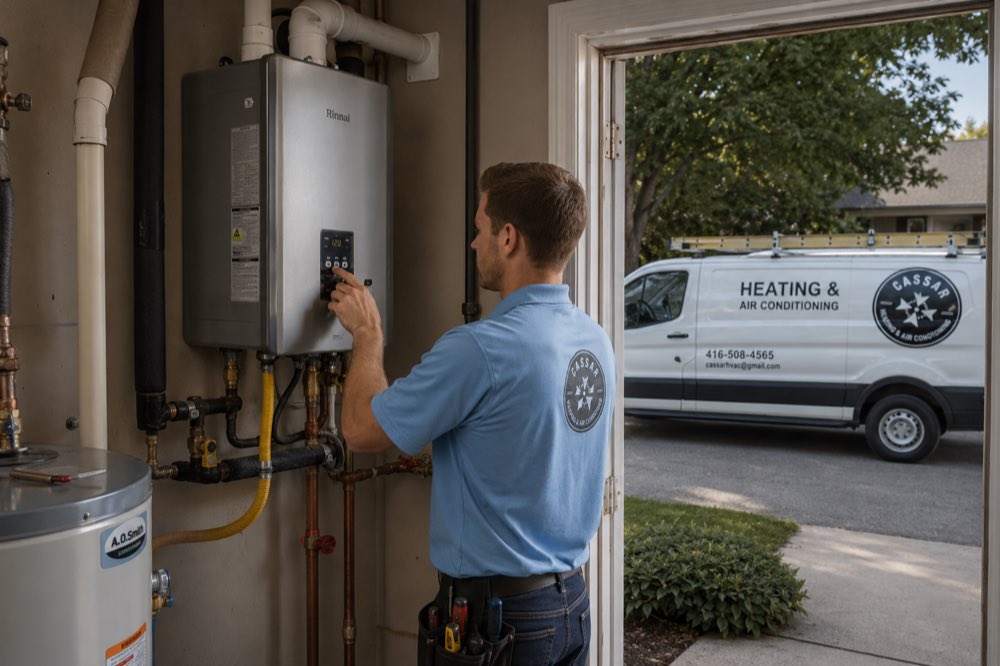
Every job below is something David handles personally, from the first phone call through to cleanup.
David installs natural-gas and propane tankless water heaters in Ajax homes, sizing each unit to match the household’s actual peak demand, not the largest model that will fit on the wall. Many Ajax homes built in the 1990s have undersized gas lines that need upgrading before a high-output tankless unit can operate properly, David checks this on every installation quote so there are no surprises on the day of the job.
Ignition failures, flow sensor faults, scale build-up, and error codes on the display are the most common repair calls David gets from Ajax homeowners. He stocks the parts that come up most often, so most repairs wrap up in a single visit. You’ll know the cost before he starts anything.
When a repair no longer makes financial sense, David gives you a straight answer about replacement rather than patching a unit that’ll fail again in six months. He’ll compare the repair cost against the age and condition of what you have, and let you decide. Ajax homeowners whose original tank units are finally giving out often move to tankless at this point, which frees up utility closet space and cuts standby energy losses.
A tankless water heater in Durham Region’s hard-water areas needs an annual flush to clear calcium scale from the heat exchanger. Skip it two or three years in a row and you’re looking at reduced output, error codes, and a shortened lifespan. David’s tune-up includes a full descale, inlet filter cleaning, burner inspection, and a combustion check.
Moving from a standard 80% efficiency tank unit to a condensing tankless model in the 96–98% AFUE range cuts your water heating costs noticeably over the year. David walks you through the options and the realistic payback window before you commit to anything. Ontario’s Enbridge Home Efficiency Rebate program has periodically offered incentives for qualifying tankless installations, and David can tell you what’s currently available.
A tankless unit that stops working on a cold January morning in Ajax isn’t something you want to wait a week for. David picks up the phone himself and gets to Ajax jobs the same day when the situation calls for it. There’s no dispatcher relaying your problem secondhand, you tell David directly what the unit is doing and he comes prepared.
Working in Ajax since 2011, I’ve seen the same pattern more than once: a homeowner calls because their tankless unit threw an error code and the company that installed it can’t get out for four days. I pick up the phone, ask a few questions, and usually I can tell you over the call whether it’s something simple or whether I need to come out. If I need to come out, I come out the same day. The quote I give you on the phone or at the door is what you pay, it doesn’t change when the invoice appears.
A gas tankless water heater, properly maintained, runs 18 to 22 years in most Ontario homes. That’s roughly double the lifespan of a conventional 40-gallon tank. The caveat is “properly maintained”, skipping annual service in a hard-water area like Durham Region can cut that lifespan down to 10 to 12 years as scale accumulates inside the heat exchanger and forces the unit to work harder to hit target temperatures.
What extends lifespan most is annual descaling with a citric acid or white vinegar flush, keeping the inlet filter clean, and making sure the venting is clear and properly supported. What shortens it fastest is running the unit in a home with very hard water and never flushing it, or using it at maximum output for years without a single service call.
Ontario’s cold winters push tankless units harder than they’d work in warmer climates. When incoming groundwater temperatures drop to near freezing in January and February, the unit has to raise the water temperature by 60 to 70 degrees Fahrenheit to hit your target, which means longer run times and more thermal cycling. That’s normal, it’s what the unit’s designed to do, but it’s one more reason annual maintenance matters here more than it would in, say, southern British Columbia.
A standard natural-gas tankless water heater installation in Ajax, where the existing gas line and venting are already suitable, runs roughly $2,800 to $4,200 installed, depending on the model, output rating, and any condensate drainage work required. If the gas line needs upgrading from a half-inch to a three-quarter-inch supply, which is common in Ajax homes built before 1995, add $300 to $600 to that range. Repairs range from $150 to $450 for most common faults, including ignition board failures, flow sensor replacements, and descaling service.
The main variables that move the number are the unit’s BTU output (a 180,000 BTU condensing unit costs more than a 140,000 BTU mid-range model), whether new venting needs to go through an exterior wall versus using an existing vent chase, and how far the unit sits from the main gas line. Condensing units, which capture heat from the exhaust gases and reach 96–98% efficiency, cost $400 to $600 more upfront than non-condensing models but save more over time on gas bills.
Every job gets a free upfront quote from David before any work starts. The best way to know what your specific job will cost is to get a free quote from David, no pressure, no obligation.
Ajax grew quickly through the late 1980s and 1990s, and most of the detached and semi-detached homes in Pickering Village, Westney Heights, and the central Ajax subdivisions were built during that period. These homes typically have a utility area in the basement with a natural gas furnace and a tank water heater on a three-quarter-inch gas line, enough to feed the original appliances but sometimes not quite enough to support a high-output condensing tankless unit without a line upgrade.
Many Ajax basements also have finished or partially finished utility rooms where the water heater sits against an interior wall. That affects where the new venting can run: a tankless unit needs a dedicated air intake and exhaust, which typically means a concentric pipe through an exterior wall. In some Ajax layouts that’s straightforward; in others, where the utility room backs onto a finished recreation room rather than an exterior wall, it takes a bit more planning. David scopes the venting path on the quote visit so you know exactly what’s involved before the install date.
Ajax’s water comes from Lake Ontario via the Durham Region water treatment system. It’s treated but still carries enough mineral hardness to build scale inside a tankless heat exchanger over time, which is why annual maintenance matters more here than homeowners sometimes expect when they first buy a unit.
The clearest sign is an error code on the display, most modern tankless units from Navien, Rinnai, Noritz, and similar manufacturers have detailed self-diagnostic systems. A code isn’t a crisis; it’s the unit telling you exactly where the problem is. Write it down before calling. The second most common sign is a noticeable drop in maximum water temperature or a unit that struggles to maintain temperature when two fixtures run at once, both usually point to scale build-up restricting the heat exchanger, though they can also indicate a gas pressure issue worth checking.
Unusual sounds matter too. A clicking noise at startup that doesn’t resolve into a steady burn means the ignition is failing. A rumbling or knocking from the heat exchanger usually means heavy scale. A high-pitched whistle from the gas valve area can indicate a faulty modulating valve. Ajax homeowners who’ve had their units for eight or more years without a service call tend to show up with a combination of these symptoms, not just one.
Water around the base of the unit or at pipe connections needs attention promptly. Condensing tankless units do produce condensate as a normal byproduct, which drains away through a dedicated line. But pooling water or drips from fittings means a connection has worked loose or a component has failed, and leaving it risks water damage to the utility area floor and adjacent finished spaces, a real concern in the basement-heavy homes across Ajax and the broader Durham Region.
Durham Region winters are genuinely cold, with outdoor temperatures dropping well below freezing for weeks at a time between December and February. A tankless unit installed on an exterior wall needs to be protected against freeze risk at its intake and exhaust terminations, snow and ice can block the pipes, which trips a safety shutdown. Check the terminations after heavy snowfall and clear any accumulation. Most manufacturers recommend keeping a clear zone of at least 12 inches around both pipes.
In the heating season, your water heater is working at the same time as your furnace, which increases the overall gas demand on the home’s supply line. If you notice weaker hot water performance specifically during peak morning hours in winter, that can point to a gas pressure drop under combined load, worth flagging to David on a service call so he can check the supply pressure at the unit while everything’s running simultaneously.
A thermostatic mixing valve at the unit output, which blends hot and cold water to deliver a consistent temperature at your fixtures, makes a meaningful difference in comfort and extends the heat exchanger’s life by reducing the on-off cycling the unit goes through when demand fluctuates. It’s a modest add-on cost on a new installation and worth considering, especially in homes with young children where scald protection matters.
Gas appliances in Ontario require installation and service by a TSSA-licensed contractor. David’s licence is #000398183, verifiable on the TSSA public registry. This isn’t a formality, a tankless water heater that’s improperly vented can introduce carbon monoxide into the living space, and an oversized unit on an undersized gas line can starve other appliances of pressure. The licence is the minimum standard for anyone touching gas equipment in your home.
On the efficiency side, Ontario’s Enbridge Home Efficiency Rebate Plus program has offered rebates for high-efficiency water heater upgrades in the past, and it’s worth confirming current availability before you buy. Qualifying condensing tankless units have periodically been eligible for $500 or more in rebates. David can tell you what’s active at the time of your quote and which models qualify, so you’re not leaving money on the table by buying the wrong unit or missing a submission deadline.
Carbon monoxide detectors are required by Ontario law in homes with gas appliances, and David checks that yours is functional and positioned correctly when he works in your utility area. It’s a small thing but it’s part of doing the job properly rather than just doing the job quickly.
Checking the simple things before calling saves time for everyone, and sometimes it saves you a service call entirely.
Tankless units have self-diagnostic displays. Write down the error code and call Cassar, this tells us exactly what’s wrong before we arrive, which means we come prepared with the right parts rather than diagnosing on the spot.
There’s a small mesh filter screen on the cold water inlet that catches debris. It blocks up over time and restricts flow enough to prevent ignition. Unscrew the inlet fitting, pull the screen, rinse it under a tap, and reinstall it, it takes five minutes and sometimes that’s all it needs.
Make sure the gas shutoff valve behind the unit is fully open. It can get partially closed during other work in the utility area, a furnace tune-up, a plumbing repair, even just someone bumping it while accessing the panel. A half-closed valve means insufficient gas pressure for ignition.
Running multiple hot water fixtures simultaneously can exceed the unit’s flow capacity, causing a cold burst. Try running one fixture at a time to test. If the unit keeps up with one shower but not two, the unit itself is fine, it may just be undersized for your household’s peak demand.
Tankless units vent through the wall or roof. Check that the intake and exhaust pipes are clear, undamaged, and properly connected. After a storm or heavy snowfall, blockages at the exterior termination are one of the most common causes of a sudden shutdown, the unit trips its safety and won’t restart until the obstruction is cleared.
If none of the above resolves it, it needs a licensed technician to diagnose. David serves all of Ajax and Durham Region and picks up the phone himself, tell him what the unit is doing and he’ll let you know the fastest path to getting your hot water back.
Yes, for most Ajax and Durham Region homeowners, the switch makes sense, especially if you’re replacing an aging tank that’s already near the end of its life. A condensing tankless unit operates at 96–98% efficiency compared to a standard tank’s 60–80%, which cuts your water heating costs noticeably over a year. The upfront investment is higher, but you’re also getting a unit that’ll last nearly twice as long as a tank, plus the convenience of continuous hot water that doesn’t run out mid-shower when there’s a full house. In Durham Region specifically, where winters are cold and incoming water temperatures drop significantly, the efficiency gap between a tankless unit and a tank is wider than it would be in a milder climate, because the tank is constantly losing heat to a cold basement environment while the tankless unit only fires when you need it. The honest answer is that it’s most worth it when you’re doing a planned replacement rather than an emergency one, because you have time to size the unit properly and address any gas line or venting prep work without the pressure of no hot water in the house. The best way to know what your specific job will cost is to get a free quote from David, no pressure, no obligation.
In Ajax, a standard tankless water heater installation runs roughly $2,800 to $4,200 all-in for most homes where the gas line and venting are already suitable. That range covers the unit, labour, permit if required, and connection work. If the gas line needs upgrading, which comes up regularly in Ajax homes built before 1995 that are still on their original half-inch gas supply, add $300 to $600. New venting through an exterior wall that doesn’t have an existing vent chase adds another $200 to $400 depending on wall thickness and run length. The unit itself is the biggest variable: a non-condensing 140,000 BTU unit costs less than a condensing 180,000 BTU model, and the condensing units command a premium of $400 to $600 over standard models. Condensate drainage is also required for condensing units, which may need a small neutralizer and drain line if one isn’t already in place. Every quote David gives is itemized so you can see exactly where the number comes from. The best way to know what your specific job will cost is to get a free quote from David, no pressure, no obligation.
It depends on the unit’s flow rate rating and how many fixtures are running simultaneously, but a correctly sized unit absolutely handles two showers running at the same time, and a high-output condensing unit manages three. The key word is “correctly sized.” The mistake David sees most often is a homeowner who bought a unit based on the store display or a previous owner’s choice, rather than a proper calculation of peak demand. Flow rate is measured in gallons per minute, and a typical shower draws about 2 GPM. A standard kitchen faucet adds another 1.5 GPM. Add those up for your household’s real morning routine and that’s the minimum flow rate the unit needs to match. In Ajax homes with large families or multiple bathrooms in use at the same time, David typically recommends a unit with a minimum 10–11 GPM rating at Ontario’s incoming groundwater temperatures. That’s not the smallest option on the shelf, but it’s the one that won’t leave the second person showering with lukewarm water. If you’re having cold-burst problems with a unit that’s already installed, the first thing to check is whether it was sized for your actual household load or just picked off a price list.
Many Ajax homes, particularly those built in the late 1980s and through the 1990s, have a half-inch gas supply running to the water heater location. A standard tank water heater draws about 30,000 to 40,000 BTUs and that supply is fine for it. A high-output condensing tankless unit can draw 150,000 to 199,000 BTUs at peak, and a half-inch line simply can’t deliver the gas volume and pressure that requires. Whether an upgrade is needed depends on two things: the existing pipe diameter and the total run length from the meter to the unit. A short half-inch run from a close meter point sometimes passes the pressure test; a long run almost never does. David checks gas pressure at the unit location during every quote visit rather than just eyeballing the pipe, because the run length and number of fittings matter as much as the diameter. If an upgrade is needed, the typical job involves running a new three-quarter-inch line from the meter or a main trunk line to the appliance location, a half-day job that gets added to the installation quote upfront so you’re not surprised by it on install day.
A straightforward tankless installation in an Ajax home, removing the old tank, installing the new unit in the same location, connecting to existing gas and water lines, and running new direct-vent piping through an exterior wall, takes three to four hours for David to complete. If a gas line upgrade is part of the same job, add another hour to two hours depending on the run. Homes where the venting needs to go through a finished wall or travel more than a few feet horizontally before exiting take longer, because cutting through finished surfaces and patching properly takes more time than a clean utility room wall does. David gives you a realistic time estimate on the quote visit once he’s seen the actual utility layout. In most cases, hot water is back on the same day the old unit comes out.
The most common cause of cold water from a tankless unit is ignition failure, which means the burner isn’t lighting even though the flow sensor triggered. This can come from a faulty igniter, a gas pressure issue, a dirty inlet filter reducing flow below the activation threshold, or a blocked exhaust that tripped the safety shutoff. Check the display for an error code first, most units will show you exactly which fault occurred. If the display shows no error but the water is cold, check that the gas valve is fully open and that the inlet filter isn’t clogged. Another common culprit in Ajax homes with multiple bathrooms is a “cold water sandwich”, a brief burst of cold water between two draws of hot, caused by residual cold water in the pipes from a previous draw. This is normal behaviour in tankless units and isn’t a malfunction. If the unit is producing genuinely cold water on every draw and there’s no error code, the flow sensor or the ignition control board is likely the issue and needs a service call to diagnose properly.
Once a year is the right interval for tankless water heaters in the Town of Ajax and Durham Region generally, because of the mineral hardness in the municipal water supply. An annual service involves flushing the heat exchanger with a descaling solution to remove calcium buildup, cleaning the inlet filter screen, inspecting the burner and ignition components, checking the combustion air and exhaust vent for obstructions, and verifying that the gas pressure at the unit is within the manufacturer’s specified range. Homeowners who skip servicing for two or three years in a row typically start seeing error codes and reduced output, the calcium scale acts as an insulator on the heat exchanger, forcing the unit to run longer to achieve the same temperature rise. Pushing past three or four years without a flush in a hard-water area shortens the heat exchanger’s life significantly and can void the manufacturer’s warranty on some models. An annual service call from David takes about an hour and is considerably cheaper than replacing a heat exchanger that scaled up from neglect.
David works on all major gas tankless water heater brands sold in Ontario, including Navien, Rinnai, Noritz, Bosch, Bradford White, A.O. Smith, Takagi, and Paloma. For new installations, he’ll recommend the models he’s seen perform reliably in Durham Region conditions over his years of service since 2011, that recommendation is based on parts availability, warranty support, and real-world performance in Ontario’s climate rather than which brand has the best margin. For service and repair calls, he works on whatever brand is already in your home. The error code systems vary by manufacturer but David’s familiar with the diagnostic language across all the common units. If a part needs ordering for a less common brand, he’ll tell you the lead time upfront so you can decide whether to wait for the repair or proceed to replacement if the unit is old enough to make that the better call.
“Our old tank finally gave out on a Friday afternoon. David had a new Navien unit installed and running in our Ajax home by Saturday morning.”
“I called because the unit was throwing an error code I’d never seen before. David picked up, I read him the code, and he told me right away it was likely the flow sensor, said he’d bring a replacement just in case. He was right, and the whole repair took maybe 45 minutes. Straightforward guy who clearly knows these units.”
“What I appreciated was that the price David quoted me over the phone, before he’d even seen the house, was within $50 of what I paid. He laid down a mat in front of the utility room, kept everything clean, and when he left you wouldn’t know he’d been there except for the shiny new unit on the wall. That kind of care matters when you’ve got a finished basement in Ajax.”
David covers all of Durham Region, if you’re near Ajax, he’s near you.
Same-day service available. TSSA certified. Honest pricing. Call or book online.