
Newcastle’s newer subdivisions along Rudell Road and the older homes closer to the village core sit on opposite ends of the spectrum when it comes to hot water tanks, some still running original builder-grade units from the early 2000s, others needing a first replacement after 15 hard winters in Durham Region. David covers all of Newcastle and surrounding Clarington communities, and he picks up when you call.
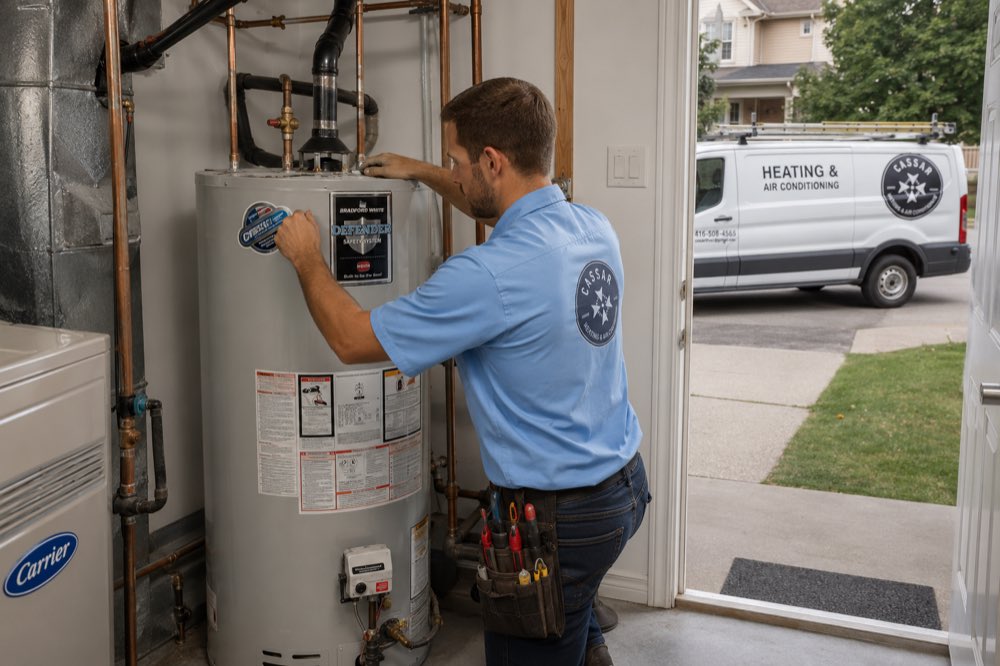
Every job below is something David handles himself, with a TSSA licence you can verify and pricing you’ll know before any work starts.
David installs natural gas, propane, and electric hot water tanks across Newcastle’s residential neighbourhoods. He sizes the unit to your household’s actual demand, not just whatever’s in stock. Every installation meets Ontario TSSA code and gets inspected before David leaves.
Pilot light issues, failed thermostats, faulty T&P valves, and burner problems are all repairable, and David won’t push a replacement if a repair makes financial sense for where your tank is in its lifespan. He stocks common repair parts so most jobs finish the same day.
Many Newcastle homes in the subdivisions built between 2000 and 2015 are reaching the point where their original tanks are due for replacement. David handles the full swap, shutting off the old unit, draining and disconnecting it, installing the new tank, and hauling the old one away. You’re not left managing any of it.
A yearly maintenance visit catches sediment buildup, checks the anode rod, tests the T&P valve, and confirms the burner or element is running efficiently. Most homeowners skip this, and then pay for a replacement five years earlier than they needed to. It’s a straightforward investment.
If your current tank is costing you more on gas or electricity than it should, upgrading to a higher-efficiency unit can reduce monthly operating costs noticeably. David explains the real payback period for your specific usage before you commit to anything. He won’t upsell you on a unit you don’t need.
A leaking tank or a complete loss of hot water isn’t something you wait a week to fix. David serves Newcastle for emergency calls and aims for same-day response. When you call (416) 508-4585, David answers, not a call centre routing your request through a queue.
Since 2011, David has worked in Newcastle homes from the older village streets near King Avenue West to the newer builds off Rudell and Beaver Street South, and the common thread is homeowners who want a straight answer, not a sales pitch. He’ll tell you honestly whether your tank needs a repair or a replacement, and he won’t pad the quote to make one option look better than the other.
A conventional storage water heater in Ontario typically lasts between 8 and 12 years, though tanks that get annual maintenance and were installed correctly can push closer to 14 or 15. The variation isn’t random, it comes down to water quality, how hard the tank works, and whether anyone’s looked at it between installation and the day something goes wrong.
Ontario’s water supply varies across Durham Region, and mineral content affects how quickly sediment accumulates on the tank floor. Sediment acts as insulation between the burner and the water, forcing the unit to work harder and run hotter than it was designed to. Flushing the tank annually removes that buildup and takes real years off the replacement timeline.
The anode rod is the other factor most homeowners never hear about until their tank fails. It’s a sacrificial magnesium or aluminum rod that corrodes in place of the tank lining. When it’s fully consumed, usually around the 5-to-7-year mark, the tank wall starts to rust from the inside. Checking and replacing the anode rod is the single highest-value maintenance step you can do for a tank’s long-term life.
A straightforward tank-for-tank replacement in a Newcastle home, same fuel type, same location, comparable capacity, runs roughly $1,200 to $1,800 installed, depending on the tank size and model. A 40-gallon gas unit sits closer to the lower end of that range. A 60-gallon high-efficiency tank with power venting will be at the higher end. Electric tank replacements tend to run $900 to $1,400 depending on capacity.
Repair costs vary more. A thermostat or element replacement on an electric tank might run $200 to $350. A gas valve or thermocouple swap on a gas unit is typically $180 to $320. If the job requires new venting, additional gas line work, or a change in tank location, those factors add to the total, and David walks you through exactly what’s involved before any work starts.
Every job David quotes is free and comes with no obligation. The price he gives you is what you pay, nothing added at the end. The best way to know your specific cost is to get a free quote from David.
Newcastle has two distinct housing eras that David runs into regularly. The older village core, homes along King Avenue West, Mill Street, and the side streets near the Wilmot Creek area, often has equipment from the late 1980s and 1990s. Many of these homes have atmospheric-vent gas tanks in utility rooms that haven’t been touched since the original installation. At that age, the question isn’t whether to replace, it’s how soon.
The newer subdivisions, particularly those developed in the 2000s and early 2010s along Rudell Road, Beaver Street South, and the newer streets north of Highway 2, have builder-grade tanks that are now 12 to 18 years old. These were often mid-range 40-gallon units installed to code minimums. They’re reaching the end of their useful life right now, and David sees several of these per season, homeowners who bought new and assumed the equipment would last longer than it has.
One thing that comes up in Newcastle specifically is access. Utility rooms in some of the town’s split-level and raised-bungalow homes from the 1980s and 1990s have tight clearances around the tank. David factors that into the job before he arrives, if a replacement requires disconnecting additional components to get the old tank out, he tells you upfront.
The most obvious sign is running out of hot water faster than you used to. That’s usually sediment reducing the effective capacity of the tank, or a failing lower heating element on an electric unit. Either way, it’s a sign the tank is working harder than it should to keep up with normal demand.
Discoloured water, rust-coloured or carrying a faint metallic smell, points to the tank lining deteriorating from the inside. Once that starts, no repair stops it. A small drip from the base of the tank or from the pressure relief valve discharge pipe is a more urgent sign. A T&P valve that’s weeping isn’t doing its job of relieving pressure correctly, and it needs attention the same day.
In Clarington’s colder months, an older tank that’s running continuously without fully recovering is a common complaint David fields from Newcastle homeowners in January and February. The tank’s insulation degrades over time, and in a colder utility room or unheated basement, a 15-year-old unit loses heat faster than its burner can replace it. If your tank sounds like it’s always running, that’s a conversation worth having before it becomes a cold-shower emergency.
Durham Region’s winters are hard on heating equipment, and hot water tanks sit in utility rooms or basements that can drop to 10 or 12 degrees Celsius in a cold snap if they’re not well-insulated. A tank in a cold space works harder and costs more to operate. Adding an insulating blanket to an older tank in an unheated utility room is a cheap, practical step that actually moves the needle on efficiency.
Setting your tank thermostat to 49°C (120°F) is the recommended balance between safety and efficiency for most households. Higher than that and you’re paying more to heat water than you’ll use, plus increasing the risk of scalding. Lower than 49°C and you’re creating conditions where Legionella bacteria can grow in a tank that sits idle for extended periods. David sets it to the right temperature on every installation.
Flushing sediment from the tank once a year matters more in Durham Region than in areas with softer water. The region’s water supply carries enough mineral content that skipping annual flushes accelerates sediment buildup on the tank floor. If you’ve never flushed your tank and it’s more than four years old, that’s the first maintenance step worth booking.
In Ontario, gas appliance installation and repair is regulated by the TSSA, the Technical Standards and Safety Authority. Any contractor working on your gas water heater is required to hold a valid TSSA gas technician licence. David’s licence number is #000398183 and it’s searchable on the TSSA’s public registry. This isn’t a technicality, an unlicensed installation puts your homeowner’s insurance at risk and creates genuine safety liability.
A malfunctioning gas water heater is one of the more common sources of carbon monoxide in residential settings. A cracked heat exchanger, blocked flue, or backdrafting vent can put CO into your living space without any visible warning. David checks the venting and combustion system on every gas tank job. If you don’t have a CO detector in the same space as your gas appliances, install one, it’s the minimum safety baseline for any home with gas equipment.
Ontario homeowners replacing an older tank with a high-efficiency unit may qualify for rebates through Enbridge Gas or the Canada Greener Homes initiative, depending on the efficiency rating of the new unit and current program availability. David can tell you what applies to your specific situation. Rebates change, and he’ll give you an accurate picture rather than a vague promise that one might exist.
Checking the simple things before calling saves time for everyone.
The temperature dial on your tank may have been turned down accidentally, especially after maintenance visits. Try turning it up and waiting 30 minutes.
Electric tanks have a dedicated breaker that trips occasionally. Gas tanks have a pilot light, if it’s out, follow the relight instructions on the label.
A dripping T&P valve is a warning sign, not normal. Turn down the thermostat and call Cassar, don’t ignore a dripping relief valve.
Loud rumbling or popping usually means sediment has built up on the tank floor. Flushing may help on newer tanks; on older ones it often signals time to replace.
The shutoff valve on the cold water inlet to the tank must be fully open. It sometimes gets partially closed during plumbing work nearby.
If none of the above resolved it, the tank needs a licensed technician. David serves all of Newcastle and Durham Region and picks up the phone himself.
“Our tank failed on a Thursday morning and we had hot water again by that afternoon. Newcastle isn’t exactly the centre of everything, so I wasn’t expecting same-day.”
“Called David about a 13-year-old gas tank that was making a lot of noise and running constantly. He came out, checked it over, and was straight with me, the sediment buildup was bad and the anode rod was gone. He walked me through what a repair would buy versus just replacing it, gave me the numbers, and let me decide. No pressure either way. Had a new tank in the same day. Exactly what I needed from someone working in my Newcastle home.”
“Quoted me $1,450 installed, charged me $1,450. I’ve dealt with contractors who treat the quote as a starting point for negotiation upward, so this was refreshing. He laid a mat down in the utility room, took the old tank out, cleaned up when he was done, and my Newcastle house looked exactly as he found it. Solid work.”
David covers all of Clarington and every community across Durham Region, here’s where you’ll find Cassar hot water tank service nearby.
Same-day service available. TSSA certified. Honest pricing. Call or book online.