
Oshawa’s housing stock runs heavily toward 1960s–1990s builds in neighbourhoods like Lakeview, Centennial and Pinecrest, and many of those homes have older B-vent or natural-draft fireplaces that haven’t been serviced in years, David sees that pattern constantly, and he knows exactly what those units need. He covers all of Oshawa and the wider Durham Region and picks up the phone himself when you call.
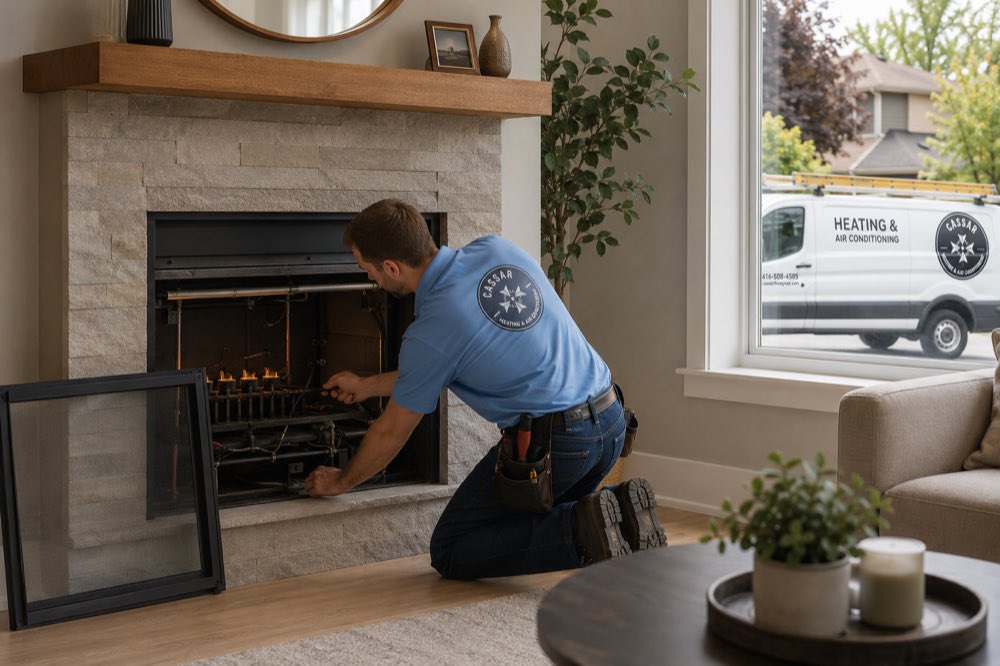
From a brand-new installation to a no-heat call on a cold January night, David handles every fireplace job himself, no subcontractors, no surprises on the invoice.
David installs direct-vent and B-vent gas fireplaces in Oshawa homes, including the infill builds going up around Windfields and the older bungalows near the waterfront. He sizes the unit to the room, runs the venting properly, and gets it connected to your existing gas line. You get a clean installation with no drywall damage left behind.
Pilot won’t stay lit, the remote’s lost its signal, or the burner fires but the flames look weak, these are the calls David gets most often from Oshawa homeowners. He carries common thermocouples, thermopiles, ignition modules and gas valves in the truck so most repairs finish on the first visit. He’ll tell you upfront whether the fix makes sense or whether the unit’s past its useful life.
Older standing-pilot fireplaces from the 1980s and 1990s are common in Oshawa’s established neighbourhoods, and parts for them are increasingly hard to source. When repair stops making economic sense, David removes the old unit, reconfigures the venting if needed, and installs a current-model replacement. He won’t recommend replacement unless he’d make the same call on his own home.
Ontario Gas regulations require that any gas fireplace be maintained in safe working order, and most manufacturers void the warranty without annual service records. David cleans the burner assembly, checks the heat exchanger for cracks, tests the thermocouple output, and inspects the venting for blockages or condensation damage. He documents everything so your warranty stays intact.
Switching from an older standing-pilot model to a millivolt or electronic-ignition unit can meaningfully cut the gas you use for supplemental heat. David matches the new unit’s BTU output to your room size so you’re not over-firing a small space or underpowering a large one. He’ll walk you through the available options and what each one will realistically cost to run.
A gas smell near the fireplace or a unit that won’t shut off needs attention right away, not a booking three days out. David answers his own phone and gets to Oshawa addresses fast because he’s based in Durham Region and knows the city well. If you smell gas, turn off the supply at the shutoff valve and call immediately, (416) 508-4585.
I’ve been working on fireplaces in Oshawa since 2011, and the same issues come up in neighbourhood after neighbourhood: units that haven’t been touched in a decade, thermocouples that should’ve been replaced two winters ago, and venting that was installed incorrectly from the start. I know what to look for, and I’ll tell you straight what it needs. You call me, I answer, and I do the work myself.
A well-maintained gas fireplace will typically last 15 to 25 years in Ontario, though some units push past that range if they’ve had regular service. The wide spread comes down to three things: how often the unit runs, how well it’s been maintained, and whether the original installation was done correctly. A fireplace that sat neglected for ten years ages faster than one that’s had an annual clean and inspection.
Ontario’s climate shortens the lifespan of venting components in particular. The freeze-thaw cycle stresses termination caps and exterior vent covers, and condensation inside B-vent piping during cold stretches corrodes the inner liner over time. Catching that early, during an annual service call, costs far less than replacing a venting run that’s rusted through.
The single biggest thing you can do to extend a fireplace’s life is annual maintenance before heating season. Clean the burner, check the thermocouple output, inspect the heat exchanger, and confirm the venting is clear and intact. Units that get that treatment routinely hit the top of their lifespan range and then some.
A basic gas fireplace service call, including cleaning and inspection, runs roughly $150–$250 in Oshawa depending on the unit’s age and condition. Repairs vary widely: a thermocouple swap is typically $150–$200 all in, while a gas valve replacement lands closer to $300–$500 depending on the valve and the access involved. Full unit replacements, including removal of the old fireplace and installation of a new direct-vent model, generally run $2,500–$5,500 depending on the unit selected and the venting configuration required.
New installation cost depends heavily on whether a gas line is already roughed in near the fireplace location, how the venting needs to route to an exterior wall, and whether any framing or drywall work is needed. Adding a new gas line from the meter can add $300–$700 to the total. David scopes all of that before quoting so the number he gives reflects the actual job.
Every job gets a free upfront quote with no obligation. The best way to know what your specific job will cost is to get a free quote from David, no pressure, no obligation.
The City of Oshawa grew rapidly through the postwar decades on the back of the auto industry, and that history shows in the housing stock. Neighbourhoods like McLaughlin, Centennial, and O’Neill are packed with 1960s and 1970s bungalows and splits that were built with wood-burning masonry fireplaces or early natural-draft gas inserts. Many of those original masonry units have since been retrofitted with gas inserts that were installed without a proper liner, which is a code issue David flags regularly on service calls in those areas.
The Lakeview and Farewell neighbourhoods closer to the waterfront have a similar profile, with a mix of original brick-chimney homes and mid-century builds where someone has added a freestanding gas stove or converted an old woodbox to gas over the years. The newer subdivisions north of Taunton Road, Windfields, Kedron, and the developments around Harmony Road North, typically have builder-installed direct-vent fireplaces that are newer but often haven’t been serviced since the home was built.
One pattern David sees specifically in Oshawa’s older core: B-vent fireplaces installed through the attic and out the roof rather than through an exterior wall. This venting route is more common here than in newer Durham Region communities, and it creates a longer venting run that’s more prone to condensation issues. If your fireplace vents through the roof, getting it checked every year matters more, not less.
The most common warning sign David hears about from Oshawa homeowners is a pilot light that goes out repeatedly. That’s almost always a thermocouple or thermopile that’s weakened with age, it generates just enough voltage to stay on in warm weather but fails when the unit’s been sitting cold all summer. It’s a straightforward repair, but leaving it means the fireplace won’t work reliably when you actually need it in November.
Soot or black staining on the glass that comes back quickly after cleaning points to incomplete combustion, the air-to-gas ratio is off, or the burner ports are partially blocked. That’s not just an efficiency issue; it means unburned byproducts are entering the room, which is a ventilation and safety concern. Yellow or orange flames on a unit that should burn blue-to-amber is the same signal.
Oshawa homeowners with roof-vented B-vent systems should watch for water stains on the ceiling near the flue or a musty smell from the firebox when the unit isn’t running. Durham Region’s wet springs and freeze-thaw cycles stress the flashing around roof penetrations, and a compromised seal lets water run down the inside of the vent pipe, something that gets expensive to ignore.
Durham Region’s heating season runs from mid-October through April in a typical year, and those seven months include the cold snaps where a gas fireplace earns its keep as a supplemental heat source. The most practical thing you can do is schedule your annual service in September, before the first cold week arrives. A fireplace that’s been sitting all summer often needs a clean and a pilot relight before it runs well, and September gives you time to deal with anything that needs a part rather than scrambling in January.
In January and February, when overnight lows regularly sit between -10°C and -20°C in Oshawa, a gas fireplace running in the main living space lets you dial the central furnace back by a few degrees without sacrificing comfort. That’s where the efficiency argument for fireplace use is strongest, zoning supplemental heat to the room you’re in rather than heating the whole house to the same temperature.
Keep the area around the firebox clear of combustibles, particularly during extended cold stretches when the unit runs longer than usual. And if your fireplace has a standing pilot, consider switching to an IPI (intermittent pilot ignition) model that only ignites when the unit calls for heat, that alone cuts the gas used for the pilot flame over a full heating season.
In Ontario, gas fireplace installation and repair must be performed by a TSSA-licensed technician. That’s not a formality, it’s the mechanism that ensures the work meets Ontario’s Technical Standards and Safety Act requirements and that your home insurer won’t reject a claim related to a gas appliance that was serviced by an unlicensed contractor. David’s TSSA Licence is #000398183, and it’s verifiable directly through the TSSA’s public registry.
Carbon monoxide is the primary safety concern with any gas-burning appliance. A cracked heat exchanger, improper venting, or a partially blocked flue can push CO into the living space without any visible or audible warning. Every home with a gas fireplace should have a CO detector installed on the same floor as the unit and tested annually. If your CO alarm activates, get everyone out and call 911 before calling David.
On the efficiency side, Ontario’s Enbridge Gas occasionally runs rebate programs on high-efficiency gas appliances, including qualifying fireplace models. Eligibility and amounts change year to year, so David checks current program availability when he’s quoting a replacement or new installation, if there’s a rebate on the table, he’ll make sure you know about it before you decide on a model.
Checking the simple things before calling saves time for everyone.
Most fireplace issues start with the pilot light going out. Follow the manufacturer’s relight instructions on the unit, usually hold the pilot button for 30–60 seconds.
These small sensors sit in the pilot flame and generate the signal to keep the gas valve open. If they’re worn, the pilot lights but won’t stay on. This needs a technician.
There’s usually a shutoff valve behind or beneath the fireplace. Make sure it’s fully open, these sometimes get turned off accidentally during cleaning.
Most modern gas fireplaces use a remote or wall switch. Weak batteries cause intermittent ignition failures before failing completely.
Heavy soot or white mineral deposits on the glass can affect some sensor-based ignition systems. Clean glass also improves efficiency significantly.
If none of the above resolved it, the fix needs a TSSA-licensed technician. David serves all of Oshawa and Durham Region and picks up the phone himself.
A straightforward gas fireplace installation in Durham Region typically runs $2,500–$5,500 for the unit and installation combined, though the total can go higher depending on the model and the complexity of the venting run. The biggest variables are the fireplace model itself, a basic builder-grade direct-vent unit sits at the lower end, while a higher-output model with a realistic log set or a linear burner climbs toward the upper range, and whether a gas line already exists near the installation location. If David needs to run a new gas line from your home’s main supply, that adds roughly $300–$700 to the total depending on the distance and the number of fittings involved. Venting that needs to route through multiple walls or a long horizontal run also adds labour time. David walks through all of that during the free quote visit so there are no surprises on the invoice. The best way to know what your specific job will cost is to get a free quote from David, no pressure, no obligation.
Most modern gas fireplaces are direct-vent units, which means they draw combustion air from outside and exhaust through a coaxial pipe that runs to an exterior wall, no chimney required. This is what David installs in the majority of Oshawa homes where there’s no existing masonry chimney, and it’s also the safest configuration because the combustion chamber is completely sealed from your living space. If your home already has a masonry chimney from an old wood-burning fireplace, you have the option of using a gas insert that vents through a liner installed inside that chimney, which avoids the exterior wall penetration. B-vent fireplaces, which use room air for combustion and exhaust through a dedicated metal flue pipe, are an older standard that’s still in service in many Oshawa homes but isn’t typically installed new anymore. David assesses what your home has in place and recommends the venting configuration that works best for your situation, not just the easiest one to install.
Yes, a properly sized gas fireplace can heat a room or an open-concept main floor effectively, but using it as the sole heat source for an entire house in Durham Region’s climate isn’t realistic for most homes. Durham Region regularly sees overnight lows below -15°C in January and February, and a single fireplace, even a high-output 40,000 BTU unit, struggles to distribute heat through closed rooms, hallways, and upper floors without a ducted system moving that air. Where gas fireplaces genuinely shine as primary heat is in a well-insulated open-plan space, a living and dining area of 400–700 square feet, where the BTU output matches the heat load. In Oshawa, David has set up fireplaces in finished basements and main-floor additions where the homeowner wanted independent zone heating without extending the ductwork, and in those cases a correctly sized unit works very well. The key is calculating the heat load for the specific space before selecting the unit, which David does as part of the quote process.
Once a year, ideally in September before the heating season starts. That’s the recommendation from both manufacturers and the TSSA, and it’s the schedule David follows for his own service clients in Oshawa. Annual service covers cleaning the burner assembly, checking the thermocouple or thermopile output, inspecting the heat exchanger for cracks, testing the gas valve operation, and examining the venting for blockages, corrosion, or condensation damage. Ontario’s climate gives venting components a harder time than milder regions because of the freeze-thaw cycling and the temperature differential between the flue gases and the exterior air in deep winter. Skipping a year or two doesn’t usually cause an immediate problem, but a cracked heat exchanger or a partially blocked flue vent can go undetected and create a carbon monoxide risk. If your fireplace hasn’t been serviced in more than two years, it’s worth getting it looked at regardless of whether it seems to be running fine.
Start with the pilot light, if it’s out, follow the relight sequence printed on the label inside the firebox door, usually involving holding the pilot button down for 30–60 seconds while you ignite it. If the pilot lights but won’t stay lit when you release the button, the thermocouple is the most likely culprit; it’s not generating enough voltage to hold the gas valve open. Next, check the gas supply shutoff valve behind or beneath the unit to confirm it’s fully open, these get bumped closed during cleaning more often than you’d expect. If your fireplace uses a remote or wall switch, replace the batteries before calling anyone; a low battery causes intermittent failures that look exactly like an ignition problem. If you’ve worked through all of that and it still won’t light, or if the pilot lights but the main burner won’t fire, that’s where a TSSA-licensed technician needs to take over. David carries the common parts for most brands in his truck and can usually diagnose and fix it on the first visit to your Oshawa home.
A fireplace insert is a gas unit designed to fit inside an existing masonry fireplace opening. It uses the existing chimney for venting (with a liner installed inside it), and it converts a drafty, inefficient wood-burning hearth into a sealed gas appliance. This is the right choice for Oshawa homeowners with an original brick fireplace who want gas heat without demolishing the surround. A built-in (also called a zero-clearance fireplace) is a self-contained unit that gets framed into a new wall opening, it includes its own firebox, venting collar, and finishing trim, and it’s what David installs in homes that don’t have an existing masonry fireplace. A gas log set is the simplest option: decorative ceramic logs and a burner dropped into an existing masonry fireplace that already has a gas line roughed in. Log sets are vented through the existing chimney (damper must stay open when running) and are less efficient than inserts or built-ins, but they’re also the least expensive option for adding a gas flame to an existing hearth. Each option has a different cost, efficiency profile, and installation requirement, and David will recommend the one that fits your home’s existing setup rather than the one that’s easiest to install.
David works on and installs fireplaces from all major brands sold in Ontario, including Napoleon, Regency, Valor, Majestic, Lennox, Heat & Glo, and Kingsman, among others. For new installations, he recommends models based on what makes sense for your room size, venting configuration, and budget, he’s not tied to one brand or one supplier. On the service and repair side, he stocks common parts for the most frequently serviced units in Oshawa and Durham Region and can source less common components when needed. If you’ve got an older unit with a brand name that’s been discontinued or absorbed into another manufacturer, that’s not an automatic dead end, most gas fireplace components are standardized enough that a TSSA-licensed technician can find a compatible replacement part. The only situation where brand becomes a real limitation is a proprietary gas valve or control module on a very old unit where no compatible part exists, and in that case David will tell you that directly and give you replacement options rather than letting you spend money on a repair that can’t be completed.
A direct-vent gas fireplace that’s been properly installed, is in good working condition, and has been serviced within the past year is generally safe to run for extended periods, including overnight. The sealed combustion chamber on a direct-vent unit means it draws its combustion air from outside and exhausts through a dedicated vent pipe, so it doesn’t compete with indoor air or risk backdrafting CO into the room the way an older B-vent or unvented unit can. That said, “safe” depends entirely on the condition of the unit. A fireplace with a cracked heat exchanger, a compromised vent connection, or a dirty burner running for eight hours straight is a different situation from a well-maintained unit. David’s honest answer: if your fireplace has been serviced in the last year and has a CO detector on the same floor operating correctly, running it overnight is a reasonable thing to do. If it hasn’t been serviced in a few years, get it checked before you make a habit of leaving it running while you sleep. Every Oshawa home with a gas appliance should have a carbon monoxide detector, it’s not optional, and in Ontario it’s required under the Fire Code for homes with attached garages or fuel-burning appliances.
“The pilot on our Oshawa living room fireplace had been going out every few days all winter. David replaced the thermocouple and it’s held solid for three months now.”
“I called about a fireplace that hadn’t worked since we bought the house in the Centennial neighbourhood. David came out, diagnosed a bad gas valve, and walked me through exactly what he was doing and why. He had the part with him and got it running the same visit. First time I’d actually spoken to the person doing the work rather than someone booking it for someone else.”
“Quoted me $340 all in. That’s what I paid. He put down covers before pulling the unit out from the wall, cleaned up after himself, and was gone inside ninety minutes. Doesn’t get simpler than that.”
David covers all of Durham Region, here’s where else he works on fireplaces.
Same-day service available. TSSA certified. Honest pricing. Call or book online.