
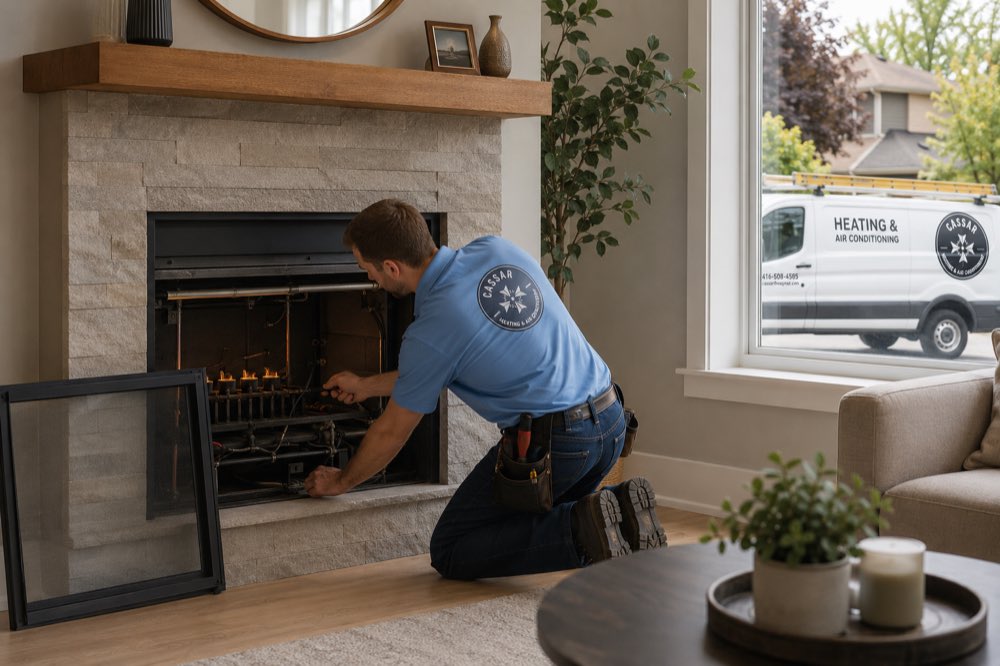
From a brand-new gas fireplace installation to a thermocouple swap on a unit that won’t light, David handles the full range of fireplace work, gas, direct-vent, and insert systems.
Installing a gas fireplace involves selecting the right unit for your room size, running or tapping into a gas line, and setting up a direct-vent or B-vent exhaust, all of which David sizes and configures before he orders the equipment. Getting the venting right the first time is what separates a fireplace that performs well from one that trips the ODS sensor every winter. David pulls the required permits and files the TSSA paperwork so your installation is fully documented.
Most fireplace repairs David sees come down to a worn thermocouple, a fouled pilot assembly, or a gas valve that’s lost its calibration, all diagnosable in one visit. He carries common replacement parts on the truck, which means most repairs are finished the same day you call. If the problem turns out to be something larger, you’ll get a clear explanation and an honest recommendation before any further work begins.
When an older fireplace has a cracked firebox, a discontinued gas valve, or heat output that no longer matches your room’s needs, replacement is often the smarter call. David measures the opening, checks the existing gas line capacity, and recommends units that fit the space properly, not just whatever’s easiest to install. He’ll also tell you when a repair still makes sense, so you’re not spending money on a new unit you don’t need.
A proper annual service covers the burner, pilot assembly, thermocouple or thermopile, gas valve, igniter, glass seals, and the entire venting path, not just a wipe-down and a test fire. David checks that the flame pattern is correct and that combustion products are exhausting cleanly, which matters for both safety and efficiency. Most homeowners who skip annual maintenance are the ones calling for emergency repairs mid-January.
A fireplace that stops working during a Durham Region cold snap isn’t a problem that can wait until next week. David takes emergency calls across all of Durham Region and aims to get to you the same day whenever possible. When you call, you reach him directly, not a dispatcher who’ll pass along a message and add two hours to your wait.
Newer gas fireplaces with variable-flame burners and sealed combustion systems put significantly more heat into the room than units built ten or fifteen years ago. If your current fireplace runs on a millivolt system with a standing pilot, switching to an electronic ignition unit alone cuts standby gas use noticeably over a season. David can walk you through the current options, including units eligible for Enbridge rebates, and give you a straight comparison so you can decide.
Four straightforward steps from your first call to a working fireplace.
When you call (416) 508-4585, David picks up, you’re talking to the person who’ll actually do the work, not a scheduler reading from a screen. Tell him what’s happening: the fireplace won’t light, it’s cycling off, you want a new one installed, whatever it is. He’ll ask a few quick questions to understand the situation and confirm a time that works for you, often the same day.
David starts with a full inspection of the gas valve, pilot assembly, thermocouple or thermopile, igniter, burner, glass, and venting before he says anything about what’s needed. Once he knows what’s wrong, he gives you a clear price for the repair or installation, and explains why each part of the job matters. The quote is what you pay; there are no add-ons once work starts.
Most fireplace repairs are finished in a single visit because David stocks the parts that fail most often on common brands. For installations, he handles the gas line connection, venting configuration, and unit startup, and tests everything through a full heating cycle before he leaves. He works cleanly and puts things back the way he found them.
Before he packs up, David walks you through what he did, shows you the flame pattern and confirms the thermostat or wall switch is responding correctly. If you’ve got a new unit, he’ll explain how to use it, what normal operation looks like, and what to watch for. You’ve got his direct number if anything comes up afterward.
David’s been servicing and installing gas fireplaces across Durham Region since 2011, which means he knows the common failure points on the brands that show up most often in Oshawa, Whitby, Ajax, and Pickering homes. He works on his own, which keeps overhead low and accountability high, when something’s done right, it’s because he did it right.
David Cassar started Cassar Heating & Air Conditioning in 2011 after years of watching homeowners get pushed into equipment they didn’t need by companies running on commission incentives. He wanted to run a business where the advice he gave was the same advice he’d give a neighbour, fix it if it can be fixed, replace it when replacement genuinely makes sense, and never inflate a job to cover overhead that has nothing to do with the customer in front of him.
On fireplace work specifically, David takes time to understand the whole system before suggesting anything. That means checking the gas pressure at the valve, testing the thermocouple output with a multimeter, inspecting the venting termination cap for blockages, and verifying the flame pattern before deciding what the actual problem is. A lot of fireplaces labelled “dead” by other contractors have walked out of a service call working fine because someone took the time to diagnose properly.
He treats your home the way he’d want someone to treat his. Shoes off at the door, drop cloth under the unit, everything cleaned up before he leaves. Durham Region homeowners call him back not because they couldn’t find someone else, but because they didn’t want to.
“Fireplace had been sitting dead for two winters. Came out the same day I called, diagnosed a failed thermocouple, and had it running in under an hour.”
“I’d had two other guys look at the fireplace and both said I needed a new one. David came in, tested the gas valve properly, found it was still within spec, and replaced just the igniter module. Saved me probably two grand. He explained every step of what he was checking and why, which I appreciated. Knows his stuff and doesn’t oversell.”
“Price he quoted on the phone was the price on the invoice. Not a dollar more. He put a drop cloth down, cleaned up the glass and the surround before he left, and the fireplace looks and runs better than it has in years. That kind of workmanship is hard to find.”
Seven questions David hears from homeowners before they commit to a fireplace installation or replacement, answered straight.
Ontario homeowners can choose from three main categories. A gas fireplace insert slides into an existing wood-burning masonry opening and converts it to gas, using a liner to vent through the existing chimney. A direct-vent built-in installs into a framed wall cavity and exhausts through a co-axial pipe punched through an exterior wall, no chimney required. A B-vent fireplace vents vertically through the home and requires a chase, making it less flexible for placement but common in older builds. Most new installations in Durham Region today use direct-vent because the placement options are widest and sealed combustion means no indoor air quality concerns.
A gas fireplace installation in Ontario typically runs between $3,500 and $7,500 for a complete job, unit, venting, gas line connection, and startup. The range is driven by several factors: the unit itself (a basic mid-efficiency insert costs less than a premium direct-vent built-in with a decorative surround), whether a new gas line needs to be run from the meter or just tapped from an existing line nearby, and how complex the venting path is given your home’s layout. Framing, drywall finishing, and decorative surround work add cost if you’re doing a full built-in installation rather than an insert into an existing opening. The best way to know what your specific job will cost is to get a free quote from David, no pressure, no obligation.
No, most gas fireplaces installed today use a direct-vent system that requires nothing more than a hole through an exterior wall. The co-axial pipe pulls combustion air from outside and exhausts flue gases back out, all through the same pipe assembly. This means you can put a gas fireplace in a basement, a bedroom, or an interior wall as long as the vent run isn’t too long and the exterior termination cap location meets clearance requirements. If your home already has a masonry chimney from a wood-burning fireplace, a gas insert with a flexible stainless liner is often the simplest and most cost-effective path. David assesses your specific layout before recommending an approach.
A modern sealed direct-vent gas fireplace typically delivers 70 to 85 percent efficiency, meaning most of the gas burned becomes usable heat in the room. A traditional open wood-burning fireplace runs at around 10 to 20 percent, because most of the heat goes up the chimney along with the combustion gases. Even a gas fireplace insert installed in an existing masonry wood-burning opening dramatically improves efficiency over the original fireplace, and it eliminates the creosote buildup, smoke, and ash management that comes with wood. From a pure BTU-per-dollar standpoint, gas wins for most Ontario homeowners at current fuel prices, especially compared to split or stacked firewood with delivery.
A properly sized gas fireplace can absolutely be the primary heat source for a single room, and some larger units, 30,000 to 40,000 BTU and above, can meaningfully supplement heat in an open-plan main floor. Using a fireplace to heat an entire multi-level home isn’t realistic without a forced-air or hydronic distribution system to move heat around. Where gas fireplaces shine in Durham Region homes is as a zone heater for a living room or family room, letting you turn the main furnace down while keeping the space you’re actually using warm. David can help you match BTU output to room square footage and insulation level so you’re not buying more fireplace than you need.
Once per year is the standard recommendation, and late summer or early fall is the right time to schedule it, before you need the fireplace for the first cold nights. An annual service should include cleaning the burner ports, inspecting and testing the thermocouple or thermopile, checking the gas valve for proper operation and calibration, cleaning the glass with the correct ceramic cleaner, inspecting the gaskets and seals, and verifying the venting path is clear and terminating properly. Homeowners who run their fireplace through a full Ontario heating season without service are the ones most likely to call David in December with a unit that won’t light. Annual maintenance costs a fraction of an emergency repair call.
Rebates for gas fireplaces in Ontario are less common than those available for furnaces or heat pumps, but Enbridge Gas has occasionally offered incentive programs for high-efficiency heating appliances, including some gas fireplace models. Eligibility depends on the specific unit’s efficiency rating, when you purchase, and your account status with Enbridge. David stays current on available programs and will flag any applicable rebates when he puts together your quote, so you’re not leaving money on the table by buying outside a program window. The best way to know what your specific job will cost is to get a free quote from David, no pressure, no obligation.
Ontario’s climate puts real demands on a gas fireplace. Here’s what matters each season.
Book your annual tune-up in September or early October before demand picks up. David checks the thermocouple output, cleans the burner ports, inspects the glass seal, and verifies the venting termination cap is clear of debris or wasp nests, a common issue on homes in Clarington and Uxbridge with exterior terminations at ground level. Getting the service done now means you’re not scrambling when the first cold snap hits in November.
If the pilot keeps going out, the flame is mostly yellow instead of blue, or the glass is consistently sooting up, those are signs the unit needs attention, don’t keep relighting and hoping it stabilises. A fireplace that cycles off on its own is often a thermocouple or ODS sensor issue that’s straightforward to fix, but leaving it unaddressed through the heating season risks a complete failure on the coldest night of the year. Call David when you notice the problem, not after it gets worse.
Spring is the right time to think about replacing an older fireplace or adding one to a room you’ve been wanting to heat better. Scheduling isn’t pressured, David has more flexibility in his calendar, and if you’re doing any renovation work it’s easier to run gas lines and vent penetrations before walls are closed up again. It’s also worth checking whether any Enbridge rebate programs are running, those windows open and close throughout the year.
Summer is when most homeowners forget about their fireplace entirely, which makes it a good time to handle anything deferred from the heating season. If the glass was cloudy all winter or the pilot was temperamental, those are easy repairs to address when there’s no urgency. It’s also worth running the fireplace for ten minutes mid-summer to keep seals from drying out and to confirm it starts cleanly before fall rolls around and you actually need it.
In Durham Region, a complete gas fireplace installation runs between $3,500 and $7,500 depending on the unit you choose, the complexity of the venting path, and how much gas line work is required. A direct-vent insert into an existing masonry opening sits at the lower end of that range if the gas line is close. A full built-in installation with framing, a new gas line from the meter, and a decorative surround can push toward the upper end. David gives you a firm, itemised quote before anything starts, the number he quotes is the number you pay. To get a price for your specific situation, book a free quote or call (416) 508-4585.
No chimney required for most gas fireplace installations. The majority of modern gas fireplaces use a direct-vent system: a co-axial pipe that draws combustion air from outside and exhausts flue gases back out through the same pipe, terminating through an exterior wall. That means you can install a gas fireplace in virtually any room, including basements and interior spaces that a traditional chimney couldn’t serve. If your home already has a masonry chimney from a wood-burning fireplace, a gas insert with a stainless flex liner venting through the existing flue is often the most straightforward approach. David assesses your layout before committing to a venting plan so there are no surprises when the job starts.
For a single room, yes, a properly sized gas fireplace can carry the full heating load comfortably through a Durham Region winter. Units in the 25,000 to 40,000 BTU range handle most living rooms and open-plan main floors well, especially in homes with decent insulation. Using one as the sole heat source for a whole house is harder because gas fireplaces don’t distribute heat through ductwork, so rooms without a fireplace stay cold. Where they work well is as zone heaters: you run the main furnace at a lower setpoint and let the fireplace handle the room you’re actually spending time in, which reduces furnace runtime and gas consumption overall. David can match BTU output to your room size during the quote visit so you buy the right unit.
Once a year, and the best time to schedule it is late August or September before heating season starts. A complete annual service covers the burner assembly, pilot and ignition system, thermocouple or thermopile, gas valve operation, all glass and gaskets, and a full inspection of the venting path from the firebox to the exterior termination cap. It’s the venting inspection that most homeowners skip, and a blocked or improperly terminating vent is a safety issue, not just a performance one. Fireplaces that haven’t been serviced in two or three years are the ones David most commonly sees failing mid-winter with ignition or gas valve problems that a $150 annual tune-up would have caught early.
Start with the pilot light. If it’s out, find the relight instructions on the label inside the access panel and follow them step by step, hold the pilot button down for a full 30 to 45 seconds before releasing. If the pilot lights but goes out when you release the button, the thermocouple or thermopile is the most likely cause; it’s a sensor that tells the gas valve the pilot is burning, and it wears out after several heating seasons. Also check that the main gas supply valve on the line feeding the fireplace is fully open, and that the wall switch or thermostat is actually calling for heat. If you’ve got spark but no pilot flame at all, the igniter or the gas valve itself may need attention. Most of these issues are fixed in a single visit, call David at (416) 508-4585 and he’ll tell you what he needs to know to come prepared.
David covers every community in Durham Region. Select your area for local fireplace installation and repair information.
David handles the full range of home heating and cooling work across Durham Region, not just fireplaces.
Same-day service available across all of Durham Region. TSSA certified. Honest pricing. No surprises.