
Durham Region’s cold, dry winters pull moisture out of homes fast, and the newer builds in Whitby, Ajax, and Pickering are especially airtight, which means low indoor humidity becomes a real problem by November and doesn’t let up until April. David covers all of Durham Region, picks up the phone personally, and can often get to you the same day.
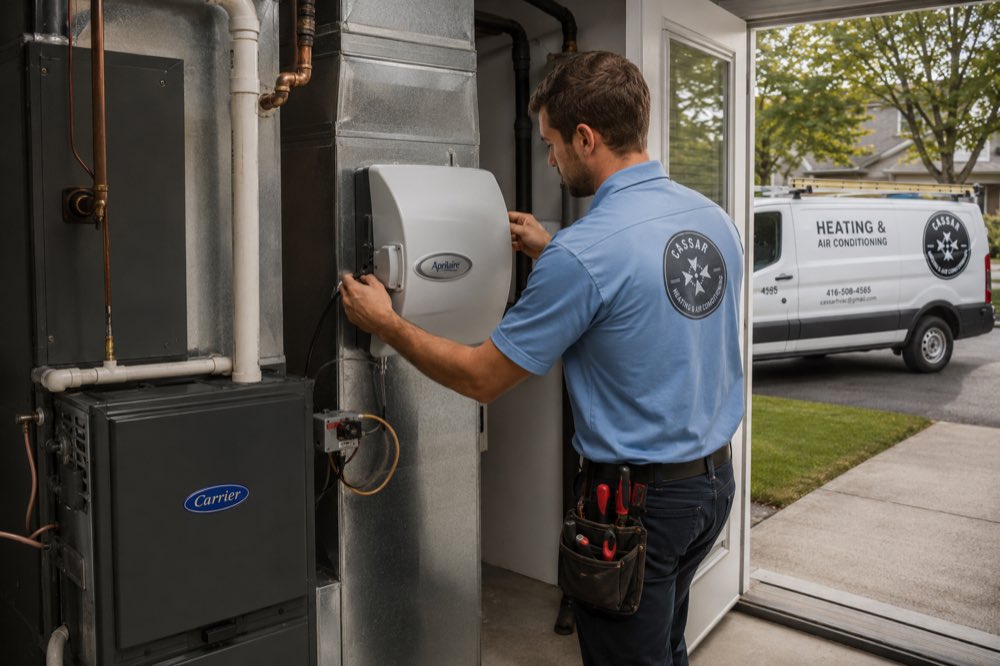
From a first-time installation to an emergency repair in the middle of January, David handles it personally across every community in Durham Region.
David installs bypass, fan-powered, and steam humidifiers on furnaces throughout Durham Region. He sizes the unit to your home’s square footage and duct layout rather than defaulting to a one-size answer. Many Oshawa and Clarington homes with older, lower-static ductwork need a fan-powered model rather than a standard bypass, David checks before recommending.
A failed solenoid valve, a cracked distribution tray, a seized drum motor, David stocks the most common parts for Aprilaire, Honeywell, and GeneralAire units and fixes most repairs in a single visit. If something’s wrong with your humidifier mid-winter, you’re probably not in the mood to schedule a follow-up appointment in two weeks.
When a repair doesn’t make financial sense, David tells you straight and recommends a replacement that fits your furnace and your budget. He won’t push a premium steam unit if a bypass model does the job. Homeowners in newer Ajax and Pickering subdivisions sometimes have builder-grade humidifiers that under-perform for the home’s size, replacing those with a properly sized unit makes a noticeable difference.
David replaces the water panel or evaporator pad, cleans mineral scale from the distribution tray, checks the solenoid valve, tests the humidistat, and confirms water flow rates. Durham Region’s water supply runs moderately hard, which accelerates scale build-up inside the unit. Skipping annual maintenance for a few seasons usually means a repair call rather than a pad swap.
If your current humidifier has been limping along and you’re spending more on service than it’s worth, David can upgrade you to a higher-capacity or steam model that matches your home’s actual needs. He walks you through the options, gives you an upfront price, and you decide without pressure.
A humidifier that’s leaking, flooding the drain pan, or causing water damage needs attention the same day. David takes emergency calls across all of Durham Region and picks up the phone himself. You’ll know who’s coming, when they’re coming, and what it’ll cost before work starts.
Since 2011, I’ve serviced humidifiers in homes from Pickering right out to rural Clarington, and the single most common thing I see is a unit that’s been running for three or four years without a pad change, by then it’s pushing humid air through scale and bacteria rather than clean water vapour. I give you the full picture, tell you what’s worth fixing and what’s not, and do the work myself.
Every call goes straight to David, not a dispatcher. You get a quote before anything starts, and the price doesn’t change when the job’s done.
A well-maintained bypass or fan-powered humidifier typically lasts 10 to 15 years. Steam humidifiers, because they work harder and have more electrical components, usually top out around 10 years. The range is wide because lifespan depends almost entirely on maintenance habits and water hardness at the installation address.
Ontario’s water supply varies by municipality, but most Durham Region communities draw water with enough dissolved calcium and magnesium to leave visible scale inside a humidifier within a single heating season. If the evaporator pad gets replaced every fall and the distribution tray gets cleaned, that mineral build-up doesn’t accumulate to the point where it starts damaging the solenoid valve or corroding the drain components. Skip maintenance for two or three years and those repairs become unavoidable.
The single maintenance step that extends humidifier life the most in Ontario is replacing the water panel before the heating season starts, not after the unit stops working. A clean pad transfers moisture efficiently. A scaled pad forces the humidifier to run longer cycles to hit the target humidity level, which puts more hours on the motor and solenoid.
A bypass humidifier installation in Durham Region typically runs between $450 and $750 installed, depending on the model and the complexity of tapping into the ductwork. Fan-powered models sit in the $550 to $900 range. Steam humidifiers, which work independently of the furnace fan and humidify more precisely, start around $900 installed and can reach $1,500 or more for larger-capacity units.
Repair costs vary by the part. A solenoid valve replacement usually comes in between $150 and $250. A water panel swap during a service call runs $80 to $130. Humidistat replacement, if the original has failed, is typically $120 to $200 depending on whether it’s a basic analog or a digital model. What drives the variation is mostly parts cost and access, some furnace configurations make pulling the humidifier off for service considerably more work than others.
Every job gets a free upfront quote before David touches anything. The best way to know what your specific job will cost is to get a free quote from David, no pressure, no obligation.
Durham Region grew rapidly through the 1990s and 2000s, and a large share of the housing stock in communities like Whitby, Ajax, Pickering, and Courtice consists of two-storey detached homes built during that period. Those homes were typically built with builder-grade bypass humidifiers sized for the furnace model rather than the home’s actual square footage or ceiling height. Many of those original units are now 15 to 20 years old and either under-performing or quietly failing.
Further east in Clarington, Bowmanville, and Newcastle, David sees more rural properties and older homes, some with basements that were converted from oil or electric heat to gas during the 2000s and 2010s. Those retrofit jobs sometimes skipped whole-home humidification entirely, meaning the furnace is newer but the home has never had a humidifier connected. Adding one to an existing forced-air system is a straightforward job in most cases.
Newer builds in the Taunton Road corridor in Whitby and the Liverpool Road area of Pickering tend to be tighter, more energy-efficient homes. The tighter the envelope, the more important it becomes to set the humidistat correctly, too much humidity in a well-sealed home causes condensation on windows and, over time, mould in wall cavities. David sets the humidistat to the right level for the home rather than leaving it at the factory default.
The most obvious sign is dry air that doesn’t improve even though the furnace is running. Static electricity every time you touch a doorknob, cracking hardwood floors, nosebleeds, and waking up with a sore throat in January are all consistent with indoor humidity below 30%. If your humidistat says the system is running but the house still feels dry, the unit likely has a failed solenoid valve, a blocked pad, or a closed water supply line.
Water on the floor around the humidifier or inside the furnace cabinet is a different problem. That points to a cracked distribution tray, a failed float or drain line, or a solenoid valve stuck in the open position. Durham Region homes with finished basements should take this seriously, a slow leak from a humidifier mounted on the furnace can saturate insulation and drywall before anyone notices. Catching it early is considerably cheaper than fixing the damage.
If your humidifier hasn’t been serviced since it was installed and it’s more than two years old, the pad is almost certainly scaled beyond what’s effective. That’s worth a service call before the problem escalates to a repair. David covers all of Durham Region and can usually get there the same week, often the same day.
Durham Region winters are long and dry. Relative humidity outdoors drops sharply from November through March, and every time cold outdoor air infiltrates a home it brings that low relative humidity with it. The heating system then warms that air, which drops the relative humidity further. Keeping indoor humidity in the 35 to 45 percent range through those months requires a working whole-home humidifier running consistently, not just occasionally.
Set the humidistat to respond to outdoor temperature. In January when it’s minus 15 outside, you can’t push indoor humidity as high as you can in November when it’s minus 5, because the excess moisture will condense on cold surfaces, especially windows and exterior walls. A good rule is 35% at minus 10 outdoor, dropping toward 30% as temperatures fall below minus 15. David leaves a reference guide when he sets up a new installation.
Bypass humidifiers only run when the furnace fan is active. If your thermostat’s fan is set to Auto rather than On, the humidifier only operates during heating cycles. During mild stretches in November and March when the furnace doesn’t call for heat very often, humidity can still drop. Switching the fan to On for a few hours during dry periods helps, or upgrading to a fan-powered model that runs independently of the furnace call solves it entirely.
Humidifiers connected to gas furnaces fall under TSSA jurisdiction in Ontario. Any work that involves modifying the ductwork connection, the water supply, or the electrical connection to the furnace system needs to be done by a TSSA-licensed technician. David’s TSSA Licence is #000398183, verifiable on the public registry. Unlicensed work on gas appliances carries real liability consequences for homeowners, particularly when selling the home.
Over-humidifying is a genuine risk. Humidity above 50% in a well-sealed home creates conditions where mould can establish in wall cavities behind vapour barriers and inside ductwork. A properly calibrated humidistat set to outdoor-temperature-referenced levels prevents this. If you’re seeing condensation running down windows regularly, your humidistat is set too high for the outdoor temperature that day.
Ontario’s Enbridge and various regional utilities have offered rebates on certain home efficiency upgrades at various points, and it’s worth checking current program availability. Whole-home humidification reduces the perceived need to turn the thermostat up, humid air at 20°C feels warmer than dry air at 21°C, which translates to real heating savings over a Durham Region winter. David can walk you through any current rebate opportunities when he gives you a quote.
Checking the simple things before calling saves time for everyone, here’s where to start.
The saddle valve or water supply line feeding the humidifier can get closed or kinked. Trace the small copper or plastic tube from the humidifier back to the water supply and confirm it’s open.
The humidistat controls when the humidifier runs, it’s separate from your thermostat. Make sure it’s set above the current home humidity level (typically 35–45% in winter).
The evaporator pad inside the humidifier needs replacing once a year. A heavily scaled or clogged pad prevents water from evaporating properly.
The solenoid valve opens to let water into the unit when the humidistat calls for humidity. If you hear the furnace running but no water flowing, the solenoid may have failed.
Bypass humidifiers only operate when the furnace fan is running. If your fan is set to Auto rather than On, the humidifier will only run during heating cycles.
If none of the above resolves it, it needs a licensed technician. David serves all of Durham Region and picks up the phone himself.
Yes, a whole-home humidifier makes a real difference in a Durham Region home from November through March. Our winters push outdoor relative humidity low, and every time that cold dry air gets into your home and your furnace heats it, the indoor relative humidity drops further. Most Durham Region homes without humidification sit below 25% relative humidity in January, which is drier than a desert and well below the 35 to 45 percent range that’s comfortable and healthy. You’ll notice dry sinuses, cracked lips, static electricity on everything, and wood furniture or flooring starting to gap and shrink. The airtight newer builds in Whitby, Ajax, and Pickering actually feel this more acutely, because the house holds onto that dry conditioned air with nowhere for moisture to enter naturally. A properly installed whole-home humidifier connected to your forced-air furnace handles the whole house automatically and costs a fraction of what portable units cost to run. I’ve installed them across Durham Region since 2011 and the difference homeowners notice in the first winter is immediate.
A bypass humidifier uses the furnace fan to push warm air through a water-saturated evaporator pad, adding moisture to the airstream passively. It’s simple, affordable, and works well for most homes up to about 2,500 square feet. A fan-powered bypass works the same way but has its own motor, so it can run even when the furnace isn’t actively heating, useful in milder weather or in tighter homes where the furnace doesn’t cycle as often. A steam humidifier is a completely different category. It boils water independently of the furnace to create steam, which gets introduced into the ductwork. It’s precise, consistent, and effective even in very large or very well-sealed homes. It also costs more to buy and more to run, because it draws significant electricity every time it operates. For most Durham Region detached homes in the 1,500 to 3,000 square foot range, a fan-powered bypass unit is the right answer. Steam makes sense for homes over 3,500 square feet, unusually dry homes with persistent humidity problems, or homeowners who want very precise control. I’ll give you a straight recommendation based on your home’s actual specs, not the highest-margin option.
Whole-home humidifier installation in Durham Region typically runs $450 to $750 for a bypass model, $550 to $900 for a fan-powered model, and $900 to $1,500 or more for a steam unit, all prices installed. What drives the variation is the model selected, the complexity of the ductwork tap, access to the water supply line, and whether any electrical work is needed for a steam unit. Homes where the furnace is tucked into a tight utility room or where the water line requires a longer run cost a bit more than a straightforward basement installation. I don’t pad quotes with vague labour estimates, I look at the job and give you a flat price. The best way to know what your specific job will cost is to get a free quote from David, no pressure, no obligation.
For most Ontario homes, 35 to 45 percent relative humidity is the right target range through the heating season. The reason it’s a range rather than a fixed number is that the appropriate indoor humidity level depends on the outdoor temperature. When it’s minus 5 outside, you can comfortably hold 40 to 45 percent indoors without condensation forming on windows or exterior walls. When it’s minus 20, you need to drop to 30 to 35 percent to avoid condensation problems on colder surfaces. Setting the humidistat to a fixed level and ignoring outdoor temperature is the most common mistake I see, homeowners set it at 45 in November when that’s fine, and then in January they’re wondering why the windows are dripping. Some humidistats have an outdoor temperature sensor that adjusts the setpoint automatically. If yours doesn’t, a simple guide is: below minus 10 outside, drop the indoor setting to 35; below minus 15, drop it to 30. I leave a reference chart with every installation I do in Durham Region so you’re not guessing.
Once a year, at the start of the heating season in September or October, is the right interval for most Durham Region homes. That service should include replacing the evaporator pad or water panel, cleaning mineral scale from the distribution tray and drain, checking the solenoid valve operation, confirming water flow rate, and verifying the humidistat calibration. Durham Region’s water supply has enough mineral content that skipping even one annual service leads to visible scale accumulation inside the unit. After two missed seasons, that scale typically gets into the solenoid valve, which starts restricting flow and eventually fails entirely. Replacing a solenoid valve costs two to three times what an annual service call costs, so the math on skipping maintenance doesn’t work out in your favour. If your humidifier hasn’t been serviced in two or more years, I’d rather inspect it before the heating season starts than get a call in January when the house is already bone dry.
Start with the four most common causes before calling anyone. First, check that the water supply saddle valve behind the unit is fully open, it can get bumped closed during furnace service. Second, check the humidistat setting and make sure it’s set above the current home humidity level. Third, pull the evaporator pad out and look at it, if it’s grey or white with mineral crust, it’s blocked and needs replacing. Fourth, for bypass models, check that the furnace fan is actually running, because bypass units won’t operate if the fan is off. If all four check out and the unit still isn’t producing moisture, the solenoid valve is the next likely culprit. It’s the valve that lets water into the unit when the humidistat calls for humidity, and it fails without warning after a few years of cycling. That’s a repair rather than a DIY fix. I carry solenoid valves for the most common brands and can usually sort it in a single visit anywhere in Durham Region. Call (416) 508-4585 and I’ll tell you what I think it is over the phone before you even book an appointment.
A bypass or fan-powered humidifier can be installed on virtually any forced-air furnace that has a return air duct and a supply plenum with enough clearance for the unit. The main limiting factor is physical space in the furnace room, not the furnace model itself. High-efficiency furnaces with sealed combustion work fine with whole-home humidifiers, the humidifier connects to the ductwork, not the combustion system. The one scenario where installation gets more complex is a heat pump or dual-fuel system, where the supply air temperature varies more than a gas furnace, which can affect how well a bypass unit performs. In those cases, a fan-powered or steam unit is usually the better fit. I’ve installed humidifiers on furnaces from the mid-1980s to brand-new units across Durham Region and I’ve only run into a handful of situations where installation wasn’t practical, mostly very old furnaces with non-standard duct configurations. I can give you a straight answer about your specific furnace over the phone or when I come out to quote.
Yes, and it’s not just a feeling. Humid air at a given temperature actually does transfer more warmth to the body than dry air at the same temperature, because dry air accelerates evaporation from your skin, which creates a cooling effect. The commonly cited example is that 20°C at 40% humidity feels roughly equivalent to 21 or 22°C at 20% humidity. That translates into real thermostat behaviour, most Durham Region homeowners who install a whole-home humidifier find themselves turning the thermostat down by a degree or two and still feeling comfortable. Over a full heating season from October to April, that’s a meaningful reduction in gas consumption. It’s not the primary reason to install one, but it’s a genuine benefit. The more immediate benefits most homeowners notice first are the end of static shocks, wood floors and trim that stop creaking and gapping, and sleeping through the night without waking up with a dry throat. Those changes show up within the first week of the heating season after installation.
“Our humidifier had been dead for two winters before I finally called Cassar. Turned out the solenoid had failed, David replaced it the same day and the house felt different within 48 hours.”
“I called because the pad hadn’t been changed in four years and I wasn’t sure if the whole unit needed to go. David came out, pulled it apart, and showed me the scale build-up inside the distribution tray. He said the unit itself was still in good shape and just needed a proper service rather than a replacement. He didn’t try to upsell me anything. Honest guy, did the job cleanly, explained what he was doing the whole time.”
“Quoted me $575 to install a new bypass humidifier on our Whitby home’s furnace. That’s exactly what I paid, nothing added on at the end. He was done in under two hours, left the utility room cleaner than he found it, and set the humidistat before he left rather than just handing me the manual.”
David covers every community across Durham Region for humidifier installation, repair, and maintenance.
Same-day service available. TSSA certified. Honest pricing. Call or book online.