
Newcastle’s housing has grown fast over the past fifteen years, and a lot of the newer subdivisions along King Avenue and Rudell Road came with builder-grade central air conditioners that are now hitting the age where they’re either due for a proper tune-up or ready to be replaced with something more efficient. David Cassar serves Newcastle and all of Clarington with same-day and emergency air conditioner service, and he picks up the phone himself when you call.
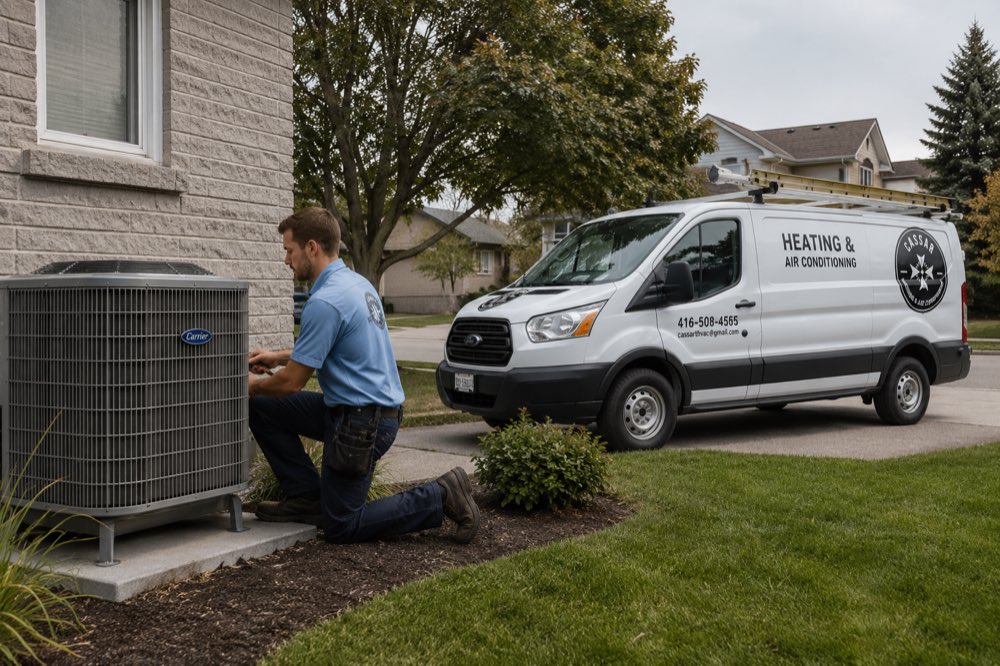
From new installs in Newcastle’s growing subdivisions to emergency repairs on a 90-degree July afternoon, David handles it all personally.
Newcastle’s newer builds along subdivisions like Wilmot Creek and the King Avenue corridor often have ductwork that needs to be properly matched to the new unit’s airflow requirements. David calculates the correct load before sizing any new system. He stocks common residential equipment so most installs happen within a day or two of your call.
If your AC stopped cooling mid-summer, David diagnoses the problem on the first visit and carries the most common replacement parts on the truck. Refrigerant issues, failed capacitors, frozen coils, he’s seen every scenario in this region since 2011. You get a clear explanation of what failed and what it costs before any work starts.
A lot of the central air conditioners installed in Newcastle’s late-1990s and early-2000s homes are hitting 20-plus years. David won’t push a replacement if a repair extends the life meaningfully. When replacement is the right call, he walks you through efficiency ratings, rebate eligibility, and what payback looks like over five years before you decide anything.
An annual tune-up before the first heat wave catches refrigerant levels, cleans the coils, checks the electrical connections, and confirms the system cycles properly. David does the inspection himself, you’re not getting a junior tech working from a checklist. A system that’s maintained annually runs 10 to 15 percent more efficiently and lasts years longer.
Moving from a standard 13 SEER unit to a 18 or 20 SEER system cuts your cooling costs significantly over a Durham Region summer. David explains what you’d actually save each year based on your home’s square footage and current usage, not a theoretical estimate pulled from a brochure. Ontario Enbridge and Hydro One rebate programs may apply depending on the equipment selected.
Newcastle sits at the eastern edge of Clarington, and when the heat index climbs past 35°C, David prioritizes calls from households with elderly residents or young children. You reach him directly, there’s no dispatcher routing your call to whoever’s closest. He’ll tell you honestly when he can be there and what to expect when he arrives.
I’ve been working in Newcastle and the surrounding Clarington communities since 2011, and the pattern I see most often is builder-grade condensers from the mid-2000s subdivisions that haven’t had a single service visit in years. Some of them I can get running properly with a cleaning and a refrigerant top-up. Others need replacing, and I’ll tell you which is which before I pick up a tool. You’ll get that assessment from me directly, not from a technician who earns commission on equipment sales.
A central air conditioner in Ontario typically lasts between 15 and 20 years, though that range shifts considerably based on how the system’s been maintained. A unit that’s had annual tune-ups, clean filters, and proper refrigerant levels throughout its life will routinely hit 18 to 20 years. One that’s been ignored tends to start failing noticeably around the 12 to 14 year mark.
Ontario’s climate puts real stress on air conditioners. Durham Region summers bring stretches of humid heat where the system runs almost continuously for days. That kind of extended operation in high humidity accelerates wear on the compressor and condenser coil. If you’re not pulling the filter every month during peak summer and having the coils cleaned annually, you’re shortening the lifespan faster than most people realize.
The single biggest maintenance point for Ontario homeowners is the coil cleaning. Cottonwood, grass pollen, and airborne debris from our spring and summer settle into the condenser fins every season. Once that buildup restricts airflow, the compressor works harder to achieve the same cooling, and compressors don’t recover from that kind of cumulative strain. A professional coil cleaning each spring is the cheapest insurance you can buy for a system you’d otherwise replace in 5 years instead of 10.
For a standard central air conditioner installation in a Newcastle home, most homeowners pay between $3,500 and $6,500 all in. That range reflects equipment tier, the size of the system the home actually needs, and whether any ductwork adjustments are required during the install. A basic 2-ton, 14 SEER unit in a straightforward installation sits toward the lower end. A 3-ton, 18 SEER two-stage system with some duct modification sits toward the higher end.
For repairs, a capacitor or contactor replacement typically runs $180 to $350 including labour. A refrigerant recharge costs $250 to $500 depending on how low the system is and which refrigerant type your unit uses, R-22 systems cost more to service because that refrigerant is no longer manufactured and has to be recovered from existing stock. Coil replacements and compressor work cost more and sometimes tip the repair vs replace calculation toward replacement.
Every job David quotes in Newcastle comes with a firm upfront number before he touches anything. The quote you get is the price you pay. The best way to know what your specific job will cost is to get a free quote from David, no pressure, no obligation.
Newcastle is a smaller community within Clarington that’s seen meaningful residential growth since the early 2000s. A significant portion of the housing stock consists of detached two-storey homes built between 2000 and 2015 in subdivisions off King Avenue West and Rudell Road. These homes typically have forced-air systems with the furnace and AC evaporator coil in the basement, and a condenser unit on a concrete pad at the rear or side of the home.
The builder-grade condensers that went into many of these homes in the early-to-mid 2000s were sized to meet code minimums rather than optimized for the specific home’s load. David regularly sees oversized units in Newcastle that short-cycle, they cool the space too quickly before properly dehumidifying, which leaves the home feeling clammy even when the temperature reads correctly. If you’ve always noticed your home feels sticky in summer even with the AC running, that’s worth asking about on a service call.
Newcastle also has a portion of older housing stock in the original village core, some of it predating forced-air heating altogether. If your home doesn’t have existing ductwork, a ductless mini-split is often the right solution rather than a full central air installation. David can assess both options and tell you which makes more sense for your specific home before any commitment is made.
The most common warning sign is a system that runs continuously without actually cooling the home to the set temperature. In a Newcastle home on a 30°C day, a properly functioning central AC should hold the house within a degree or two of the thermostat setpoint. If it’s running all day and the upstairs is still 26°C, something’s wrong, it could be low refrigerant, a dirty coil, or an undersized system, but any of those need a diagnosis.
Short-cycling is another one worth flagging. If the compressor kicks on and off every few minutes rather than running a full cooling cycle, that strains the compressor and points toward a refrigerant issue, an electrical problem, or an oversized unit. Durham Region homeowners sometimes mistake this for the system working normally because the air blows cold briefly. It’s not normal, and left alone it shortens the compressor life significantly.
Ice on the refrigerant lines or the indoor coil is a clear sign to shut the system off and call. Running an iced-up AC harder doesn’t fix the ice, it makes it worse and risks damaging the compressor. The most common causes in this region are a clogged filter blocking airflow or low refrigerant from a slow leak. Both are fixable, but not while the unit keeps running.
Durham Region summers follow a predictable pattern: a mild June, then July and August bringing week-long stretches of heat and humidity that push the humidex above 40°C. The key to running your AC efficiently through those stretches is keeping the system from working harder than it needs to. That means a clean filter checked monthly during summer, ceiling fans set to counterclockwise rotation to create a wind-chill effect, and window coverings closed on south and west-facing windows during peak afternoon heat.
Your thermostat setpoint matters more than most people realize. Each degree below 24°C adds roughly 5 percent to your cooling energy use. Setting the thermostat to 22°C instead of 24°C across a full Durham Region summer adds up meaningfully on your hydro bill. A programmable or smart thermostat that raises the setpoint when the house is empty during the day reduces that cost without affecting comfort when you’re home.
Spring is also when you should schedule your annual tune-up, before the system runs hard for the first time. David books up quickly in June once the heat arrives. Booking in April or early May means the system gets inspected, the coils get cleaned, refrigerant gets checked, and any small issues get sorted before they become no-AC-on-a-heatwave problems.
Air conditioners themselves don’t produce carbon monoxide, but the furnace that shares the same air handler and ductwork does. If your HVAC system is an integrated forced-air setup, which describes most Newcastle homes with central air, a CO detector on every level of the home is essential. TSSA regulations in Ontario require licensed contractors for any work involving refrigerants, and David’s TSSA Licence #000398183 covers exactly that. Hiring an unlicensed technician to handle refrigerant puts you on the wrong side of those regulations and voids most equipment warranties.
On the efficiency side, Ontario homeowners replacing older central AC units may qualify for rebates through the Canada Greener Homes program or utility-specific programs. Equipment that meets or exceeds 15 SEER2 (the new 2023 minimum efficiency standard in Canada) qualifies for consideration. David can confirm what rebates apply to the specific equipment you’re looking at, the programs change year to year and the eligibility details matter.
One efficiency point that often gets overlooked is duct sealing. In Newcastle’s older two-storey homes, leaky ductwork can bleed 20 to 30 percent of the cooled air into the ceiling cavity before it reaches the living space. Upgrading to a higher-efficiency AC unit without sealing the ducts means you’re still paying to cool the attic. It’s worth asking David to check for obvious duct leakage during any installation or major service visit.
Checking the simple things before calling saves time for everyone, here’s what to look at first.
Make sure it’s set to Cool and the temperature is set below current room temperature. Check the batteries too, a weak battery causes erratic thermostat behaviour.
Your AC has a breaker in the main panel and an exterior disconnect box next to the outdoor unit. Check both are on.
A clogged filter blocks airflow and causes the evaporator coil to ice up, completely stopping cooling. Replace the filter and let the unit thaw for an hour before restarting.
The condenser unit outside needs clear airflow. Remove any debris, overgrowth, or objects within 60cm of the unit. Don’t hose it down while running.
Closed vents create pressure imbalances that reduce cooling and can damage the system. Make sure every supply vent in the home is open.
If none of the above solved it, the system needs a licensed technician. David serves all of Durham Region, including Newcastle, and picks up the phone himself.
Once a year is the right answer for most Newcastle homes, and that service visit should happen in spring, before the system runs hard for the first time. An annual tune-up covers coil cleaning, refrigerant level check, electrical connection inspection, and a test of the full cooling cycle. Skipping a year won’t cause an immediate breakdown, but it lets small problems compound. A dirty coil works the compressor harder every cycle. Low refrigerant from a slow leak gets lower. What starts as a minor issue at the spring service call becomes a mid-July breakdown if you wait. If your system is older than 12 years, I’d also recommend a visual inspection of the refrigerant lines and coil condition during that annual visit, those are the components that tend to show wear first in our climate. Booking in April or early May gets you ahead of the summer rush and makes sure the system’s ready before Clarington’s first heat wave hits.
There are five things I check first when a Newcastle homeowner calls with this problem. The most common culprit is a clogged air filter, it blocks airflow over the evaporator coil and the system loses the ability to transfer heat. Second is low refrigerant from a leak, which reduces the system’s capacity to cool even if everything else works. Third is a dirty condenser coil on the outdoor unit, if the fins are packed with cottonwood or debris from the yard, the system can’t dump heat effectively. Fourth is a failing capacitor, which weakens the compressor start and reduces its output. Fifth is an oversized unit that short-cycles, it cools the air temperature down quickly without running long enough to remove humidity, so the house feels warm and clammy even at the right temperature. I can usually pinpoint which of these applies on the first visit. Start by replacing your filter and checking that the outdoor unit has clear airflow. If that doesn’t resolve it, call me and I’ll come take a look.
Most central air conditioner installations in Newcastle take between four and seven hours for a straightforward replacement, old unit out, new unit in, refrigerant lines connected and charged, system tested and commissioned. If it’s a first-time installation in a home that already has a forced-air furnace and ductwork, add an hour or two for running the refrigerant lines and wiring the new disconnect. The cases that take longer are homes that need ductwork modifications to properly support the new system’s airflow, or situations where the electrical panel needs work to support the new equipment. I can usually give you a reliable time estimate once I’ve seen the existing setup. I carry equipment on the truck and order jobs efficiently so I’m not leaving you without AC overnight if I can avoid it. In Newcastle, I’m typically able to schedule installations within a few days of the estimate, and same-week slots are usually available outside of peak summer weeks.
The honest answer depends on three things: the age of the system, the cost of the repair relative to the cost of replacement, and whether the system has had other significant repairs recently. A unit that’s 8 years old with a failed capacitor, that’s a $200 to $300 repair and the system has plenty of life left. A unit that’s 16 years old with a failed compressor, the compressor repair might cost $1,200 to $1,800, and you’d be putting that money into a system that’s already past its expected lifespan. In that case, putting that money toward a new system makes more financial sense. The general rule I use with Newcastle homeowners is this: if the repair costs more than half the price of a comparable new system, and the existing unit is older than 12 years, replacement usually wins. But I’ll run those numbers with you specifically rather than guessing. I won’t push a replacement if a repair genuinely makes sense, that’s a promise I keep on every call.
In Durham Region’s climate, a 16 to 18 SEER2 unit hits the sweet spot between upfront cost and long-term savings for most homeowners. The new Canadian minimum efficiency standard as of January 2023 is 14 SEER2 (roughly equivalent to 15 SEER under the old rating system), so anything at or above that is code-compliant. Going from a 14 SEER2 to a 17 SEER2 unit typically reduces cooling energy use by 18 to 20 percent. In a Durham Region home running the AC from late May through September, that’s a noticeable reduction in your Hydro One bill over a full summer. Two-stage or variable-speed compressors, which are standard on higher-SEER equipment, also do a much better job of humidity control, which matters in our July and August humidity. If you’re upgrading from a unit older than 10 years, you’ll almost certainly be jumping from a 10 to 13 SEER system to something in the 16 to 20 SEER range, and the efficiency improvement is significant. I can show you the payback calculation for your specific home before you decide which tier makes sense.
A system that runs continuously without cooling the space is one of the most common calls I get from Clarington homeowners in July and August, and it’s almost always one of four things. First: low refrigerant from a leak, the system runs but doesn’t have enough refrigerant to absorb heat properly. Second: a frozen evaporator coil, usually caused by a clogged filter or low refrigerant, which blocks all heat transfer even though the fan blows. Third: a dirty condenser coil on the outdoor unit that can’t release heat into the outside air effectively. Fourth: a failed or weakening compressor that’s running but not actually compressing the refrigerant. Before you call, check and replace the filter if it’s overdue, and look at the indoor unit for frost or ice on the lines. If the lines are iced up, shut the system off and let it thaw for an hour with the fan running. If it’s still not cooling after that, call me and I’ll come diagnose it properly. Running a system that’s not cooling correctly causes more damage the longer it runs.
Yes, I work on all major residential central air conditioner brands, including Carrier, Lennox, Trane, York, Goodman, Daikin, Bryant, Rheem, and others you’re likely to find in Newcastle and Clarington homes. The fundamental components, compressors, capacitors, contactors, refrigerant circuits, evaporator and condenser coils, are consistent across brands even though the cabinet designs and control boards vary. I carry the most common replacement parts on the truck for the brands I see most frequently in Durham Region homes, which means I can often complete the repair on the same visit rather than ordering parts and coming back. If you’ve got an older unit with a brand I haven’t seen before or an unusual configuration, I’ll tell you upfront if sourcing parts is going to take time. I don’t charge a different labour rate based on the brand of equipment, the diagnostic and repair process is what it is, regardless of whose name is on the cabinet.
Yes, financing options are available for air conditioner installations in Durham Region, including Newcastle. A new central AC system is a significant purchase, and spreading that cost over 12 to 60 months makes it more manageable for most homeowners. Financing is available through third-party lenders and doesn’t require a large upfront deposit in most cases. The cost of a standard installation in Newcastle runs between $3,500 and $6,500 depending on equipment tier and installation requirements, financing lets you get a properly sized, higher-efficiency system now rather than running an aging unit through another Durham Region summer and paying higher hydro bills in the meantime. Some Ontario energy rebate programs also apply to qualifying high-efficiency equipment, which can reduce the amount you’re financing. The best way to know what your specific job will cost is to get a free quote from David, no pressure, no obligation.
“AC stopped working on a Friday afternoon in July. David was at my Newcastle home by 4 PM, found a failed capacitor, and had it running before dinner.”
“Our central AC in Newcastle had been short-cycling for two summers and we didn’t know what it was. David looked at the setup for about ten minutes and explained exactly what was happening, the unit was oversized for our house and had never been set up properly. He didn’t try to sell us a new system. He adjusted the refrigerant charge and the settings, told us what to watch for, and the house has felt normal ever since. It’s the first time someone actually explained what they were doing while they did it.”
“Got three quotes for a new AC installation in Newcastle. David’s price came in the middle, but he was the only one who actually told me what size unit my house needed and why, not just what he had available. Floors were covered, work was clean, and the number on the invoice matched exactly what he quoted. That last part seems basic but apparently it isn’t.”
David serves all of Durham Region, find air conditioner service in your community below.
Same-day service available. TSSA certified. Honest pricing. Call or book online.