
Pickering’s housing mix spans newer subdivisions in Duffin Heights and Seaton alongside older bungalows in Bay Ridges and West Shore, and the gas line and venting requirements for tankless installation differ significantly between those builds. David covers all of Pickering and the rest of Durham Region and picks up the phone himself when you call.
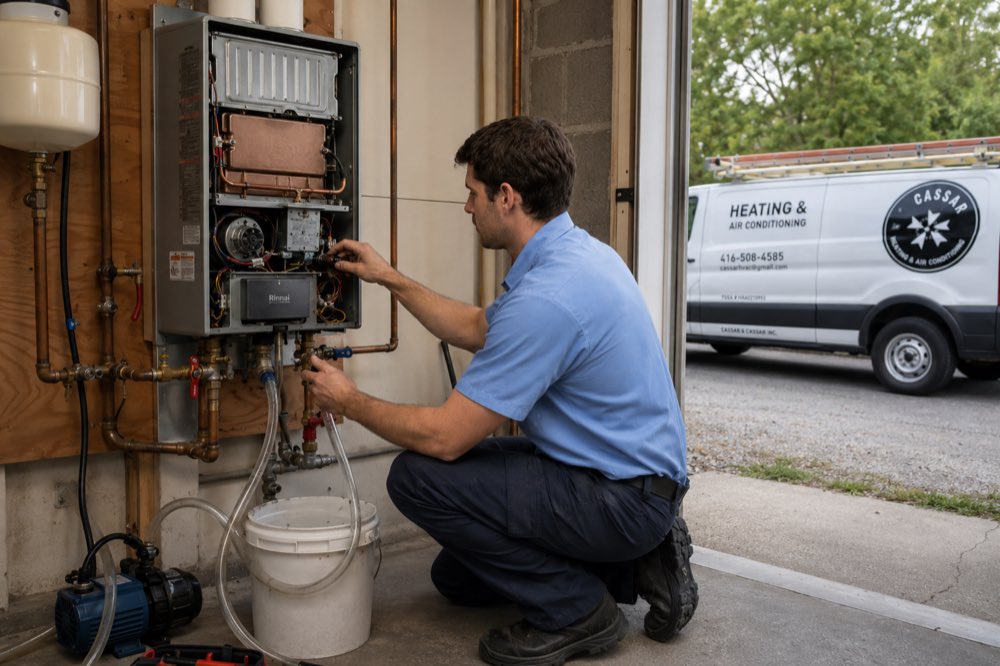
From a first-time install in a Duffin Heights new build to an emergency repair on a unit that’s been running in a Bay Ridges home for a decade, David handles every job personally.
David sizes every unit to the home before recommending a model. Newer Duffin Heights and Seaton builds often have the gas capacity for a high-output unit right away, but older Bay Ridges and West Shore homes frequently need a gas line upgrade first. You’ll know exactly what’s required before any work starts.
Ignition failures, error codes, fluctuating water temperature and scale buildup are the most common calls David gets in Pickering. He stocks the parts that cover the majority of repairs, which means most jobs get resolved the same day. You won’t be quoted for a replacement if a repair is the right answer.
When a unit’s beyond economical repair, David walks you through the replacement options without pushing the most expensive model. He’ll explain what each unit will actually cost to run given your household’s usage, and he’ll handle the disposal of your old equipment.
Durham Region’s water supply carries enough mineral content to build scale inside your heat exchanger within a year or two of installation. A proper annual flush and filter clean keeps your unit running at rated efficiency and extends its service life noticeably. David books most Pickering tune-ups within a week of your call.
Moving from a conventional tank or an older tankless unit to a condensing 0.95 EF or higher model can meaningfully cut your gas bill. David calculates the payback period honestly so you’re deciding based on real numbers, and he’ll flag any current Ontario rebate programs that apply to your specific upgrade.
A tankless unit that stops producing hot water isn’t something you can schedule around for a week. David takes emergency calls across Pickering and responds the same day in most cases. When you call (416) 508-4585 you reach David directly, not a dispatcher who has to relay the job to someone else.
Since 2011, David has worked in Pickering homes ranging from the compact older bungalows along Liverpool Road to the larger new builds going up in Seaton, and he’s seen firsthand how often a previous installer sized the unit wrong or skipped the gas line assessment entirely. He gives every Pickering homeowner the same upfront diagnosis he’d give a family member, and he doesn’t push a replacement if the repair makes financial sense.
A well-maintained tankless water heater lasts 18 to 22 years in most Ontario homes, which is roughly double the lifespan you’d expect from a conventional tank. That range shrinks toward the lower end when the unit goes years without a descale flush, when the inlet filter never gets cleaned, or when it was undersized for the household from the start. Push a unit past its capacity on a daily basis and the heat exchanger ages faster than the warranty implies.
Ontario’s climate shortens lifespan in one specific way that doesn’t apply in warmer provinces: the incoming cold water temperature drops significantly through January and February, sometimes below 4°C on the coldest Pickering nights. That means the burner fires harder and longer to hit the output temperature, which adds wear compared to a unit doing the same job in a milder climate. It’s not a reason to avoid tankless, but it is a reason to stay current on annual maintenance.
The single biggest maintenance task that extends service life is an annual vinegar or citric acid flush to remove the scale that Durham Region’s water deposits inside the heat exchanger. Skip it for three or four years and you’ll notice a drop in output temperature and flow rate before any error code appears. David typically spots scale buildup on a tune-up before the homeowner has noticed any performance change at all.
A standard tankless water heater installation in Pickering, replacing an existing tank unit, runs roughly $2,800 to $4,500 installed depending on the model and whether the gas line needs upgrading. A condensing high-efficiency unit at the top of that range will cost more upfront but delivers a noticeably lower annual gas bill. At the lower end, a non-condensing unit at a straightforward install location in a newer home sits around $2,800 to $3,200 all-in.
The factors that push a job toward the higher end of that range are: the existing gas line being undersized for a tankless unit (common in pre-2000 Pickering homes that were built with tank water heaters in mind), a venting run that requires more than a basic through-wall setup, and second-floor or mechanical room locations that add labour time. None of those are surprises David springs on you mid-job. He identifies them during the assessment and quotes the full scope before he picks up a tool.
Repairs are a different conversation. An ignition module replacement typically runs $300 to $600 including parts and labour. A heat exchanger replacement is closer to $700 to $1,200, at which point the repair vs replace math becomes worth discussing. The best way to know what your specific job will cost is to get a free quote from David, no pressure, no obligation.
Pickering’s housing stock covers a wide range of eras. The older neighbourhoods along the waterfront and around the town centre, Bay Ridges, West Shore and Rougemount, include bungalows and split-levels built in the 1960s through 1980s. Those homes typically have 1/2-inch gas lines and older venting configurations that weren’t designed with tankless in mind. Installing a 180,000 BTU tankless unit on a line originally sized for a tank water heater and a gas range is a mistake David has corrected more than once in this area.
The newer developments, particularly the subdivisions in Duffin Heights and the growing Seaton community on the north side of the city, are a different picture. Many of those homes were built after 2010 with larger gas lines and direct-vent rough-ins, so the installation is more straightforward and the gas line upgrade is often not needed. That said, even in newer builds David checks the actual meter capacity and gas line sizing rather than assuming the rough-in was done to spec.
One pattern specific to Pickering’s mid-range subdivisions from the 1990s and early 2000s, places like Amberlea and Woodlands, is that the homes were sometimes built with 3/4-inch gas lines that stop just short of what a modern high-output tankless unit demands under full draw. A short line extension from the meter is usually all that’s needed, but it needs to be accounted for in the quote rather than discovered after the unit is already on the wall.
The most direct signal is an error code on the unit’s display panel. Most modern tankless brands, Navien, Rinnai, Noritz and Bosch among others, have self-diagnostic systems that flag the specific subsystem that’s failing. An error code means something specific, and telling David the code when you call means he arrives knowing what parts to bring rather than diagnosing from scratch.
Beyond error codes, watch for these patterns: water temperature that swings cold mid-shower (often a flow sensor or scale buildup), a unit that ignites, runs for a few seconds and then shuts off (commonly a venting obstruction or a flame rod issue), and reduced hot water pressure only at hot taps (usually the inlet filter screen partially blocked). In Pickering’s older homes, a sudden drop in output can also indicate that a partial gas valve closure happened during other utility work in the mechanical room, which is an easy fix once you know to look for it.
A less obvious sign is a unit that runs fine but takes noticeably longer than it used to before hot water reaches the tap. That’s usually scale reducing the heat exchanger’s efficiency rather than a component failure, and an annual descale service resolves it without any parts replacement. Durham Region’s water hardness makes this a common finding on units over three years old that haven’t been serviced.
Durham Region’s winters put a specific demand on tankless units that homeowners in milder climates don’t face. When the ground temperature drops in January and February, incoming cold water arrives at temperatures that force the burner to work near its maximum output just to reach 49°C at the tap. Running multiple hot water fixtures simultaneously during the coldest weeks is where undersized units show their limits most clearly. If you’re buying a unit for a family of four in Pickering, sizing up one capacity tier from the minimum that covers your fixture count is a decision David recommends for this climate.
Pipe freeze protection is another consideration unique to Ontario. Most modern tankless units have a built-in freeze protection mode that activates the burner at low intervals when ambient temperature near the unit drops too low. That protection only works if the unit has gas and power available. A utility room that’s unheated or poorly insulated on an exterior wall in a Pickering home is worth addressing before the unit goes in, not after.
On the other side of the year, summer is the right time to book your annual maintenance. The unit’s working less hard, David’s schedule has more flexibility for non-emergency bookings, and you’ll head into the next heating season with a clean heat exchanger and fresh inlet filter. Most Pickering homeowners who do this find their unit performs noticeably better through the high-demand winter months.
Every gas appliance installation in Ontario, tankless water heaters included, requires work by a TSSA-licensed technician. David’s licence number is #000398183, which you can verify directly with the Technical Standards and Safety Authority. Unlicensed gas work voids your home insurance and creates a CO risk that a properly installed unit doesn’t carry. It’s not a technicality. It’s the standard that protects your household.
On the efficiency side, condensing tankless units operate at 0.94 to 0.96 Energy Factor ratings compared to 0.78 to 0.82 for conventional tanks. For a typical Pickering household using roughly 200 litres of hot water daily, that efficiency difference translates to a meaningful annual saving on your gas bill over the unit’s lifespan. The Canada Greener Homes Grant has previously offered rebates on high-efficiency water heaters, and the Enbridge Home Efficiency Rebate program has covered qualifying upgrades. David can tell you which incentives are currently active and whether your specific upgrade qualifies when he assesses your home.
CO safety is the most important reason to get the venting right on every installation. Tankless units that vent through the wall need proper clearance from windows, doors, and adjacent units to prevent exhaust recirculation. David checks every vent termination against TSSA and manufacturer requirements before the job is considered done, and he won’t sign off on an installation where the venting has been improvised or modified outside spec.
Checking the simple things before calling saves time for everyone, run through these before you pick up the phone.
Tankless units have self-diagnostic displays. Write down the error code and call Cassar, this tells us exactly what’s wrong before we arrive, so David shows up with the right parts rather than diagnosing blind.
There’s a small mesh filter screen on the cold water inlet that catches debris. It blocks up over time and restricts flow enough to prevent ignition. Remove it, rinse it under the tap, and reinstall to see if that restores normal operation.
Make sure the gas shutoff valve behind the unit is fully open. It can get partially closed during other work in the utility area, a plumber working on a nearby line, for instance, and a partially closed valve produces exactly the kind of intermittent behaviour that looks like a component failure.
Running multiple hot water fixtures simultaneously can exceed the unit’s flow capacity, causing a cold burst. Try running one fixture at a time to test. If the unit performs fine with a single tap but struggles with two showers and a dishwasher, the unit may be undersized for the household rather than faulty.
Tankless units vent through the wall or roof. Check that the intake and exhaust pipes are clear, undamaged, and properly connected. A bird nest in a roof vent terminal, or a pipe joint that’s worked loose over a winter, will trigger a lockout on most units and looks like an internal failure until you trace it back to the vent.
If none of the above resolved it, there’s a component or gas issue that needs a licensed technician. David serves all of Pickering and Durham Region and picks up the phone himself.
Yes, for most Durham Region households a tankless unit delivers a genuine return over its lifespan, though the payback period depends on a few specific factors. A condensing tankless unit running at 0.95 EF versus a conventional tank at 0.78 EF produces annual gas savings that, at current Enbridge rates, typically recover the installation premium within 6 to 10 years, and these units last 18 to 22 years. The math works out clearly in favour of tankless if you plan to stay in the home. Where it gets more nuanced is in very large households that run multiple showers simultaneously during the coldest Ontario mornings, because that’s when you’re stressing a unit most. The fix there isn’t to avoid tankless, it’s to size correctly. An undersized unit chosen to save $300 upfront often costs more in wear and call-outs within five years. David sizes every job to the actual household demand rather than the minimum rated output, which is the main reason the units he installs perform consistently through a Durham winter.
Most tankless water heater installations in Pickering fall between $2,800 and $4,500 for a complete job including unit, labour, and standard venting. A non-condensing unit at a straightforward location in a newer Duffin Heights or Seaton home sits toward the lower end of that range. A condensing high-efficiency unit in an older Bay Ridges home that needs a gas line upgrade and a longer venting run sits toward the upper end. The three factors that move the needle most are the gas line capacity at your home, the venting distance and configuration, and whether you’re replacing a tank in the same mechanical room location or relocating equipment. David identifies all of those during the assessment before quoting, so the number he gives you covers the full job. There are no line items that appear on the day of installation that weren’t in the original quote. The best way to know what your specific job will cost is to get a free quote from David, no pressure, no obligation.
It depends on the unit’s rated flow capacity and whether it was sized for your actual household demand rather than just meeting minimum requirements. A unit rated for 8 to 9 litres per minute handles two showers simultaneously at typical shower head flow rates. A family of four where two showers, a dishwasher, and a laundry tap are running at the same time needs a unit rated for 12 to 15 litres per minute or more. Where homeowners run into trouble is when a previous installer chose a unit based on the smallest model that would technically work, not the one sized for real peak usage. David’s assessment for a Pickering installation starts with your household size and your peak usage habits, specifically what runs simultaneously during the busiest morning hour, and sizes from there. A properly sized unit handles multiple simultaneous fixtures without temperature swings. One sized to the minimum spec struggles on a busy Saturday morning in January when incoming water is near freezing.
Many homes in Pickering built before 2000 need at least a partial gas line upgrade when switching to a tankless unit. A standard tank water heater draws around 40,000 to 50,000 BTU per hour. A tankless unit in the same home draws 150,000 to 199,000 BTU per hour at full demand. The existing 1/2-inch gas line that supplied the tank often can’t deliver that volume at adequate pressure. The result is an undersupplied unit that fires inconsistently or fails to maintain temperature under load. The fix is usually upgrading the line from the meter to the unit, which is a straightforward job but needs to be in the quote upfront. In Pickering’s older Bay Ridges and West Shore neighbourhoods, David checks gas line sizing as part of every pre-installation assessment. In the newer Seaton developments most homes have 3/4-inch or larger lines already, so upgrades are less common there. Either way, you’ll know before the installation day, not during.
A typical tankless water heater installation in a Pickering home takes three to five hours when it’s a straightforward tank-for-tankless swap with no gas line upgrade needed. If the job includes a gas line extension, a new venting run through a wall or roof, or electrical work for a new dedicated outlet, that extends the time to five to seven hours. David gives you a realistic time estimate when he quotes the job, so you’re not blocking off the whole day based on guesswork. He works alone on most residential installs, which means there’s no second tradesperson scheduling to coordinate. When he says he’ll arrive at 9am he’s there at 9am, and if the job runs longer than quoted that extra time doesn’t add to your invoice. You pay what was quoted.
Cold water from a tankless unit usually comes from one of five causes: an ignition failure, a blocked inlet filter restricting flow below the activation threshold, a partially closed gas valve, a flow sensor that’s not detecting the draw correctly, or a venting obstruction causing a safety lockout. The “cold water sandwich” specifically, where you get a few seconds of hot water followed by a cold burst and then hot again, is a normal characteristic of tankless units that occurs when a second draw pulls water that was sitting in the pipe between the unit and the tap. That’s not a malfunction. But sustained cold output, or a unit that ignites and then cuts out within a few seconds, needs a technician. In Pickering’s harder water areas, scale buildup on the heat exchanger can also cause temperature to drop under load without triggering a clear error code. David has seen this pattern on units in Pickering as young as four years old that had never been serviced. Call (416) 508-4585 and describe exactly what the unit is doing, David can usually narrow down the cause before he arrives.
Annual service is the right interval for a tankless unit in Durham Region, and the main reason is water hardness rather than mechanical wear. The municipal water supply in the City of Pickering carries enough dissolved calcium and magnesium to deposit meaningful scale inside the heat exchanger within 12 to 18 months of installation. An annual flush removes that scale before it reduces efficiency or causes a component failure. Beyond descaling, a proper annual service includes cleaning the inlet filter, checking the burner assembly and igniter, testing the pressure relief valve, and inspecting the venting connections. Homeowners who skip service for two or three years don’t always notice the gradual drop in performance until something actually fails. David typically finds that a unit arriving for its first service after two or three years has measurably reduced output capacity compared to its spec, simply due to scale, and that a single flush restores it. Book a tune-up every autumn before the high-demand winter months and the unit will serve its full expected lifespan.
David works on all of the major tankless brands sold in Ontario, including Navien, Rinnai, Noritz, Bosch, Bradford White, and Rheem, among others. He also services units installed by other contractors, so if you’ve got an existing unit that’s showing an error code or performing below spec, you don’t need to go back to whoever installed it. When it comes to installations, David recommends the brands and models he’s seen perform well over years of service in Durham Region’s climate and water conditions rather than pushing whatever carries the highest margin. If you’ve already got a brand preference or have done your own research, he’ll give you an honest read on whether that unit is a good fit for your home’s gas and venting setup before you commit.
“Our tankless unit in Pickering went cold on a Wednesday morning. David came out the same day, found a blocked inlet filter and a failing flow sensor, and had hot water running again before dinner.”
“I called about replacing our old tank with a tankless unit in our Bay Ridges home and David answered himself. He came out, told me the existing gas line wouldn’t support the unit I’d been quoted by another company, and explained exactly what was needed and why. The job came in at the price he quoted, no additions. He’s the kind of tradesperson who’s actually straight with you.”
“Pricing was clear from the start, no surprises when he handed over the invoice. He put down floor covers before bringing anything in, worked clean the whole time, and the utility room looked exactly the same when he left. For a tankless installation in Pickering I wouldn’t go anywhere else.”
David covers all of Durham Region, so wherever you are near Pickering, he can get to you.
Same-day service available. TSSA certified. Honest pricing. Call or book online.