
Oshawa’s mix of postwar bungalows and newer Kedron subdivisions means David sees everything from aging tank setups in cramped utility rooms to brand-new builds where a tankless unit fits perfectly but needs the right sizing to handle a full household’s demand. He’s available same-day for repairs and emergencies across the City of Oshawa and all of Durham Region.
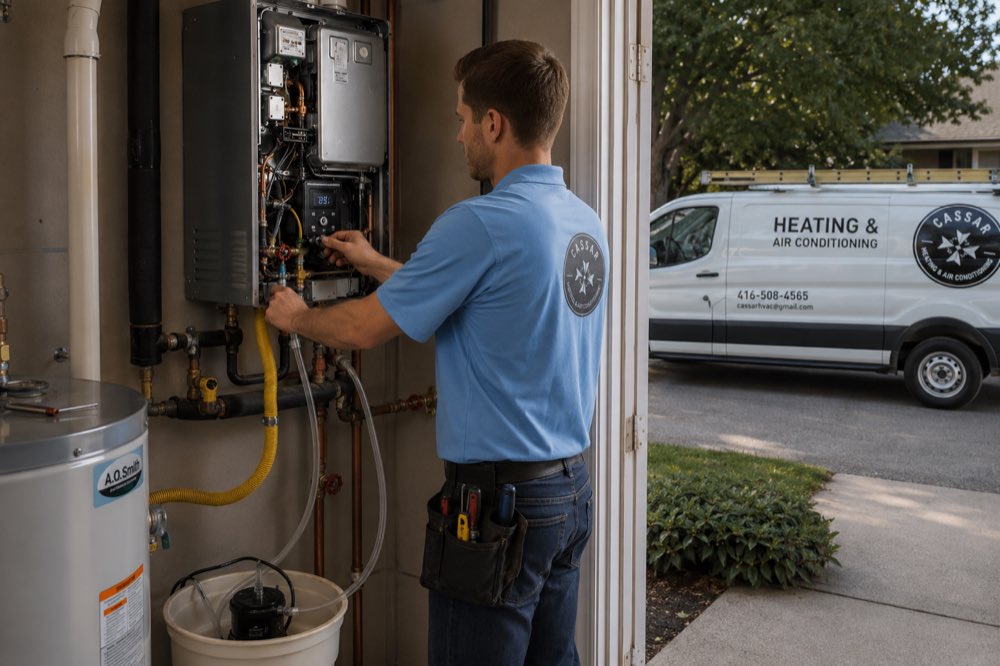
From new installations to emergency repairs, David handles every aspect of tankless water heater work across the City of Oshawa.
David sizes every unit to the home before recommending a model. Oshawa’s older homes in Lakeview and O’Neill often have smaller gas lines and tighter utility spaces that affect which units can realistically be installed. He’ll confirm your gas supply and venting path before any equipment gets ordered, so there are no surprises on installation day.
When your tankless unit stops heating, David diagnoses the problem the same day in most cases. He carries common replacement parts, including igniters, flow sensors, and heat exchangers, so he can often fix it on the first visit. He’ll tell you the error code’s meaning before he starts, and he’ll give you a straight answer on whether the repair makes financial sense.
If your unit has reached the end of its useful life or a repair cost approaches what a new unit would cost, David gives you the honest comparison. He won’t push replacement on a unit that’s got good years left. When it is time to replace, he handles the full swap: disconnecting the old unit, rechecking the gas line sizing, and commissioning the new one properly.
A tankless unit needs flushing every one to two years to clear mineral scale from the heat exchanger. Oshawa draws from Lake Ontario through the Region of Durham’s water treatment system, but the water’s mineral content still builds up inside the unit over time and reduces efficiency. David flushes the heat exchanger, cleans the inlet filter, inspects the burner, and checks the venting on every annual visit.
Upgrading from a standard storage tank to a condensing tankless unit can cut your water heating costs significantly. David helps you understand the actual payback period based on your household’s usage, not a generic marketing claim. He’ll also check whether your current gas meter and line can handle the demand before recommending a specific model.
A cold shower at 6 a.m. or a unit that shuts down mid-evening isn’t something you want to wait a week for. David picks up the phone personally when you call, so you know within minutes whether he can get to you that day. He covers the full City of Oshawa, including Windfields, Samac, and Northwood neighbourhoods, and doesn’t charge a different rate just because it’s urgent.
I’ve been working in Oshawa homes since 2011 and I’ve seen the same problems repeat: units that were undersized for the household, installations where nobody rechecked the gas line, and homeowners told they needed a full replacement when a $200 part would’ve done the job. I give you the same answer I’d give my own family. You get my direct number, you reach me when you call, and the price I quote is the price on the invoice.
David holds TSSA Licence #000398183. You can verify that yourself on the TSSA website before you book.
A well-maintained tankless water heater typically lasts 18 to 25 years. That’s roughly double what a conventional storage tank gives you. The range exists because brand quality, installation quality, and how consistently the unit gets serviced all move that number significantly. A Navien or Rinnai unit installed correctly and flushed annually will reach the upper end of that range. A budget-brand unit that never gets serviced will start causing problems at year ten.
What shortens lifespan most in Ontario is scale buildup inside the heat exchanger. Ontario’s municipal water supply isn’t the hardest in Canada, but mineral deposits still accumulate inside the heat exchanger over time. When scale builds up, the unit works harder to heat the same volume of water, which stresses the components and eventually causes the heat exchanger to crack or fail. Flushing the unit with a descaling solution every one to two years is the single most effective maintenance step an Oshawa homeowner can take.
Venting also matters more in Ontario’s climate than people realize. Freeze-thaw cycles can cause condensate to build up in improperly sloped exhaust pipes, which eventually triggers fault codes and, in serious cases, corrodes the venting. David checks the venting slope and condition on every service call because it’s one of the problems that gets overlooked until it causes a shutdown in the middle of January.
A straightforward tankless water heater installation in Oshawa typically runs between $3,000 and $5,500, including the unit, labour, and standard venting. The spread depends on the unit’s flow rate and efficiency rating, whether the gas line needs upgrading, the complexity of the venting route, and whether you’re replacing an existing tankless unit or converting from a storage tank. Converting from a tank to tankless almost always requires new venting and sometimes a gas line upgrade, which adds cost.
Repairs are considerably less. A common igniter replacement runs $250 to $450. A flow sensor is similar. Heat exchanger replacement on an older unit can reach $800 to $1,200, at which point David will walk you through the math on repair versus replacement so you can decide with real numbers in front of you. Annual maintenance visits run $150 to $250 depending on the service performed.
Every job gets a written quote before David touches anything. The best way to know what your specific job will cost is to get a free quote from David, no pressure, no obligation.
Oshawa has one of the most varied housing stocks in Durham Region. The city’s postwar growth produced large swaths of bungalows and split-levels in neighbourhoods like Lakeview, McLaughlin, and O’Neill, most built between the 1950s and the 1970s. These homes often have smaller-diameter gas lines sized for the original appliances of that era. When a homeowner wants to install a high-demand condensing tankless unit, that original ¾-inch gas line sometimes needs upgrading to 1-inch to deliver the BTU capacity the new unit requires. David checks this before recommending any unit.
The city’s newer growth areas tell a different story. Kedron, Windfields, and the Taunton Road corridor have seen significant new construction since the early 2000s. These homes often arrive from the builder with a tankless unit already installed, but those builder-grade units are frequently undersized for a four- or five-person household. David gets calls from families in these neighbourhoods who’ve been fighting cold-water sandwiches since they moved in. In many cases the fix is a higher-capacity unit, not a repair.
Oshawa’s older downtown and waterfront-adjacent areas also present venting challenges. Some attached homes and semi-detached properties have limited exterior wall access for the direct-vent intake and exhaust pipes, which affects where the unit can be mounted and which venting configuration works. David assesses the venting route before installation day so nothing needs to be re-run at extra cost once the work has started.
The most obvious sign is an error code on the unit’s display. Every major brand, Navien, Rinnai, Noritz, Bosch, has a self-diagnostic system that flashes a code when something’s wrong. Write the code down before you call, because it tells David exactly which system triggered the fault before he arrives. The two most common codes David sees on Oshawa service calls are flow-related errors (usually a clogged inlet filter) and ignition failures (often a dirty burner or a faulty igniter).
A cold-water sandwich is another common complaint. That’s the burst of cold water you get between two bursts of hot when you turn on the shower. It happens because the water sitting in the pipes from the last draw is cold, then the newly heated water arrives, then a slug of cold water that was in the heat exchanger when the unit cycled off comes through. A recirculation pump eliminates this problem entirely. In Oshawa’s older homes where the hot water line runs a long distance from the utility room to the bathrooms, David often recommends adding a recirculation pump at the same time as an installation.
Reduced hot water output, longer heat-up times, or a unit that works fine in summer but struggles in winter all point to scale buildup or a venting restriction. Durham Region winters drop well below freezing from December through March, and a partially blocked exhaust pipe will cause the unit’s pressure switch to trip on the coldest days, which is exactly when you notice it most. If your unit’s been running fine for years and starts acting up in January, the venting is worth checking first.
Durham Region’s winters are hard on any HVAC or plumbing equipment that has an outdoor component. Tankless units that vent through the wall have a condensate drain that can freeze if the unit isn’t properly installed or if the drain runs through an unheated space. David pitches condensate lines to drain freely and checks that the exterior termination points are clear of ice and debris on every visit during heating season.
Ground water temperature in Ontario drops to around 4°C in winter. A tankless unit heating incoming water from 4°C to a delivery temperature of 49°C needs to work significantly harder than it does in July when the incoming water is 15°C or warmer. This is why proper sizing matters more in Ontario than in warmer climates. A unit that keeps up in summer might fall short on the coldest February mornings if it wasn’t sized with the winter inlet temperature in mind. David calculates the required temperature rise when he sizes a unit, not just the peak flow rate.
Annual servicing in the fall, before heating demand peaks, gives David a chance to flush the heat exchanger, verify the gas pressure, and check the condensate drain before winter arrives. Catching a partially clogged filter or a loose flue connection in October is a much better outcome than dealing with a no-hot-water call in February.
In Ontario, tankless water heater installation falls under TSSA jurisdiction. The TSSA regulates gas appliance installation and requires the work to be performed by a licensed contractor. David holds TSSA Licence #000398183. This matters because an improperly installed gas appliance is a carbon monoxide risk. CO is colourless and odourless, and a combustion leak inside a utility room can reach dangerous concentrations before anyone notices. Proper commissioning and a CO detector near the utility area are both things David takes seriously on every job.
On the efficiency side, the Canada Greener Homes Grant previously offered rebates for upgrading to high-efficiency water heating equipment. That specific program has concluded, but Ontario homeowners should check with Enbridge Gas and the current Canada Greener Homes Initiative for any available incentives at the time of purchase. David can provide the equipment documentation you’ll need if a rebate application requires it.
Condensing tankless units achieve thermal efficiencies of 94 to 96 percent compared to 60 to 70 percent for a standard storage tank. That efficiency gain is real, but David will tell you plainly that the payback period depends on your household’s actual hot water consumption. A two-person household using modest hot water won’t see the same payback as a family of five with high daily demand. He’ll give you a realistic estimate based on your specific usage, not a manufacturer’s best-case projection.
Checking the simple things before calling saves everyone time, here’s where to start.
Tankless units have self-diagnostic displays. Write down the error code and call Cassar, this tells us exactly what’s wrong before we arrive, which means David can bring the right parts and get it resolved faster.
There’s a small mesh filter screen on the cold water inlet that catches debris. It blocks up over time and restricts flow enough to prevent ignition. Removing and rinsing it takes two minutes and sometimes that’s all that’s needed.
Make sure the gas shutoff valve behind the unit is fully open. It can get partially closed during other work in the utility area, a plumber, an HVAC tech, or even a previous service call. A partially closed valve will cause ignition failures and low-heat complaints.
Running multiple hot water fixtures simultaneously can exceed the unit’s flow capacity, causing a cold burst. Try running one fixture at a time to test. If the unit keeps up with a single fixture but not two, it’s a sizing issue, not a malfunction.
Tankless units vent through the wall or roof. Check that the intake and exhaust pipes are clear, undamaged, and properly connected. In winter, ice can partially block the exterior termination and trigger a pressure fault that shuts the unit down.
If none of the above cleared it up, it needs a licensed technician. David covers all of Durham Region and picks up the phone personally, you won’t get a call centre or a callback queue.
Yes, for most Durham Region households, the switch to tankless makes financial and practical sense. A condensing tankless unit operates at 94 to 96 percent thermal efficiency compared to 60 to 70 percent for a standard storage tank, and it only heats water when you need it rather than keeping a 40- or 60-gallon tank warm around the clock. In Durham Region’s climate, where gas prices factor into every month of the year, that continuous standby loss from a tank adds up. The payback period varies by household. A family of four with high daily hot water use will recoup the installation premium faster than a couple in a small home with modest demand. Tankless units also last 18 to 25 years versus 10 to 12 for a tank, which changes the long-term math significantly. David gives honest payback estimates based on your actual usage, not a manufacturer’s best-case scenario.
Most tankless water heater installations in Durham Region fall between $3,000 and $5,500, all in. That range covers the unit, labour, standard venting materials, and permits where required. The variables that push the cost toward the higher end include converting from a storage tank to tankless (which requires new venting and sometimes a gas line upgrade), a complicated venting route through finished walls or long horizontal runs, and choosing a higher-capacity condensing unit for a larger household. A straightforward like-for-like tankless replacement where the venting and gas line are already sized correctly comes in at the lower end. Repairs range from $250 for a common igniter or sensor to $800 to $1,200 for a heat exchanger replacement on an older unit. The best way to know what your specific job will cost is to get a free quote from David, no pressure, no obligation.
It will if it’s sized correctly for your household’s peak demand. This is where a lot of Oshawa homeowners run into trouble, particularly in newer builds in Windfields and Kedron where builders installed entry-level tankless units that can handle one or two simultaneous draws but struggle when three or four fixtures run at the same time. The key number is the unit’s flow rate in gallons per minute at the required temperature rise. In Ontario, the incoming cold water in winter drops to around 4°C, so the unit needs to raise it about 45 degrees Celsius to reach a delivery temperature of 49°C. That winter temperature rise takes more capacity than the summer calculation. David sizes units to handle your household’s peak winter demand, not just the average. If your current unit can’t keep up, the fix is usually a higher-capacity unit or, in some cases, a second unit plumbed in parallel.
Many Oshawa homes, particularly those built before 1990 in neighbourhoods like McLaughlin, O’Neill, and Lakeview, have ¾-inch gas lines that were sized for the appliances installed at the time. A high-efficiency condensing tankless unit can require up to 199,000 BTU/hr at peak demand, which a ¾-inch line may not deliver at adequate pressure over the full run length. David checks the gas line size and the line pressure at the unit location before recommending any specific model. If an upgrade is needed, it’s factored into the quote upfront, not discovered after installation day. The upgrade typically means running a 1-inch line from the meter to the unit location, and that work requires a licensed gas contractor. David is licensed under TSSA Licence #000398183 to perform this work. The cost of a gas line upgrade in a typical Oshawa home ranges from $400 to $900 depending on the run length and access.
A like-for-like tankless replacement, where the venting and gas line are already in place and sized correctly, typically takes three to four hours. David can usually complete it in a single visit with no hot water interruption beyond the installation window itself. A full conversion from a storage tank to tankless takes longer because the old tank needs to be disconnected and removed, new venting needs to be run through the wall, and the gas line may need modification. That type of job typically runs five to seven hours. If the venting route is complex or the gas line runs a significant distance, it can extend to a full day. David tells you upfront how long he expects the job to take based on your specific setup, so you can plan accordingly. He doesn’t leave a job unfinished and come back the next day unless something genuinely unexpected comes up, which he’ll communicate immediately.
Cold water from a tankless unit usually has one of four causes, and figuring out which one is straightforward. The most common is the cold-water sandwich, which is the slug of cold water sitting in the heat exchanger from the previous draw that comes through before the newly heated water arrives. This isn’t a malfunction, it’s how tankless units work, and a recirculation pump eliminates it. The second cause is a clogged cold water inlet filter restricting flow below the activation threshold, which means the burner never fires. The third is a failed flow sensor that can’t detect the water moving through the unit. The fourth, especially common during Oshawa winters, is a venting blockage or freeze that trips the pressure switch and prevents the burner from firing. Check the error code on the display first. If it shows a flow or ignition fault, the inlet filter and gas valve are worth checking before calling David. If the display shows a pressure or exhaust fault, the venting is the likely culprit and that needs a hands-on inspection.
Once a year is the right interval for most Oshawa households. The core of the annual service is flushing the heat exchanger with a descaling solution to clear mineral deposits before they accumulate to the point of reducing efficiency or cracking the exchanger. David also cleans the inlet filter, inspects the burner assembly, checks the igniter, verifies the gas pressure at the unit, and inspects the venting for proper slope, seal integrity, and exterior clearance. In a household with particularly hard water or very high hot water demand, a flush every six months makes sense. The service visit typically takes 60 to 90 minutes. Skipping the annual flush is the single most common reason David sees heat exchangers fail prematurely. A heat exchanger replacement on a unit that should have had ten more years runs $800 to $1,200. The annual flush costs $150 to $250. The math is straightforward.
David works on all major tankless brands, including Navien, Rinnai, Noritz, Bosch, Bradford White, A.O. Smith, and Rheem, among others. For installations, he typically recommends Navien or Rinnai based on their reliability record and parts availability in the Durham Region market. When David services a brand he doesn’t recommend, he’ll still tell you honestly what condition it’s in and what it would cost to repair versus replace with something he’d stand behind. He won’t refuse to work on a unit just because he’d have chosen a different brand. If you’ve already got a specific brand installed in your Oshawa home or you’ve done your own research and want a particular model, David will work with that and give you his honest assessment before the equipment is ordered. The goal is that the unit performs well for the next 20 years, not that it’s the brand David happens to have a preference for.
“Our tankless unit in Oshawa stopped firing on a Thursday morning. David was here by noon, had the flow sensor replaced, and we had hot water again before dinner.”
“I called David because our Navien unit in our Windfields home kept giving us cold bursts mid-shower. He came out, looked at the setup, and explained that the builder had put in a unit two sizes too small for our household. He didn’t just sell me a new one on the spot, he walked me through the numbers first. We ended up replacing it with a higher-capacity unit and the difference was immediate. Straight shooter.”
“The quote I got was exactly what I paid. No add-ons, no surprises when the invoice came. He covered the floors in my Oshawa home before he started, put everything back where he found it, and was done in under four hours. That kind of care for someone else’s house isn’t something you always get.”
David covers all of Durham Region, if you’re outside Oshawa, here’s where else he works.
David handles all home comfort equipment for Oshawa homeowners.
Same-day service available. TSSA certified. Honest pricing. Call or book online.