
Durham Region’s rapid suburban growth, from Pickering’s newer subdivisions to Clarington’s expanding communities, means thousands of homes are adding gas appliances, BBQ hookups, and basement stoves to lines that weren’t originally sized for that load. David Cassar has held TSSA Licence #000398183 since 2011 and covers every community across Durham Region, same day when you need it.
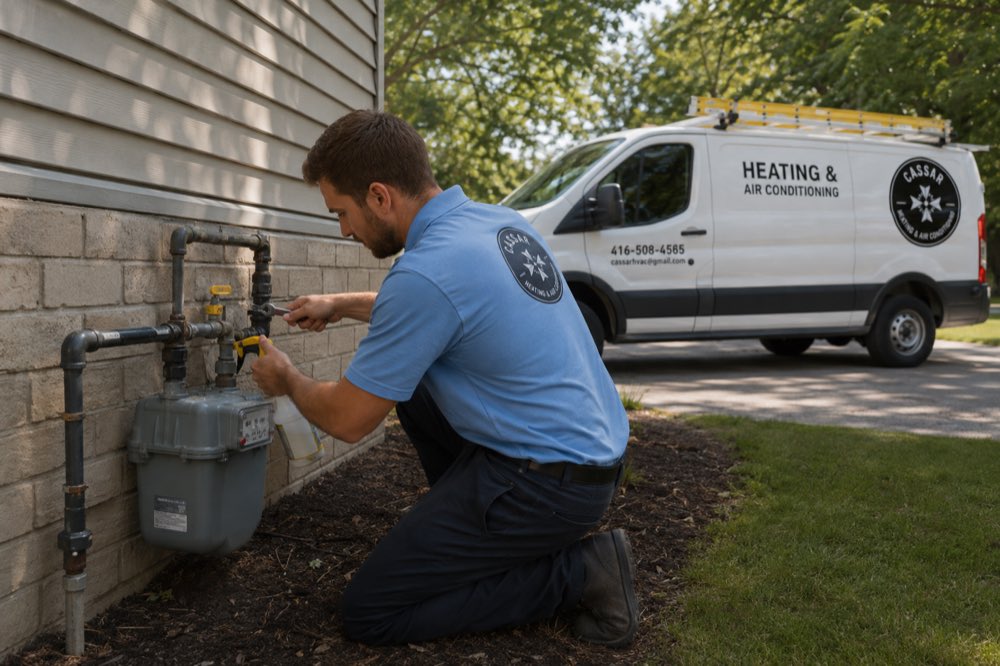
Whether you’re adding a gas appliance or dealing with a line that’s lost pressure, David diagnoses and fixes it the same day.
David runs new gas lines to appliances, BBQs, fireplaces, generators, and garage heaters throughout Durham Region. Every installation is permitted and inspected to TSSA standards. Many Oshawa and Whitby homes David works in were built without a second gas outlet, he sizes and routes the new line correctly from the start.
A slow leak, a corroded fitting, or a line that simply won’t hold pressure, David diagnoses the problem and repairs it properly. He carries the fittings and flex connectors on the truck, so most repairs finish in a single visit. He won’t recommend replacing a line that just needs a fitting fixed.
Black iron pipe from the 1970s and early 1980s is still common in Durham Region’s older Ajax and Pickering homes. When corrosion goes past the point of repair, David replaces the run with modern corrugated stainless steel tubing (CSST) or black iron, depending on what the application needs.
David checks every connection, tests for leaks with calibrated equipment, and verifies that all shutoff valves are operating correctly. Catching a hairline leak in a basement fitting before it becomes a problem costs far less than an emergency call. Most homeowners schedule this at the same time as a furnace tune-up in the fall.
Upgrading from a mid-efficiency furnace to a 96% AFUE unit often requires upsizing the gas line to match the new BTU demand. David calculates the load before starting so the new appliance gets the gas supply it needs. He’s seen more than a few Durham Region installs done by others where the line was undersized and the new furnace short-cycled because of it.
When you smell gas or lose pressure to multiple appliances, you need someone on-site fast. David answers the phone personally and serves all of Durham Region. He stocks the parts that fix the most common emergency failures, so the job doesn’t drag into a second visit while you’re waiting on a supplier.
I’ve been running and repairing gas lines in Durham Region since 2011, and the single most common thing I see is a homeowner who called someone else first, got a quote for a full replacement, and then called me to get a second opinion. Most of the time, it’s a fitting or a section of line. I’ll tell you exactly what it is and what it’ll cost before I touch anything. Every job I do here is covered under TSSA Licence #000398183, which you can verify on the TSSA website.
Black iron gas pipe, which is still the most common material in Ontario homes built before 1990, typically lasts 40 to 70 years when it’s installed correctly and the home stays dry. The range is wide because moisture is the main enemy, a basement that floods regularly, or a crawlspace that stays humid through our wet springs and falls, accelerates corrosion at joints and low points where water collects.
CSST (corrugated stainless steel tubing), which became standard in Ontario through the late 1990s and 2000s, has a similar projected lifespan, but it’s sensitive to mechanical damage and needs bonding to protect against lightning-induced arcing. Ontario’s freeze-thaw cycles put stress on underground sections too, so any outdoor line or line through an unheated crawlspace deserves a close look every few years.
The single best thing you can do to extend the life of a gas line in Ontario is to have a licensed technician test every connection with a leak detector once a year. A slow seep at a compression fitting doesn’t smell strong enough to trigger alarm, but it weakens the fitting over time. David catches these during annual tune-ups before they become an emergency.
A straightforward gas line extension for a BBQ hookup or a new stove outlet in a Durham Region home typically runs between $300 and $600, assuming the main line has enough capacity and the run is under 15 feet through accessible space. A longer run, or one that needs to go through finished walls or a concrete floor, adds time and materials and will push the cost higher, generally in the $600 to $1,200 range for most residential jobs.
A full gas line replacement, replacing all the black iron from the meter to the appliances in a 1970s bungalow, for example, can range from $1,500 to $3,500 depending on the number of appliances, the length of the runs, and whether the basement is finished. The permit and inspection from the local authority is included in David’s quotes; that’s not an add-on.
Emergency calls carry a service fee that David gives you upfront when you call. What drives variation in any job is access, distance from the main, how many connections need testing, and whether the existing pipe is in good enough condition to tie into. The best way to know what your specific job will cost is to get a free quote from David, no pressure, no obligation.
Durham Region grew fast through two distinct building eras. The older communities, central Oshawa, downtown Ajax, older Pickering, have a substantial stock of bungalows and split-levels built between the 1950s and 1980s. These homes often have original black iron gas lines that haven’t been touched since installation. The lines themselves may be fine, but the fittings and shutoff valves in those homes are frequently corroded or seizing, and they often weren’t sized with today’s appliance loads in mind.
The newer subdivisions in Whitby, Courtice, Bowmanville, and northeast Pickering were built mostly from the mid-1990s onward and use CSST. These homes generally have more appliance outlets, but David regularly sees bonding that’s missing or incomplete on CSST installations in these communities, a code requirement that was sometimes skipped during the original construction. An unbonded CSST line poses a real risk if the home ever takes a lightning strike nearby.
Newcastle and the rural parts of Clarington have a different challenge entirely: some properties still have older natural gas infrastructure where the service pressure at the meter is lower than in the urban core, which affects what appliances you can run and how the lines need to be sized. David knows this region’s gas infrastructure well, and he checks service pressure before designing any new installation.
The most obvious sign is the smell of rotten eggs near an appliance or along the basement wall where a line runs. Natural gas is odourless on its own, the mercaptan added to it is what you’re smelling, and it’s there precisely so you notice a leak before it accumulates to a dangerous concentration. If you smell it, leave first and call Enbridge from outside. Don’t try to locate the source yourself.
Less obvious signs include a furnace or gas stove that takes longer to ignite than it used to, a pilot light that keeps going out on a water heater or fireplace, or a drop in flame height on a gas range that used to burn at full strength. These often point to a restriction, a partially closed valve, or a section of line that’s partially blocked with corrosion debris, something David has seen in older Oshawa and Ajax homes where black iron pipe is degrading from the inside.
A yellow or orange flame on a gas burner that should burn blue is worth calling about. It signals incomplete combustion, which means the appliance isn’t getting the air-to-gas ratio it needs. That’s sometimes an appliance issue, but it can also indicate low gas pressure from a line that’s undersized or damaged. Either way, it produces more carbon monoxide than a properly burning appliance, and that matters in a Durham Region winter when the house is sealed up tight.
Durham Region’s winters are cold enough that gas appliances run hard from November through March, and that sustained load puts real stress on fittings that might otherwise sit stable for years. The best time to have a gas line inspected is October, before the heating season starts. David books up fast in November once furnaces start failing, so a fall inspection is worth scheduling early.
Spring is the other important window, particularly for outdoor lines and any gas line running through a crawlspace. The freeze-thaw cycle through February and March can shift soil, stress underground sections, and loosen fittings at penetration points. If you have an outdoor gas BBQ line or a pool heater line that runs through the ground, a quick pressure test in April catches any movement damage before the summer season.
Humidity in Durham Region’s summers is hard on any exposed iron fittings, especially in homes where the basement isn’t air-conditioned. If you’ve noticed any surface rust on visible gas line sections, don’t ignore it. Surface rust on black iron is normal, but deep pitting at threaded joints is where leaks start, and those joints are worth a visual inspection once a year.
In Ontario, all gas line work must be performed by a TSSA-licensed contractor. TSSA sets the standards for installation, materials, and testing, and they inspect the work on new installations and replacements. A contractor who pulls a permit and passes the inspection gives you documentation that the work was done to code, that matters for your home insurance and for resale. David’s TSSA Licence #000398183 is on every permit application.
Carbon monoxide is the risk that most homeowners underestimate with gas lines. A slow leak or a partially blocked burner produces CO that a properly installed CO detector catches. Ontario requires CO alarms on every storey of a home with gas appliances. If you haven’t replaced the batteries or tested the unit recently, do it today. David checks every CO detector in homes he works in as part of a gas line visit, at no extra charge.
On the efficiency side, Enbridge Gas periodically offers rebates for upgrading older appliances to newer high-efficiency units, and some upgrades qualify under the Canada Greener Homes Grant when combined with a heat pump system. David can advise on what’s currently available and whether your planned installation qualifies. The rebates change year to year, so getting current information before you commit to a specific appliance saves money.
Checking the simple things before calling saves time for everyone, here’s where to start.
Don’t operate any switches or look for the source. Leave the home immediately keeping the door open, then call Enbridge Gas at 1-866-763-5427 from outside or a neighbour’s home.
Each gas appliance has its own shutoff valve. Make sure it’s fully open, these sometimes get turned off accidentally during renovations or cleaning.
If several gas appliances lost pressure at the same time, the issue may be at the meter or regulator. Call your gas utility before calling us.
If a gas appliance was recently installed or moved, check that all fittings are tight. Loose connections are common after DIY appliance hookups.
If the meter display shows an error or the meter has been shut off, call Enbridge Gas to restore service before calling Cassar for appliance work.
If none of the above resolved the problem, it needs a licensed technician. David serves all of Durham Region and picks up the phone himself.
Yes, any new gas line installation or replacement in Ontario requires a permit from the local building department and inspection by the TSSA or an authorized inspection authority. This applies to a new BBQ hookup, a gas dryer outlet, a fireplace installation, or any extension of an existing line. The permit exists to make sure the work is done to the Ontario Gas Installation Code, and the inspection gives you documented proof that it passed. David pulls the permit on every job and includes that cost in your quote, there’s no add-on charge for permit administration. Skipping the permit to save a few hundred dollars is a genuine liability if you ever make an insurance claim or sell the home, and it’s something a home inspector will flag. In Durham Region, the municipality coordinates with the TSSA on residential gas work, so the process is straightforward when you’re working with a licensed contractor.
For most residential gas line installations in Durham Region, you’re looking at a range of $300 to $1,200 for a new run to a single appliance. A short BBQ hookup from an existing outlet in an accessible basement is typically at the lower end of that range. A longer run through a finished wall, or a new line that requires upsizing the main from the meter, sits toward the higher end. Full line replacements covering multiple appliances in older homes generally run between $1,500 and $3,500. What drives the variation is the length and complexity of the run, whether walls or floors need to be opened, the current capacity of your main line, and permit fees. The labour rate stays consistent, what changes is the time and materials. The best way to know what your specific job will cost is to get a free quote from David, no pressure, no obligation.
Yes, and this is one of the most common jobs David does across Durham Region. A gas BBQ hookup, a new gas range outlet in the kitchen, a direct-vent fireplace, or a garage heater, David handles all of these. For a BBQ line, he’ll typically run a black iron or CSST line from the basement to an outdoor quick-disconnect fitting on the exterior wall, so you’re not dragging a flexible hose every time you want to cook. For a new stove or fireplace, he checks your existing main line’s capacity first to make sure adding the new appliance doesn’t starve another one. In Durham Region’s newer Whitby and Clarington homes, the lines are usually sized with some room to grow. In older Oshawa homes, he sometimes needs to upsize a section of main before adding a high-BTU appliance. The permit and inspection are included in every quote.
The way to know for certain is to add up the BTU demand of every gas appliance on the line and compare that against the delivery capacity of the pipe size and length you have. If the total demand exceeds the line’s capacity, you’ll see symptoms: appliances that take longer to ignite, burners that won’t reach full output, or a furnace that short-cycles because it’s not getting enough gas to maintain the call for heat. David does this calculation on every installation and checks it on repair calls when the symptoms suggest a capacity issue. The most common scenario he sees in Durham Region is a homeowner who added a gas dryer or a high-BTU range to a line that was originally sized just for a furnace and water heater, there’s enough gas for each appliance individually, but not for all of them running at the same time. If you’re adding an appliance or your existing ones aren’t performing as expected, a capacity check takes about 20 minutes and David includes it in every service visit.
Leave the house immediately, that’s the only right first move. Don’t turn lights on or off, don’t open the fridge, don’t look for the source of the smell. Leave the front door open as you go and get yourself and everyone in the home outside. Once you’re outside, call Enbridge Gas at 1-866-763-5427. They’ll dispatch an emergency technician to shut off the supply at the meter and clear the structure. Only after Enbridge has declared the home safe should you call David to diagnose and repair the source of the leak. The reason the sequence matters is that Enbridge’s emergency technicians are the ones authorized to restore gas service at the meter, David can fix the leak, but Enbridge needs to shut it off first and turn it back on after the repair. Don’t re-enter the home until Enbridge gives the all-clear. Once they do, David can typically get there the same day to complete the repair and get your appliances back on.
A single appliance gas line installation, a BBQ hookup, a new stove outlet, or a fireplace line in a typical Durham Region home, takes between two and four hours, start to finish. That includes the rough-in, all connections, and the pressure test before David signs off on the job. The permit inspection is a separate appointment with the inspector, but David coordinates that and it doesn’t affect how quickly you can use the appliance in most cases. A more involved job, like replacing all the gas lines in an older home or running a line through multiple floors, generally takes a full day. If David needs to cut into drywall to run the line, he works cleanly and the opening he leaves is as small as the job allows. He’ll tell you the expected time frame when he gives the quote, so you’re not guessing.
Yes, absolutely. The Technical Standards and Safety Authority (TSSA) regulates all gas work in Ontario under the Technical Standards and Safety Act. Any person or company doing gas line installation, repair, or replacement must hold a valid TSSA gas contractor licence. This isn’t optional and it’s not a formality, it’s the law, and it’s the reason you can verify David’s licence (#000398183) directly on the TSSA public registry at tssa.org. Homeowners hiring an unlicensed contractor for gas work risk voided insurance, failed inspections, and the very real safety consequences of work that wasn’t done to code. Before you hire anyone for gas line work in Durham Region, check their TSSA number. David’s is on every invoice and on every permit application, and he’ll give it to you on the phone if you ask before he arrives. Don’t take anyone’s word for it, verify it yourself.
In most cases, an existing line can be extended without replacing the whole run, the decision comes down to the condition of the pipe, the capacity of what’s already there, and where you need the new outlet to go. If the existing line is black iron in good condition with no significant corrosion at the joints, David can tie into it and extend it to the new appliance location. If it’s showing deep pitting, thread degradation, or if the existing pipe isn’t large enough to supply the additional load, then replacing the affected section makes more sense than extending a compromised line. In Durham Region’s older housing stock, David frequently finds that the existing main is in fine shape but the branch lines to individual appliances are corroded enough to warrant replacement while he’s already in there. He’ll show you what he’s found and give you the options with honest advice on which one makes sense. The best way to know what your specific situation needs is to get a free quote from David, no pressure, no obligation.
“Gas line to our new BBQ outlet in Pickering was done in one visit. No mess, no follow-up calls to fix anything.”
“We had a slow pressure drop on the gas range that two other contractors couldn’t pin down. David came out to our Whitby home, found a hairline crack at a fitting behind the stove, and had it fixed inside an hour. He explained exactly what caused it and showed me the fitting so I could see it myself. That kind of straight talk is hard to find.”
“I’d been quoted close to $2,400 to replace all the gas lines in my Oshawa bungalow. David came out, checked the actual condition of the pipes, told me only one branch needed replacing, and charged me $480. The price he quoted on the phone was the price on the invoice. Didn’t try to sell me anything extra.”
David covers every community across Durham Region for gas line installation, repair, and replacement.
Same-day service available. TSSA certified. Honest pricing. Call or book online.