
Courtice grew fast through the 1990s and 2000s, and a lot of those original builder-spec central air conditioners are now 15 to 20 years old and running on borrowed time through Durham Region’s increasingly hot summers. David covers all of Courtice and the wider Clarington area, picks up his own phone, and can often get to you the same day you call.
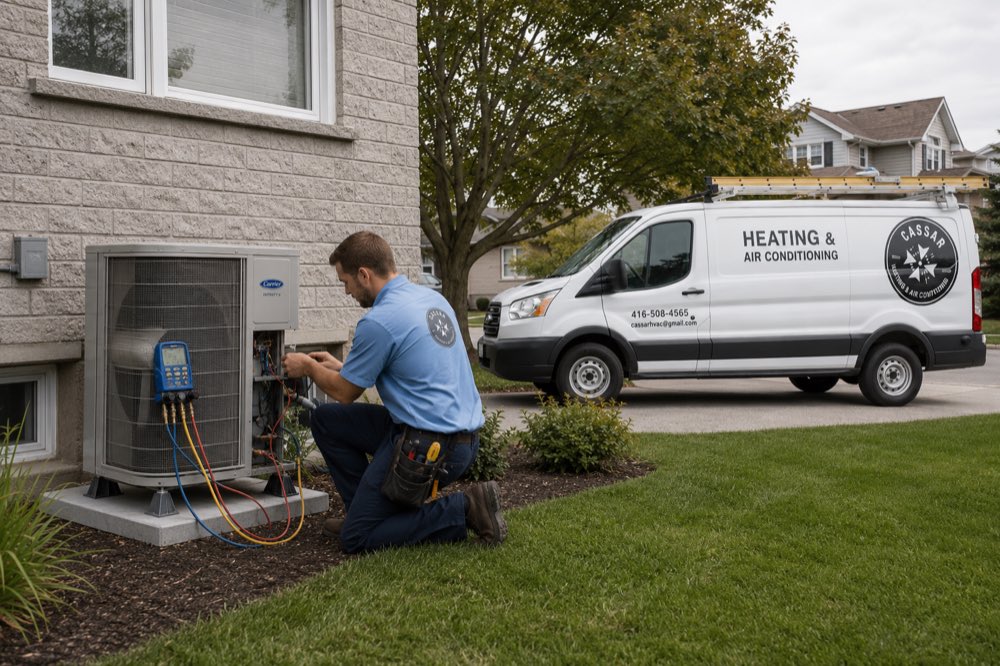
Every job gets David, not a subcontractor. He sizes the equipment, pulls the quote, and does the work.
Many Courtice homes built between 1995 and 2010 have ductwork that was sized for lower-capacity equipment. David checks the existing duct layout before recommending a unit size so you’re not overpaying for tonnage the system can’t actually deliver. He carries top-tier equipment and installs everything to TSSA standards.
David diagnoses and repairs refrigerant leaks, failed capacitors, frozen evaporator coils, faulty contactors, and most other common AC faults on the same visit. He stocks a wide range of parts in his truck, which means most repairs in Courtice don’t need a follow-up trip. You get the diagnosis and the fix in one call.
When a repair costs more than the system is worth, David will tell you directly. He won’t recommend replacement to make a bigger sale. If your Courtice home’s AC is over 15 years old and has already needed one or two significant repairs, he’ll walk you through the numbers so you can make the call yourself.
A pre-season tune-up in late April or May catches refrigerant issues, dirty coils, and worn electrical components before the July heat wave hits. David checks refrigerant charge, cleans the condenser coil, inspects the capacitor and contactor, and tests the system through a full cooling cycle. Most tune-ups take about an hour.
Moving from a 10 SEER unit to a 18 or 20 SEER model cuts your cooling costs noticeably over a Courtice summer. David sizes the replacement correctly and can walk you through any available Enbridge or Hydro One rebates that apply to your situation. The goal is a system that earns back its cost over time, not just the one with the highest sticker rating.
If your AC quits on a 35°C afternoon, David picks up the phone. He doesn’t route calls through a dispatch centre. Courtice is well inside his service area, and he prioritizes emergency calls so you’re not sitting in an overheated house waiting for a callback that never comes. Call (416) 508-4585 directly.
I’ve been working in Courtice since 2011 and I’ve seen what happens when a contractor installs the wrong size unit in a 2,200-square-foot semi on Darlington Boulevard and calls it done. The house never cools properly, the equipment short-cycles, and the homeowner gets a bigger hydro bill every month. Getting the sizing right before the install is where the job actually starts. If you call me, you’re talking to the person who’ll show up at your door, not someone reading from a script.
A central air conditioner in Ontario typically runs well for 12 to 18 years. The range is wide because lifespan depends heavily on how often the unit’s been serviced, whether it was correctly sized at installation, and how hard it’s worked during the peak of the season. A unit that’s slightly undersized and runs almost constantly through a hot Courtice summer will wear out faster than one that cycles properly.
Annual maintenance extends lifespan meaningfully. Cleaning the condenser coil, checking refrigerant charge, and inspecting the capacitor and contactor every spring catches small problems before they become expensive ones. A clogged coil forces the compressor to work harder. A failing capacitor can take the compressor with it when it finally gives out, turning what would’ve been a $150 part replacement into a much larger decision.
Ontario’s climate adds specific stress. The province doesn’t have a long steady cooling season like the southern U.S., but it has intense peak periods in July and August where equipment runs hard for days without a break. That kind of intermittent high-demand use is harder on components than steady moderate use, so keeping the system clean and properly charged going into summer matters more than some homeowners realize.
A standard central air conditioner installation in Courtice runs between $3,500 and $6,500 depending on the equipment tier, the size of your home, and whether any ductwork modifications are needed. A mid-efficiency 2-ton unit in a smaller Courtice townhouse sits toward the lower end. A high-efficiency 3-ton system in a larger detached home with some ductwork work involved pushes toward the upper range.
Repairs vary more widely. A capacitor replacement is typically $150 to $250. A refrigerant recharge runs $200 to $500 depending on how much refrigerant the system needs and whether there’s a leak that also needs finding and fixing. A compressor replacement on an older unit can cost $1,200 to $2,000, which is often the point where replacement makes more sense than repair. David will tell you exactly which situation you’re in before any work starts.
Annual tune-ups run $120 to $180 and are the best money you’ll spend on your AC system. Every job comes with a free upfront quote. The best way to know what your specific job will cost is to get a free quote from David, no pressure, no obligation.
Courtice expanded rapidly from the late 1980s through the mid-2000s, with the bulk of its residential development happening in that window. That means a large portion of the housing stock is now 20 to 35 years old, and original air conditioners in those homes are reaching or past the end of their service life. David sees a lot of replacements in the Nash Road, Darlington and Haydon Creek neighbourhoods because the original builder-grade equipment from that era simply wasn’t built to last beyond 15 to 18 years.
Many of these homes also have ductwork that was designed and sized for the lower-capacity equipment that was standard at the time. When a homeowner calls a contractor who just drops in a larger-tonnage unit without checking the duct system, the result is poor airflow, uneven cooling, and a unit that short-cycles because the ducts can’t move enough air. David checks the duct layout as part of every installation assessment in Courtice so the new equipment actually performs the way it should.
Newer Courtice developments along the Highway 2 and Bloor Street corridors tend to have better-specified ductwork and more recent equipment, but they come with their own issues. Tightly built homes with minimal air leakage can develop humidity problems if the AC system’s latent cooling capacity isn’t matched correctly to the house. David accounts for this when sizing replacement equipment, particularly in homes built after 2010 that were constructed to tighter energy codes.
The most common warning sign is the system running continuously without reaching the set temperature. In Courtice, where summer afternoons regularly hit 30°C or above, a properly sized and functioning AC should be able to maintain indoor temperature on all but the most extreme days. If it’s running for hours and the house still feels warm, the cause is usually low refrigerant charge, a dirty condenser coil, or an undersized unit that’s been struggling for years.
Unusual sounds warrant a call. A grinding noise from the outdoor unit points to a failing compressor bearing. A clicking that happens on every startup and shutdown attempt is often a failing capacitor trying to start the compressor motor. A hissing or bubbling sound near the indoor unit usually means a refrigerant leak at a line connection. None of these get better on their own. Catching a failing capacitor before it fails completely is a $150 fix instead of a compressor replacement.
Ice on the refrigerant lines or on the indoor coil is another sign that something’s wrong. It looks counterintuitive, ice on a cooling system seems like it’s working too well, but it actually means airflow is restricted, usually from a clogged filter or a dirty evaporator coil. Durham Region’s humid summers mean mould and debris accumulate on coils faster than homeowners expect. If you see ice forming on the lines running out of your furnace or air handler, shut the system down and call David before it causes water damage to your equipment or your home.
Durham Region’s summers are warm and humid. The humidity load on an AC system here is significant, and that affects how you should run the system. Setting your thermostat to 24 or 25°C and letting the system run in longer, steadier cycles does a better job of dehumidifying than cranking it down to 19°C and letting it short-cycle. The dehumidification happens during the cooling cycle, so a system that cycles off quickly because it hit a very low setpoint doesn’t pull as much moisture from the air.
Keep the outdoor condenser unit clear. Courtice’s established neighbourhoods have mature trees and shrubs that can encroach on the condenser unit over time. You need at least 60cm of clearance on all sides for adequate airflow. Overgrown cedars or ornamental grasses pressed against the unit are one of the most common causes of reduced cooling efficiency David sees on service calls across Clarington.
Replace your air filter every one to three months during cooling season. A filter that’s been in place since last fall is partially clogged before the first hot day of the year, and a restricted filter is the single most common cause of a frozen evaporator coil. A $15 filter change is the easiest maintenance task you can do yourself to keep the system running properly all summer.
In Ontario, refrigerant handling on AC equipment must be performed by a TSSA-licensed technician. Adding or recovering refrigerant isn’t a DIY task, and any contractor who offers to “top it off” without finding and repairing the underlying leak is setting you up for the same problem next season. David’s TSSA Licence #000398183 is publicly verifiable and covers this work. Every refrigerant service he performs is done correctly and documented.
On the efficiency side, Ontario homeowners can access rebates through the Canada Greener Homes Initiative and, in some cases, through Hydro One’s rebate programs for high-efficiency cooling equipment. Eligibility depends on the SEER rating of the unit being installed and whether a home energy audit is part of the process. David can point you toward the programs that apply to your situation and make sure the equipment he installs qualifies, so you’re not leaving money on the table.
If you’re combining a new AC with a high-efficiency furnace or a heat pump system, the efficiency and safety considerations compound. A properly matched system with correctly sized equipment and clean, balanced ductwork performs better, costs less to operate, and lasts longer. David’s been doing this work since 2011 and can assess your whole system, not just the individual piece that’s acting up today.
Checking the simple things before calling saves time for everyone, and sometimes it’s all you need.
Make sure it’s set to Cool and the temperature is set below current room temperature. Check the batteries too, a weak battery causes erratic thermostat behaviour that looks like an AC problem but isn’t.
Your AC has a breaker in the main panel and an exterior disconnect box next to the outdoor unit. Check both are on. A tripped breaker that resets but trips again immediately means there’s a fault that needs a technician.
A clogged filter blocks airflow and causes the evaporator coil to ice up, completely stopping cooling. Replace the filter and let the unit thaw for an hour before restarting. If it ices up again after a new filter, call David.
The condenser unit outside needs clear airflow. Remove any debris, overgrowth, or objects within 60cm of the unit. Don’t hose it down while it’s running. If the fan isn’t spinning when the system’s on, shut it off and call.
Closed vents create pressure imbalances that reduce cooling and can damage the system. Make sure every supply vent in the home is open, including rooms you don’t regularly use. Closing vents to “save energy” actually works against you.
If none of the above fixed it, it needs a licensed technician. David serves all of Courtice and Durham Region and picks up his own phone.
Once a year, ideally in late April or early May before the first heat of the season hits. A pre-season tune-up gives David time to check refrigerant charge, clean the condenser coil, inspect the capacitor and contactor, and run the system through a full cooling cycle while there’s still time to order parts if something needs replacing. Waiting until your AC quits on a 34°C July afternoon in Courtice means you’re competing with everyone else in Clarington who also just found out their system doesn’t work. Annual servicing also extends the life of the equipment meaningfully. A compressor that’s been running with a dirty coil and a weak capacitor for three seasons accumulates wear it didn’t need to. A $150 tune-up each spring is the cheapest maintenance you can do to protect a $4,000 to $6,000 system.
The four most common causes are low refrigerant, a dirty condenser coil, a clogged air filter, or a failing capacitor. Low refrigerant means the system can’t absorb enough heat from your home’s air regardless of how long it runs. A dirty coil blocks heat transfer at the outdoor unit and has the same effect. A clogged filter restricts airflow to the indoor coil, which causes it to ice over and stop cooling entirely. A failing capacitor may allow the system to start but prevent the compressor from running at full capacity, so the system runs but doesn’t cool properly. Before calling, replace the filter and check that the outdoor unit is clear of debris. If the system has ice on the refrigerant lines, shut it down and let it thaw completely before restarting. If the problem continues after those steps, David can diagnose the rest on a same-day visit to your Courtice home.
Most central air conditioner installations in Courtice take between four and seven hours for a straightforward replacement where the existing ductwork and electrical are in good shape. David removes the old unit, installs and connects the new equipment, pressure tests the refrigerant lines, vacuums the system down, charges it with refrigerant, and runs it through a full operational test before he leaves. If there’s ductwork modification involved, or if the electrical disconnect or wiring needs updating to match the new unit’s requirements, add another one to two hours. David gives you a realistic time estimate before the job starts so you can plan your day. He doesn’t quote a four-hour job and still be there at dinnertime without telling you why. For Courtice homes where the existing pad or line set needs replacement, he’ll flag that before the install date so there are no surprises on the day.
The honest answer depends on three things: the age of the unit, the cost of the repair relative to the system’s remaining value, and whether it’s had repeated breakdowns. A unit that’s 8 years old with a failed capacitor should almost always be repaired. A unit that’s 17 years old and needs a compressor replacement is a much closer call, and in most cases replacement makes more financial sense. A rough rule of thumb is this: if the repair costs more than half what a new system would cost, and the unit is over 12 years old, replacement is usually the smarter move. David will give you a straight answer on this. He doesn’t push replacement to make a bigger sale. He’ll tell you what the repair costs, what a replacement costs, and what he’d do in your position. In Courtice, where a lot of the original builder-grade equipment from the 1990s and early 2000s is now at or past the end of its life, he has this conversation regularly and he gives the same honest answer every time.
For Durham Region’s climate, a SEER2 rating of 14 to 18 is the practical sweet spot for most homeowners. Canada’s minimum efficiency standard for new central air conditioners is currently 13 SEER2, and anything in the 14 to 16 range gives you a meaningful efficiency improvement over the old 10 to 12 SEER units still running in many Courtice homes without paying the premium for the highest-tier equipment. Systems rated 18 SEER2 and above make more sense if you run your AC heavily through a long season, but Durham Region’s cooling season is concentrated into roughly three months, which affects how long it takes to recover the cost premium in energy savings. David will run the numbers with you based on your actual home size, current equipment, and how you use the system, so you’re buying what actually makes sense rather than what sounds best on a spec sheet.
When the system runs but doesn’t cool, the most likely causes are low refrigerant charge, a dirty or blocked condenser coil, or a failing compressor. Low refrigerant is the most common culprit, the system sounds normal, the fan runs, the compressor hums, but there isn’t enough refrigerant in the circuit to absorb heat properly, so warm air keeps coming out of the vents. A dirty condenser coil has the same effect because the heat the refrigerant absorbed inside can’t transfer out through a coil caked with cottonwood, dust, and debris. Both of these require a licensed technician to diagnose and fix properly. If you’ve already replaced the filter and confirmed the outdoor unit is clear of obstructions, the next step is a service call. David can typically diagnose the specific cause on the same visit and carry out most repairs the same day for Courtice homeowners.
Yes. David services all major central air conditioner brands found in Courtice homes, including Carrier, Lennox, Trane, York, Goodman, Rheem, Bryant, and Keeprite, among others. The diagnostic process for refrigerant issues, electrical faults, and mechanical problems is largely consistent across brands, and David stocks a wide range of common parts including capacitors, contactors, and fan motors for the most frequently serviced equipment in Clarington. For older or more obscure units where a part needs to be ordered, he’ll tell you upfront what the lead time looks like and whether waiting for the part makes sense or whether it triggers the replacement conversation instead. Brand isn’t a barrier to getting service. The age and condition of the equipment matters far more than who made it.
Financing options are available for new air conditioner installations in Durham Region, including Courtice. A new central AC system is a significant expense, and spreading the cost over time is a practical option for a lot of homeowners, particularly when the existing system fails mid-season and there’s no time to save for the replacement. The specific terms, rates, and eligibility requirements depend on the financing program in place at the time of your installation. David can walk you through what’s currently available when you get your quote. Installation costs for a new central air conditioner in Courtice typically run between $3,500 and $6,500 depending on the equipment and the scope of work. The best way to know what your specific job will cost is to get a free quote from David, no pressure, no obligation.
“Our AC in Courtice stopped cooling on a Saturday afternoon in July. David answered on the first ring, showed up within a few hours, and fixed a failed capacitor on the spot.”
“I called about replacing our old Courtice home’s central AC and David actually talked me out of a full replacement. He showed up, checked the system, said the compressor was fine and it just needed a refrigerant top-up and a coil clean. He could have sold me a new unit and I wouldn’t have known the difference. That kind of honesty is hard to find.”
“The quote David gave me was exactly what I paid, no add-ons, no ‘while I was in there’ charges. He put covers down before he brought any equipment inside, and you wouldn’t have known anyone had been in the mechanical room when he finished. For an AC install in Courtice that went completely without incident, I couldn’t ask for more.”
David covers all of Durham Region, if you’re near Courtice, you’re well within his service area.
Same-day service available. TSSA certified. Honest pricing. Call or book online.