
Pickering’s housing mix runs from 1970s and 1980s builds in Bay Ridges and Dunbarton to newer subdivisions west of Brock Road, and the ductwork challenges in each era are genuinely different, older homes often have undersized galvanized trunks while newer builds sometimes have flex-duct layouts that weren’t balanced properly from day one. David covers all of Pickering and the rest of Durham Region, with same-day and emergency appointments available when you need them most.
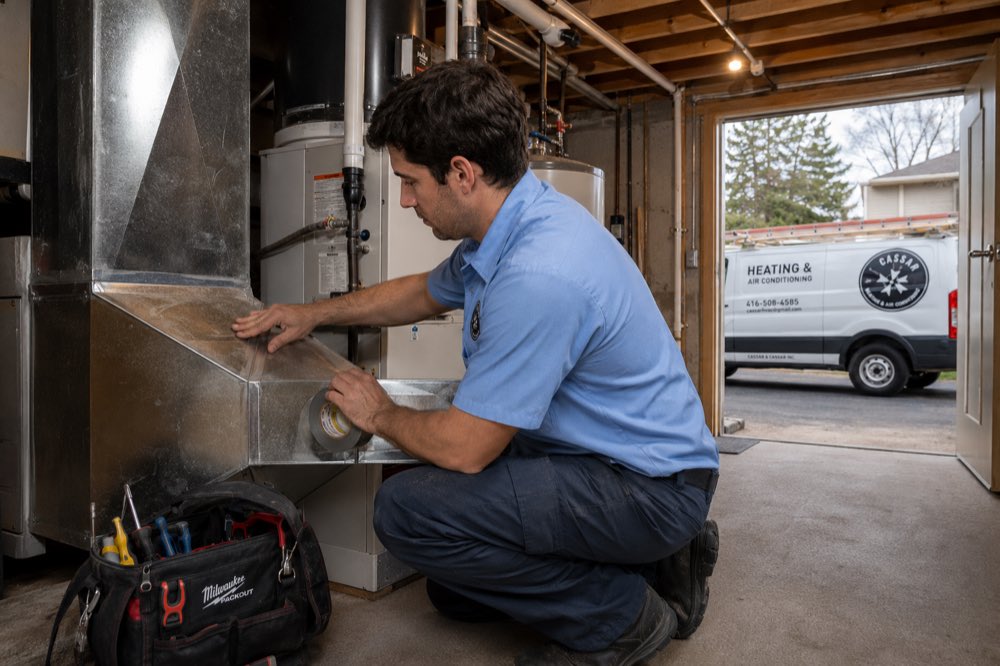
Every job David takes on in Pickering starts with a proper look at what’s there before anything gets quoted or replaced.
David installs complete duct systems in new builds and additions across Pickering, sizing each trunk and branch to match the actual load, not a template from a parts catalogue. Newer subdivisions near Seaton and the Duffin Heights area often have multi-storey layouts where getting the second-floor supply runs right takes real field experience. Every installation gets a full flow check before David leaves.
Gaps at joints, torn flex sections, and disconnected boots are the repairs David handles most often in Pickering homes. A single open joint in a basement ceiling can push 20 percent of your conditioned air into an unheated space. David locates the leak, seals or replaces the affected section, and confirms the fix before wrapping up.
When a repair won’t get the job done, David replaces the ductwork in sections or in full. Homes built in Pickering’s Bay Ridges neighbourhood during the 1970s often have original galvanized steel that’s corroded at the seams or was never properly supported. David won’t push a full replacement if part of the system is sound. You’ll get an honest assessment first.
A yearly duct inspection catches small issues before they turn into expensive repairs. David checks for loose connections, damaged insulation on supply runs, and blockages at the grilles. It’s also a good time to check that the system’s static pressure is still within range, a number that shifts as homes age and equipment gets upgraded.
Upgrading to a higher-efficiency furnace without rechecking the ductwork is a mistake David sees regularly across Durham Region. A 96% AFUE unit moves air differently than the 80% unit it replaced, and ducts that were borderline acceptable before can become a performance problem after. David checks the whole system when an equipment upgrade is planned.
When a duct collapses or disconnects during peak heating or cooling season, waiting a week isn’t an option. David offers emergency ductwork response across Pickering and all of Durham Region. You reach him directly when you call, not a call centre, and he’ll tell you straight away whether it’s something he can get to same-day.
I’ve been working in Pickering homes since 2011, and the ductwork issues I find most often aren’t random, they follow the era the home was built and how the original installer cut corners. In Bay Ridges and West Shore, that usually means undersized return air. In the newer Duffin Heights builds, it’s flex duct that was kinked during construction and never corrected. You’ll get a straight read on what’s actually wrong, not a sales pitch for a full replacement.
Sheet metal ductwork in a well-maintained home typically lasts 25 to 30 years before joints start to loosen and internal surfaces corrode enough to affect airflow. Flexible duct has a shorter useful life, closer to 15 to 20 years, and the plastic liner can crack or develop pinholes well before the outer jacket fails visibly. In Ontario’s climate, the seasonal pressure cycling from heating in winter and cooling in summer stresses joints more than in milder regions, so the lower end of those ranges is more realistic for systems that haven’t been looked at regularly.
What extends duct life significantly is keeping the system clean and balanced. When static pressure runs high because of a blocked filter or a closed-off room, every joint and seam is under more stress than it was designed for. Getting an annual inspection means you catch a loose connection before it becomes a full separation. Keeping relative humidity under 55 percent in summer also matters, damp air accelerates corrosion inside metal ducts, particularly on the return side where the air is warmer and wetter before it reaches the coil.
If your Pickering home’s ductwork is original and the house was built before 1990, it’s worth having David take a look. Systems that age, especially those that haven’t been modified when new equipment was installed, often have issues that show up as comfort problems before they show up as obvious damage.
A targeted duct repair, like sealing a disconnected joint or replacing a damaged flex run, typically runs between $150 and $400 depending on access and how much material is involved. A partial replacement covering a single branch or a damaged trunk section usually lands between $600 and $1,500. A full duct system replacement in an average Pickering detached home, two storeys, four bedrooms, finished basement, generally runs from $3,500 to $7,000, with the variation driven by the complexity of the layout, whether existing ductwork can be reused in parts, and what the access situation looks like in the basement and ceiling cavities.
What drives the variation most is labour time, not materials. A home where every basement joist bay is clear and the duct runs are straightforward takes far less time than a finished basement where every ceiling tile has to come down and go back up. David quotes the full scope before starting, so there’s no ambiguity about what the number covers.
The best way to know what your specific job will cost is to get a free quote from David, no pressure, no obligation.
Pickering’s housing stock covers a wide range of eras and build types. The older areas, Bay Ridges, West Shore, Dunbarton, and Rougemount, have a lot of detached homes built between the 1960s and mid-1980s. These homes commonly have galvanized steel trunk-and-branch systems that were sized for lower-output equipment and weren’t designed with central air conditioning in mind. When a/c was added later, it was often retrofitted onto a system that was never intended to carry the cooling load, which is why so many of these homes run uneven in summer.
Further north and east, the Liverpool and Highbush neighbourhoods developed through the late 1980s and 1990s, and homes from that period often used early flexible ductwork for branch runs. That material’s useful life is now either approaching or already past its end. David regularly finds flex duct in these homes that’s sagged, kinked, or cracked at the connections to the boots, small problems that add up to significant airflow loss and uneven comfort throughout the house.
The newer Duffin Heights development, which expanded substantially through the 2010s, has its own pattern. These homes were built quickly during a high-demand period, and David has seen a number of them with flex duct that was installed correctly on paper but kinked or undersupported in practice. If you’re in a Duffin Heights home and you’ve noticed uneven temperatures since you moved in, the ductwork is a reasonable place to start looking.
The most common sign is uneven temperatures between rooms or floors that your thermostat can’t fix. If your second floor is consistently 3 to 5 degrees warmer than the main floor in summer, or a bedroom stays cold regardless of how long the furnace runs, the issue is almost always in the duct distribution, not the equipment itself. In Pickering’s older two-storey homes, the supply runs to upper floors are often undersized relative to what a modern system needs to move.
Unusual dust levels near supply vents are another indicator worth taking seriously. When ducts leak in unconditioned spaces like attics or wall cavities, the negative pressure on the return side pulls unconditioned and often dusty air into the system. That air then gets distributed through the supply side. If you’re changing filters more frequently than usual or noticing dust settling faster than it used to, it’s worth checking whether the duct system is pulling in outside air somewhere it shouldn’t be.
A noticeable increase in your heating or cooling bill without a corresponding change in how you’re using the system is also a reliable warning. In Durham Region, where both heating and cooling seasons are demanding, even a 15 percent loss to duct leakage shows up on the gas and hydro bills in a way that most homeowners notice over a season or two. David can measure static pressure and identify where the losses are coming from before recommending a fix.
Durham Region’s climate puts real seasonal demands on a duct system. Winters regularly push below -15°C, and summers can run above 30°C with humidity that makes it feel significantly hotter. A duct system that’s borderline adequate in mild conditions will fail to keep up at the temperature extremes, which is when you most need it to perform. Making sure your ducts are properly insulated in unconditioned spaces, particularly supply runs through unheated basements or rim joist areas, prevents a significant portion of heat loss in winter and condensation issues in summer.
Balancing the system so every room gets the airflow it needs is also more important in this climate than it might be elsewhere. When rooms are consistently under-supplied, occupants close vents or use portable heaters and fans to compensate, which creates pressure imbalances that accelerate wear on the blower and increase energy use. David checks the whole system when he’s on site, not just the section that prompted the call.
Sealing the return air side is something many homeowners overlook. Most duct leakage discussions focus on supply runs, but a leaky return that pulls basement or crawl space air into the system brings with it elevated humidity, potential combustion byproducts if the furnace is nearby, and additional dust loading. Getting the return side sealed properly is one of the higher-value improvements David makes in older Pickering homes.
In Ontario, forced-air ductwork that runs near fuel-burning appliances carries real safety implications. A cracked heat exchanger combined with a leaky return duct in close proximity to the furnace creates a path for combustion gases, including carbon monoxide, to enter the living space. David’s TSSA licence, #000398183, covers the full scope of gas system and associated equipment work, and he checks for these conditions whenever he’s working on ducts near a furnace or water heater. Every Ontario home with fuel-burning appliances should have working CO detectors, and the duct system should be inspected any time equipment is replaced or repaired.
On the efficiency side, Ontario’s Enbridge and Save on Energy programs have offered rebates for air sealing work that includes duct sealing as part of a broader home energy audit. The availability and amounts change annually, so it’s worth checking current offerings when planning duct work. Even without a rebate, sealing a leaky duct system typically reduces heating and cooling energy use enough to recover the cost within two to three seasons in a Durham Region home.
From a building code standpoint, any new ductwork installation or significant replacement in Ontario requires that the system be installed to ASHRAE 62.2 and Ontario Building Code standards for duct sizing and sealing. David works to those standards on every job, which matters when you sell your home and the buyer’s inspector starts asking questions.
Checking the simple things before calling saves time for everyone.
Make sure every supply vent in the home is fully open. Closed vents cause pressure imbalances that reduce performance and can damage equipment.
In basements and utility rooms, look for disconnected joints, torn flex duct, or visible gaps. Even small separations can lose significant conditioned air.
A blocked filter causes pressure imbalance across the entire duct system, making uneven heating and cooling worse. Replace it first before anything else.
Rooms consistently too hot or cold, or that take longer to reach temperature, indicate specific duct branches that are undersized, leaking, or poorly routed.
Unusual dust buildup around supply vents can indicate leaks pulling in unconditioned air from attic or wall cavities, a significant air quality and efficiency issue.
If none of the above resolved the issue, it’s time for a licensed technician to take a look. David serves all of Pickering and Durham Region and picks up the phone himself.
The clearest signs are rooms that won’t reach the thermostat temperature, uneven comfort between floors, and supply vents that barely move air even when the system is running hard. Leaking ducts usually show up as dusty buildup around supply grilles, higher-than-expected energy bills, and in some cases musty smells if the leak is pulling air from a damp basement or crawl space. Undersized ducts feel different, the airflow is weak at the registers even though everything upstream looks fine, and the equipment tends to run longer cycles to compensate. In Pickering homes built before 1990, I find both problems regularly, often in the same house. Measuring static pressure and doing a room-by-room airflow check tells you exactly what you’re dealing with, and that’s how I start every ductwork assessment. If your home has had an equipment upgrade since the ducts were originally installed, undersizing becomes much more likely because newer systems move air at different pressures than the older units they replaced.
Repair costs in Durham Region typically range from $150 to $400 for a straightforward fix like resealing a joint or replacing a short flex duct run. Partial duct replacement, covering one branch or a damaged trunk section, usually runs between $600 and $1,500. A full duct system replacement in an average two-storey detached home generally lands between $3,500 and $7,000. What drives the variation is access and complexity: a home with an open, unfinished basement takes less labour than a finished space where ceiling tiles or drywall have to come out. Material choice also matters, rigid sheet metal costs more upfront than flex duct but lasts longer and performs better for main trunk runs. The scope of any job I quote covers exactly what’s needed and nothing more. The best way to know what your specific job will cost is to get a free quote from David, no pressure, no obligation.
Yes, and it’s one of the most common reasons equipment underperforms even when it’s mechanically sound. A leaky or undersized duct system forces the blower to work against higher static pressure than it was designed for, which reduces airflow across the heat exchanger or evaporator coil, increases motor wear, and in the case of a furnace, can trigger high-limit shutdowns as the heat exchanger overheats from restricted airflow. Over time, running a furnace or AC against excessive static pressure shortens the life of the blower motor and can crack a heat exchanger, a repair that costs considerably more than fixing the ductwork that caused it. On the cooling side, restricted airflow across a wet evaporator coil leads to coil icing, which shuts the system down entirely. I’ve diagnosed AC systems in Pickering that were blamed on refrigerant issues when the actual problem was a kinked flex duct run reducing airflow to the indoor unit. Fixing the duct resolved it without touching the refrigerant circuit.
A full ductwork installation in a typical Pickering detached home takes one to two full days for the main trunk and branch runs, with a third day sometimes needed if there are complex routing requirements or if the installation is going into a finished space that requires careful work around existing finishes. A partial replacement covering a floor or a few branch runs is usually a half-day to full-day job depending on access. Targeted repairs, a disconnected joint, a damaged flex section, typically take one to three hours. The timeline is also affected by what we find once we’re in the walls and ceilings, so I don’t lock in a hard finish time until I’ve had a look at the actual space. I’ll give you a realistic estimate during the quote visit so you can plan accordingly. There’s no benefit to rushing a duct installation, if branches aren’t properly supported or connections aren’t sealed correctly, problems show up within the first heating or cooling season.
Sealing makes sense when the ductwork is fundamentally sound, good material, correct sizing, adequate support, but has joint leakage that’s developed over time. In that case, mastic sealant or foil tape applied to all the joints can recover a significant percentage of lost airflow at a fraction of replacement cost. Replacement makes more sense when the ducts are the wrong size for the current equipment, when the routing is so poorly designed that conditioned air is travelling unnecessary distances and losing temperature before it reaches the room, or when the material itself has degraded past the point where sealing will hold. In Pickering, I often find the answer is partial, seal the metal trunk because it’s in good shape, replace the original flex branch runs because they’re cracked and kinked. A full replacement is the right call less often than some contractors suggest. I’ll tell you which approach makes sense for your specific system after I’ve had a proper look.
Ductwork is the most common cause of persistent hot and cold spots in Pickering homes, particularly in the older Bay Ridges and Dunbarton areas where original duct systems weren’t designed to serve central air conditioning. When the duct branches feeding a room are too small, or when a flex duct run has sagged or kinked in the ceiling, that room simply doesn’t get enough airflow to keep up with the rest of the house. Thermostat location also matters, if the thermostat is in a room that reaches temperature quickly, the system shuts off before outlying rooms are comfortable. But before assuming the thermostat is the problem, I’d check whether the supply run to the problem room is delivering adequate airflow. Other causes that look like ductwork problems but aren’t: inadequate insulation in an exterior wall, a window with poor sealing, or a room over an unheated garage. I check for those during an assessment so you know exactly what’s causing the issue before anything gets repaired or replaced.
David focuses on ductwork installation, repair, and replacement rather than cleaning services. Duct cleaning as a standalone service is a separate trade, and doing it well requires dedicated equipment that isn’t part of what Cassar HVAC carries. What I do during any ductwork job is check the interior of accessible duct sections for debris, blockages, or contamination that could affect performance or air quality. If I find a situation that genuinely warrants cleaning, excessive dust accumulation, evidence of moisture ingress, or debris from renovation work, I’ll tell you and point you toward a reputable cleaning company rather than suggest you need a service I don’t provide. What I’d caution against is paying for duct cleaning as a preventive measure on a system that isn’t showing signs of contamination. The research on routine duct cleaning as a standard maintenance item is mixed, and in many cases it’s sold more aggressively than the evidence warrants. If you’re unsure whether your system needs it, ask David during the quote visit and he’ll give you a straight answer.
Older Pickering homes from the 1960s through the 1980s show a few characteristic patterns of poor duct design. The most common is an undersized return air system, one central return grille in a hallway trying to serve a whole house, which creates negative pressure in rooms with closed doors and makes the entire system work harder than it needs to. Another pattern is supply runs that are too long for their diameter, which drops velocity and temperature before the air reaches the register. You’ll know this is happening if rooms at the end of a duct run are consistently harder to heat or cool than rooms close to the air handler. Using building cavities, joist bays or stud walls, as informal duct paths is also common in older construction and leads to significant air leakage because those cavities were never designed to be airtight. If your Pickering home was built before 1985 and you’ve never had the duct system formally assessed, there’s a reasonable chance it has at least one of these issues, and fixing them often makes a bigger difference to comfort than replacing the furnace or air conditioner.
“The master bedroom in our Pickering house had been cold every winter for years. David found a kinked flex duct run in the ceiling on the first visit and fixed it the same day. That room heats normally now.”
“I’d had two other guys quote replacing my whole duct system. David came out, looked at everything properly, and told me the trunk line was fine but three branch runs needed to be replaced. He did it in a day and it came in at about a third of what the other quotes were. He’s straightforward about what actually needs doing and what doesn’t.”
“Booked on a Tuesday, David was at our Pickering home Wednesday morning. Quoted the job on the spot, price didn’t change when the work was done. He put down covers on the floors before starting and took everything with him when he left. Exactly what you want.”
David covers all of Durham Region for ductwork installation, repair, and replacement.
Same-day service available. TSSA certified. Honest pricing. Call or book online.