
Oshawa’s mix of postwar bungalows, 1980s semis, and newer Kedron or Windfields builds means ductless heat pumps are showing up in homes of every age, often as the only practical way to heat or cool an addition, a converted garage, or a finished basement where running new duct would cost more than the system itself. David covers all of Oshawa and the rest of Durham Region seven days a week, with same-day availability for installs and emergency repairs.
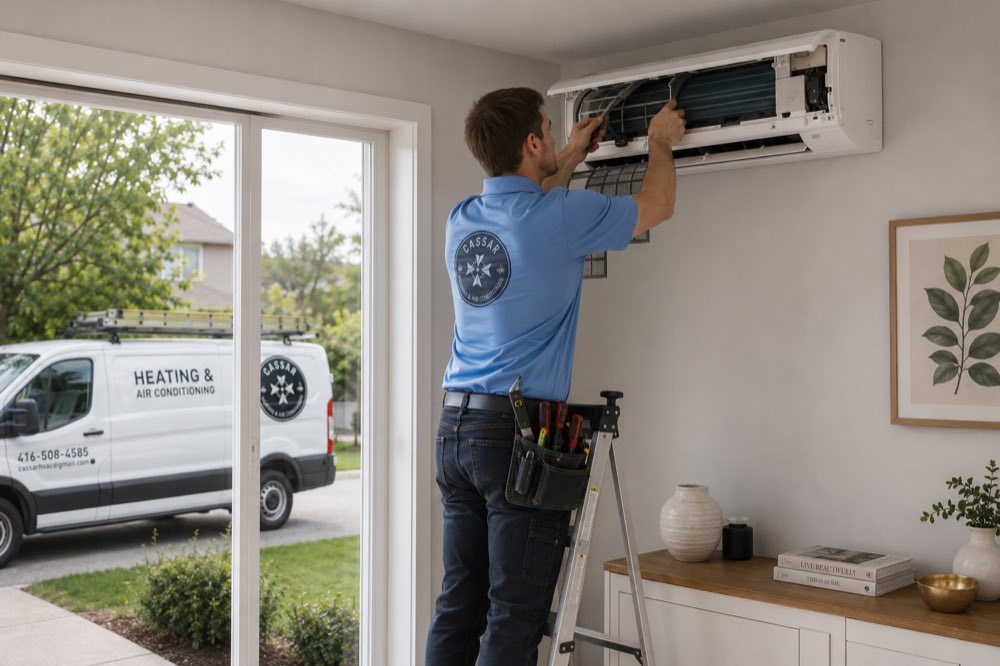
Every job below is handled by David personally. You get one person who sizes the equipment, pulls the permit where required, does the install, and answers the phone if something goes wrong afterward.
David sizes and installs single-zone and multi-zone ductless systems for Oshawa homes. Many Oshawa bungalows built in the 1950s and 60s were never designed for central air, and a ductless unit is often the cleanest solution. David handles the refrigerant lines, electrical connection, and commissioning in a single visit for most single-zone jobs.
If your indoor unit is blowing cold air in heating mode, making grinding or clicking noises, or showing an error code on the remote, David diagnoses it the same day in most cases. He stocks common parts for major brands so most Oshawa repair calls don’t turn into a week-long wait for a component.
When a repair no longer makes sense, David’ll give you an honest opinion on why before recommending a replacement. He doesn’t push replacements on systems that have repair life left in them. If replacement is the right call, he’ll match the new unit to your actual heating and cooling load, not just swap in the same tonnage as before.
A yearly service visit covers filter cleaning, coil inspection, refrigerant level check, electrical connection tightening, and a test run in both heating and cooling modes. Most ductless systems David services in Oshawa haven’t had their outdoor coil cleaned since installation, which is one of the main reasons efficiency drops off over time.
Older ductless units from the mid-2000s to early 2010s typically run at SEER ratings of 13 to 16. Current cold-climate heat pumps reach SEER2 ratings of 20 or higher and maintain full heating capacity down to around minus 15 Celsius. If your older unit is struggling through Oshawa winters, an upgrade pays back quickly on hydro bills.
When your ductless unit stops working mid-January and it’s the primary heat source for a room or addition, David picks up the phone. He covers all of Oshawa for emergency calls and aims to get there the same day. You reach David directly, not a dispatcher who has to call someone else to find out when a tech is available.
I’ve worked on ductless systems in homes right across Oshawa since 2011, from older Lakeview bungalows where the unit was added to heat a sunroom addition, to newer builds in Kedron where the homeowner wanted to condition a finished basement without tapping into the main furnace ductwork. What I see most often is systems that were installed without proper load calculations, or that haven’t had a single service visit since day one. That matters, because it’s usually the reason a system that should last 15 years needs a compressor at year eight.
When you call me, I answer. I give you a straight quote before I start anything. And I’ll tell you honestly whether a repair makes sense or whether you’re throwing money at a system that’s on its way out.
A well-maintained ductless heat pump in Ontario typically runs for 15 to 20 years. The compressor in the outdoor unit is the component most likely to determine the system’s lifespan. Units that run in heating mode through a full Ontario winter and then switch to cooling all summer put more hours on the compressor than systems in milder climates, so the lower end of that range is realistic if the system hasn’t been serviced regularly.
What shortens a system’s life most reliably is neglect. Dirty filters restrict airflow across the indoor coil, which forces the compressor to work harder. A blocked or corroded outdoor coil does the same thing. David sees systems in Oshawa that are eight or nine years old and already failing because they’ve never been cleaned. That same unit, properly maintained, would likely have another seven or eight years in it.
Ontario’s freeze-thaw cycles are hard on outdoor units. Ice forming on the coil in early spring or late fall is normal, and the system’s defrost cycle handles it. A unit that stays fully iced over for hours, though, means the defrost cycle isn’t working, and running the compressor against a blocked coil damages it quickly. Catching that early in a service call is far cheaper than a compressor replacement later.
A single-zone ductless heat pump installation in Oshawa typically runs between $3,500 and $5,500 all-in, including the equipment, refrigerant lines, electrical connection, and labour. That range moves based on the size of the unit, the length of the line set run, whether electrical panel work is needed, and which brand you choose. A Mitsubishi or Daikin cold-climate unit at the high end of the efficiency scale costs more than a standard unit, but the operating cost difference in an Ontario winter is real.
Multi-zone systems, where one outdoor unit connects to two or three indoor heads, run from roughly $6,500 to $12,000 or more depending on how many zones you’re adding. Repair costs vary widely. A refrigerant recharge with a leak check runs $300 to $600. A faulty circuit board or expansion valve lands in the $400 to $900 range parts and labour combined. A compressor replacement on a unit that’s more than ten years old often costs more than a new system, which is why David’ll give you the honest math before he recommends it.
The best way to know what your specific job will cost is to get a free quote from David, no pressure, no obligation.
Oshawa’s housing stock spans a wide range. The older core neighbourhoods, Lakeview, O’Neill, Vanier, and Mclaughlin, are full of postwar bungalows and two-storey homes built between the 1940s and 1970s. Many of these were built with oil or gas forced-air systems and undersized ductwork, and some were converted to gas in the 1980s or 90s. A number of them have had additions built on, and those additions almost never have duct connections. That’s where ductless fits perfectly as a primary conditioning solution for the added space.
The newer west end and north end subdivisions, Kedron, Windfields, Pinecrest, and Taunton communities, tend to have central HVAC already, but David regularly installs ductless units in finished basements, home offices, and three-season rooms in these homes. The basement situation is common across all of Oshawa: the main furnace system doesn’t reach the finished lower level well, especially in split-level or walk-out designs, and a single ductless head solves the problem without major ductwork modifications.
One thing David sees specifically in older Oshawa homes is knob-and-tube wiring that was never fully updated. A ductless system needs a dedicated 240V circuit. If the electrical panel hasn’t been upgraded, that work has to happen first. David’ll identify that during the quote visit so there are no surprises on installation day.
The most common sign is the unit blowing room-temperature air in heating mode. This usually means one of three things: the system has lost refrigerant charge through a slow leak, the outdoor unit is iced over and the defrost cycle has failed, or the reversing valve that switches the system between heating and cooling has stuck. All three need a licensed technician with refrigerant handling certification, which in Ontario means TSSA or EPA 608 certification.
Unusual noise is another reliable indicator. A grinding or rattling from the outdoor unit often points to a failing fan motor bearing. A gurgling sound from the indoor head can mean refrigerant is low. A clicking or buzzing on startup that wasn’t there before sometimes means a capacitor is failing on the compressor circuit. These are all repairable if caught early, and they all get more expensive if you run the system another season hoping it goes away.
In Durham Region’s climate, pay attention in late fall when you switch from cooling to heating for the first time. Running the system in heating mode for ten minutes and checking that the air coming out of the indoor head is genuinely warm takes thirty seconds. Catching a problem in October is a lot better than discovering it on a January night when the temperature drops to minus twenty in Oshawa.
Durham Region winters get cold enough that not every ductless system handles them equally. Older single-speed units from before about 2015 lose heating capacity significantly once temperatures drop below minus ten Celsius. Current cold-climate inverter systems, units rated as cold-climate or hyper-heat by the manufacturer, maintain close to full capacity down to minus fifteen or colder. If your ductless unit is the primary heat source for a space with no backup, that distinction matters.
In summer, the heat and humidity that comes off Lake Ontario affects Durham Region more than areas further inland. A properly sized ductless unit handles both temperature and humidity. An oversized unit, which is a common installation mistake David sees, short-cycles, it cools the air quickly but doesn’t run long enough to pull humidity out, leaving the space feeling clammy. Correct sizing at installation time prevents this entirely.
Keep the outdoor unit clear year-round. In summer, shrubs and grass growing against the unit restrict airflow. In winter, snow loading on the top of the unit can damage the fan. A simple wall bracket mount positions the unit high enough that snowfall isn’t an issue, and David recommends this on virtually every Oshawa install where the outdoor unit sits at or near ground level.
Ductless heat pumps don’t burn fuel, so there’s no combustion risk and no carbon monoxide concern from the unit itself. That said, the electrical installation matters. A ductless system draws significant amperage on startup, and an undersized circuit or a loose connection at the breaker or disconnect can cause nuisance trips or, worse, a wiring fault. David installs dedicated circuits to manufacturer specifications on every job and checks the disconnect box as part of any service visit.
Ontario’s Enbridge and Hydro One rebate programs have changed over the years. As of 2024 and into 2025, the Canada Greener Homes Grant wound down, but the Canada Greener Homes Loan program remains available, offering interest-free financing for qualifying energy efficiency upgrades including cold-climate heat pumps. Ontario also runs rebates through the Home Efficiency Rebate Plus (HER+) program in partnership with Enbridge. Eligibility and amounts change, so David recommends checking current program status when you’re budgeting a new install.
From an efficiency standpoint, a cold-climate ductless heat pump running in Ontario delivers two to three units of heat energy for every one unit of electrical energy consumed, even in cold weather. Compared to electric baseboard heat, which is a one-to-one ratio, the operating cost difference is substantial over a full heating season. For Oshawa homeowners using baseboard heat in an addition or a basement, switching to ductless is one of the faster-payback equipment decisions available right now.
Checking the simple things before calling saves time for everyone, including you.
Confirm the mode is set to Heat, the temperature is set above room temperature, and the remote has fresh batteries. Wrong mode is the most common ductless issue David gets called out for. It’s a quick fix you can handle yourself.
Ductless systems have separate breakers for the indoor air handler and outdoor compressor. Check both in your electrical panel. If one has tripped and keeps tripping after you reset it, stop and call David, because something is drawing too much current.
Ductless filters are inside the indoor wall unit behind the front panel. Slide it out and rinse it under water, these block up faster than furnace filters. A clogged filter cuts airflow and causes the system to underperform or freeze up. Clean it every four to six weeks during heavy use.
Clear any snow, ice, or debris blocking the outdoor unit. Light frost on the coil is normal and the defrost cycle handles it. A fully iced-over unit needs a technician, don’t attempt to remove ice manually. Chipping or pouring hot water on the coil damages the fins and refrigerant lines.
Ductless remotes have many modes. Confirm the display shows the heat icon, not a water droplet (dry mode) or fan symbol. In dry mode the system runs but doesn’t produce meaningful heat, and it’s an easy setting to accidentally land on when changing the temperature.
If none of the above resolved it, the system needs a licensed technician. David serves all of Oshawa and Durham Region and picks up the phone himself.
Yes, the right ones do. The key distinction is between standard ductless systems and cold-climate inverter models. Standard ductless units start losing significant heating capacity when outdoor temperatures drop below about minus five Celsius, which is a real limitation in Ontario winters. Cold-climate units, models from Mitsubishi, Daikin, Bosch, and others marketed as hyper-heat or cold-climate, maintain close to full heating capacity down to minus fifteen or minus twenty Celsius. Ontario winters regularly see nights in that range, particularly in inland parts of Durham Region away from the lake’s moderating effect. If you’re using a ductless unit as the primary or sole heat source for a space, a cold-climate rated model is the one to install. David’ll be direct with you about which units make sense for Oshawa conditions and which ones are going to leave you cold at the wrong time. A unit that performs well in a Vancouver winter isn’t necessarily the right choice here.
A single-zone ductless heat pump installation in Oshawa or anywhere in Durham Region typically costs between $3,500 and $5,500, all-in. That includes the indoor head, outdoor compressor unit, refrigerant line set, electrical disconnect, and labour. The variation in that range comes down to a few factors: the size (BTU capacity) of the unit you need, the length of the refrigerant line run between indoor and outdoor units, whether you need electrical panel work or a new dedicated circuit, and which brand and efficiency tier you choose. A Mitsubishi Hyper-Heat unit at SEER2 22 costs more upfront than a standard single-speed unit, but it performs better in Ontario winters and costs less to run. Multi-zone systems, one outdoor unit feeding two or three indoor heads, run from about $6,500 to $12,000 or more depending on how many zones you’re adding and what line set lengths are involved. Repair costs also vary: a refrigerant recharge with a leak search runs $300 to $600, a control board replacement lands in the $500 to $900 range, and a compressor replacement on an older unit can exceed the cost of a new system entirely. The best way to know what your specific job will cost is to get a free quote from David, no pressure, no obligation.
That depends on what you’re trying to condition and whether the spaces are open to each other or separated by walls and doors. A single indoor head in a large open-plan main floor can condition the whole space if the BTU output is sized correctly for the square footage and the room’s insulation. Once you add doors, you add zones. A bedroom with a door closed off from the hallway won’t be conditioned by a head mounted in the living room. For a typical Oshawa bungalow where someone’s adding cooling and heating to the main floor and a finished basement, two zones are usually the right answer. One head upstairs, one downstairs. For a two-storey home where the central furnace already handles the main and upper floors reasonably well, a single basement head is often all that’s needed. Multi-zone systems can support up to four or five indoor heads off one outdoor unit for larger homes. David’ll walk through the layout with you during the quote visit and tell you exactly what’ll work and what’s overkill for your situation. He won’t sell you three heads when two do the job.
Yes, virtually all ductless systems sold today are heat pumps, meaning they run in both heating and cooling modes. The same unit that cools your space in July heats it in January by reversing the refrigeration cycle. This is one of the main reasons ductless makes financial sense compared to installing a window air conditioner for summer and electric baseboards for winter. You’re buying one system that handles both seasons. The switchover is done through the remote, usually by selecting the heat or cool mode. Some remotes also have an auto mode that switches between heating and cooling based on the room temperature versus the setpoint. The only caveat is that standard ductless heat pumps lose heating efficiency in extreme cold, so if you’re in Oshawa and the unit will be the sole heat source through January, confirm with David that the model you’re getting has adequate cold-weather heating performance for your specific situation. He won’t install a cooling-oriented unit and tell you it’ll handle an Ontario winter without qualification.
As of 2025, the main program available to Ontario homeowners is the Canada Greener Homes Loan, which offers interest-free financing up to $40,000 for qualifying energy efficiency upgrades including cold-climate heat pumps. This replaced the grant component of the Greener Homes program, which ended in early 2024. The application process requires a pre-retrofit and post-retrofit EnerGuide home energy assessment, which adds time and a registration step before you can claim. For Oshawa homeowners on natural gas, the Home Efficiency Rebate Plus (HER+) program through Enbridge offers rebates on qualifying heat pump installations. The rebate amounts and eligibility criteria change periodically, so David recommends confirming current program details when you’re budgeting the job, not relying on numbers you read six months ago. The equipment has to meet minimum efficiency thresholds to qualify, and David installs only units that meet those standards. If rebates factor into your budget, mention that when you call and he’ll make sure the equipment he quotes qualifies. The best way to know what your specific job will cost after rebates is to get a free quote from David, no pressure, no obligation.
A single-zone installation in an Oshawa home typically takes three to five hours from arrival to a running, commissioned system. David mounts the indoor head, runs the refrigerant lines through the wall to the outdoor unit, makes the electrical connections at the disconnect and the indoor unit, vacuums the refrigerant circuit down, charges it to specification, and test-runs the system in both heating and cooling modes before he leaves. Multi-zone installs, with two or three indoor heads connected to one outdoor unit, take longer, usually a full day. The main variable that extends the time is the line set routing. If the outdoor unit is going on the back of the house and the indoor head is at the front, running the copper lines through the wall cavity or along the exterior takes more time than a straightforward back-of-house installation. David’ll give you a realistic time estimate at the quote stage so you know what to expect. Most Oshawa homeowners are back to a fully running system the same day David arrives.
Start with the remote. Confirm the mode is set to Heat and the setpoint temperature is higher than the current room temperature. It sounds obvious, but wrong mode is genuinely the most common call David gets. Next, check both breakers for the system in your electrical panel, one for the indoor unit and one for the outdoor compressor. Then go outside and look at the outdoor unit. If it’s fully encased in ice with the fan not running, the defrost system has failed and you’ll need a technician. If the outdoor unit is running but the indoor unit is blowing cool or room-temperature air, you’re likely looking at low refrigerant charge, a stuck reversing valve, or a faulty expansion valve. None of those are DIY repairs. Refrigerant work in Ontario requires a licensed technician with proper certification, and David carries TSSA Licence #000398183. Don’t let anyone work on the refrigerant circuit in your Oshawa home who can’t provide a verifiable licence number. Running a system that’s low on refrigerant also damages the compressor over time, so the sooner you get it looked at, the better.
David works with all major ductless brands including Mitsubishi, Daikin, Fujitsu, LG, Bosch, and others. He’s not locked into pushing one manufacturer, which means he can recommend the unit that genuinely fits your home and your budget rather than the one that earns him the highest margin. That said, he does have preferences based on what he’s seen perform well in Ontario’s climate over the years. Mitsubishi’s Hyper-Heat line and Daikin’s cold-climate models come up often in his recommendations for Oshawa installs where the unit needs to perform through a real Ontario winter. For repairs and maintenance, David works on any brand already installed in your home. If you’ve got a Gree or Samsung unit from a previous owner and it needs a service visit, he’ll come out regardless of the brand. He’ll also be straight with you if a repair on a lesser-known brand is going to be difficult due to parts availability, which is a real consideration for some off-brand units installed by previous homeowners in Oshawa.
“Our ductless unit in the Oshawa basement had stopped heating entirely. David found a failed reversing valve, had the part with him, and fixed it the same afternoon.”
“I called David about adding a ductless unit to our sunroom addition off the back of our house in Oshawa. He came out to look at the space, told me exactly what size we needed and why, and didn’t try to sell me something bigger. Installation was done in about four hours. The unit’s been running two winters now without a single issue.”
“Price he quoted was price I paid, full stop. No add-ons, no surprises. He also put down drop cloths on my floors and wiped down the wall around the indoor unit before he left. For anyone in Oshawa looking to get ductless installed, this is who you call.”
David covers all of Durham Region from the same truck, so if you’re just outside Oshawa, he’ll still get to you.
Same-day service available. TSSA certified. Honest pricing. Call or book online.