
Uxbridge’s mix of rural acreages, older in-town bungalows, and newer subdivisions off Brock Street means furnaces here work hard, long driveways, drafty basements, and heating loads that spike fast when temperatures drop well below what they’d see in Pickering or Ajax. David covers the entire Township of Uxbridge with same-day and emergency service, and he picks up the phone himself when you call.
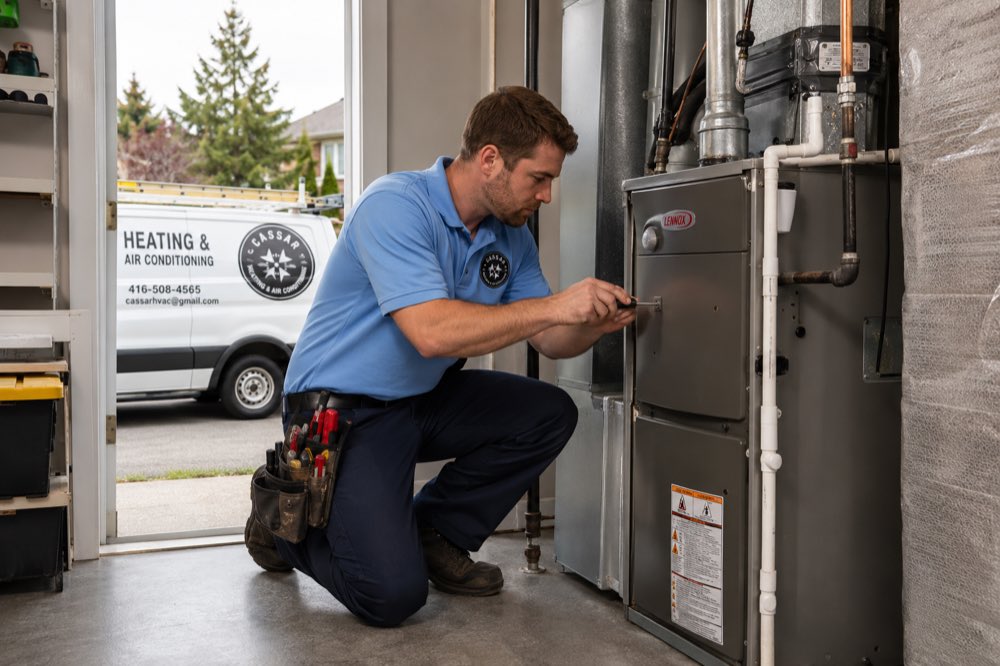
David handles every furnace job himself, installation, repair, replacement, and annual maintenance, across the Township of Uxbridge and all of Durham Region.
David sizes every new furnace to the actual load of your home, not a guess based on square footage. Uxbridge’s older in-town bungalows and larger rural properties have very different heating demands, and installing the wrong capacity unit causes short-cycling, uneven heat, and early breakdowns. Every installation includes a free upfront quote and is completed to TSSA standards.
David diagnoses the problem before quoting the fix. He carries common parts on the truck so many repairs finish the same day he arrives. If it’s something he can’t fix on the spot, he’ll tell you straight, what it needs, what it costs, and whether it makes financial sense given the age of the unit.
David won’t push a replacement if a repair makes more sense. When replacement is the right call, he’ll explain why, age, heat exchanger cracks, repair cost relative to the unit’s remaining life, so you’re deciding with the full picture. New equipment comes with a manufacturer warranty and David’s installation guarantee.
A furnace tune-up before winter means checking the heat exchanger, testing controls and safety switches, cleaning the burners, and verifying combustion. It’s the kind of visit that catches a $120 igniter problem before it becomes a no-heat call at midnight in January. David books tune-ups across Uxbridge every fall.
Upgrading from a mid-efficiency unit (80% AFUE) to a high-efficiency model (96%+) cuts gas consumption significantly over an Ontario winter. David calculates whether the payback period makes sense for your home’s usage before recommending the switch, and he handles the venting changes a high-efficiency unit requires, including the PVC intake and exhaust that standard gas fittings don’t cover.
Uxbridge sits further north and west than most of Durham Region, and when temperatures drop hard overnight, a furnace failure there isn’t a minor inconvenience. David takes emergency calls personally. He’ll tell you whether he can get there same-day, what to check in the meantime, and what the job will cost before he starts. No dispatch queue, no callback system, you reach David directly.
I’ve been working furnaces in the Township of Uxbridge since 2011, and what I see regularly are older mid-efficiency units in homes that haven’t had a proper tune-up in years, sometimes still on original heat exchangers from the early 2000s. I’ll tell you what the equipment actually needs, not what gets the biggest invoice. TSSA Licence #000398183 means my work is verifiable, not just a claim on a website.
Most gas furnaces installed in Ontario homes last between 18 and 25 years, with a realistic average around 20 years when the unit’s been serviced annually. The wide range comes down to a few variables: how well the equipment was installed, whether it was sized correctly for the home, and how often it’s been maintained. A furnace that’s been running with a plugged filter every winter, or one that was oversized at installation and short-cycles constantly, will wear out significantly faster than that average.
Ontario’s climate accelerates wear in ways that milder climates don’t. From November through March, a furnace in Uxbridge runs far more hours than one in, say, southwestern British Columbia. That runtime adds up, heat exchangers fatigue, igniter rods weaken, and inducer motors accumulate bearing wear. An annual tune-up catches these things early and genuinely extends the serviceable life of the unit.
If your furnace is past 18 years old and needs a major repair, that’s the moment to weigh replacement seriously. A heat exchanger replacement on a 20-year-old furnace can cost close to what a new mid-efficiency unit costs installed. David walks through that math with every customer before recommending either path.
A furnace repair in Uxbridge typically runs between $150 and $900, depending on what’s failed. Igniter replacements usually land in the $150–$250 range. A draft inducer motor or control board replacement runs $400–$800. Those ranges assume the part is available, some older or discontinued units need sourced components that add cost and lead time, which is one reason David will tell you if a repair on an older unit isn’t financially sensible.
New furnace installation costs in Uxbridge range from roughly $3,500 to $6,500 installed, depending on the efficiency tier, brand, and whether the venting needs modification. A mid-efficiency (80% AFUE) gas furnace sits toward the lower end of that range. A high-efficiency (96%+) unit with PVC venting runs higher but recovers much of that through lower gas bills over time, especially relevant in Uxbridge where heating seasons are long.
Every job David quotes is free and upfront, and the number he gives you before he starts is the number on the invoice. The best way to know what your specific job will cost is to get a free quote from David, no pressure, no obligation.
The Township of Uxbridge has a housing stock that spans a wide range of ages and types. The older core of Uxbridge village includes post-war bungalows and two-storey homes built between the 1950s and 1980s, many of which still have their original ductwork. That older duct sizing was designed around lower-efficiency furnaces with higher air volumes, and retrofitting a modern high-efficiency unit into those systems without recalculating airflow can create static pressure problems, noise, and uneven heat distribution throughout the house.
Newer subdivisions on the north and east edges of the village, areas like those off Reach Street and around the Goodwood Road corridor, tend to have homes built in the 1990s through 2010s with better-insulated envelopes and mid-efficiency equipment that’s now approaching end-of-life. These are the homes where an upgrade conversation makes the most sense right now: the ductwork is in reasonable shape, the infrastructure supports a high-efficiency install, and the original furnace is old enough that a replacement delivers real value rather than just displacing a working unit.
Rural properties in the township, acreages, hobby farms, and estate lots outside the village boundary, often have larger square footages with propane rather than natural gas, or older oil-to-gas conversions that introduce their own set of venting and chimney liner considerations. David’s done enough of these in the Uxbridge area to know what to look for before committing to a scope of work.
Short-cycling, where the furnace fires up, runs for a minute or two, then shuts off before the home reaches temperature, is one of the most common complaints David gets from Uxbridge homeowners. It’s almost never a random fault. The most frequent causes are a clogged air filter restricting return airflow, an oversized furnace that satisfies the thermostat before the heat distributes properly, or a failing flame sensor that cuts the burner before it can sustain combustion. Each of these has a different fix and a very different cost.
Unusual sounds matter too. A banging noise on startup usually means delayed ignition, gas is accumulating before it ignites, which stresses the heat exchanger over time. A squealing or grinding noise from the blower motor points to bearing wear and a motor that’s closer to failure than most homeowners realise. In Durham Region’s climate, that kind of failure tends to happen on the coldest night of February, not a mild October afternoon.
Yellow or flickering burner flames, a sudden increase in your gas bill without a change in usage, or persistent cold spots in rooms that used to heat normally, all of these tell you something’s changed inside the unit or the duct system. If you’re noticing any of them, get it looked at before the temperature drops hard. Uxbridge sits at enough elevation that its overnight lows track a few degrees colder than Whitby or Ajax on the same weather system.
Durham Region’s heating season runs roughly from mid-October through mid-April, about six months where your furnace is the primary mechanical system keeping your home liveable. That’s a long run-time, and how you manage the shoulder seasons matters. Keeping your filter on a regular replacement schedule (every one to three months depending on your household and filter type) is the single highest-return maintenance habit you can build. It costs almost nothing and prevents airflow restrictions that make the system work harder than it should.
Programmable or smart thermostats help extend equipment life by smoothing out the number of on-off cycles per day. A furnace that runs one longer cycle is under less ignition stress than one that short-cycles six times in the same period. Setting back the temperature by four to six degrees overnight rather than letting it drop and recover sharply reduces wear on the heat exchanger and keeps gas consumption predictable.
Before the first cold snap of the season, check that your outdoor intake and exhaust vents are clear of debris, spider webs, and any landscaping that’s grown up over the summer. High-efficiency furnaces with PVC vent pipes low on the foundation are particularly prone to blockage from snow and ice in January and February, a five-minute visual check in October prevents a midnight no-heat call in January.
In Ontario, gas furnace installation and repair must be performed by a TSSA-licensed technician. TSSA Licence #000398183 is David’s credential, it’s on the public registry and you can verify it. This matters because a furnace installed or repaired by an unlicensed contractor isn’t just a compliance issue: it’s a liability problem for your home insurance and a genuine safety risk. A cracked heat exchanger repaired improperly, or a gas connection made without pressure testing, creates carbon monoxide exposure that CO detectors may not catch before symptoms develop.
Every home in Ontario with a gas furnace should have a working carbon monoxide detector installed within five metres of each sleeping area. It’s required by the Ontario Fire Code. If yours is more than seven years old, replace it, CO detectors degrade and give false-clear readings as the sensor ages. David flags this on every service visit if he notices detectors that look old or poorly placed.
Ontario’s Enbridge Gas Home Efficiency Rebate program has offered rebates on high-efficiency furnace installations in recent years, and the Canada Greener Homes program has provided additional federal incentives. Eligibility and amounts change, so it’s worth checking current Enbridge and federal program terms when you’re planning a replacement, David can point you in the right direction on what documentation you’ll need from the installation to qualify.
Checking the simple things before calling saves time for everyone, and a surprising number of no-heat calls turn out to be one of these.
Make sure it’s set to Heat, the temperature is above room temperature, and the batteries are fresh. This resolves more calls than you’d expect.
Your furnace has a dedicated circuit breaker in your electrical panel and usually a wall switch nearby. Check both are on.
A clogged filter restricts airflow and can trigger a safety shutoff. If you can’t see light through it, replace it before calling.
High-efficiency furnaces have plastic pipes exiting near the foundation. Snow or ice blocking these causes an automatic shutoff, clear them and restart.
Many furnaces have a safety switch that cuts power if the access panel isn’t fully closed. Make sure it’s secured properly.
If none of the above worked, it needs a licensed technician. David serves all of Uxbridge and Durham Region and picks up the phone himself.
Once a year, ideally in September or early October before the heating season starts in earnest. Ontario’s winters are long enough that a furnace without annual maintenance accumulates wear faster than most homeowners realise. A tune-up covers the heat exchanger inspection, burner cleaning, igniter test, flue check, and verification of all safety controls. These aren’t optional checks, a cracked heat exchanger that goes undetected is a carbon monoxide risk, and an inducer motor showing bearing wear will fail mid-winter if it’s not caught. In Uxbridge specifically, where temperatures can drop hard and quickly, a pre-season service visit is the most reliable way to avoid an emergency call in January. David books annual maintenance across the Township of Uxbridge every fall, scheduling in September means you’re not competing with everyone else who waited until their furnace failed on the first cold night.
The honest answer is: it depends on the age of the unit and the cost of the repair. Here’s the framework David uses. If your furnace is under 12 years old, a repair almost always makes sense unless it’s a heat exchanger replacement, that’s the one exception where repair cost can approach replacement cost even on a relatively young unit. If the furnace is between 12 and 18 years old, weigh the repair cost against 50% of what a new unit would cost installed; if the repair exceeds that threshold, replacement is usually the smarter financial move. Over 18 years old, nearly any major repair prompts a serious replacement conversation. The second variable is efficiency: if you’re running an 80% AFUE unit and a repair costs $600, it’s worth knowing that a new 96% unit would cut your gas bill enough to recover the replacement cost in four to six Ontario heating seasons. David gives you both numbers so you can decide, he won’t push a replacement if a repair makes sense, and he won’t push a repair that’s throwing money at a unit that’s close to done.
For a Durham Region home, a 96% AFUE high-efficiency furnace makes financial sense for most households. Durham Region’s heating season runs roughly six months, and the difference between an 80% and a 96% unit is meaningful on a gas bill you’re paying every month from October through April. The 80% mid-efficiency tier still has a place, older homes with masonry chimneys where the cost of converting to PVC venting is high, or rental properties where long-term payback calculations are less relevant. But for an owner-occupied home in Uxbridge where you’re planning to stay for five or more years, the high-efficiency unit pays back the cost difference in fuel savings within that window. The one thing David always checks before recommending a 96% unit is the existing ductwork, older duct systems in Uxbridge’s village-area homes weren’t designed for the lower air temperatures a high-efficiency furnace produces, and sometimes a variable-speed unit that modulates output is the better fit than a single-stage high-efficiency model.
A straightforward replacement, same footprint, same venting configuration, no major ductwork changes, takes four to six hours from start to finish. David arrives, removes the old unit, installs and connects the new furnace, tests every control and safety switch, and walks you through the new equipment before he leaves. If the job involves converting from mid-efficiency to high-efficiency venting (switching from a chimney flue to PVC exhaust pipes), add an hour or two. If there are ductwork modifications needed, common in Uxbridge’s older homes where duct sizing doesn’t match modern equipment, the timeline extends accordingly, and David will have told you that upfront in the quote rather than discovering it mid-installation. Brand-new installations in homes that haven’t had a forced-air furnace before are more involved and typically take a full day. You’ll have heat the same day David installs the unit, regardless of which category your job falls into.
Yes. David works on all major gas furnace brands, Lennox, Carrier, Bryant, Trane, York, Goodman, Keeprite, Napoleon, and others. The diagnostic process is the same regardless of brand: check the error codes, test the components in sequence, identify the fault. Most furnaces built in the last 20 years use similar components, hot surface igniters, pressure switches, inducer motors, flame sensors, and control boards, and David carries the most commonly failed parts on the truck. Brand-specific parts that aren’t in stock get sourced quickly. The only situation where brand becomes a complicating factor is with very old or discontinued equipment where parts are no longer manufactured, at that point David will tell you directly whether sourcing the part is feasible or whether replacement makes more sense.
Cold air from the vents usually points to one of four things: the thermostat is set to Fan rather than Auto (the blower runs continuously without the burner firing), a clogged air filter has triggered a high-limit safety shutoff, the flame sensor is dirty and cutting the burner off after a few seconds of ignition, or the outdoor intake/exhaust vent is blocked, which is especially common in Uxbridge in January and February when snow drifts against the foundation. Start by checking the thermostat setting and the filter. If those are fine, check the PVC pipes at the side of your house and clear any snow or ice blockage. Restart the furnace and give it two or three cycles to see if it recovers. If the furnace still blows cold air after that, the flame sensor or a control board fault is the most likely cause and it needs a technician. David can walk through the basics with you on the phone before booking a visit, call (416) 508-4585 and he’ll answer directly.
Leave the house immediately. Don’t turn any lights or switches on or off on the way out, and don’t use your phone until you’re outside and clear of the building. Call Enbridge Gas emergency line at 1-866-763-5427 from outside, they operate 24 hours and will dispatch a technician to confirm whether there’s an active gas leak and shut off supply if needed. Only after Enbridge has cleared the property should you contact David for the furnace assessment and repair. Natural gas smells like rotten eggs because of the mercaptan odorant added to it, even a faint smell in the mechanical room is worth treating seriously. A small leak at a fitting can accumulate in a basement and reach ignition concentration without triggering CO detectors, since CO and gas are different hazards. Don’t re-enter the home until Enbridge has given the all-clear.
Yes. Financing options are available for furnace installation, making it easier to replace a failing unit without absorbing the full cost upfront. A new high-efficiency furnace installed in an Uxbridge home typically runs between $3,500 and $6,500 depending on the unit and scope of work, financing spreads that across monthly payments that most households find more manageable than a lump sum during heating season. It’s also worth checking current Enbridge Gas Home Efficiency Rebate program terms and any available federal incentives for high-efficiency equipment, which can reduce the effective cost of a qualifying installation. David can walk you through what’s currently available when he provides your quote. The best way to know what your specific job will cost is to get a free quote from David, no pressure, no obligation.
“Furnace stopped producing heat on a Tuesday night in January. David was at our Uxbridge house by noon the next day, diagnosed a failed flame sensor, and had it running before he left.”
“We’d had two other companies look at the furnace and both said we needed a full replacement. David came out, checked it over, and told us the heat exchanger was fine and it was actually just a cracked inducer housing causing the CO alarm to trip. He had the part on the truck. Saved us a few thousand dollars and we’ve had no issues since. I appreciated that he explained what he was looking at and why, didn’t feel like we were just being told what to do.”
“Booked a new furnace install for our place north of the village. The quote David gave me on the phone matched the invoice exactly. He put down floor covers before bringing anything through the front door, and the mechanical room was cleaner when he left than when he arrived. For anyone in the Uxbridge area looking for someone who does the job right and charges what he says he will, this is the call to make.”
David covers the entire Township of Uxbridge and all of Durham Region, here’s where else he works.
Same-day service available. TSSA certified. Honest pricing. Call or book online.