
Township of Brock’s rural properties and older village homes in Cannington, Beaverton, and Sunderland run their furnaces hard through long northern Durham winters, and when something breaks at the wrong time, you don’t want to wait two days for a call centre to dispatch someone you’ve never met. David Cassar covers all of Brock Township and the surrounding Durham Region communities, picks up the phone himself, and offers same-day and emergency service seven days a week.
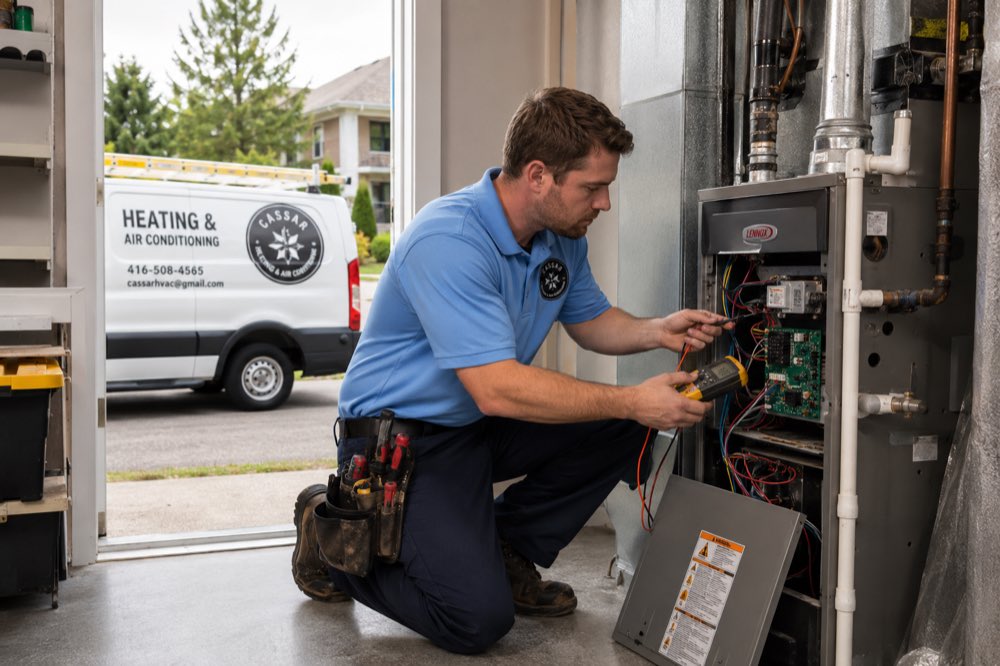
From a routine tune-up in Cannington to an emergency repair on a rural property outside Beaverton, David handles every furnace job personally.
When it’s time to put in a new furnace, David sizes the unit to your home’s actual load, not just whatever model happens to be in the truck. Many Brock Township homes sit on larger lots with less insulation than newer suburban builds, which means an undersized unit will short-cycle and wear out early. David calculates the right capacity, installs it to TSSA standards, and walks you through the equipment before he leaves.
A furnace that stops working in January in Brock Township isn’t an inconvenience, it’s urgent. David stocks a broad range of common parts on the truck so most repairs happen in a single visit. He diagnoses the actual fault first, tells you what it’ll cost before touching anything, and fixes what’s broken without recommending parts you don’t need.
David won’t push a replacement if a repair makes economic sense. If your furnace is 20-plus years old, cracked heat exchangers or rising repair costs usually make replacement the smarter call. He’ll give you a straight comparison, what the repair costs now versus what a new unit costs over its lifespan, and let you decide. No pressure, no upsell.
A furnace tune-up before the heating season catches small problems before they become expensive ones. David cleans the burners, checks the heat exchanger for cracks, tests the igniter and flame sensor, verifies the flue, and confirms combustion is running cleanly. An hour of maintenance in September keeps you out of trouble when temperatures drop below minus twenty in December.
Upgrading from an older mid-efficiency furnace to a 96% AFUE unit can cut your gas bill noticeably, especially in Brock Township where homes with larger square footage and older envelopes run longer heating cycles than a typical Oshawa semi. David handles the equipment swap, re-routes the flue to a proper direct-vent configuration if needed, and handles the paperwork for any available Enbridge rebates.
Brock Township sits at the northern edge of Durham Region, and roads can make a cold night even harder if you’re waiting on a technician coming from a distant dispatch centre. David answers his own phone, covers all of Brock including Cannington, Beaverton, and Sunderland, and gets out to you the same day. There’s no call centre routing your request through three hands before someone calls you back.
I’ve been servicing furnaces in Brock Township since 2011, and what I see consistently is that rural and village properties here run older equipment longer than homeowners in newer subdivisions do, partly because replacement is a bigger investment when you’re not in a competitive quote environment, and partly because a mid-efficiency furnace that’s still limping along feels okay until it isn’t. I give every Brock homeowner a straight read on where their equipment stands, what it’ll cost to keep it going, and whether a new unit actually pencils out. You get that conversation with me, not with a salesperson working on commission.
Most gas furnaces last between 18 and 25 years, though what you actually get depends heavily on how the unit was installed, how regularly it’s been serviced, and how hard it works. A furnace that was oversized at installation short-cycles, turning on and off repeatedly without completing a full heating cycle, and that wears out the heat exchanger and inducer faster than normal. One that’s been running with a dirty filter for several winters stresses the blower motor and heat exchanger in a different way but with similarly shortened results.
Ontario’s climate pushes furnaces hard. A furnace in Brock Township might run six or seven months of the year, especially if you’re north of Sunderland where winters land earlier and harder than they do closer to the lake. Annual maintenance, cleaning the burners, checking the heat exchanger, testing ignition, adds years to that lifespan by catching small problems before they cascade. A furnace that gets a tune-up every fall and a filter change every two to three months will regularly hit the top of that 18-to-25 range.
Past the 20-year mark, the honest question shifts from “can it be fixed” to “is it worth fixing.” Heat exchangers develop cracks, and a cracked heat exchanger is both a safety issue and a repair bill that often approaches the cost of a replacement. David checks the heat exchanger every time he services a furnace, and he’ll tell you plainly what he finds.
A standard furnace repair in Brock typically runs between $150 and $600, depending on what failed. Igniter replacements and flame sensor cleanings are at the lower end. A draft inducer motor or control board puts you closer to the top. Emergency after-hours calls carry a higher service fee, which David is upfront about before he comes out. The quote covers the full job, there’s no separate “diagnostic fee” stacked on top once he arrives.
A new furnace installation in Brock, including the equipment and all labour, generally falls between $3,500 and $6,500 for a mid-to-high-efficiency gas furnace. Higher-efficiency 96% AFUE units sit at the upper end of that range, and homes that need ductwork modifications or a new flue configuration add to the total. Older Brock homes with original ductwork sometimes need a duct assessment as part of the installation, which David can handle at the same time.
Annual maintenance tune-ups run in the $120 to $180 range. Every job, whether it’s a repair or a full install, gets a written quote before David starts. The best way to know what your specific job will cost is to get a free quote from David, no pressure, no obligation.
The Township of Brock is rural Durham Region, and its housing stock reflects that. The three main villages, Cannington, Beaverton, and Sunderland, are built largely on homes from the 1950s through 1980s, with a smaller number of rural properties, hobby farms, and newer builds scattered through the township. Many of the older village homes were originally heated by lower-efficiency systems with single-wall metal flues, and when it comes time to replace them, the chimney situation needs to be sorted out. A high-efficiency condensing furnace can’t use an unlined masonry chimney, it needs its own direct-vent plastic piping run to the exterior.
Rural properties in Brock present a different set of considerations. Homes on well and septic, larger square footage, and less continuous insulation than newer builds mean heating loads run higher and equipment has to work harder through a long winter. Oversizing a furnace at installation is a common error David sees when contractors use rule-of-thumb sizing instead of a Manual J load calculation, a furnace that’s too large for the space short-cycles and delivers uneven heat, which is particularly noticeable in open-concept rural homes with high ceilings.
Ductwork in older Brock homes also warrants attention. Flex duct that’s been kinked or compressed in tight crawlspaces reduces airflow enough to affect comfort and efficiency. David checks the accessible ductwork as part of every installation, and if there’s a problem he can see, he’ll flag it before the new equipment goes in.
The most obvious sign is a furnace that won’t start or stops mid-cycle. But plenty of problems show up earlier and subtly. If your furnace is short-cycling, running for a few minutes, shutting off, and starting again repeatedly, it’s usually triggering a high-limit switch from restricted airflow. Check the filter first. If the filter is clean and the cycling continues, the limit switch itself, the inducer motor, or a partially blocked flue could be the cause.
Uneven heat in different rooms is worth paying attention to, especially in larger Brock rural properties where the duct runs are longer. If one end of the house is cold while the other is fine, you’ve got either a duct issue or a blower that isn’t moving enough air. A furnace that’s been running fine for years and suddenly can’t keep up on cold nights should be looked at, a dirty heat exchanger or failing inducer motor will rob efficiency before it causes a complete shutdown.
Yellow or flickering flames, unusual smells when the furnace fires, and a pilot light that won’t stay lit are all reasons to call rather than wait. In Durham Region, carbon monoxide from a cracked heat exchanger is the furnace problem David takes most seriously. If your CO detector goes off and you can’t pin it to another source, call and get the furnace checked before you reset the alarm and move on.
Durham Region sits in a climate band that sees genuine cold, January lows regularly hit minus fifteen to minus twenty in northern parts of the region, and Brock Township is at the northern end. That means your furnace needs to be in good shape heading into fall, not limping through October hoping it holds. The fall maintenance window, September through early November, is when David’s schedule is most available and when problems are cheapest to fix. Waiting until December to find out your igniter is degraded means you’re calling for emergency service.
Filter changes make the single biggest difference to furnace performance between service visits. A clogged 1-inch filter restricts airflow enough to trigger safety limits and cause premature blower motor wear. If you have a high-MERV filter for air quality reasons, check it more often, those filters load up faster than standard ones, especially in a rural property where more particulate comes through the system. Every two months is a reasonable baseline for most Brock homes.
The outdoor intake and exhaust vents on a high-efficiency furnace are the other item Brock homeowners need to watch. The plastic PVC pipes that exit near your foundation can ice over during a freezing rain event or get buried in a heavy snowfall against the house. A blocked vent causes an immediate safety shutoff. Keeping that area clear, particularly after a significant storm, prevents a lot of unnecessary service calls in January.
In Ontario, all gas furnace installations and repairs must be performed by a TSSA-licensed gas technician. That licence isn’t a formality, it’s the legal requirement that ensures the work meets the Technical Standards and Safety Act. David’s TSSA licence number is #000398183, verifiable directly through the TSSA registry. If a contractor can’t give you a TSSA number, they’re not legally authorised to touch your gas appliance. That matters for your insurance and for your safety.
Carbon monoxide is the furnace safety concern that David treats with the most urgency. A cracked heat exchanger allows combustion gases, including CO, to enter the air distribution system and circulate through your home. CO is odourless and colourless, and symptoms of low-level exposure are easy to mistake for illness. Every home with a gas furnace should have a working CO detector on each level. David tests for CO as part of every furnace service call. If a heat exchanger is cracked, he’ll tell you clearly what the options are.
On the efficiency side, Ontario’s Enbridge Gas Home Efficiency Rebate Plus program currently offers rebates for upgrading to qualifying high-efficiency equipment. Amounts and qualifying criteria change periodically, so David will confirm what’s current at the time of your quote. A 96% AFUE furnace replacing a 78% unit generates real gas bill savings year over year, and the rebate offsets a portion of the upfront cost. David handles the rebate documentation as part of the job.
Checking the simple things before calling saves time for everyone, run through these five steps first.
Make sure it’s set to Heat, the temperature is above room temperature, and the batteries are fresh. This resolves more calls than you’d expect.
Your furnace has a dedicated circuit breaker in your electrical panel and usually a wall switch nearby. Check both are on.
A clogged filter restricts airflow and can trigger a safety shutoff. If you can’t see light through it, replace it before calling.
High-efficiency furnaces have plastic pipes exiting near the foundation. Snow or ice blocking these causes an automatic shutoff, clear them and restart.
Many furnaces have a safety switch that cuts power if the access panel isn’t fully closed. Make sure it’s secured properly.
If none of the above work, it needs a licensed technician. David serves all of Brock Township and Durham Region and picks up the phone himself.
Once a year, before the heating season starts, is the right answer for most Ontario homes. In Brock Township, where furnaces run from October through April and sometimes into May, that annual service should happen in September or early October, before the first cold stretch hits and before David’s schedule fills up with emergency calls. A tune-up at that point means he’s cleaning burners, checking the heat exchanger for cracks, testing the igniter and flame sensor, and confirming the flue is clear and combustion is clean. If anything’s starting to fail, it gets caught while you still have time to order parts and schedule a repair before temperatures drop. Homes in the township with older equipment, anything 15 years or more, benefit from twice-yearly service, once in fall and once in spring, because problems compound faster in older units.
The repair-or-replace question comes down to three things: how old the furnace is, what the repair costs, and how efficient the current unit is. Under ten years old, repair almost always makes sense unless the heat exchanger is cracked, that’s a safety issue that changes the calculation. Between ten and fifteen years, compare the repair cost against the lifespan and efficiency gain from a new unit. Past fifteen to eighteen years, a repair that costs more than $500 to $700 is often harder to justify against a replacement, especially if the furnace is 78% to 80% efficient and a new 96% AFUE unit would pay back meaningfully in gas savings. David will give you both numbers and let you make the call. He won’t recommend replacement to close a bigger sale. If your Brock Township furnace has specific issues, the best way to get an honest answer is to get a free quote from David, no pressure, no obligation.
For most Durham Region homes, a 96% AFUE condensing furnace is the right choice and the most common recommendation David makes. The 80% mid-efficiency units are cheaper upfront but cost more to operate year over year, and in a climate like Durham Region’s, where you’re running the furnace six or more months a year, the efficiency gap adds up on the gas bill. The 96% unit requires a direct-vent PVC flue rather than a chimney connection, which matters if your Brock home has a masonry chimney that used to serve the old furnace. David factors that venting modification into the installation quote so there are no surprises. The mid-efficiency 80% option still makes sense in specific situations, a rental property with a tight budget, or a home where the chimney situation makes direct-vent impractical, but David will walk through the trade-offs with you before you decide.
A standard furnace replacement in a Brock Township home takes four to six hours in most cases. That includes removing the old unit, installing the new one, making the gas connection, running the new venting if needed, wiring up the thermostat, and testing the system through a full heating cycle before David leaves. Homes that need more involved ductwork modifications or a new condensate drain line can run a bit longer, sometimes into a second half-day. David gives you a realistic time estimate when he quotes the job, not a best-case number. If your installation involves anything unusual, tight mechanical room access, original ductwork in rough shape, a masonry chimney that needs lining or abandoning, he’ll flag that before the install date so you’re not surprised. He works clean and doesn’t leave until the system is running properly and you’ve had a walkthrough of the new equipment.
Yes, David services and repairs all major gas furnace brands, including Carrier, Lennox, Trane, York, Goodman, Bryant, Rheem, Napoleon, Keeprite, and others. Brand doesn’t limit what he can work on. Most furnace components, igniters, flame sensors, pressure switches, control boards, blower motors, draft inducers, follow similar diagnostic and replacement procedures across brands, and David stocks the most commonly needed parts on the truck. If your Brock home has a less common unit or an older model where parts need to be sourced, he’ll let you know the lead time before committing to a repair date. He also installs Lennox and Carrier equipment on new installations, and can advise on which brand and model makes the most sense for your home’s specific heating load and budget.
Cold air from a furnace almost always points to one of four things: the thermostat is set to Fan instead of Auto (the blower runs constantly but the burner doesn’t fire), the flame sensor is dirty and the furnace is locking out after one ignition attempt, the high-limit switch is tripping from restricted airflow (check the filter first), or the inducer motor isn’t pulling enough draft to allow the burner to stay on. A dirty flame sensor is one of the most common causes David finds on service calls in Brock Township, it’s a simple fix when caught early, but if it’s left alone the furnace keeps locking out and the control board eventually logs a fault code that can lead homeowners to misdiagnose a bigger problem. Check your filter and your thermostat setting first. If the furnace fires briefly and then shuts down, the flame sensor is likely the culprit and David can clean or replace it in a single visit.
If you smell gas near your furnace, leave the house immediately, don’t stop to turn off lights or grab belongings. Once outside, call Enbridge Gas emergency line at 1-866-763-5427 from your cell phone or a neighbour’s phone. Don’t use any light switches, phones, or anything electrical inside the house before you’re out, because a spark can ignite gas that’s accumulated. After Enbridge has cleared the property and identified the source, call David to inspect the furnace before you restart it. A faint gas smell when the furnace first fires in the fall can sometimes be normal, a small amount of gas that settled in the burner compartment during the off-season burns off quickly. But a persistent smell, a strong smell, or any smell accompanied by a hissing sound is a genuine emergency. Gas leaks from a loose connection, a deteriorated valve, or a cracked line, and none of those conditions resolve on their own.
Yes, financing options are available for furnace installations in Brock Township. A new furnace is a significant expense, typically $3,500 to $6,500 depending on equipment and installation requirements, and spreading that cost over monthly payments makes it more manageable for many homeowners, especially when the existing furnace fails unexpectedly in the middle of winter rather than on a planned schedule. David can walk you through the current financing options when he provides your quote. It’s worth noting that the Enbridge Gas Home Efficiency Rebate Plus program may also offset part of the cost if you’re upgrading to a qualifying high-efficiency unit, which reduces the total amount you’d need to finance. The best way to know what your specific job will cost is to get a free quote from David, no pressure, no obligation.
“Furnace quit on a Thursday night in January out here in Cannington. David came the next morning, diagnosed a failed inducer motor, and had it running before noon. Exactly what you need when it’s minus eighteen.”
“I called about replacing our old furnace in Beaverton and David actually talked me through whether it was worth replacing or fixing first. He came out, looked at it, said the heat exchanger was still solid and the repair was straightforward. He fixed it for $280 and told me I’ve probably got three or four more winters on it if I keep it serviced. That’s not what a contractor trying to sell me a new furnace says.”
“Price he quoted was price I paid, full stop. Did a new furnace install at our place outside Sunderland, he put down floor covers, ran the new venting clean through the rim joist, and cleaned up the mechanical room better than it was before he got there. No mess, no surprises on the bill.”
David covers all of Durham Region, if you’re close to Brock Township, he’s likely already in your area regularly.
Same-day service available. TSSA certified. Honest pricing. Call or book online.