
Durham Region’s housing mix runs from tight, newly built subdivisions in Courtice and Bowmanville to older brick homes in Oshawa’s downtown core built long before mechanical ventilation was standard, and David sees the full range of air quality problems that come with both ends of that spectrum, from stale recirculated air in airtight builds to dusty, unbalanced ductwork in homes from the 1960s and 70s. He covers all of Durham Region, picks up the phone personally, and offers same-day assessments when you need answers today.
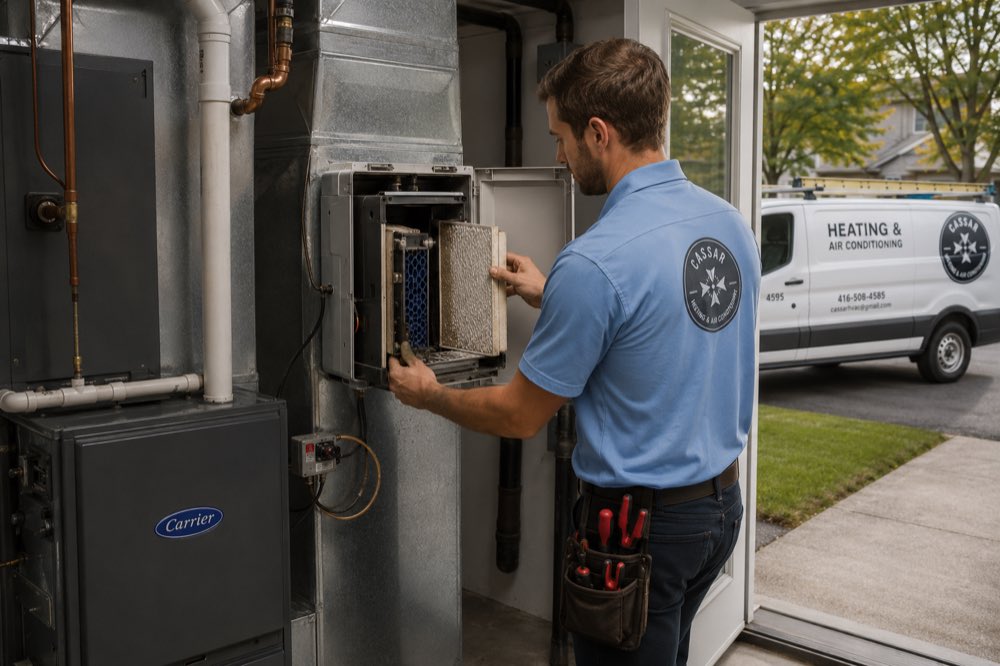
From a full assessment to a same-day fix, David handles every piece of the indoor air quality puzzle across Oshawa, Whitby, Ajax, Pickering, Clarington, and every community in between.
David installs HRV and ERV systems, whole-home humidifiers, dehumidifiers, electronic air cleaners, and UV germicidal lights across all of Durham Region. Many newer homes in Whitby and Ajax arrive from the builder with a basic HRV that’s never been properly commissioned, David sizes and installs the right unit and sets it up correctly from the start.
If your HRV isn’t exchanging air, your humidifier stopped putting out moisture, or your air cleaner’s indicator light is on, David diagnoses it and fixes it the same day wherever possible. He carries the most common replacement motors, cores, and media pads on the truck so he’s not ordering parts and coming back a week later.
When a repair no longer makes economic sense, David gives you a straight answer rather than patching something that’ll fail again in a season. He’ll tell you what the repair costs, what a replacement costs, and which one he’d choose if it were his house. Older Oshawa homes with original 1990s HRV units often reach this point, and replacing with a modern unit typically cuts energy use noticeably.
A yearly service on your HRV, ERV, or humidifier keeps it running at rated efficiency and catches problems before they become expensive. David cleans the heat exchange core, checks airflow balance, inspects the condensate drain, and replaces filters, the jobs that most homeowners don’t know need doing until something stops working.
If you’re still running a basic builder-grade HRV or a drum humidifier from ten years ago, upgrading to a modern energy recovery ventilator or a bypass flow-through humidifier makes a real difference in comfort and running costs. David walks you through the options, gives you a firm price, and installs the same day in most cases.
Mould smell from your vents, a humidifier flooding, or an HRV that’s shut down in the middle of winter, these aren’t problems you want to sit with until next week. David covers all of Durham Region for emergency calls and answers the phone himself, so you’re talking to the person who’ll actually show up and fix it.
Since 2011, I’ve been in a lot of Durham Region homes, Pickering townhouses where the HRV was installed but never connected to fresh air properly, Clarington bungalows where the builder’s drum humidifier rotted out the duct liner, Ajax semis where the owners had no idea what the box on the furnace actually did. I know what these homes need because I’ve been fixing the same problems for fifteen years. You get me on the phone and me at your door.
A well-maintained HRV or ERV will typically run 15 to 20 years before the heat exchange core degrades or the motor wears to the point where replacement makes more sense than repair. Whole-home humidifiers and electronic air cleaners have a similar range, though the humidifier’s water panel and the air cleaner’s cells need replacing on a set schedule throughout that lifespan. Units that are never serviced tend to land at the shorter end of that window.
Ontario’s climate pushes these systems hard. HRVs run year-round here because our winters are cold enough to require continuous ventilation without freezing the core, and our humid summers mean the unit still needs to manage moisture load. That continuous operation makes annual servicing more important than it would be in a milder climate. A dirty core loses heat exchange efficiency fast, which drives up your heating bill and reduces the unit’s lifespan at the same time.
The single maintenance task that extends lifespan the most is keeping the filters clean. Most manufacturers call for every three to six months. In Durham Region homes with pets, renovation dust, or a woodstove, I’d lean toward every three. The core itself needs a full wash once a year, it’s a job most homeowners don’t realize is part of the package.
A standard HRV service and cleaning runs $150 to $250 depending on how long the unit’s been neglected and whether it needs filter replacements or a condensate drain flush. Repairing a faulty HRV motor or damper actuator typically falls in the $200 to $450 range including parts. Whole-home humidifier service, panel replacement, scale cleaning, and a valve check, usually runs $100 to $180.
For new installations, a supply-and-install HRV or ERV in a Durham Region home runs approximately $1,400 to $2,200 depending on the unit’s capacity, the complexity of the ductwork connections, and whether the existing rough-in is usable or needs modification. A whole-home flow-through humidifier installed on your furnace typically costs $450 to $750 all in. UV germicidal light systems run $300 to $600 depending on the configuration. Electronic air cleaners, including the media-based whole-home units that outperform a standard 1-inch filter, fall in the $600 to $1,200 range installed.
What moves prices around is usually the condition of the existing rough-in, the accessibility of the install location, and whether any ductwork modifications are needed. Every job gets a free upfront quote before I touch anything. The best way to know what your specific job will cost is to get a free quote from David, no pressure, no obligation.
Durham Region has seen enormous growth since the early 2000s, and a large portion of the housing stock in communities like Courtice, Bowmanville, Newcastle, and north Whitby was built to tighter energy codes than the older homes in Oshawa’s established neighbourhoods. That’s a good thing for heating bills, but it creates an air quality problem the original owners often don’t expect. Tightly built homes rely entirely on mechanical ventilation to cycle out CO2, humidity, and VOCs from cooking, cleaning products, and off-gassing furniture. If the HRV isn’t working properly, or was never properly balanced at commissioning, those pollutants build up.
Older Oshawa and Whitby homes built before 1985 mostly ventilated through natural air leakage, which worked reasonably well for air quality even if it was terrible for energy efficiency. As homeowners in these older areas have upgraded insulation and windows over the years, they’ve tightened the envelope without necessarily adding mechanical ventilation. That’s when I start getting calls about musty smells, condensation on windows in winter, and family members with persistent sinus issues.
There’s also a ductwork issue specific to a lot of Durham Region’s mid-century housing stock. Homes from the 1950s through 1970s in Oshawa’s east and west end were built with oversized supply ducts designed for lower-efficiency equipment and less precise airflow control. Retrofitting modern air quality equipment into those systems sometimes requires duct modifications to get the distribution right, something I check before I quote, not after I’ve started the job.
The most telling sign is condensation on your windows through the winter months. In Durham Region, where overnight temperatures regularly drop below -10°C from December through February, condensation on double-glazed windows means the indoor humidity is higher than the glass surface can handle, which usually means your HRV isn’t exhausting moisture-laden air effectively. That same excess moisture ends up in your wall cavities and attic if it goes unchecked long enough.
A persistent musty smell that gets worse when the furnace kicks on is another one that warrants a call. It usually points to one of three things: a dirty evaporator coil on the air conditioning side, a humidifier that’s grown mould on the water panel or reservoir, or moisture that’s found its way into the ductwork somewhere. All three are fixable, but the longer you leave it the more the smell embeds itself into the duct liner.
Allergy symptoms that get worse indoors than outdoors, especially through the winter when windows are closed, often come down to particulate load in the air, dust mite debris, pet dander, and mould spores that a basic 1-inch filter doesn’t capture. Durham Region’s newer, tighter homes recirculate that air more than older leaky homes did. If two or more people in the house have started reaching for antihistamines through the winter, it’s worth looking at what’s in the air rather than just reaching for the medication.
Durham Region sits in a climate zone where the HRV does meaningful work in every season. In winter it recovers heat from exhaust air before it leaves the house, keeping ventilation costs low. In summer the same unit exhausts humidity from cooking, showers, and breathing before it drives up the cooling load on your air conditioner. Running it on a low continuous speed year-round, rather than only running it for a few hours a day as some homeowners do, keeps CO2 and humidity levels consistently in range rather than letting them spike between cycles.
Humidity management is where a lot of Durham Region homeowners leave comfort on the table. In winter, a whole-home humidifier set between 35% and 45% relative humidity eliminates the dry skin, static electricity, and cracked wood trim that come with dry forced-air heating. The exact target shifts down as the outdoor temperature drops, running 45% RH indoors when it’s -20°C outside pushes moisture into walls. I set the humidistat to a seasonal curve when I install or service one, so it adjusts automatically rather than needing the homeowner to track it.
Spring and fall are the best times to service an HRV or ERV in this region. After a Durham Region winter the core is coated in mineral deposits from condensate, and the filters are carrying a full season of particulate load. Getting a clean, balanced unit heading into summer means it manages the humid July and August air efficiently. Getting it serviced again in September means it’s ready for the heating season without running degraded through the coldest months.
Mechanical ventilation and combustion safety go hand in hand in any home with a gas furnace, water heater, or fireplace. An HRV that’s depressurizing the house more than it’s pressurizing it can backdraft a naturally drafting appliance, pulling combustion gases, including carbon monoxide, back into the living space. This is why HRV commissioning and balancing matters, and why TSSA licensing covers this work in Ontario. My TSSA licence number is #000398183, you can verify it directly with the Technical Standards and Safety Authority if you want to confirm I’m authorized to work on fuel-burning and related ventilation equipment in Ontario homes.
Ontario’s Enbridge Home Efficiency Rebate program and the Canada Greener Homes initiative have both offered rebates on qualifying mechanical ventilation upgrades, including HRV and ERV installations, when paired with an energy audit. The programs and their eligibility criteria change periodically, but if you’re replacing an older unit it’s worth asking David whether your specific installation qualifies, the rebates can offset a meaningful portion of the installation cost.
From an efficiency standpoint, modern HRVs with DC brushless motors and high-efficiency cores recover 70% to 80% of the heat from exhaust air compared to 50% to 60% for units made fifteen years ago. In a Durham Region home where the furnace runs four to five months of the year, that difference shows up on your gas bill. If your HRV is original to a home built in the early 2000s, it’s worth having David assess whether the efficiency gain on a new unit would pay for the replacement over a reasonable timeframe.
Checking the simple things first saves time for everyone, including me.
A clogged furnace filter is the single most common cause of poor indoor air quality. Replace it and run the fan for a few hours, you may notice an immediate difference.
Heat recovery ventilator filters need cleaning every 3–6 months. Blocked filters cause the unit to recirculate stale air rather than exchanging it.
A persistent musty or mouldy smell from vents suggests moisture in the ductwork, drain pan, or evaporator coil, a health concern that needs professional inspection.
Both too-high humidity (above 55%) and too-low humidity (below 30%) cause air quality problems. A basic hygrometer from a hardware store tells you where you are.
HRVs and ERVs have exterior intake vents that can get blocked by leaves, snow, insulation, or nesting material, especially after winter.
If none of the above sorted it, it needs a licensed technician to diagnose it properly. David serves all of Durham Region and picks up the phone himself.
The clearest indicators are physical symptoms and visible signs inside the home. If people in the household are getting more headaches than usual, waking up with dry eyes or a scratchy throat, or noticing that allergy symptoms are worse indoors than outside, the air quality is worth investigating. Condensation on windows during a Durham Region winter is one of the most reliable visual signals, it means indoor humidity is too high, which points to inadequate ventilation. Musty odours that intensify when the furnace runs, visible mould around window frames or in closets, or stuffy air that doesn’t clear even with a new furnace filter are all signs the home needs more than a basic filter change. A proper assessment covers airflow balance, humidity levels, particulate load, and whether the mechanical ventilation equipment is actually doing its job, not just running.
An HRV, or heat recovery ventilator, transfers heat between exhaust and incoming fresh air but lets moisture pass through separately. An ERV, energy recovery ventilator, transfers both heat and moisture. In Ontario’s climate, most homes with typical occupancy levels and humidity sources are better served by an HRV, it exhausts excess moisture in winter rather than retaining it, which is what you want in a climate where homes naturally generate a lot of indoor humidity from cooking, bathing, and breathing. An ERV makes more sense in homes that run very dry in winter, usually because they’re exceptionally well-sealed with very low occupancy, or in climates where summer humidity retention is a priority. For most Durham Region houses, including the newer tight subdivisions in Bowmanville and Courtice and the upgraded older homes in Whitby and Oshawa, an HRV is the right call. I can assess your specific situation and tell you which one fits your home before you spend anything.
It depends on what you need, so here’s what the most common jobs actually cost in Durham Region. A supply-and-install HRV or ERV runs approximately $1,400 to $2,200 all in, with the variation driven by unit capacity, the condition of the existing rough-in, and whether duct modifications are needed to connect it properly. A whole-home flow-through humidifier installed on your furnace typically costs $450 to $750 installed. A UV germicidal light system runs $300 to $600 depending on the lamp configuration. A whole-home media air cleaner, the kind that actually reduces fine particulates rather than just catching lint, runs $600 to $1,200 installed. Annual service calls for an existing HRV run $150 to $250. These ranges reflect real Durham Region jobs, not national averages. What moves the number around is the accessibility of your mechanical room, the complexity of the existing ductwork, and whether any modifications are needed. The best way to know what your specific job will cost is to get a free quote from David, no pressure, no obligation.
Absolutely, and it’s one of the most common things I find in older Durham Region homes. Leaky ductwork in unconditioned spaces, an unfinished basement, a crawlspace, or an attic, pulls in air from those areas and distributes it through the living space. Basements in Oshawa’s older housing stock often contain mould, dust, and fibreglass fragments from deteriorating duct insulation, and a leaky return duct will pull all of that into the airstream. Undersized or poorly designed duct systems also create pressure imbalances that affect how well ventilation equipment can do its job, an HRV that’s fighting against a depressurized house won’t balance airflow the way it should. Duct sealing and repair is part of what I look at when someone calls about air quality problems that don’t have an obvious source. Getting a new air quality system installed into a compromised duct system means the new equipment starts fighting the same battle the old one was losing.
The most impactful upgrade for allergy and asthma sufferers is replacing the standard 1-inch furnace filter with a whole-home media air cleaner rated MERV 11 or higher, or an electronic air cleaner that captures particles below 1 micron. Standard builder-grade filters stop large dust particles but let pollen, pet dander, and dust mite debris pass right through. A high-efficiency media filter installed in the return air plenum captures those finer particles on every air handler cycle. Combined with a properly functioning HRV that’s continuously cycling in fresh air and diluting the concentration of indoor allergens, most allergy sufferers notice a meaningful improvement within a few weeks. For homes with mould concerns, a UV germicidal light mounted near the evaporator coil kills mould spores and bacteria before they circulate. The combination of high-efficiency filtration, proper ventilation, and UV treatment addresses the three main allergen categories simultaneously. I’ll tell you honestly which of these your home actually needs rather than selling you the full package if parts of it won’t make a difference in your specific situation.
Once a year as a minimum, and twice a year if your home has pets, higher occupancy, or if anyone smokes inside. In Durham Region’s climate the HRV runs continuously through both the heating and cooling seasons, which means it accumulates a full year’s worth of particulate on the filters and mineral scale on the core every twelve months. The filters need cleaning or replacing every three to six months, that’s something most homeowners can do themselves if they know where the filter access panels are. The core wash, condensate drain inspection, damper check, and airflow rebalance is annual professional work. I find that most Durham Region units I see for the first time haven’t been professionally serviced since installation, which means the core’s efficiency has dropped significantly and the airflow balance is off from what the commissioning spec called for. A properly serviced unit uses less energy, ventilates more effectively, and lasts several years longer than one that runs ignored until something stops working.
Yes, more urgently than an older leaky home does. Ontario’s building code has required mechanical ventilation in new construction since the early 2000s for exactly this reason, a well-sealed home has essentially no natural air changes per hour, so without an HRV or ERV running continuously, CO2 levels climb, moisture from cooking and bathing accumulates, and VOCs from furniture, finishes, and cleaning products concentrate in the living space. The newer subdivisions in Bowmanville, Courtice, Newcastle, and north Whitby are built tightly enough that the HRV isn’t optional equipment, it’s part of the home’s basic life-safety ventilation design. What I find regularly in these newer Durham Region homes is an HRV that was installed by the builder but was never properly commissioned or balanced, so the homeowners assume their air quality is fine when the unit is actually moving a fraction of the airflow it should be. If your home was built after 2005 and you’ve never had the HRV serviced or balanced, it’s worth having me take a look at what it’s actually doing.
Yes, and I’d rather do that than skip straight to selling you equipment. When I come out to a Durham Region home for an air quality assessment, I’m checking the existing ventilation equipment’s airflow and balance, looking at humidity levels, inspecting the ductwork condition, asking about symptoms the household has noticed, and identifying whether the problem is a mechanical failure, a maintenance issue, or a gap in the system that needs a new piece of equipment to address. That assessment gives me the information I need to tell you specifically what’s causing the problem and what fixing it will cost, rather than presenting you with a list of products and letting you guess which one applies to your situation. Most of the time I find that the existing equipment can be repaired or serviced for far less than replacing it, and I’ll tell you that even if a replacement would be more profitable for me. If something does need replacing or adding, you’ll get a written quote with a clear explanation of why before any work starts.
“Our Whitby home’s HRV had never been serviced since it was installed in 2008. David cleaned it, rebalanced the airflow, and the stuffiness we’d been living with for years was gone within a day.”
“I called about a musty smell coming from the vents in our Ajax house and David showed up the same afternoon. He traced it to a mouldy drum humidifier that had been sitting wet all summer, I had no idea that was even the thing causing the smell. He replaced it with a flow-through unit, explained the difference, and told me exactly what to check every season. It felt like talking to someone who actually knew my house, not someone reading from a script.”
“The quote was the price. No add-ons when he got here, no surprises on the invoice. He put down mats before going anywhere near the furnace room, reinstalled every panel, and left the space cleaner than he found it. For what it’s worth, I’d called two other companies in Durham Region first and neither one called back inside 24 hours. David answered on the first ring.”
David serves every community across Durham Region, click your area for local information.
Same-day service available. TSSA certified. Honest pricing. Call or book online.