
Most homes in Brock Township sit on rural or semi-rural lots, built before central forced-air ever reached them, and a ductless heat pump is often the most practical way to add year-round comfort without tearing walls apart for new ductwork. David covers all of Brock and surrounding Durham Region communities, picks up the phone directly, and books same-day when the situation calls for it.
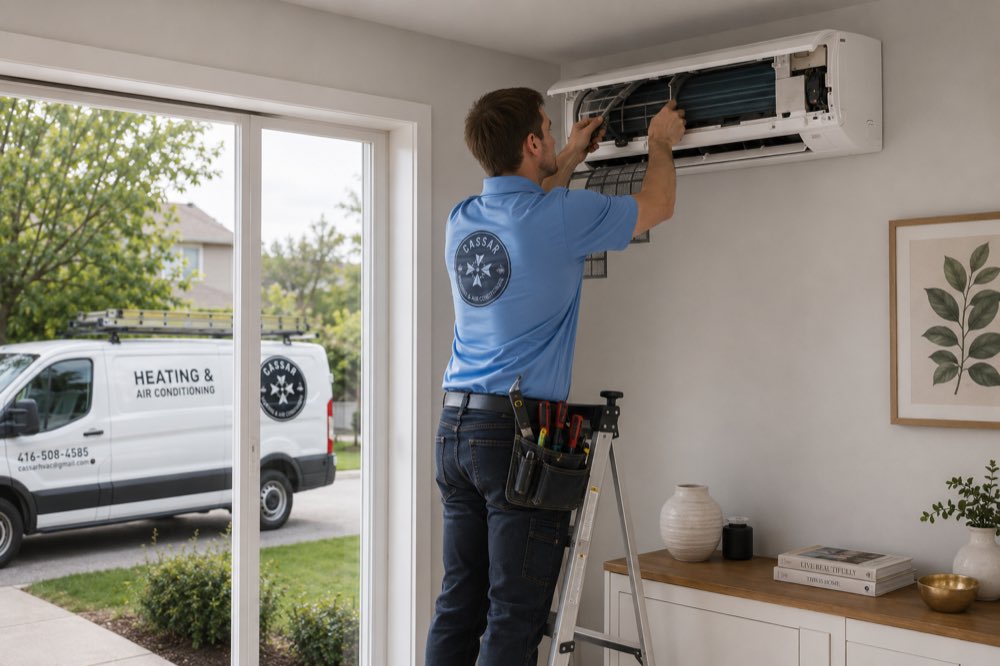
Every job in Brock gets David on-site, not a subcontractor. Here’s what he handles.
Many Brock homes are older builds on rural lots that never had ductwork installed. David sizes and installs single-zone and multi-zone ductless systems that match the actual load of the space, not a number pulled from a catalogue. You get a written quote before anything goes on the wall.
If your ductless unit is blowing cold on heat mode, cycling on and off, or the outdoor unit has iced over, David diagnoses the actual cause rather than selling you a part you don’t need. He carries common components on the truck so most repairs wrap up in one visit.
When a repair genuinely doesn’t make economic sense, David will tell you plainly and walk you through replacement options that fit the home. He won’t push a replacement on a unit that has useful life left. For Brock’s older cottages and century homes, he selects systems built to handle colder ambient temperatures.
A ductless system that skips annual maintenance loses efficiency gradually, and the drop is noticeable on your hydro bill before you notice it in comfort. David checks refrigerant levels, cleans coils, inspects the condensate drain, and confirms the defrost cycle is working correctly. Scheduling before the shoulder season means you’re ready when you need it.
If your current ductless unit is a first-generation model from the early 2010s, a modern cold-climate heat pump rated for operation down to -30°C delivers measurably more heat per kilowatt-hour. David calculates the payback period honestly so you can decide whether an upgrade makes financial sense for your household before committing.
Brock’s winters are cold and rural addresses mean longer gaps between service calls if you’re working with a large dispatch company. David answers his own phone. If your system quits in January and the temperature inside is dropping, call (416) 508-4585 directly and you’ll speak to the person who’ll show up at your door.
I’ve worked in Brock Township since 2011, and the pattern I see over and over is homeowners who got a ductless unit installed by someone who sized it for a smaller space, so it either short-cycles in summer or falls short on the coldest nights. Getting that right from the start is the whole job. I do this work personally, every time.
A well-maintained ductless heat pump typically lasts between 15 and 20 years in Ontario. Units that get annual service, have their filters cleaned regularly, and were correctly sized at installation tend to reach the top of that range. Units that were undersized from the start, run constantly trying to meet load, and never get a coil cleaning often show compressor wear before the ten-year mark.
Ontario’s climate puts a specific strain on ductless systems that milder regions don’t see. The defrost cycle runs hard through January and February, and if the outdoor unit’s drainage path freezes over repeatedly, you get ice buildup that stresses the fan and refrigerant circuit. David checks defrost function and drainage every tune-up specifically because this is a Durham Region failure pattern.
The single biggest thing that shortens lifespan is neglecting filter cleaning. Ductless filters sit inside the indoor wall unit and collect dust fast in most homes. A clogged filter forces the blower motor to work harder and restricts airflow over the evaporator coil, which makes the whole system less efficient and accelerates wear. Rinse yours every four to six weeks during heavy-use seasons.
A single-zone ductless installation in Brock typically runs between $2,800 and $4,500, depending on the brand, the SEER2 and HSPF2 ratings, the length of the line set run, and whether the installation requires any electrical panel upgrade or dedicated circuit work. Multi-zone systems covering two or three indoor heads start around $5,500 and can reach $9,000 or more for larger homes with longer runs and more complex mounting requirements.
Repair costs vary more widely. A refrigerant recharge runs $300 to $600 depending on the amount needed and the refrigerant type. A faulty control board replacement can run $400 to $800 with labour. A failed compressor on an older unit often tips the math toward replacement rather than repair, and David will tell you that plainly instead of approving a repair that won’t serve you for long.
Every job in Brock gets a free upfront quote before David picks up a tool. The best way to know what your specific job will cost is to get a free quote from David, no pressure, no obligation.
The Township of Brock covers a large, predominantly rural area stretching north from Lake Scugog to the edge of Simcoe County. Sunderland, Beaverton, and Cannington are the main communities, and a significant portion of the housing stock consists of older century homes, farmhouses, and lakefront cottages along Lake Simcoe and the Black River area. Many of these properties were never designed for forced-air HVAC and have limited wall cavity space for ductwork retrofits.
Ductless systems are a natural fit here because the installation requires only a small hole through the exterior wall for the line set and no major renovation work. That said, older Brock homes with solid masonry walls or low attic clearance do create specific mounting challenges for the outdoor unit’s refrigerant lines. David accounts for the line set routing in the quote, rather than pricing the equipment and leaving the routing as a surprise on installation day.
Brock’s lakefront cottage properties present their own considerations. Seasonal use means a ductless unit may sit dormant for months at a time. David advises owners to run the unit briefly in fan mode during any prolonged idle period to keep the system’s internal components from seizing, and to schedule a pre-season check before the first heavy use. Units that restart after a long idle without any checks are where David sees the most early-season service calls from Brock addresses.
The most direct signal is a unit blowing room-temperature air when it should be heating. This usually points to one of three things: the system is in the wrong mode, the refrigerant charge is low, or the outdoor unit’s defrost cycle has failed and the heat exchanger is buried in ice. In Brock’s winters, the ice scenario is the one David sees most often at that first cold snap in November when a unit that sat idle all summer gets turned on for the first time.
Unusual sounds are worth acting on quickly. A grinding noise from the indoor unit usually indicates a failing blower motor bearing. A gurgling or bubbling sound suggests refrigerant is low and the system is drawing vapour through the expansion valve. A rattling outdoor unit often means the fan blade has picked up debris or a mounting screw has loosened over a freeze-thaw cycle. None of these get better with time.
Watch your hydro bill. A ductless heat pump running efficiently on a cold Durham Region day will consume more power than mild-weather operation, but a sudden spike with no change in usage pattern usually means the system is working twice as hard to move the same amount of heat. That’s coil fouling, refrigerant loss, or a failing compressor, and catching it early is always cheaper than waiting for a full breakdown.
Durham Region runs cold from November through March, and April can still throw overnight temperatures below zero. Modern cold-climate ductless systems are rated for heating down to -25°C or lower, but they do this most efficiently when they’re not fighting a wide indoor-outdoor temperature gap. Keeping your home at a consistent temperature rather than letting it drop overnight and reheating it in the morning reduces the total energy consumed over a heating season.
Clean filters are the most impactful thing a homeowner can do between service visits. In Durham Region’s shoulder seasons, when windows are open and pollen counts are high, ductless filters accumulate debris fast. A filter cleaned monthly during spring and fall keeps airflow where it needs to be and prevents the efficiency losses that stack up quietly over a season.
Keep the outdoor unit clear of snow and ice accumulation. Modern ductless systems run automatic defrost cycles, but heavy snowfall that buries the unit entirely can overwhelm the defrost function. David recommends leaving at least 30 centimetres of clearance around the outdoor unit and checking after any significant snowfall. A cover is not the answer, because the unit needs airflow to operate.
Ductless heat pumps don’t burn fuel, so there’s no combustion risk or carbon monoxide concern from the unit itself. However, if you’re using a ductless system alongside a gas furnace or fireplace as a backup heat source, make sure your CO detector is current and tested. TSSA licence #000398183 covers David’s gas work as well as refrigerant handling, so both sides of a hybrid heating setup are within his scope.
On the refrigerant side, Ontario follows federal regulations under the Environmental Protection Act governing how refrigerants are handled, recovered, and recharged. Work must be done by a licensed technician. A contractor who offers to “top up” refrigerant without diagnosing where it went is not doing the job correctly. Refrigerant doesn’t disappear through normal operation. If the charge is low, there’s a leak, and that leak needs to be found and repaired before recharging.
Ontario’s Enbridge Home Efficiency Rebate Plus and Canada Greener Homes programs have offered rebates for cold-climate heat pump installations, though program terms change. At the time of booking, David can advise on what’s currently available and what documentation you’ll need to claim it. Rebates have ranged from $1,000 to over $5,000 depending on the equipment’s efficiency rating and the program year, so it’s worth confirming before you commit to a specific unit.
Checking the simple things before calling saves time for everyone.
Confirm the mode is set to Heat, the temperature is set above room temperature, and the remote has fresh batteries. Wrong mode is the most common ductless issue.
Ductless systems have separate breakers for the indoor air handler and outdoor compressor. Check both in your electrical panel.
Ductless filters are inside the indoor wall unit behind the front panel. Slide it out and rinse it under water, these block up faster than furnace filters.
Clear any snow, ice, or debris blocking the outdoor unit. A fully iced-over unit needs a technician, don’t attempt to remove ice manually.
Ductless remotes have many modes. Confirm the display shows the heat icon, not a water droplet (dry mode) or fan symbol.
If none of the above resolved it, the system needs a licensed technician to diagnose it properly. David serves all of Durham Region and picks up the phone himself.
Yes, modern cold-climate ductless heat pumps work effectively through Ontario winters, including Brock’s colder northern temperatures. Systems rated for cold-climate operation are designed to extract heat from outdoor air down to around -25°C or lower, which covers everything Durham Region throws at them. The key word is “cold-climate”, not every ductless unit on the market is built for this. Older or lower-tier units lose heating capacity rapidly below -10°C and start to struggle exactly when you need them most. If you’re installing in Brock, David selects equipment with a high HSPF2 rating and a rated heating capacity that holds at low ambient temperatures, not just at the standard 8.3°C test condition. You’ll see those specifications in the quote, not just a brand name.
A single-zone ductless heat pump installation in Durham Region, including Brock, typically runs between $2,800 and $4,500 for the equipment and labour combined. Multi-zone systems covering two indoor heads start around $5,500 and climb from there based on the number of zones, line set lengths, and any electrical work required. What moves the number are the brand and efficiency tier you choose, the distance the refrigerant lines need to run from the indoor unit to the outdoor compressor, whether your electrical panel needs a dedicated circuit added, and the difficulty of the mounting location. A lakefront cottage in Brock with an exterior masonry wall takes more time to mount correctly than a frame-built home in Sunderland. Every job gets a free written quote before any work starts. The best way to know what your specific job will cost is to get a free quote from David, no pressure, no obligation.
The number of indoor units you need depends on the layout of your home, how it’s insulated, and whether you want each zone to have independent temperature control. For most homes in Brock, a single-zone unit in an open-plan main living area handles the bulk of heating and cooling. If you have separate bedroom wings, a finished basement, or a detached outbuilding, those warrant their own heads. A two-storey home with poor insulation in the upper floor often needs a second head upstairs because heat rises but the ductless system in the living area won’t push enough through a staircase to condition the bedrooms adequately. David does a proper load calculation before recommending how many zones you need. Buying more indoor heads than necessary wastes money on installation and on electricity. Buying too few means the system short-cycles and the far rooms never reach temperature.
Yes, every ductless heat pump David installs provides both heating and cooling from the same unit. That’s the point of a heat pump. In summer it moves heat from inside your home to the outdoors, cooling the space. In winter it reverses the process, extracting heat from the outdoor air and bringing it inside. You switch modes on the remote. For Brock homeowners who currently heat with a propane furnace or electric baseboards and don’t have any central air conditioning, a ductless heat pump addresses both gaps in one installation. That’s a common situation in Brock’s rural residential stock, where central air was never installed alongside the original heating system. One unit, one install, both seasons covered.
Ontario homeowners installing eligible cold-climate heat pumps have had access to rebates through the Canada Greener Homes Grant, the Canada Greener Homes Loan, and more recently through programs administered at the federal level following the wind-down of the grant program. Rebate amounts for air-source heat pumps have ranged from $1,000 to $5,000 or more depending on the equipment’s efficiency specifications and the current program year. Enbridge’s Home Efficiency Rebate Plus program has also covered heat pump installations for eligible households. The specifics change year to year and program availability shifts, so David checks what’s current and what documentation you’ll need before finalising your equipment selection. Choosing a unit that qualifies for a rebate versus one that doesn’t can meaningfully change the net cost of the project, and that’s a factor in the quote conversation. The best way to know what your specific job will cost after available rebates is to get a free quote from David, no pressure, no obligation.
A standard single-zone ductless installation in Brock takes three to five hours from arrival to system commissioning. That covers mounting the indoor wall unit, positioning and securing the outdoor compressor, drilling the wall penetration for the line set, running and connecting the refrigerant lines and electrical, vacuuming down the system, and testing operation in both heating and cooling modes. Multi-zone installations with two or three indoor heads take a full day, sometimes slightly longer if the line set routing is complex or the building has masonry walls. David books one job per day so he’s not rushing to a second appointment. Your installation gets his full attention until the system is running correctly and you’re comfortable using the remote. Same-day installation is available when scheduling allows.
Start with the remote. Confirm it’s set to Heat mode, that the set temperature is above the current room temperature, and that the batteries are fresh. Wrong mode is genuinely the most common cause of a call. Next, check both circuit breakers in your electrical panel, the indoor handler and outdoor compressor each have their own. If those are fine, look at the outdoor unit. In Brock’s winters, a unit that’s fully encased in ice won’t move refrigerant properly and will blow room-temperature air. Don’t chip the ice manually. The defrost cycle should clear it, but if it’s overwhelmed, the unit needs service. If none of those explain the problem, the fault is likely a refrigerant loss, a failed control board, or a compressor issue, all of which need a technician. David covers Brock directly and picks up the phone at (416) 508-4585.
David works with a range of ductless brands and selects equipment based on what suits the home and the climate, not based on which manufacturer is running the best dealer incentive that month. He installs units from Mitsubishi, Daikin, Fujitsu, and other manufacturers with proven cold-climate performance records. If you’ve already purchased a specific unit and need it installed in Brock, call and discuss the brand and model before booking. Some off-brand units sourced from wholesale clubs or online marketplaces lack cold-climate ratings or use refrigerants that complicate future servicing, and David will tell you that honestly rather than install something that’ll underperform through a Brock winter. His goal is a system that works correctly for the next 15 to 20 years, and that starts with the right equipment selection.
“Ductless unit at our Beaverton property stopped heating mid-January. David had it diagnosed and repaired the same afternoon, turned out to be a defrost sensor fault.”
“I called about installing a ductless system in our older farmhouse north of Sunderland and David picked up right away. He came out, looked at the exterior wall where I wanted the outdoor unit, and flagged that the original mounting spot I had in mind would have blocked the drainage path in winter. He relocated it about four feet over and explained why. The install went smoothly and it’s been heating perfectly since.”
“Got three quotes for a ductless install at our Cannington place. Two came back vague about what was included. David’s quote broke everything down, equipment, line set length, electrical, all of it. Final invoice matched exactly. He also put down drop cloths through the hallway without being asked.”
David covers all of Durham Region, here are the communities he serves for ductless heat pump installation, repair, and maintenance.
Same-day service available. TSSA certified. Honest pricing. Call or book online.