
Orono’s mix of older village homes and newer rural builds on Clarington’s back roads means AC sizing and ductwork vary widely from house to house, a one-size-fits-all approach won’t cut it out here. David covers all of Orono and surrounding Clarington with same-day and emergency air conditioner service, and he picks up the phone himself.
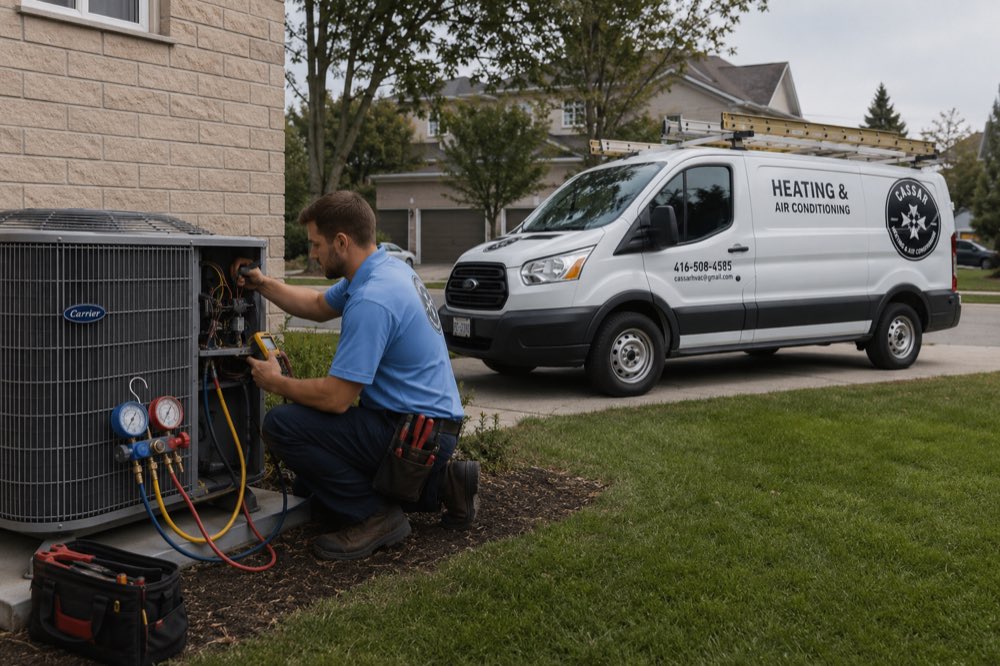
From first installs in newly built Clarington properties to repairs on units that’ve run through fifteen Ontario summers, David handles it all.
David sizes every installation to the actual house, not a square footage estimate pulled off a spec sheet. Orono’s older village homes often have narrow utility spaces, so he plans the line-set routing and disconnect placement before any equipment arrives on site. You get a quoted price upfront and that’s the price you pay.
If your AC stopped cooling overnight or the outdoor unit won’t start, David diagnoses the problem before he quotes the repair. He stocks common capacitors, contactors, and refrigerant on the truck so most repairs finish the same day. He’ll tell you honestly whether a repair makes sense or whether replacement is closer to the right call.
When a unit’s hit 15 or more years, repair costs start chasing their tail. David walks you through the replacement options that actually fit your home’s existing ductwork and electrical service, no upselling to equipment you don’t need. He handles the full swap, from disconnecting the old unit to commissioning the new one.
A spring tune-up catches the problems that show up on the hottest day of July, not before. David checks refrigerant levels, cleans the coils, tests the capacitor and contactor, and verifies airflow through the system. It’s a real inspection, not a filter swap and a sales pitch for a new unit.
Upgrading from an older 10 SEER unit to a 16 SEER or higher cuts cooling costs noticeably over an Ontario summer. David’ll look at what your current system is paired with, specifically your air handler or furnace fan, and make sure the new equipment works as a system, not just as a standalone unit dropped outside.
Orono sits far enough from the 401 corridor that some HVAC companies treat it as an afterthought. David doesn’t, he covers Orono the same way he covers Oshawa or Whitby. If your AC fails during a heat event, call (416) 508-4585 and David picks up. He’ll get out to you the same day.
Working in Orono since 2011, I’ve seen a lot of rural properties where the AC was installed years ago by whoever was cheapest at the time, undersized units, poorly routed line sets, and condensate drains that drain nowhere useful. When you call, you’re talking to me, and I’ll tell you straight what the system actually needs.
A central air conditioner in Ontario typically lasts between 15 and 20 years, though the real number depends heavily on how well it’s been maintained and how hard it’s worked each summer. A unit that’s had annual tune-ups, clean coils, and consistent filter changes will outrun one that’s been ignored by five years or more. On the other end, a unit that was undersized for the home from day one, something David sees regularly in older Clarington properties, wears out faster because it cycles constantly trying to keep up.
Ontario’s climate accelerates wear in a specific way: the shoulder seasons here are unpredictable. A system might sit idle for six weeks in a cool June, then run almost continuously through a two-week July heat dome. That stop-and-start cycling, combined with high humidity, puts stress on capacitors and compressors. Getting the coils cleaned in the spring and checking refrigerant charge before the heat arrives extends usable life meaningfully.
If your unit’s between 12 and 15 years old and it’s had a repair in the last year, it’s worth asking whether the next repair bill makes sense relative to the cost of a new system. David gives that assessment honestly, and he won’t steer you toward replacement if the repair is a reasonable bet.
A standard central air conditioner installation in Orono runs between $3,500 and $6,500 for most homes, depending on the unit’s efficiency rating, the complexity of the line-set run, and whether any electrical work is needed at the disconnect or panel. High-efficiency units (16 SEER2 and above) sit at the upper end of that range but reduce hydro costs over time. Straight replacements, where the existing line-set and electrical are reused, come in lower than first-time installs.
Repairs vary widely. A capacitor replacement is typically $150 to $350 all-in. A contactor swap is similar. Refrigerant recharges depend on the refrigerant type and how much is needed, R-410A systems run $300 to $600 for a typical top-up. If the leak is from a failed coil or a cracked line set, the repair cost climbs and the replacement conversation becomes more relevant. David diagnoses before quoting so you know exactly what you’re paying for before he picks up a tool.
Every job gets a free upfront quote. The best way to know what your specific job will cost is to get a free quote from David, no pressure, no obligation.
Orono is a small historic village in the northern part of Clarington municipality, and its housing stock reflects that. The older part of the village, the streets around Main Street and the downtown core, contains homes built from the 1880s through the mid-1900s. These properties often have older ductwork that was designed for gravity or early forced-air heating, not modern air conditioning airflow. The supply and return sizing in these homes frequently creates airflow imbalances that cause rooms to cool unevenly, and it’s something David looks at before recommending any equipment.
Outside the village core, Orono’s surrounding rural roads have a mix of properties: farmhouses with attached additions, newer bungalows, and some custom-built homes on larger lots. These properties often don’t have natural gas available, so the air conditioner pairs with an oil furnace or electric air handler rather than a gas system. That changes the coil configuration and controls setup, and it’s something that needs to be accounted for during installation, not discovered after the equipment arrives.
Because Orono sits further north and east within Clarington, it also tends to run slightly cooler than areas closer to the lake. That doesn’t mean homeowners skip AC, it means sizing needs to reflect actual load calculations rather than defaulting to the largest unit that fits the budget. An oversized unit short-cycles and leaves the house humid even when the temperature drops.
The most obvious sign is warm air coming from the vents when the system’s running. That usually points to one of three things: low refrigerant from a slow leak, a failed compressor, or a dirty evaporator coil that’s iced over and blocking airflow. Before calling, check your filter, a completely blocked filter causes ice buildup within hours on a humid day. If the filter’s clean and airflow still seems weak, it’s time to call David.
Short cycling, where the outdoor unit kicks on and off every few minutes rather than running a full cooling cycle, is a sign the system’s either oversized for the house or has a refrigerant or electrical issue. In Orono’s older homes where ductwork has been modified over the decades, restricted airflow is often the culprit. A system that can’t push air through properly will overheat and shut off on high-pressure lockout.
Unusual sounds deserve attention quickly. A grinding or screeching from the outdoor unit usually means the fan motor bearings are failing. A liquid gurgling sound from the indoor unit often means refrigerant levels are off. In Durham Region’s humid summers, these problems rarely improve on their own, they accelerate. Catching them before the compressor is involved saves real money.
Durham Region summers tend to bring extended humid stretches rather than consistent dry heat. Your air conditioner removes both heat and moisture, and that moisture load is significant. Running the fan continuously on “Auto” rather than “On” lets the coil dry between cycles, which prevents mould growth in the drain pan and keeps the system moving humidity out of the house rather than redistributing it. It also reduces energy consumption compared to running the fan full-time.
Keeping the outdoor condenser unit clear matters more than most homeowners realize. In rural Orono properties, overgrown grass, cedar hedges, and garden debris around the unit restrict the airflow the condenser needs to reject heat. A condenser working against blocked airflow runs hotter, consumes more power, and shortens compressor life. Clear 60cm around the unit on all sides and clean the fins every spring.
Programmable thermostat use has a bigger impact in Ontario’s climate than in warmer climates because the temperature swings here are significant. Setting the system to allow the house to warm up by a few degrees during the day and recovering in the evening works the AC harder in short bursts rather than constantly fighting a barely-beating setpoint. It’s a real reduction in runtime hours over a season.
Central air conditioners themselves aren’t a carbon monoxide source, but the system they share with a gas furnace is. The air handler pulls air across the furnace heat exchanger, if that exchanger is cracked, CO can enter the air stream and get distributed through the house. If you’re having AC work done on a combined system, it’s worth asking David to take a look at the furnace side while he’s there, especially if the furnace is getting older. TSSA licencing covers both.
Ontario homeowners installing new high-efficiency air conditioners may qualify for rebates through the Canada Greener Homes Grant or Enbridge programs, depending on the equipment tier and the home’s current efficiency profile. These programs change frequently, but David can walk you through what’s currently available at the time of your installation. A higher SEER2 unit often pays for the efficiency premium within a few years of Ontario hydro costs.
All refrigerant handling in Ontario requires a TSSA-licensed technician, it’s not a job for unlicensed contractors. Improper refrigerant handling voids manufacturer warranties and carries regulatory consequences. TSSA Licence #000398183 is verifiable on the TSSA public registry, and it covers every job David does in Orono and across Durham Region.
Checking the simple things before calling saves time for everyone, work through this list and you might have cool air running again before David even arrives.
Make sure it’s set to Cool and the temperature is set below current room temperature. Check the batteries too, a weak battery causes erratic thermostat behaviour.
Your AC has a breaker in the main panel and an exterior disconnect box next to the outdoor unit. Check both are on.
A clogged filter blocks airflow and causes the evaporator coil to ice up, completely stopping cooling. Replace the filter and let the unit thaw for an hour before restarting.
The condenser unit outside needs clear airflow. Remove any debris, overgrowth, or objects within 60cm of the unit. Don’t hose it down while running.
Closed vents create pressure imbalances that reduce cooling and can damage the system. Make sure every supply vent in the home is open.
If none of the above worked, it needs a licensed technician. David serves all of Durham Region including Orono and picks up the phone himself.
Once a year, in the spring before the cooling season starts, that’s the right schedule for most Orono homes. A pre-season tune-up lets David check refrigerant charge, clean the coils, test the capacitor and contactor, and verify the drain is clear. In Ontario’s climate, humidity is the big variable: a dirty coil or a partially blocked drain can cause the system to ice up or flood the drain pan within a few weeks of heavy summer use. In Clarington’s older village homes where the ductwork hasn’t been touched in decades, it’s also worth having airflow checked periodically, restricted ducts make the system work harder and wear faster. If your unit’s over ten years old, annual service is non-negotiable if you want it to finish out its lifespan.
There are four likely causes, and they’re not equally expensive to fix. First, check the filter, a blocked filter causes the evaporator coil to freeze over and stops airflow entirely. Replace it and give the system an hour to thaw. Second, check the outdoor unit for debris restricting the condenser. Third, if airflow’s fine but the air coming through the vents isn’t cold, you’re likely looking at low refrigerant from a leak or a failed capacitor. Capacitors are cheap and fast to replace. Refrigerant leaks need to be located and sealed before a recharge makes sense, otherwise you’re just topping up a leaking tank. Fourth, if the compressor itself has failed, that’s a repair-versus-replace conversation. David diagnoses first and tells you exactly what’s wrong before any work starts.
A standard replacement installation, swapping an old outdoor condenser and indoor coil for new equipment, typically takes four to six hours for most Orono homes. A first-time installation where there’s no existing refrigerant line set, disconnect wiring, or condensate drain in place takes longer, usually six to eight hours depending on how the utility space is configured. Orono’s older village homes sometimes require more planning around line-set routing because the mechanical rooms are compact and access to the exterior wall isn’t always straightforward. David does an on-site assessment before installation day so there are no surprises about what’s involved. He works alone or with one assistant, keeps the site clean, and doesn’t leave until the system’s commissioned and running properly.
The honest answer depends on three things: the age of the unit, the cost of the repair, and the unit’s repair history. A rule of thumb that holds up well in practice is the “5,000 rule”, multiply the unit’s age by the repair cost. If the number exceeds $5,000, replacement usually wins. A ten-year-old unit needing a $600 capacitor replacement is a clear repair. A fourteen-year-old unit needing a $1,200 coil repair is a closer call. A fifteen-year-old unit needing a compressor is almost always a replacement. In Orono, David also factors in the equipment the AC is paired with: if the furnace is also aging, it sometimes makes sense to plan a combined replacement rather than two separate service calls over two years. He’ll lay the numbers out plainly and let you decide.
For a Durham Region home, a 16 SEER2 unit is a solid baseline that balances upfront cost with meaningful efficiency gains over an Ontario cooling season. The minimum SEER2 allowed under current Canadian standards is 13.4 for split systems, but that’s a floor, not a recommendation. Going from 13 SEER to 16 SEER cuts cooling energy consumption by roughly 20%, which adds up on hydro bills through a long hot July. Units at 18 SEER2 and above are worth considering if you’re running the system heavily through a whole summer, but the payback period stretches out if you’re in a home with good insulation and moderate cooling loads. In Clarington communities like Orono, where some homes rely on electric heat, the hydro savings from a higher-SEER unit matter more than in gas-heated homes elsewhere in Durham Region. David’ll size and recommend based on your actual home, not a brochure.
If the system’s running, fan’s spinning, outdoor unit’s humming, but the air coming through the vents isn’t cold, the most common culprits are low refrigerant, a dirty evaporator coil, or a failing compressor. Low refrigerant is a leak problem, not a “needs a top-up” problem: R-410A systems are sealed, so if the charge is low, refrigerant has escaped somewhere. David finds the leak before recharging, because topping up without fixing the source just delays the next call. A dirty evaporator coil reduces heat transfer dramatically, the coil frosts over and blocks airflow, and the air that does get through isn’t being cooled properly. A compressor that’s working but not building pressure will run continuously without actually moving refrigerant through the cycle. That last one typically means replacement is on the table. None of these are guesswork jobs, they need proper diagnostics.
Yes, David services all major residential central air conditioner brands, including Carrier, Lennox, Trane, York, Goodman, Bryant, Rheem, and others. In Orono and the wider Clarington area, he’s worked on equipment from pretty much every brand that’s been installed in Durham Region homes over the last two decades. Most repairs come down to the same core components, capacitors, contactors, fan motors, refrigerant charge, coil cleanliness, regardless of the brand name on the cabinet. Where brand-specific parts are needed, David sources them and won’t substitute an incompatible generic component to close the job faster. If you’re not sure whether he covers your brand, call (416) 508-4585 and ask, he’ll tell you straight.
Yes, financing options are available for air conditioner installation in Durham Region, including Orono. Spreading the cost of a new unit over monthly payments makes sense for a lot of homeowners who need a replacement during the cooling season and can’t absorb the full cost upfront. The exact terms depend on the financing program, your credit profile, and the total job cost. Typical financing structures in the HVAC market run from 12 to 60 months, with promotional zero-interest periods for shorter terms. A new 16 SEER2 system at $4,500 to $5,500 installed runs roughly $90 to $130 per month over 48 months at standard rates. David can walk you through what’s available when you get your quote. The best way to know what your specific job will cost is to get a free quote from David, no pressure, no obligation.
“Our AC died on the hottest Wednesday in July. David was at our Orono house that afternoon, found a blown capacitor, and had cold air running again within an hour.”
“I called about replacing our old Lennox central air, the thing was about 17 years old and had already been repaired twice. David came out, looked at the whole setup including how the ductwork runs through our older Orono place, and explained exactly why he was recommending the unit he did. He didn’t try to sell me the most expensive option. Installation was clean, he put down drop cloths through the hallway, and he went through the thermostat settings with me before he left.”
“Got three quotes for a new AC install at our property just outside Orono. Cassar came in mid-range on price and was the only one who actually looked at the mechanical room before quoting. The number he gave me on the phone was the number on the invoice. That matters.”
David covers Orono and every community across Durham Region, same service, same pricing, same person on the phone.
Same-day service available. TSSA certified. Honest pricing. Call or book online.