
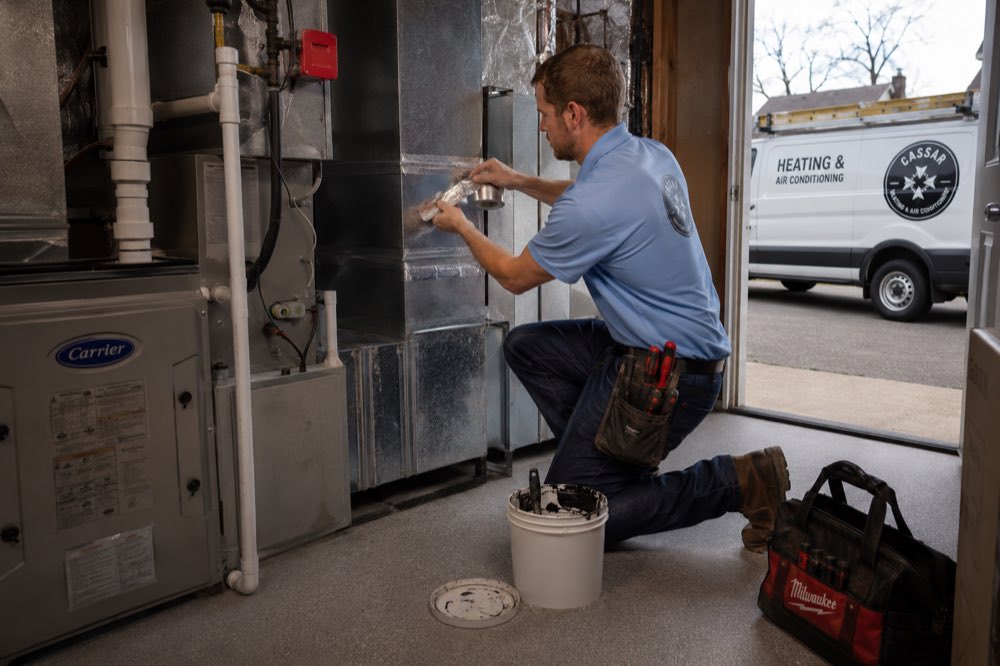
From a single leaking joint to a full new system, David handles every aspect of residential ductwork across all of Durham Region.
David calculates the correct duct sizing using Manual D before a single piece of metal goes in, so the system delivers the right airflow to every room from day one. Rushing that step is how homes end up with a hot bedroom upstairs and a cold one at the end of the hall. New construction, additions, and full system replacements are all covered.
A disconnected joint in the attic or a crushed flex run in a crawlspace can push 20–30% of your conditioned air into the wrong space. David locates the leak, reseals or replaces the affected section, and checks static pressure afterward to confirm the fix actually worked. Most repairs are completed in a single visit.
Older Durham Region homes, especially those built before 1990, often have undersized or deteriorating ductwork that can’t support a modern high-efficiency furnace or heat pump. David assesses what’s actually there, explains what needs to go and what’s worth keeping, and replaces only what the system genuinely requires.
Duct connections loosen over time, especially where flex duct meets metal collar. David checks every accessible joint, measures supply and return air balance, and looks for signs of moisture or pest intrusion that most homeowners never see until a bigger problem shows up. A one-hour annual check saves real money.
A collapsed duct trunk in the middle of January is an emergency, not a scheduled appointment. David takes emergency calls personally across all of Durham Region and aims for same-day response. You won’t reach a dispatcher, you’ll reach the person who shows up.
Upgrading to a 96% AFUE furnace or a two-stage heat pump without upgrading the ductwork often creates more problems than it solves, those systems need properly sized ducts to modulate correctly. David designs and installs upgraded duct systems that let high-efficiency equipment perform at the ratings on the box.
Call (416) 508-4585 and David answers, not a call centre, not a receptionist. You describe what you’re noticing and he’ll tell you honestly whether it sounds like a repair, a replacement, or a diagnostics visit before anything is scheduled.
David inspects the ductwork, checks static pressure, and identifies exactly what’s failing and why. You get a written quote on the spot, what the work involves, what it costs, and why he’s recommending it. There’s no pressure to decide on the day.
David completes the work himself, sealing joints with mastic or UL-listed foil tape, securing all connections, and verifying airflow to each register before packing up. He treats access panels and finished surfaces the way he’d want his own home treated.
Before he leaves, David walks you through what was done and what to watch for going forward. If anything feels off in the next few days, you call the same number and reach the same person who did the work.
David has been sizing and installing ductwork in Durham Region homes since 2011. He’s seen what corners look like when they’ve been cut, and he’s learned that a properly installed duct system pays for itself in lower bills and fewer equipment breakdowns. His TSSA licence number is #000398183, you can verify it yourself at any time.
David Cassar started Cassar Heating & Air Conditioning in 2011 after spending years working for larger HVAC companies and watching homeowners get sold equipment and duct systems that were never quite right for their homes. He wanted to do the job properly, explain what he was doing and why, and charge a fair price without the upsell. That idea turned into a business that’s been serving Durham Region homeowners ever since.
His approach to ductwork is different from what most homeowners expect. Before touching anything, he measures the heating and cooling load, checks static pressure, and identifies whether the problem is in the ducts, the registers, the equipment, or some combination of all three. A lot of Durham Region homes have ductwork that was installed when oil furnaces or low-efficiency equipment was the norm, those systems need a different airflow design than a modern 96% AFUE unit. Getting that wrong after an equipment upgrade is a mistake that costs money every month.
When David finishes a job, the space looks the way he found it. He doesn’t leave duct tape hanging off a register and call it done. Homeowners in Whitby, Oshawa, Ajax, Pickering, and Clarington keep calling him back not because they can’t find anyone else, but because he shows up on time, does the work right, and answers the phone when they call a year later with a question.
Ready to talk ductwork? Call David directly.
“Our back bedroom was always 4 degrees colder than the rest of the house. Turned out to be a disconnected duct run behind the drywall. Fixed it same day, problem gone.”
“I called about a whistling noise coming from a ceiling vent and David picked up immediately. He came out the next morning, found a collapsed flex duct in the attic, and explained exactly what had happened and what it would cost before touching anything. He didn’t try to sell me a new furnace, just fixed the duct and that was that.”
“The quote was exactly what I paid. No extras added on after he opened up the ceiling. He put drop cloths down before he started and cleaned up every bit of debris on the way out. For ductwork in a finished basement, that’s not something you take for granted.”
Seven questions worth answering before you call anyone, including Cassar.
The most obvious signs are uneven temperatures between floors or rooms, a noticeable jump in your gas or hydro bills after an equipment change, musty smells from the registers, or visible damage like crushed or disconnected sections in the basement or attic. Older homes, particularly anything built before 1985 in Durham Region, often have duct runs sized for the equipment that was original to the house, which may be completely wrong for a modern furnace or heat pump. Age alone doesn’t mean replacement, but age combined with undersizing, visible deterioration, or major efficiency losses is a strong indicator. The only way to know for certain is a proper inspection that checks both the physical condition and the airflow performance of the system. David can do that assessment and give you a clear recommendation without any obligation to proceed.
A partial ductwork extension or a single-zone repair typically runs $400–$900. A full ductwork replacement for a two-storey Durham Region home falls in the $2,500–$6,000 range, depending on the size of the home, the complexity of the layout, how accessible the existing ducts are, and whether the job requires cutting into finished walls or ceilings. Homes with crawlspaces or difficult attic access cost more because the labour time is higher. New construction installs on a raw basement are at the lower end; replacing a concealed duct system in a finished home with a dropped ceiling is at the upper end. The best way to know what your specific job will cost is to get a free quote from David, no pressure, no obligation.
Yes, significantly. The U.S. Department of Energy and Natural Resources Canada both cite duct leakage as one of the largest sources of energy loss in residential systems, with studies showing that leaky ducts can waste 20–30% of the conditioned air a furnace or air conditioner produces. In a Durham Region home running the furnace for seven months a year, that loss adds up fast. What makes it worse is that most of that lost air ends up in unconditioned spaces, a cold garage, a hot attic, or an unfinished basement, rather than the rooms you’re actually trying to heat. The system works harder, the equipment wears faster, and the comfort level stays lower than it should be. Sealing the leaks is one of the highest-return investments you can make in an existing HVAC system.
Rigid sheet metal duct is the industry standard for main trunk lines because it delivers consistent airflow, doesn’t sag or kink, and lasts the life of the building when properly installed and sealed. Flex duct is a corrugated, insulated tube used for branch runs, the shorter connections between the main trunk and individual registers. It’s faster to install and works well for those shorter runs, but it creates more airflow resistance per foot than metal, and it’s easily damaged by improper handling, excess bending, or being pinched against a floor joist. A common mistake David sees in Durham Region homes is using flex duct for long runs or routing it with tight bends, which can cut airflow to a room by 30–40%. The right answer is usually metal trunk lines with properly installed flex branch runs kept as short and straight as possible.
Sealing makes sense when the ductwork is physically intact and correctly sized for the current equipment. If the joints are leaking but the runs are sound and the layout still works, applying mastic sealant or UL-listed foil tape to every connection is a cost-effective fix that delivers measurable results. Replacement is the right call when the ductwork is undersized for the current system, when there’s physical damage or deterioration throughout, when the layout was designed for a different type of system, or when an equipment upgrade has changed the airflow requirements. David’s approach is to assess the actual condition and performance of what’s there first, then recommend sealing if it’ll solve the problem or replacement only when sealing won’t be enough. He won’t recommend a full replacement to avoid the time it takes to seal properly.
Well-installed rigid sheet metal ductwork can last 25 years or longer with periodic joint resealing. Flex duct has a shorter practical lifespan, typically 15–25 years, depending on installation quality and conditions in the space. Ductwork in humid crawlspaces or attics with significant temperature swings degrades faster than ductwork in a climate-controlled basement. In Ontario, where the temperature differential between a winter attic and the heated living space can be 50°C or more, thermal expansion and contraction takes a toll on sealed connections over time. The single biggest factor in ductwork longevity is installation quality, poorly secured connections that move during seasonal cycling will fail in five years. Properly sealed and supported systems run well for decades. If your home is over 25 years old and hasn’t had the ductwork inspected, it’s worth checking.
It can make a real difference, particularly in older homes. Leaky return ducts that run through unconditioned spaces can pull in insulation fibres, mould spores, pest debris, and construction dust from attics or crawlspaces and distribute them throughout the home with every furnace cycle. Sealing or replacing those return runs stops that from happening. New ductwork also allows for better integration of HRVs (heat recovery ventilators), humidifiers, and air filtration systems, all of which directly affect indoor air quality. If anyone in your home has allergies or respiratory sensitivities and you’ve noticed the problem is worse in winter when the furnace runs more, it’s worth having the duct system inspected for leaks in the return side specifically.
Still not sure? Call David at (416) 508-4585
Have the duct system checked before you start running the furnace in October. David looks for any joints that have shifted over summer, checks that all register dampers open properly, and confirms there’s no pest intrusion in accessible crawlspace runs. A problem found in September is a scheduled repair. The same problem found in January is an emergency call during the coldest week of the year.
If one room in your home stops keeping up with the rest during a cold snap, that’s often a duct issue rather than an equipment problem. A pop or bang when the furnace kicks on can be a sign of undersized ducts creating pressure buildup. Frost or condensation around a register in an exterior wall may mean a supply run is passing through a cold space without adequate insulation. Don’t wait until spring to investigate, these problems get worse with continued use.
Spring is the ideal time to replace or extend ductwork in Durham Region. The furnace season is winding down, the A/C season hasn’t started, and David has more scheduling flexibility than in mid-winter or mid-summer. If you’re planning a home addition, a basement finish, or an HVAC equipment upgrade for next heating season, booking the ductwork work in April or May means everything’s in place before you need it.
Summer is when most Durham Region homeowners ignore their ductwork, which makes it the best time to get ahead of problems. Attic duct runs that were fine all winter may show heat-related deterioration in the flex connections when you look in July. It’s also a good time to add insulation to supply runs passing through a hot garage or unconditioned attic, which improves both summer cooling performance and next winter’s heating efficiency. A quick inspection now saves a service call when you turn the furnace back on in October.
The clearest signs are rooms that can’t reach the thermostat temperature even when the furnace runs continuously, higher-than-normal gas bills after an equipment upgrade, and dust buildup around specific registers. Undersized ducts also create a pressure hiss or whistle at registers, the air is being forced through an opening that’s too small for the volume the furnace is pushing. Duct leaks are harder to spot visually because they’re often in concealed runs, but you can sometimes feel air movement near joints in accessible areas while the system is running. A proper diagnosis means measuring the static pressure in the system and comparing it to the equipment’s rated operating range. If the pressure is too high, the ducts are restricting airflow. If there’s a large gap between supply and return air volumes, air is escaping somewhere it shouldn’t be. David does both checks as part of a standard ductwork assessment.
Duct repairs in Durham Region typically run $200–$600 for accessible joints, sealing, or single-section replacements. A partial duct extension to a new room or a finished basement usually falls in the $600–$1,500 range. Full ductwork replacement for a typical two-storey home runs $2,500–$6,000. The main variables are home size, how accessible the duct runs are, whether any finished surfaces need to be opened up, and the complexity of the layout. A home with an open unfinished basement costs much less to work on than one with a fully finished lower level and concealed soffits throughout. Homes that need both the supply and return systems redesigned for a new high-efficiency system sit at the higher end of that range. The best way to know what your specific job will cost is to get a free quote from David, no pressure, no obligation.
Yes, and it’s one of the most common misdiagnoses David sees in Durham Region homes. A homeowner notices the upstairs is too cold, assumes the furnace is undersized or failing, and calls about equipment replacement. When David inspects the system, the furnace is fine, it’s a disconnected return duct or a severely pinched flex run that’s starving half the house. Leaky supply ducts push conditioned air into wall cavities, attics, or crawlspaces instead of the rooms you’re heating. Leaky return ducts pull cold unconditioned air into the system, making the furnace work harder to hit the set temperature. Both problems increase run time, raise bills, and accelerate wear on the heat exchanger and blower motor. In some cases, persistent duct restriction can trigger a high-temperature limit fault on the furnace. If your equipment seems to be struggling, it’s worth confirming the ducts are doing their job before spending money on a new system.
A targeted repair, sealing leaking joints, replacing a damaged flex run, or adding a single branch, usually takes two to four hours. A full ductwork replacement for a typical two-storey Durham Region home takes one to two days, depending on how many supply and return runs are involved and how complex the access is. New construction basement duct installs in an open space can be completed in a day. A job that involves cutting through finished drywall or working in a tight crawlspace takes longer. David gives you a realistic time estimate when he quotes the job, not a best-case scenario. If there’s anything that might extend the timeline once he opens things up, he’ll tell you before proceeding.
Sealing is the right answer when the ducts are in good physical condition, the layout is correct for the current equipment, and the problem is leaking joints rather than wrong sizing. Applying mastic compound or proper foil tape to every accessible connection is a proven, cost-effective fix that most homeowners see pay back in energy savings within a year or two. Replacement is the right answer when the existing layout can’t deliver adequate airflow to all zones of the house, when the ducts are deteriorating throughout, or when a significant equipment change has fundamentally altered what the duct system needs to do. David’s default is to seal first and replace only when sealing won’t solve the underlying problem. He won’t recommend replacing functional ductwork just because replacement would be a bigger job, that’s not how he operates.
David covers all of Durham Region. Select your community below for local service information.
Same-day service available across all of Durham Region. TSSA certified. Honest pricing. No surprises.