
Call David and you’ll get a straight answer about whether your ductless system needs a repair, a tune-up, or a new installation, and a fixed price before any work begins. He’s been sizing, installing, and servicing ductless heat pumps across Oshawa, Whitby, Ajax, Pickering, Clarington, and surrounding Durham Region communities since 2011.
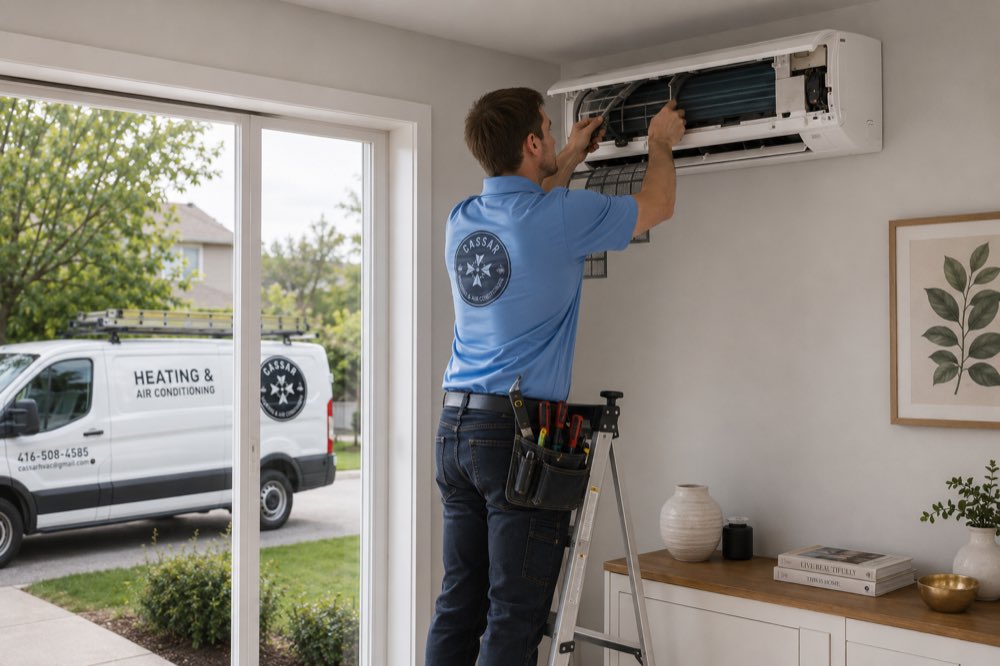
From first installation to emergency repairs, David handles every aspect of ductless heat pump work across Durham Region.
David calculates a proper heat-loss figure for each zone before choosing unit capacity, skipping that step is why so many systems short-cycle or can’t keep up on the coldest nights. He handles the refrigerant line set, electrical connection, and drain line, and he commissions the system before he leaves. Most single-zone installations finish in one day.
When a ductless unit throws an error code, loses heating capacity, or stops responding to the remote, David diagnoses the actual fault rather than guessing and replacing parts. Common issues he finds in Durham Region homes include refrigerant leaks from vibration-worn line sets, failed drain pumps in wall-mounted heads, and dirty coils that restrict airflow enough to trigger high-pressure lockouts. He carries common parts and refrigerant on the truck.
If your system is 15 or more years old and repairs are stacking up, replacing the outdoor unit and indoor heads together often makes more sense than chasing faults. David gives you an honest read on whether repair is still worth it, and he won’t push a replacement to increase the invoice. When replacement does make sense, he sizes the new system correctly and handles disposal of the old equipment.
A ductless tune-up covers cleaning the indoor head’s filter and evaporator coil, checking refrigerant charge and line-set integrity, inspecting the condensate drain, and testing all operating modes. Most manufacturers require documented annual maintenance to keep the warranty valid, David keeps a record of every visit. A clean, properly charged system uses meaningfully less electricity than a neglected one.
A ductless system that quits on a January night in Clarington or Oshawa isn’t something you want to wait three days to fix. David takes emergency calls personally, you reach the technician, not a call centre, and he covers all of Durham Region for urgent work. If the repair can’t be completed same-day, he’ll tell you that upfront rather than leaving you with an unfinished job and no heat.
Older R-22 or early R-410A systems can’t match what today’s cold-climate inverter units deliver in efficiency or low-temperature performance. David installs premium cold-climate units rated to operate at full capacity well below -20°C, which matters here, Durham Region winters regularly drop to -15°C or colder. He’ll walk you through current Ontario rebate programs so you know what financial incentives apply before you decide.
Four straightforward steps from first call to a working system.
David picks up the phone, there’s no dispatcher relaying messages between you and the person doing the work. Tell him what’s happening: the unit’s error code, when the problem started, whether it’s heating, cooling, or both. He’ll ask the right questions so he arrives with the right parts.
For repairs, David checks refrigerant charge, coil condition, drain operation, and any fault codes the unit’s storing before he quotes anything. You get a fixed price for the specific repair, not an estimate that grows once work starts. For installations, he measures the space and calculates the load so the unit he recommends is the right size for the room.
David completes the repair or installation to TSSA standards, handles the refrigerant work under his licence, and tests every operating mode before packing up. If the job is an installation, he walks you through the remote, the modes, and what to watch for through the first heating season.
You pay the price that was quoted, nothing added for materials, nothing tacked on for disposal. David leaves your home the way he found it and follows up if there’s anything you weren’t sure about from the walkthrough. If a problem comes back within the warranty period, he comes back.
David has been doing ductless heat pump work in Durham Region since 2011, through enough Ontario winters to know exactly where systems fail and which installations hold up long-term. He works independently, which means the brand he recommends is the one that fits your home, not the one that pays the best dealer margin. Every job is covered by TSSA Licence #000398183.
After years working for larger HVAC companies and watching homeowners pay for replacements they didn’t need, David Cassar started Cassar Heating & Air Conditioning in 2011 to do things differently. The core idea was simple: give people the same advice you’d give your own family, charge what the job actually costs, and do the work right the first time.
On ductless heat pump jobs specifically, David runs a proper load calculation for every zone before recommending any equipment, something a lot of contractors skip to move faster. He’s seen Durham Region homeowners get stuck with undersized systems that can’t heat a bedroom below -15°C because whoever installed the unit just grabbed the same capacity they always used. That’s a fixable mistake during sizing; it’s an expensive one after the fact.
When he’s working in your home, David treats it with the same care he’d want in his own. Drop cloths go down, shoes come off or get covered, and the space he worked in gets left cleaner than he found it. That attention is part of why so many Durham Region homeowners have been calling back for over a decade, and why they refer their neighbours.
“Our ductless unit was throwing an error code and blowing cold air in heating mode. David diagnosed a refrigerant leak in the line set, fixed it the same afternoon, and the system’s been solid since.”
“I’d gotten two quotes for a two-zone ductless installation and both contractors just picked sizes off the top of their heads. David actually measured the rooms and explained why the bedroom needed a smaller head than the main floor. He knew what he was talking about, and the install was clean. No mess, no confusion about the price.”
“Quoted me $X, charged me $X. My last contractor added $200 in ‘materials’ at the end that were never mentioned. With David, what he says is what you pay. He also covered the floors before bringing anything through, which I noticed.”
Seven questions David gets asked regularly. Straightforward answers so you can make a confident decision.
A ductless heat pump moves heat between indoors and outdoors instead of generating it by burning fuel. It consists of an outdoor unit connected by refrigerant lines to one or more indoor wall-mounted heads. In heating mode, the system extracts heat energy from outdoor air, even at very cold temperatures, and delivers it inside. In cooling mode, it reverses that flow, pulling heat from inside and rejecting it outdoors. Because it moves heat rather than creating it, a well-matched cold-climate unit can deliver three to four times as much thermal energy per kilowatt of electricity as a baseboard heater. There are no ducts required, which makes it practical for additions, older homes without central air, and any room that’s consistently too hot or too cold.
A single-zone ductless heat pump installed in Ontario typically costs $3,500 to $5,500 all in. The main variables are brand and efficiency tier, the capacity needed for your space, how far the indoor head is from the outdoor unit, and whether any electrical panel work is needed for the dedicated circuit. Multi-zone systems with two indoor heads generally run $6,000 to $8,500, and three-head systems land in the $8,500 to $11,000 range, again depending on complexity. Premium cold-climate models rated for -25°C operation cost more upfront but tend to be the right call in Durham Region given our winters. The best way to know what your specific job will cost is to get a free quote from David, no pressure, no obligation.
Yes, if you install the right type. Standard heat pumps lose heating capacity quickly once outdoor temperatures drop below about -8°C to -10°C, which means they’d struggle through a typical Durham Region January. Cold-climate inverter units, Mitsubishi’s Hyper-Heat line, Daikin’s Emura, Fujitsu’s Halcyon, are rated to operate at full capacity down to -15°C and continue providing useful heat to -25°C or beyond. David only installs units appropriate for Ontario’s climate range. If you’re replacing a gas furnace entirely or heating a space that has no backup source, the unit specification matters enormously and he’ll walk you through the numbers before recommending anything.
Each indoor head conditions one zone, and a zone is roughly one open area where you want independent temperature control. A wide-open main floor might need one head sized at 18,000 BTU. Separate bedrooms usually need their own heads, typically 9,000 or 12,000 BTU each. An open-concept bungalow around 1,200 to 1,400 sq ft might work well with two heads. A two-storey home where you want bedroom control separate from the living area often needs three or four. The real answer comes from a heat-loss calculation that accounts for ceiling height, insulation, window area, and orientation. David runs those numbers before recommending any equipment. Guessing and rounding up wastes money; guessing and rounding down means you’re cold all winter.
The Canada Greener Homes Loan is currently open and offers up to $40,000 interest-free over 10 years for eligible heat pump installations, you’ll need a pre-installation energy audit to qualify. Enbridge Gas offers rebates between $250 and $1,000 for homeowners who add a heat pump as their primary heating source and reduce gas consumption. Some Durham Region municipalities have their own top-up programs that stack with federal and provincial incentives. The eligibility rules change more often than anyone publishes updates, so David checks current program status before each quote to tell you exactly what applies to your situation and your home’s current heating setup.
A central heat pump connects to your existing duct system and conditions the whole house from one indoor air handler, the same way a central air conditioner does. A ductless system uses individual wall-mounted heads in each room, so there are no ducts at all. Ductless systems are better suited to homes without existing ductwork, individual room additions, or situations where you want zone-by-zone temperature control. Central heat pumps make more sense when you already have ducts in good condition and want whole-home conditioning from a single system. The operating efficiency of both types is comparable at the same temperature rating, but ductless eliminates the energy losses that come from air leaking through duct joints, which in older Durham Region homes can be substantial.
A well-maintained ductless heat pump lasts 15 to 20 years. The outdoor compressor is the most expensive component and typically determines the system’s lifespan. Annual maintenance, cleaning coils, checking refrigerant charge, clearing the drain path, makes a measurable difference to longevity. Systems that get serviced regularly and are correctly sized for the space tend to reach 18 to 20 years. Systems that get ignored, run with dirty coils, or were oversized at installation often start having compressor issues in 10 to 12 years. If your system is 12 to 15 years old and you’re putting repair money into it annually, David will tell you honestly when the economics shift toward replacement rather than letting repairs accumulate indefinitely.
What to do, and watch for, in each season to keep your ductless system running the way it should.
Book your annual ductless tune-up in September or October, before heating demand kicks in. David checks refrigerant charge, cleans the indoor coil, confirms the drain path is clear, and runs the unit through a full heating-mode test while outdoor temperatures are still forgiving. A system that starts the heating season with a low charge or a clogged coil will struggle through January when you need it most. Fall is also when David catches failing capacitors on the outdoor unit before a cold-snap failure.
If your ductless unit is running longer than usual to hit the set temperature, the indoor head’s filter is likely overdue for cleaning, pull it out and rinse it under the tap. Ice on the outdoor unit is normal during a defrost cycle and clears itself; ice that stays for hours or grows on the refrigerant lines is a sign of a low-charge problem that needs a service call. Unusual noises from the outdoor unit in very cold weather, grinding or loud rattling, often mean a refrigerant-starved compressor. Catch it early.
If your ductless system is older and you’ve been on the fence about replacing it, spring is the right time to act. Installation lead times are shorter before summer demand peaks, David has more scheduling flexibility, and you’ll have the new system commissioned and ready before the first hot week. Spring is also when rebate program budgets are typically refreshed, if you’ve been waiting on the Greener Homes Loan or an Enbridge rebate, confirming eligibility now before summer installers queue up is a smart move.
Your ductless unit is working hard in cooling mode all summer. Clean the indoor filter every four to six weeks during peak use, a clogged filter reduces airflow enough to cause the evaporator coil to ice over, which can trip a lockout fault. Keep the outdoor unit clear of grass clippings and debris after every mow. If the unit’s cooling but struggling to hit setpoint on hot days, that’s often a low refrigerant charge that’s been gradual, David can check the pressures and top up if needed before the problem gets worse.
Yes, the right ones do, and that qualifier matters. Standard heat pumps lose heating capacity quickly as outdoor temperatures drop, which means a standard unit installed in a Durham Region home will struggle from January through February when you’re relying on it most. Cold-climate inverter units are built specifically for this. Mitsubishi’s Hyper-Heat models, Daikin’s Emura, and Fujitsu’s Halcyon cold-climate series all maintain full rated capacity to -15°C and continue producing useful heat to -25°C or below. David only installs units appropriate for Ontario’s climate, if a standard-rated unit showed up on a quote for a Durham Region home, that’s a red flag worth asking about. The upfront cost difference between a standard and a cold-climate unit is typically $300 to $600. Paying that now costs much less than supplemental electric heat all winter.
A single-zone installation in Durham Region runs $3,500 to $5,500 installed, including the outdoor unit, indoor head, refrigerant line set, electrical connection, and commissioning. The spread in that range comes from brand and efficiency tier, unit capacity, the distance between indoor and outdoor units, and whether any panel work is needed for the dedicated 240V circuit. A two-zone system, two indoor heads, one outdoor unit, typically lands between $6,000 and $8,500. Three zones usually run $8,500 to $11,000. Premium cold-climate models that are the right choice for full-home heating in Ontario cost more than basic cooling-focused units, and that’s a worthwhile difference given what Durham Region winters look like. David quotes the whole job as a fixed price. The best way to know what your specific job will cost is to get a free quote from David, no pressure, no obligation.
One indoor head handles one zone, generally one open area where you want independent temperature control. The size of that zone depends on square footage, ceiling height, insulation quality, window area, and which direction those windows face. A rough guide: a 9,000 BTU head handles about 350 to 450 sq ft in a well-insulated space; a 12,000 BTU head covers 500 to 600 sq ft; an 18,000 BTU head covers 700 to 900 sq ft. But those numbers shift a lot based on actual heat-loss figures, which is why David runs a calculation for every zone before recommending anything. An open-concept bungalow around 1,400 sq ft might need two heads. A two-storey home where you want the upstairs bedrooms at a different temperature than the main floor usually needs three or four. Over-sizing a head because it was “close enough” leads to a system that short-cycles and doesn’t dehumidify properly in summer. Under-sizing means it can’t keep up on the coldest nights.
Every ductless heat pump David installs runs in both directions. In summer it extracts heat from your indoor air and rejects it outside, that’s the cooling cycle. In winter it reverses, pulling heat energy from the outdoor air and delivering it inside, that’s heating. One system replaces both an air conditioner and a heating source. The key thing to understand is that “heat pump” doesn’t mean it only heats. The name comes from the physics: it pumps heat from one place to another rather than burning fuel to generate it. For Durham Region homes, a cold-climate model gives you reliable cooling in July and reliable heating in January from the same equipment. David also makes sure the refrigerant type and electrical sizing are correct for year-round dual-mode operation, not just one season.
There are currently a few programs worth knowing about. The Canada Greener Homes Loan offers up to $40,000 interest-free over 10 years for eligible retrofits including heat pump installation, you need a pre-retrofit EnerGuide home evaluation to qualify, and the work has to be done by a registered contractor. Enbridge Gas offers a heat pump rebate for homeowners who switch their primary heating source from gas to a heat pump, the amount varies by program year but has been in the $250 to $1,000 range. There are also occasional Durham Region municipal programs that stack on top of provincial and federal ones. These programs update frequently and the details change, so David checks current eligibility requirements before every quote so he can tell you exactly what applies to your situation, your home’s current heating type, and whether the equipment he’s recommending qualifies under the relevant program rules.
David covers every community in Durham Region for ductless heat pump installation, repair, and maintenance. Select your community for local service details.
David handles the full range of home comfort equipment across Durham Region. If you need something alongside your ductless work, it’s one call.
Same-day service available across all of Durham Region. TSSA certified. Honest pricing. No surprises.