
Brock Township’s mix of older rural homes and newer lakefront builds on Lake Simcoe and Beaver Lake means David runs into everything from aging single-stage units on undersized ductwork to brand-new high-efficiency systems that weren’t commissioned properly. He covers all of Brock, including Beaverton, Cannington, and Sunderland, and picks up the phone when you call.
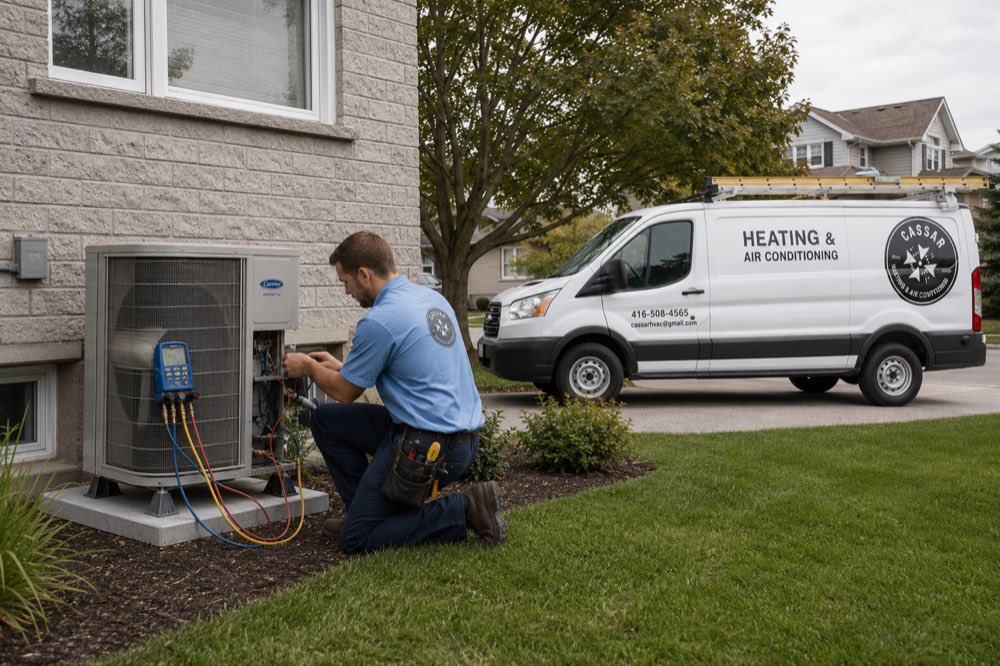
From Beaverton to Cannington, David handles every air conditioner job himself, installation, repair, tune-ups, and emergency calls.
Many Brock homes, particularly the older farmhouses and cottages near Beaverton, were built without central air, so David sizes and installs a system that actually fits the home’s existing ductwork rather than forcing a unit that’s too large. He calculates the load before recommending any equipment. You get one quote upfront and that’s what you pay.
David stocks the most common components, capacitors, contactors, fan motors, refrigerant, so most repairs happen on the first visit. If your AC stops working during a July heat wave in Sunderland, you’re not waiting four days for a parts order. He diagnoses the problem, tells you what it costs, and fixes it that day if the part is on the truck.
When a repair no longer makes financial sense, David’ll say so clearly and walk you through your replacement options without pushing the most expensive unit on the shelf. He takes the old equipment away, handles the refrigerant disposal correctly, and leaves the mechanical room cleaner than he found it.
A maintenance visit before the summer season catches the problems that cause breakdowns in August, not in April when they’d be easier to fix. David cleans the coils, checks the refrigerant charge, tests the capacitor and contactor, and verifies airflow. A system that’s tuned runs cooler, uses less electricity, and lasts longer.
If your current unit is a 10 SEER system installed in the early 2000s, a modern 18 SEER replacement will cut your cooling costs noticeably over a Brock summer. David’ll tell you how long it realistically takes to recoup the cost difference so you can make an informed decision. Ontario’s Enbridge and Hydro One rebate programs may reduce the upfront cost further.
Brock Township sits far enough north and west that some contractors won’t dispatch out here for emergency calls. David does. He’s been covering the outer edges of Durham Region since 2011 and knows the drive to Cannington or the lakefront roads off Thorah Concession. When you call (416) 508-4585, you’re talking to the person who’s coming to fix it.
Brock homeowners tend to call after a bad experience with a contractor who quoted one price and billed another, or who recommended a full replacement on a system that had a straightforward fix. David’s been out to enough Township of Brock homes since 2011 to know what the common equipment failures look like here, and his answer is always the same: fix it if it makes sense, replace it if it doesn’t, and tell you the price before he touches anything.
A central air conditioner in Ontario typically lasts 15 to 20 years if it’s sized correctly for the home and gets serviced every year or two. Units that were oversized at installation, which is more common than most homeowners realize, tend to short-cycle, meaning they click on and off too frequently without completing a full cooling cycle. That wears out the compressor years earlier than it should.
Ontario’s climate pushes AC systems hard. Humid summers mean the evaporator coil is always pulling moisture out of the air, which accelerates corrosion on older units and strains refrigerant circuits. A system running low on refrigerant works harder to achieve the same cooling, and the extra load shortens compressor life. Annual maintenance catches a low refrigerant charge before it turns into a $1,500 compressor replacement.
The other factor is filter discipline. A clogged filter restricts airflow across the evaporator coil, causing it to ice over and forcing the system to run longer cycles to reach setpoint. Replacing the filter every 60 to 90 days during cooling season costs almost nothing and directly extends the equipment’s serviceable life.
A straightforward repair, replacing a capacitor, contactor, or fan motor, typically runs between $200 and $500 including parts and labour. Refrigerant recharges sit in the $300 to $600 range depending on how much is needed and what refrigerant type your system uses. Compressor replacements, when they’re worth doing at all, run $800 to $1,400 installed. David’ll tell you upfront if the compressor repair cost is close to the cost of a new unit, because in that situation a replacement often makes more financial sense.
New central AC installations in Brock generally run $3,500 to $6,500 for the equipment and labour, depending on unit size, SEER rating, and whether the existing ductwork needs modification. High-efficiency units sit at the upper end of that range but carry lower operating costs year over year. Ductless mini-split installations for a single zone typically cost $2,800 to $4,500 installed.
Every job David quotes is free, upfront, and firm. The number you agree to is the number on the invoice. The best way to know what your specific job will cost is to get a free quote from David, no pressure, no obligation.
Brock Township’s housing stock is genuinely varied, which affects every AC decision. The older century homes and farmhouses, common around Sunderland and along the concession roads, were built long before central air was standard. Many have ductwork that was added after the fact, sized for heating only. Installing a central AC on undersized or poorly laid-out ducts means poor airflow distribution, hot spots in upstairs rooms, and a compressor that works harder than it should. David checks duct sizing before recommending any unit.
The lakefront communities on Lake Simcoe, particularly around Beaverton and along Thorah Island Road, have a different challenge: humidity. Properties close to the water run higher ambient humidity through the summer, which means the AC system’s dehumidification capacity matters as much as its cooling capacity. A unit with a lower sensible heat ratio handles humid conditions better and keeps the home more comfortable at a higher thermostat setpoint.
Newer subdivisions in the Beaverton core, built in the 1990s and 2000s, more often have existing central air that’s simply aging out. These homes usually have adequate ductwork, so replacement is mostly a straightforward equipment swap. The main decision is SEER rating and whether to move up to a two-stage or variable-capacity compressor for better comfort and humidity control on the shoulder seasons.
The clearest signal is an AC that runs constantly but can’t bring the house to setpoint on a hot day. In most cases, that’s either a refrigerant leak, a dirty evaporator coil, or a failing compressor. A refrigerant leak usually shows up first as ice forming on the refrigerant lines near the indoor coil, if you see frost in July, shut the system off and call David. Running a low-charge system long enough will damage the compressor.
Short-cycling, the unit clicking on and off every few minutes, is worth paying attention to. It’s sometimes a thermostat calibration issue, sometimes a refrigerant problem, and sometimes a sign the unit was oversized for the home at installation. In Brock, where older homes get retrofitted with whatever unit was available at the time, oversizing is something David sees more often than you’d expect.
Unusual sounds are also worth acting on quickly. A grinding or screeching noise from the outdoor unit usually means a failing fan motor bearing. A banging sound inside the air handler often points to a loose blower wheel. These aren’t problems that resolve themselves, and delaying a $300 fix can turn it into a $1,200 one if the failing component takes something else down with it.
Durham Region and the northern communities like Brock get a genuinely mixed climate: cold, wet springs; hot and humid July and August peaks; and cool, damp falls. That means your AC system needs to handle both sensible heat (temperature) and latent heat (humidity) effectively. Setting the thermostat fan to “Auto” rather than “On” keeps the fan off between cooling cycles, which lets the coil drain condensate properly instead of recirculating humid air back into the space.
Keeping the outdoor condenser unit clear of overgrowth matters more in rural Brock than it does in a typical suburban yard. Tall grass, weeds, and shrubs pressing up against the condenser cabinet restrict airflow and cause the refrigerant pressure to climb, which stresses the compressor. Trim back anything within 60 centimetres of the unit and check it at the start of each season. David sees plenty of service calls in Brock that turn out to be nothing more than a neglected condenser.
Pre-season tune-ups booked in April or May are worth scheduling before the rush hits. By the time the first serious heat wave arrives in late June, David’s schedule fills quickly. A spring maintenance visit means the system’s refrigerant charge, coil cleanliness, and electrical components are checked before you actually need the AC to work, not the day it stops working during a heat advisory.
Ontario’s TSSA (Technical Standards and Safety Authority) licenses and regulates HVAC technicians who handle refrigerants. Refrigerant work done without a licence isn’t just illegal, improperly handled refrigerant can cause equipment damage, and a botched repair voids most manufacturer warranties. David’s TSSA Licence #000398183 is publicly verifiable. Any contractor who can’t produce a licence number shouldn’t be touching your refrigerant system.
Ontario’s Affordability Fund and Enbridge’s Home Efficiency Rebate program offer incentives for upgrading to high-efficiency cooling equipment. ENERGY STAR-certified air conditioners with a SEER rating of 18 or higher may qualify for rebates that reduce the upfront cost of a replacement. David’ll let you know which units qualify and what documentation you need to claim the rebate, though the rebate application is ultimately the homeowner’s to submit to the relevant program.
If your home has a gas furnace sharing the same air handler and ductwork as the AC system, it’s worth having the heat exchanger inspected at the same time as any major HVAC work. A cracked heat exchanger is a carbon monoxide risk. David checks for obvious signs during every major service call and will flag anything that warrants a closer look, not because it generates extra revenue, but because it’s the right thing to do.
Checking the simple things before calling saves time for everyone, work through these five steps before picking up the phone.
Make sure it’s set to Cool and the temperature is set below current room temperature. Check the batteries too, a weak battery causes erratic thermostat behaviour.
Your AC has a breaker in the main panel and an exterior disconnect box next to the outdoor unit. Check both are on.
A clogged filter blocks airflow and causes the evaporator coil to ice up, completely stopping cooling. Replace the filter and let the unit thaw for an hour before restarting.
The condenser unit outside needs clear airflow. Remove any debris, overgrowth, or objects within 60cm of the unit. Don’t hose it down while running.
Closed vents create pressure imbalances that reduce cooling and can damage the system. Make sure every supply vent in the home is open.
If none of the above steps resolve the problem, it needs a licensed technician. David serves all of Durham Region including Brock and picks up the phone himself.
Once a year is the right answer for most homes in Brock Township, and the best time to book is April or early May before the season kicks in. A maintenance visit covers refrigerant charge, coil cleanliness, capacitor and contactor condition, and airflow, all the things that cause breakdowns when the system is running hard in July. In rural Brock, where properties often have more vegetation around the outdoor unit and dustier conditions than a suburban lot, the coils can foul faster and may benefit from a mid-season check too. Systems older than 12 years with any history of refrigerant loss are worth checking every spring without exception. Skipping a year or two of maintenance might seem like a saving, but the repair it leads to almost always costs more than several tune-ups combined.
The most common causes are low refrigerant, a dirty evaporator or condenser coil, a failing capacitor, or a clogged air filter. Low refrigerant is the one that most homeowners don’t catch until the system stops cooling entirely, by then, the compressor has been working under stress for a while and may have taken damage. A dirty condenser coil causes the refrigerant pressure to spike, which reduces cooling capacity and puts strain on the compressor. A capacitor failure is the most abrupt: the unit tries to start, can’t, and either trips a thermal overload or just hums and shuts down. Start with the filter and outdoor unit checks outlined in the troubleshooting section above. If those don’t resolve it, call David and he’ll diagnose it on the visit, he carries the common parts on the truck so most repairs happen the same day.
A standard central AC installation, swapping out an existing unit on existing ductwork, takes David four to six hours from arrival to commissioning. That includes evacuating the old refrigerant, setting the new condenser, connecting the refrigerant lines, wiring, and verifying the system charges and cools correctly before he leaves. If the installation involves running new refrigerant lines, modifying electrical, or any ductwork adjustment, add two to three hours. Ductless mini-split installations for a single zone take about the same time, four to six hours, but don’t require any duct modifications, which makes them practical for Brock homes that lack existing central ductwork. David books the full day for installations so there’s no rush and the job gets done right the first time.
The practical rule is this: if the repair costs more than half the price of a replacement unit, replacement usually wins on economics. But that’s not the whole picture. Age matters significantly. A 14-year-old unit with a failing compressor is a candidate for replacement even if the compressor repair is technically within budget, because the rest of the system is at the same age and the next failure could arrive within a year. A 7-year-old unit with a blown capacitor is an obvious repair, $200 to $300 and it runs fine for another decade. In Brock, David sees a lot of systems installed in the late 1990s and early 2000s that are genuinely at end-of-life and where repair costs are stacking up. He’ll give you a straight answer on which way to go, he doesn’t earn a commission on equipment, so the advice is honest.
For Durham Region and Brock specifically, a SEER rating of 16 to 18 is a practical sweet spot between upfront cost and operating savings. The minimum legal efficiency for new central AC in Canada is 13 SEER, and anything in the 13 to 15 range runs fine but costs more to operate year over year than a higher-efficiency unit. A 18 SEER unit costs more upfront but the electricity savings over 15 years are real, particularly in a home that runs the AC through most of July and August. Beyond 20 SEER, the payback period gets longer and the efficiency gains per dollar spent diminish. If your electricity bill is a significant concern or you’re in a larger Brock home that runs the AC heavily, go higher. If you’re replacing a failed unit and budget is the priority, a 16 SEER gets the job done well and won’t leave you overpaying on hydro.
A system that runs continuously without cooling the house has one of a few things going wrong. Low refrigerant is the first thing to check, the system is operating but the refrigerant charge is too low to move enough heat out of the air. A dirty evaporator coil is the second: if the coil is coated in dust and debris, heat transfer is compromised and the system can’t cool effectively even though the compressor is running. A failed reversing valve can cause this in a heat pump system, but for straight cooling units, the likeliest culprits are refrigerant, coil condition, and compressor capacity. Check your filter first, a severely clogged filter causes the coil to ice over and the system blows room-temperature air through the blockage. If the filter is clean and the outdoor unit is running, call David and he’ll bring the gauges.
David services all major brands, Carrier, Lennox, Trane, York, Goodman, Rheem, American Standard, Bryant, and others. The refrigerant work, electrical diagnosis, and mechanical repair skills transfer across brands. What varies is parts availability. Common components like capacitors, contactors, and fan motors are mostly interchangeable or available from HVAC supply houses within a day. Proprietary control boards and brand-specific blower assemblies on less common models occasionally require an order, which David’ll tell you upfront rather than leaving you without a timeline. He stocks the high-failure parts for the most common brands running in Brock homes so that the typical repair doesn’t need a return visit. If you’re not sure whether he services your equipment, call (416) 508-4585 and he’ll tell you directly.
Yes. Financing options are available for AC installations in Brock and across Durham Region, which makes replacing an older, failed, or inefficient unit manageable without paying the full cost upfront. Typical financing through HVAC-specific programs allows homeowners to spread payments over 12 to 60 months, sometimes with a deferred interest period for the first year. The right option depends on your situation, and David’ll walk you through what’s available on the quote call. New central AC installations in Brock generally run $3,500 to $6,500 depending on unit size and efficiency, so financing makes a meaningful difference for many families. Ontario’s rebate programs can also reduce the effective cost of a high-efficiency unit. The best way to know what your specific job will cost is to get a free quote from David, no pressure, no obligation.
“AC quit on a Friday afternoon in the middle of August. David was out to our place in Beaverton that same evening and had it running again before 8 o’clock.”
“I called David expecting to hear I needed a new unit, the old Carrier had been struggling all summer and I figured it was done. He came out to our house off Thorah Concession, put his gauges on it, and told me the compressor was fine. It was a failed capacitor. He had the part on the truck, replaced it in about forty minutes, and charged me exactly what he quoted over the phone. That was it.”
“What stood out was the price didn’t change from what he told me beforehand, I’d had a quote from another company that somehow grew by $400 by the time the invoice showed up. David quoted the installation for our Cannington home, showed up when he said he would, put down floor coverings before bringing anything inside, and handed me a receipt for the exact same number we’d agreed on.”
David covers all of Durham Region, Brock is part of his regular route, not a special trip.
Same-day service available. TSSA certified. Honest pricing. Call or book online.