
Newcastle’s growth over the past decade has brought a wave of newer builds along Highway 2 and Rudell Road, and those homes often came with builder-grade tank units that owners are now replacing with tankless, David’s seen this pattern play out across Clarington, and he knows what these installations actually involve. He covers all of Durham Region and picks up the phone himself, so you’re not waiting on a callback from a dispatcher.
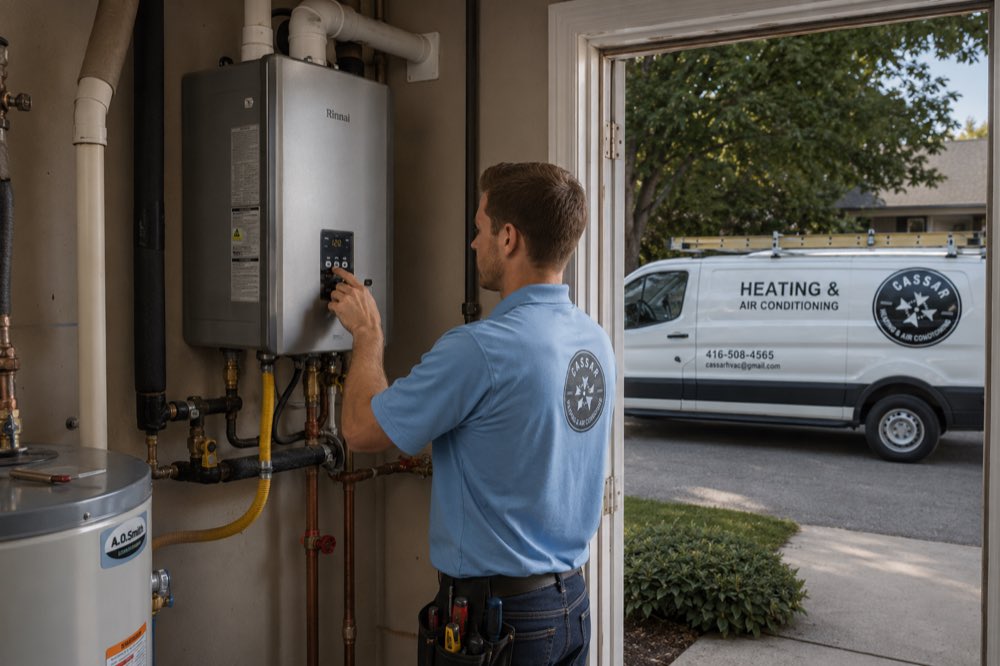
From first-time installations to emergency repairs, David handles every job personally, no subcontractors, no surprises.
Newcastle’s newer subdivisions near Beacon East and Foster Creek often have utility rooms sized for compact tankless units, but the gas line supply pressure and venting route need checking before any unit goes in. David sizes the unit to the home’s actual peak demand, not just the manufacturer’s suggested spec. Every installation includes a full commission check and a walkthrough so you know how the unit works.
Error codes, ignition failures, temperature swings, and scale buildup are the most common repair calls David gets in the Newcastle area. He carries parts for most major brands on the truck, which means most repairs finish on the first visit. If a part isn’t on hand, he’ll tell you the timeline upfront rather than leaving you without hot water while he tracks it down.
When a tankless unit reaches the end of its life, David gives you a straight assessment, whether that’s a repair that buys another five years or a replacement that makes more financial sense long-term. He won’t push a replacement if a repair is the right call. Replacements include proper disposal of the old unit and a verified-safe commission of the new one before he leaves.
Durham Region’s water has enough mineral content to build scale inside a heat exchanger within a couple of years if the unit isn’t flushed. An annual service includes a vinegar or descaling flush, inlet filter cleaning, burner inspection, and a combustion check. It keeps the unit running at rated efficiency and catches small problems before they become expensive ones.
Upgrading from a standard tank to a condensing tankless unit can cut gas water heating costs by 30 to 40 percent in an average Newcastle home. David walks you through which unit fits your household size and hot water patterns, a family of five has very different needs than a couple, and he’ll tell you honestly if an upgrade makes economic sense given your current setup and gas rates.
A tankless failure in January in Newcastle isn’t a call that waits until Monday. David answers his phone directly, if you’re calling at 7 in the morning because there’s no hot water and two kids need showers before school, he’s the one who picks up. He’ll tell you right away whether it’s something you can reset yourself or whether he needs to come out, and he’ll be honest about the timeline.
Working in Newcastle since 2011, I’ve installed and serviced tankless units in everything from the older century homes near the village core to the newer builds spreading east along Highway 2, and the job looks different in each one. I give every homeowner a real assessment before any work starts, so you know what you’re getting into and what it’s going to cost.
A gas-fired tankless water heater installed and serviced properly will typically last 18 to 25 years in an Ontario home, significantly longer than a conventional tank, which averages 10 to 12 years. That lifespan isn’t guaranteed by the brand name on the front. It depends almost entirely on water quality, how often the unit gets serviced, and whether it was sized and installed correctly in the first place.
Ontario’s water supply varies by municipality, and in Clarington the water tends to carry enough dissolved minerals to leave meaningful scale deposits inside a heat exchanger within two to three years of use. Scale acts as an insulator between the burner and the water, which forces the unit to work harder and run hotter to reach the set temperature. Over time that stress shortens the heat exchanger’s life. An annual flush removes that buildup before it becomes a structural problem.
Venting also matters for longevity. Tankless units pull in combustion air and expel exhaust through dedicated pipes, and in Ontario’s freeze-thaw winters those pipes are vulnerable to moisture infiltration and ice blockages. A unit that’s shutting down on cold nights because its intake is partially blocked is running start-stop cycles that wear on the igniter and gas valve. Catching that early keeps the unit going for the full expected lifespan.
For most Newcastle homeowners switching from a conventional tank to a tankless unit, the total installed cost runs between $3,000 and $5,500. That range reflects the unit itself, any gas line upgrades required, venting modifications, and labour. A straightforward swap in a newer home with an existing dedicated gas line and accessible venting sits toward the lower end. A century home in the village where the gas supply line needs upgrading and venting needs to be routed through an exterior wall can push into the higher range.
Repairs are a different category. A common repair like a scale-blocked heat exchanger flush, a failed flow sensor, or a faulty igniter typically runs between $200 and $600 depending on parts and the time to access them. Error-code diagnostics where the fix turns out to be something straightforward cost less. A failed heat exchanger on an older unit can run $800 to $1,200 or more, at which point the honest conversation is whether that money is better spent on a replacement.
Every job David quotes is priced before work starts, and that number is the number on the invoice. The best way to know what your specific job will cost is to get a free quote from David, no pressure, no obligation.
Newcastle sits in the western corner of Clarington and has seen substantial residential development since the early 2000s, with another significant wave of subdivisions built between 2010 and 2020 along the Rudell Road corridor and north of King Avenue. A large portion of these homes were built by volume builders who standardised on 40 or 50-gallon power-vent tanks as the default water heating solution, functional, inexpensive to install at the time, but not the most efficient option for a household that runs back-to-back showers or fills a soaker tub regularly.
The older part of Newcastle near the village centre has a different character, some homes there predate natural gas service being widely available, and a handful still have older galvanised supply lines that need assessing before any new appliance goes in. David’s worked in both ends of town and the approach is different in each. In a newer subdivision build the gas line is usually adequate but the venting route needs planning because many utility rooms back onto finished basement space with limited wall access. In the older stock it’s the infrastructure that needs the closer look.
One detail worth knowing: some of Newcastle’s newer builds in the Beacon East area used combination tankless units that handle both space heating and domestic hot water through a single appliance. These combi units are efficient but they have a specific service profile, if one fails in February you’ve lost both heat and hot water simultaneously. David services these units and carries common parts for the major combi brands used by builders in Clarington during that construction period.
The clearest sign is an error code on the unit’s display. Most tankless units sold in Canada since 2010 have self-diagnostic systems that flag specific fault conditions, a code for low water flow, a code for ignition failure, a code for a temperature sensor reading outside its expected range. These aren’t decorative. Writing down the code and calling David with it means he often knows what’s wrong before he arrives, which shortens the job.
Hot water that starts warm and then goes cold mid-shower is often a flow sensor problem or a partially blocked inlet filter. The unit needs a minimum flow rate to stay ignited, and if debris from Durham Region’s water supply has clogged the small mesh screen on the cold water inlet, the unit drops in and out of firing mode. This is one of the most common service calls David gets in Clarington and it’s usually a straightforward fix, but it mimics symptoms that can also indicate a failing heat exchanger, so it’s worth having it checked rather than guessing.
A unit that’s running but producing water that’s never quite hot enough, even at the maximum temperature setting, typically has scale buildup in the heat exchanger. In Newcastle’s water conditions this can happen within three to four years on a unit that hasn’t been serviced. The fix is a descaling flush, not a replacement, but if the scale has been there long enough to cause heat exchanger damage, the conversation changes. Catching it at the flush stage saves several hundred dollars over catching it at the replacement stage.
Durham Region winters push tankless units harder than homeowners often expect. When the incoming cold water temperature drops to 2 or 3 degrees Celsius in January, the unit has to raise that water by 45 to 50 degrees to reach a usable temperature, that’s near the top of its rated capacity, and it means the unit has less headroom to serve multiple fixtures at the same time. A unit that handles two simultaneous showers easily in July may struggle in January. Knowing this lets you plan hot water use in the coldest weeks rather than calling for a repair on a unit that’s actually working correctly.
Protecting the venting pipes matters more in a climate like Clarington’s than it does in milder regions. The exhaust pipe from a condensing tankless unit carries moisture-laden air, and in a hard freeze that moisture can ice up at the pipe termination on the exterior wall. David installs vent terminations rated for Canadian winters, but on existing installations it’s worth checking the pipe termination each fall to confirm it’s clear and undamaged. A blocked exhaust will trigger a shutdown fault and, in a worse scenario, a dangerous backdraft condition.
Water softeners are worth considering in Durham Region if you want to maximise the life of a tankless unit. Softened water dramatically reduces the rate of scale accumulation in the heat exchanger. If you already have a softener, make sure the bypass valve isn’t directing hard water to the water heater, David’s seen this more than once on service calls where the homeowner assumed the softener was protecting the tankless unit but it hadn’t been plumbed that way.
In Ontario, tankless water heater installation is regulated work under the Technical Standards and Safety Authority. Any licensed technician who works on gas appliances must hold a valid TSSA gas technician licence. David’s TSSA licence number is #000398183, which you can verify directly on the TSSA registry. This isn’t a detail to skip over, an unlicensed installation can void a manufacturer’s warranty, create liability issues for the homeowner, and in a worst case result in a carbon monoxide situation that an inspection would have caught.
CO risk is real with any gas appliance, and tankless units are no exception. A cracked heat exchanger or an improperly vented unit can introduce combustion gases into the living space. David performs a combustion analysis and CO check on every installation and service call. If you don’t have a CO detector near your utility room, put one in, it’s a $30 investment that earns its place every time there’s any work done on a gas appliance.
On the efficiency side, Ontario homeowners may qualify for rebates through the Canada Greener Homes Initiative or Enbridge Gas programs when upgrading to a high-efficiency condensing tankless unit. Eligibility and rebate amounts change, so David can walk you through what’s currently available when you’re getting a quote. Condensing units recover heat from the exhaust gases that non-condensing units expel, which is where the efficiency gains, typically AFUE ratings of 94 to 96 percent, come from compared to a conventional tank at 60 to 65 percent.
Checking the simple things before calling saves time for everyone, run through these steps first.
Tankless units have self-diagnostic displays. Write down the error code and call Cassar, this tells David exactly what’s wrong before he arrives and often means the repair goes faster.
There’s a small mesh filter screen on the cold water inlet that catches debris. It blocks up over time and restricts flow enough to prevent ignition. Rinsing it under tap water takes two minutes and solves the problem more often than you’d expect.
Make sure the gas shutoff valve behind the unit is fully open. It can get partially closed during other work in the utility area, even a quarter-turn restriction drops the gas pressure enough to cause ignition failures.
Running multiple hot water fixtures simultaneously can exceed the unit’s flow capacity, causing a cold burst. Try running one fixture at a time to test whether the unit performs normally on its own, this tells you whether it’s a capacity issue or a fault.
Tankless units vent through the wall or roof. Check that the intake and exhaust pipes are clear, undamaged, and properly connected. In a Newcastle winter, ice can partially block the pipe termination on the exterior wall and trigger a safety shutdown.
If none of the above resolved it, the unit needs a licensed technician to diagnose it properly. David serves all of Durham Region and picks up the phone himself.
Yes, for most Durham Region homeowners a tankless upgrade makes financial sense over a 10 to 15-year horizon. A condensing tankless unit runs at 94 to 96 percent AFUE compared to a conventional tank’s 60 to 65 percent, on a household that spends $50 to $80 a month on gas water heating, that efficiency difference adds up to real savings. The upfront cost is higher than a tank replacement, typically $3,000 to $5,500 installed versus $1,200 to $1,800 for a conventional tank, so the question is how long you plan to stay in the home. In Newcastle specifically, where a lot of newer builds have already had their builder-grade tanks for 8 to 12 years, the timing often lines up well, the tank’s due for replacement anyway and switching to tankless avoids the next tank replacement cycle entirely. You also gain the space the tank occupied in your utility room, which isn’t nothing in the tighter mechanical rooms in some of Newcastle’s newer builds. If you want a straight answer on whether it makes sense for your specific home and usage, call David and he’ll walk through it with you.
Most tankless water heater installations in Durham Region come in between $3,000 and $5,500 fully installed, depending on the unit, the complexity of the gas line work, and the venting requirements. The unit itself typically accounts for $1,200 to $2,500 of that total depending on the brand, BTU capacity, and whether it’s a standard or condensing model. Labour and materials for the installation, including gas line connection, venting pipe, and any upgrades to the gas supply line, make up the remainder. A straightforward swap in a newer Newcastle home where the gas line is already sized correctly and the venting route is accessible sits toward the lower end of that range. An older home near the village centre where the gas line runs through finished space and needs upgrading can push toward the top. David gives you a complete upfront quote before any work starts, so the number you agree to is the number on the invoice. The best way to know what your specific job will cost is to get a free quote from David, no pressure, no obligation.
It depends on the unit’s flow rate rating and the number of fixtures running simultaneously, and getting this sizing right is one of the most important parts of the installation. A common mistake is sizing the unit for average demand rather than peak demand. A unit rated at 7 gallons per minute might handle two showers running at the same time comfortably in summer, but struggle in January when incoming cold water is near freezing and the unit has to work much harder to reach temperature. For a Newcastle household of three or four people where two showers might run at the same time, David typically recommends a unit with a minimum 9 to 10 GPM rating to give you comfortable headroom in the coldest weeks. Adding a small recirculation pump can also help, it keeps hot water pre-staged in the pipes so there’s no cold wait at the tap, which reduces the frustrating cold burst that some people blame on the tankless unit but is actually just the volume of cold water sitting in the pipes. David sizes every install for the household’s real hot water habits, not a generic spec from a brochure.
A tankless water heater pulls a much higher peak BTU load than a conventional tank, a tank might draw 30,000 to 40,000 BTUs while a tankless unit can demand 150,000 to 200,000 BTUs in full fire mode. That difference means the gas supply line delivering fuel to the appliance needs to be sized to deliver adequate pressure at that peak demand. In many Clarington homes built before 2005, the existing gas line running to the water heater is a half-inch line sized for a tank, it often can’t supply the volume a tankless unit needs without a pressure drop that causes ignition faults or incomplete combustion. Upgrading to a three-quarter-inch or one-inch line from the main gas supply resolves this. In newer Newcastle builds the gas infrastructure is usually better sized, but it still needs to be confirmed before the installation, not assumed. David checks the gas supply pressure and line sizing before any installation and includes any necessary upgrades in the quote so there are no surprises after the work starts. The best way to know what your specific job will cost is to get a free quote from David, no pressure, no obligation.
A typical tankless installation in a Newcastle home takes between three and six hours from start to finish, including removal of the old unit if there is one. A straightforward swap where the gas line is already the right size, the venting runs cleanly through an exterior wall, and no structural modifications are needed is on the shorter end. If the gas line needs upgrading, the venting requires a new run through the wall or ceiling, or the utility area needs modification to fit the new unit, it’ll take longer. David gives you a realistic time estimate when he quotes the job so you can plan your day, he doesn’t show up with a three-hour window and then tell you it’s going to be an all-day job. Once the unit’s installed, he commissions it, verifies the temperature settings, runs a CO check, and walks you through the controls before leaving. You’ll have hot water before he packs up.
Cold water from a tankless unit usually comes down to one of four things: the unit isn’t igniting, the flow sensor isn’t detecting enough flow to trigger ignition, the heat exchanger is heavily scaled and can’t transfer enough heat, or the unit’s capacity is being exceeded by simultaneous demand. Start by checking the display for an error code, most units will tell you specifically what fault it’s logged. If there’s no error code and the unit appears to be running but the water’s cold, check the inlet filter screen for debris buildup. In Clarington’s water conditions that screen can restrict flow enough to drop below the minimum ignition threshold within a year or two of use. If the unit fires and runs but the water never gets fully hot even at maximum setting, scale in the heat exchanger is the most likely cause and a descaling flush is the fix. If you’re running two showers simultaneously and one goes cold, it may be a capacity issue rather than a fault. Write down any error code you see and call David, that code often tells him the answer before he arrives.
Once a year is the right service interval for a tankless water heater in Durham Region, and that frequency is driven by the water quality more than anything else. Clarington’s municipal water has enough dissolved calcium and magnesium to build meaningful scale deposits in a heat exchanger over a 12-month period, annual servicing catches that accumulation before it reduces efficiency or causes damage. A typical annual service includes a descaling flush using food-grade white vinegar or a commercial descaling solution, cleaning the cold water inlet filter, inspecting the burner assembly, checking the igniter and flame sensor, verifying the venting is clear and correctly sealed, and a combustion and CO check. The whole visit runs about 90 minutes. Skipping a year here and there won’t kill a unit, but consistently skipping annual service shortens the heat exchanger’s lifespan and tends to result in a larger repair bill down the road that a flush would have prevented. David books annual service calls for existing customers and can set you up with a reminder if you want to stay on schedule.
David works on all major tankless brands, including Navien, Rinnai, Noritz, Bosch, Bradford White, and A.O. Smith, among others. He carries parts for the most common brands and models on his truck, which means most repairs on these units wrap up on the first visit without waiting on an ordered part. If you’ve got an off-brand unit from a builder installation or a rental company swap-out, David can still diagnose it and advise you on whether repair or replacement makes more sense. In Newcastle specifically, Navien and Rinnai units are the most common brands David services, both are well-built and parts availability is good. For new installations, David will recommend the unit that fits your household’s needs and budget rather than pushing a specific brand for other reasons. He’s not a dealer tied to one manufacturer’s incentive program, so the recommendation you get is based on the job, not a sales target.
“Our Navien unit in Newcastle threw an error code on a Thursday morning and we had no hot water. David diagnosed it as a failed flow sensor, had the part on the truck, and fixed it the same day.”
“I called David about switching from our old tank to a tankless unit in our Newcastle home. He came out, looked at the gas line setup, and told me straight up the existing half-inch line wasn’t going to cut it and what it would cost to upgrade, no surprises when the invoice came. He did the full install in about four hours and the new unit’s been running perfectly. He’s genuinely the kind of guy who explains what he’s doing and why.”
“Quoted me on a Tuesday, installed Friday, price matched exactly what he said it would be. He put down floor covers in the utility room, cleaned up completely when he was done, and the place looked the same as when he got there. I’ve dealt with contractors who leave a mess and disappear, David wasn’t that.”
David serves Newcastle and every community across Durham Region, same technician, same standards, every location.
Same-day service available. TSSA certified. Honest pricing. Call or book online.