
Courtice grew fast through the late 1990s and 2000s, and a lot of those builder-grade tank water heaters are now hitting the end of their life at the same time, which means David fields more tankless upgrade calls from Courtice than almost anywhere else in Clarington. He covers all of Courtice and the broader Durham Region, and same-day service is available when something stops working.
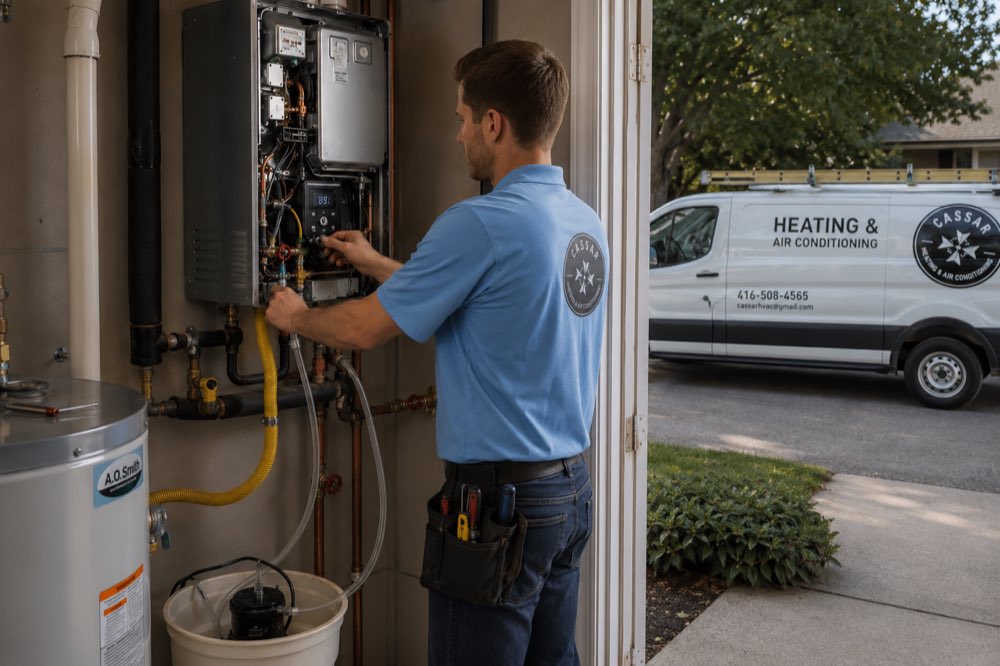
David installs, repairs, and replaces tankless water heaters across Courtice. Every job gets a free upfront quote before any work starts.
Many Courtice homes built in the late 1990s on streets like Prestonvale Road and Courtice Road were plumbed for standard 40- or 50-gallon tanks, so a tankless install here often involves a gas line upgrade and new venting through the rim joist or exterior wall. David sizes the unit to your household’s actual demand before anything gets ordered. You’ll know the full cost before the work begins.
An error code on the display, a burner that won’t ignite, or a unit throwing cold water mid-shower, David diagnoses these quickly because he carries common parts for the most popular brands on every service call. Most repairs wrap up the same day he arrives. You’re talking to David when you call, so there’s no relaying information through a dispatcher.
If your existing tankless unit is past 15 years or the repair cost is approaching 50% of a new unit’s price, replacement usually makes more sense. David gives you an honest assessment, he won’t recommend replacement if a repair will serve you well for several more years. He stocks commonly used units and can often complete a swap in a single visit.
Durham Region’s water supply carries enough mineral content that scale buildup inside a tankless heat exchanger is a real issue, not a theoretical one. An annual descaling flush and filter clean keeps the unit running at rated efficiency and prevents the kind of damage that voids manufacturer warranties. David schedules these quickly and works around your day.
Swapping an older 80% AFUE tank or an early-generation tankless unit for a condensing tankless model rated at 96% or higher cuts your gas bill meaningfully over a Courtice winter. David walks you through the options, explains what the actual payback period looks like for your household size, and handles the Enbridge rebate paperwork where applicable.
When the hot water stops in the middle of January on Trulls Road or anywhere else in Courtice, David picks up the phone. There’s no automated system routing you to a queue. He’ll tell you honestly whether it’s something you can safely reset yourself or whether he needs to come out, and if he needs to come out, he’ll get there the same day.
I’ve been doing tankless installs and repairs in Courtice since 2011, and the pattern I see repeatedly is homeowners who got talked into a replacement they didn’t need or who got a quote that changed by the time the invoice arrived. That’s not how I work. You’ll know the full price before I touch anything, and I’ll tell you straight whether a repair makes sense or whether the unit’s genuinely done.
A gas tankless water heater installed in Ontario typically lasts between 15 and 20 years when it’s serviced annually. The higher end of that range belongs to units that get a descaling flush every year and have their inlet filter cleaned regularly. Units that go five or six years without any maintenance tend to drop off faster as scale chokes the heat exchanger and forces the burner to work harder than it should.
What shortens lifespan in Ontario specifically is our water hardness. Durham Region’s municipal water carries dissolved calcium and magnesium that deposits inside the heat exchanger over time. Left unaddressed, that scale acts as insulation, drives up gas consumption, and eventually cracks the exchanger, which is a replacement, not a repair. A simple annual flush with a descaling solution costs far less than a premature replacement.
Cold weather also plays a role. Ontario winters put real stress on the cold water inlet side of the unit, particularly if the unit is installed near an exterior wall without adequate insulation around the supply lines. A freeze at the inlet can damage internal components. David checks for this during installs and service calls, it’s an easy fix when caught early and an expensive one when it’s not.
A straightforward tankless water heater installation in Courtice, where an existing tank is being swapped and the gas line and venting are already in reasonable shape, typically runs between $3,500 and $5,500 installed. That range covers the unit itself and the labour. Where the cost rises is when the job needs a gas line upgrade, new dedicated venting through the wall or roof, or when the existing shut-off valve or supply lines need replacing at the same time. A full new installation with all those elements can reach $6,500 to $8,000.
Repairs vary considerably. A sensor replacement or igniter swap might be $200 to $400 in parts and labour. A heat exchanger replacement on an older unit can approach $1,200 to $1,800, at which point a new unit often makes better financial sense. David will tell you which way the math falls before you spend anything.
The best way to know what your specific job will cost is to get a free quote from David, no pressure, no obligation.
Courtice developed heavily through the late 1980s, 1990s, and into the mid-2000s, which means a significant portion of the housing stock is detached and semi-detached homes built on slabs or with unfinished basements. The utility areas in these homes were typically plumbed for 40- or 50-gallon natural gas tanks, with a 1/2-inch gas supply line running to the water heater location. Many tankless units, especially higher-capacity condensing models, require a 3/4-inch line, so David checks gas line sizing on every Courtice job before recommending a unit.
Venting is the other variable. The older homes in Courtice’s established neighbourhoods around Sandringham Drive and Courtice Road often have B-vent chimneys shared between the furnace and the water heater. Tankless units need their own dedicated PVC or stainless flue. That usually means running new venting horizontally through the rim joist to the exterior, which is standard work, but it needs to be accounted for in the quote.
Courtice’s newer builds, particularly in the Avondale and Fairview neighbourhoods developed from the mid-2000s onward, are more likely to already have tankless units from the original builder that are now approaching the 15-year mark. On these jobs David often sees units that were never properly serviced, with heavy scale buildup and error codes that look alarming but are actually just maintenance issues. A thorough service call often brings them back to reliable operation without needing full replacement.
The most direct sign is an error code on the unit’s display panel. Navien, Rinnai, Noritz, and Rheem all have self-diagnostic systems that throw specific codes when something’s wrong. Don’t ignore them and don’t reset the unit repeatedly without addressing the underlying cause, some codes point to combustion issues that get worse with continued use. Write down the code and call David. He’ll tell you what it means before he even arrives.
A temperature fluctuation during a shower, where the water goes hot, then cold, then hot again, is often a flow rate issue or a failing flow sensor rather than a failing unit. In Courtice and across Durham Region, this symptom gets worse in winter when incoming cold water is significantly colder than in summer, pushing the unit harder to reach set temperature. It’s a diagnosable and usually fixable problem.
Reduced flow at hot water fixtures, a sulphur or unusual smell from the hot water, visible water under the unit, or a unit that cycles on and off more frequently than it used to are all signs worth calling about. David’s seen every variation of these in Courtice homes since 2011, none of them require guesswork to diagnose when you know what you’re looking at.
Ontario’s winter groundwater temperature drops significantly by January and February, incoming cold water in Durham Region can be as low as 3 to 5 degrees Celsius at peak winter. That means your tankless unit has to work harder to hit your set temperature than it does in summer, and it reduces the effective flow rate the unit can deliver at that temperature rise. If you’re noticing weaker hot water performance in January, this is likely why. Setting your thermostat to 49 degrees Celsius rather than the default 60 reduces strain and still delivers comfortable water at the tap.
Annual servicing before winter, September or October, is better timing than a spring tune-up for Durham Region homeowners. You want the unit descaled and the igniter and sensors checked before it faces the heaviest demand of the year. David typically books these up quickly in the fall, so scheduling ahead avoids a wait.
Insulating the cold water supply lines in unheated areas of your basement, particularly near the exterior wall where the unit is installed, protects against freeze damage during a cold snap. It’s a cheap and simple precaution that prevents a genuinely expensive repair.
In Ontario, any gas appliance installation or replacement must be performed by a TSSA-licensed technician. That’s not optional, and it’s not just about permits, an improperly vented tankless unit can produce carbon monoxide inside the home. David’s TSSA licence number is #000398183, verifiable on the public registry. He pulls permits where required and ensures the installation meets Ontario’s gas code.
Enbridge Gas offers rebates for qualifying high-efficiency water heating equipment in Ontario. As of recent program years, homeowners replacing a conventional storage tank with a qualifying tankless condensing unit may be eligible for a rebate of $250 to $500 through the Home Efficiency Rebate Plus (HER+) program, depending on the unit’s energy factor rating. David can confirm eligibility for your specific unit at the time of quote, it’s worth asking.
On the efficiency side, a condensing tankless unit operating at 96% AFUE or higher recaptures heat from the exhaust gases that a non-condensing unit vents outside. Over a full Ontario heating season, that difference adds up. The condensate these units produce is mildly acidic and needs a proper drain connection, another item David addresses at installation so it doesn’t create problems later.
Checking the simple things before calling saves time for everyone, run through these quickly before you pick up the phone.
Tankless units have self-diagnostic displays. Write down the error code and call Cassar, this tells us exactly what’s wrong before we arrive.
There’s a small mesh filter screen on the cold water inlet that catches debris. It blocks up over time and restricts flow enough to prevent ignition.
Make sure the gas shutoff valve behind the unit is fully open. It can get partially closed during other work in the utility area.
Running multiple hot water fixtures simultaneously can exceed the unit’s flow capacity, causing a cold burst. Try running one fixture at a time to test.
Tankless units vent through the wall or roof. Check that the intake and exhaust pipes are clear, undamaged, and properly connected.
If none of the above resolved the problem, it needs a licensed technician. David serves all of Courtice and Durham Region and picks up the phone himself.
Yes, for most Durham Region households a tankless water heater pays for itself over its lifespan, especially if you’re replacing an aging standard tank that’s already inefficient. A condensing tankless unit operates at 96% or higher efficiency compared to 60 to 80% for most older tanks, which means a meaningful reduction in your monthly Enbridge bill through an Ontario winter. For a household of three or four people in Courtice or Clarington running gas heat and hot water, the annual gas savings typically run between $150 and $300 depending on usage. Tankless units also last 15 to 20 years compared to the 10 to 12 years you typically get from a tank, so the longer service life factors into the value calculation. The economics are strongest when you’re replacing a tank that’s already near end of life rather than pulling out something with years left in it.
A tankless water heater installation in Durham Region runs between $3,500 and $8,000 depending on what the job actually involves. A straightforward swap where the gas line and venting are already compatible sits at the lower end, typically $3,500 to $5,500 for the unit and labour combined. Jobs that need a gas line upsized from 1/2-inch to 3/4-inch, new dedicated PVC venting run through the wall, or updated shutoff valves and supply lines climb toward $6,000 to $8,000. In Courtice specifically, homes built before the mid-1990s quite often need both the gas line and venting addressed because they were set up for tank water heaters with shared B-vent chimneys. The unit itself represents a significant portion of the cost, a quality condensing tankless from Navien, Rinnai, or Noritz runs $1,200 to $2,500 depending on capacity. The best way to know what your specific job will cost is to get a free quote from David, no pressure, no obligation.
It depends on the unit’s flow rate capacity and how many fixtures you’re running simultaneously, and this is exactly why sizing matters before you buy. A standard residential tankless unit rated at 8 to 9 gallons per minute can handle two showers running at the same time in most cases. Add a third shower or a dishwasher running at the same time and you’ll start to feel the temperature drop. The solution is proper sizing at the point of purchase, not buying whatever’s on the shelf. David calculates your household’s peak simultaneous demand before recommending a model. In a Courtice household with four or five people, he’ll often recommend a unit rated at 9 to 11 GPM to handle morning rush without anyone getting a cold surprise. Ontario’s cold inlet water temperature in winter also reduces effective GPM at your set temperature, a unit rated at 10 GPM in summer might deliver 7.5 GPM in February at the same temperature rise. That calculation has to happen before the unit gets specified.
Most tankless water heaters require a 3/4-inch gas supply line, and a lot of older Courtice and Clarington homes were plumbed with 1/2-inch lines running to the water heater location. A 1/2-inch line simply can’t deliver enough gas volume to support the burner on a modern tankless unit at full firing capacity, you’ll get cold water or frequent shutdowns. Upsizing the line means running new pipe from the nearest 3/4-inch branch in your gas system to the unit location. Depending on how far that is and what’s in the way, that work typically adds $300 to $700 to the installation cost. David checks your existing gas line sizing during the free quote visit, so there are no surprises when the job starts. He also checks the gas meter’s capacity, high-demand homes with multiple gas appliances occasionally need a meter upgrade, though that’s less common and Enbridge handles that portion directly.
A straightforward tankless installation where the gas line and venting are already compatible takes three to four hours from start to finish. When the job involves a gas line upgrade and new venting through the exterior wall, budget four to six hours. David works alone, there’s no crew showing up at different times or handoffs between tradespeople, so the job progresses start to finish in one visit. He’ll have hot water running and the installation tested before he leaves. If a permit is required for your municipality in Clarington or Durham Region, David pulls it beforehand so the inspection process doesn’t delay you. In most cases, you’ll have a fully operational tankless system the same day he arrives.
Cold water from a tankless unit has a handful of common causes, and most of them are diagnosable quickly. The most common is a blocked inlet filter screen, debris from the supply line builds up on the mesh filter and restricts flow below the unit’s minimum activation threshold, so the burner never fires. Pull the filter and rinse it. The second common cause is the “cold water sandwich” effect, a brief burst of cold water that occurs when you turn on hot water shortly after someone else just used it. Residual hot water in the pipe clears first, then cold water sitting in the supply line reaches the tap before the burner fires. This is a design characteristic of all tankless units and can be addressed with a recirculation pump if it bothers you. Less commonly, a failing flow sensor, a faulty temperature sensor, or an ignition issue prevents the burner from firing at all. In Courtice during winter, a partially frozen inlet line near an exterior wall can also cut flow enough to prevent activation. If checking the filter doesn’t resolve it, call David, an error code on the display will point directly to the cause.
Once a year is the right interval for a tankless water heater in Clarington and Durham Region. The annual service involves descaling the heat exchanger with a vinegar or citric acid flush to remove mineral deposits, cleaning the cold water inlet filter, inspecting the burner and igniter, checking the venting connections for blockages or deterioration, and confirming the unit’s temperature and pressure relief valve is functioning correctly. Skipping this for several years doesn’t mean the unit will stop working immediately, it means it’ll work harder, use more gas, and fail earlier than it should. Durham Region’s water hardness makes the descaling portion of the service genuinely important, not just a checkbox. David books annual tune-ups year-round, though September and October are popular slots before the heating season puts the unit under heavier demand.
David installs and services all major tankless water heater brands commonly found in Courtice and Durham Region homes, including Navien, Rinnai, Noritz, Rheem, Bradford White, and Bosch. He carries parts for the most common units and can source parts for less common models quickly. When it comes to new installations, he’ll recommend a specific model based on your household’s demand, your existing gas line capacity, and your budget, not based on what’s most profitable to sell. If you already have a unit from a brand not on that list, call and describe what you have. David will tell you straight whether he can service it or whether you’d be better served by someone with specific brand certification for that unit. No runaround.
“Our tankless unit in Courtice threw an error code on a Friday afternoon and we had no hot water. David diagnosed a blocked inlet filter and a failing flow sensor, replaced the sensor the same day, and we were back up and running before dinner.”
“I called about replacing our 16-year-old tankless that kept cycling off. David came out, looked at it, and was straight with me, he said the heat exchanger was showing scale damage but the igniter and controls were fine, and that a descale and sensor swap would likely give us another two or three years before we’d need a new unit. He did the repair, explained what he was doing as he went, and charged exactly what he quoted. Appreciated that he didn’t push a full replacement.”
“Got three quotes for a new tankless install in our Courtice home. David’s quote was the only one that actually broke down what was included, gas line upgrade, new venting, the unit itself. The others were just a single number. His price came in competitive and the final invoice matched what he quoted to the dollar. He also put down a drop cloth in the utility room and took it with him when he left, which I didn’t expect but noticed.”
David covers Courtice and every community across Durham Region for tankless water heater installation, repair, and replacement.
Same-day service available. TSSA certified. Honest pricing. Call or book online.