
Port Perry’s mix of older lakeside cottages, rural acreage homes, and newer subdivisions off Simcoe Street means a lot of properties without existing ductwork, ductless heat pumps are often the most practical heating and cooling solution David installs out here. He covers all of Port Perry and the Township of Scugog, with same-day and emergency service available when something stops working.
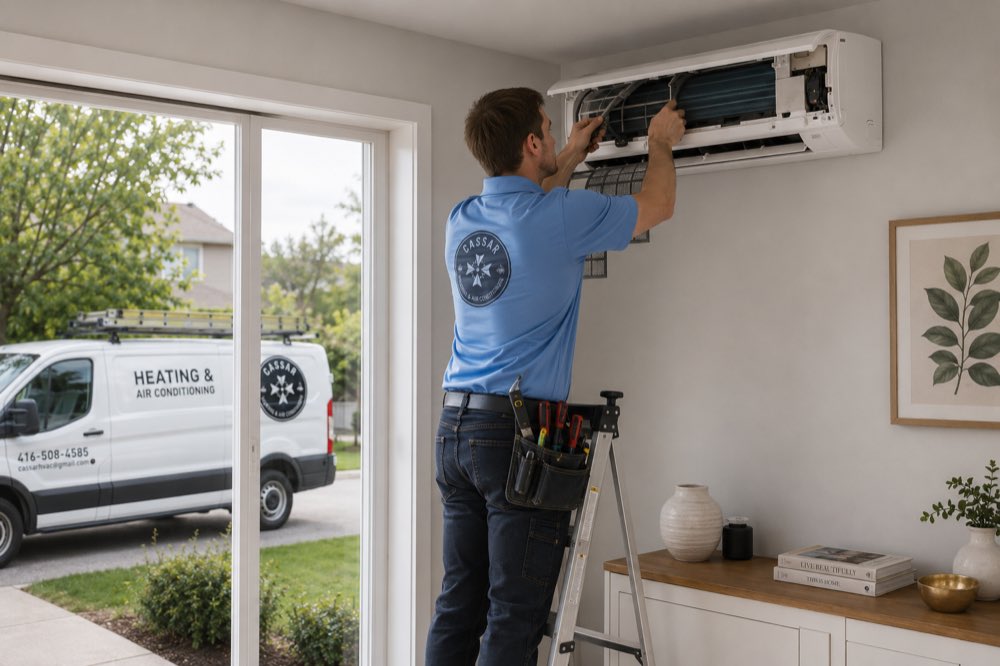
David handles every aspect of ductless heat pump work across Port Perry and the Township of Scugog, from first-time installations to emergency repairs.
A large portion of Port Perry’s housing stock, particularly the older homes along Water Street and the lakeshore properties on Lake Scugog, was built without central ductwork, making ductless the go-to solution. David sizes each system properly for the room or zone, mounts the indoor unit, runs the refrigerant lines, and commissions the system the same day in most cases. Every installation comes with a written quote before work starts.
When your ductless unit stops heating or cooling, David diagnoses the problem on the first visit. Common issues he repairs include refrigerant leaks, faulty control boards, frozen coils, and failed capacitors in the outdoor compressor. He stocks frequently needed parts and drives out to Port Perry directly, so there’s no multi-day wait for a second visit to complete the job.
If your system is over 15 years old or the repair cost is approaching half the unit’s value, replacement often makes more financial sense. David tells you which way honestly, he won’t push a new unit if a repair will do the job. When replacement is the right call, he’ll recommend a properly sized system and handle the full swap, including disposal of the old equipment.
A yearly service visit catches small problems before they become expensive ones. David cleans the indoor filter and coil, inspects the refrigerant charge, checks electrical connections at the outdoor unit, and tests both heating and cooling modes. Systems that get annual maintenance consistently outlast those that don’t, and they run more efficiently through the shoulder seasons when Port Perry temperatures swing hard.
Older single-stage ductless units installed before 2015 often run at a fraction of the efficiency of current inverter-driven systems. Upgrading to a modern cold-climate heat pump rated for operation down to -25°C makes a real difference in Port Perry’s winters, where temperatures regularly drop into the minus twenties. David assesses whether your existing line set and electrical can support a higher-efficiency unit, which can reduce upgrade costs significantly.
Port Perry sits at the northern edge of Durham Region, and in January that matters, a ductless unit that’s your primary heat source failing overnight is an urgent call. David answers his own phone and prioritises emergency calls across the Township of Scugog. When you call, you’re talking to the person doing the work, not a dispatcher triaging your request.
Working out in Port Perry and the Township of Scugog since 2011, David’s seen firsthand that a lot of the rural properties here have undersized electrical panels that need attention before a new ductless system can go in, it’s something he flags upfront so there are no surprises on installation day. He’s done installs on everything from century-old farmhouses on Reach Street to newer builds in the Balsam subdivision, and he knows the houses out here aren’t all the same. You’ll get a quote that reflects your actual situation, not a number pulled from a price sheet.
A well-maintained ductless heat pump typically lasts between 15 and 20 years in Ontario conditions. The outdoor compressor unit takes the brunt of the wear, cycling through heating and cooling demands across our wide temperature range, so it often dictates the system’s lifespan. Indoor air handlers tend to outlast the compressor when they’re kept clean.
What shortens that lifespan most reliably is skipping annual maintenance. Dirty coils force the compressor to work harder, refrigerant leaks go unnoticed until the system fails on a cold night, and electrical connections corrode over time in Ontario’s freeze-thaw cycles. A system that gets a professional inspection every year will routinely hit 18 to 20 years. One that gets ignored might struggle past 10.
Ontario’s climate specifically demands attention to the outdoor unit’s defrost cycle. In our winters, the unit goes through repeated freeze-thaw, and if the defrost board or sensors degrade, the coil can ice up completely. Catching that early during a fall tune-up prevents a mid-winter failure. It’s one of the first things David checks when servicing a system that’s been running for more than five or six years.
A single-zone ductless heat pump installation in Port Perry typically runs between $3,500 and $6,500 installed, depending on the system’s capacity, efficiency rating, and how straightforward the line set routing is. A two-zone system serving two separate rooms or a main floor and a loft will generally land between $5,500 and $9,500. Multi-zone systems with three or four indoor heads can reach $10,000 to $14,000 or more for high-efficiency cold-climate models.
What drives variation in Port Perry specifically is the nature of the homes. Older properties along the lake or in the historic downtown core sometimes require longer refrigerant line runs, or electrical upgrades to the panel before the system can go in. A new subdivision home with a modern 200-amp panel and easy exterior wall access is a much simpler installation than a century farmhouse on a rural concession. David checks all of this before quoting so the number reflects the actual job.
Repair costs are separate and depend on what’s failed. A refrigerant top-up and leak repair might be $300 to $600. A control board replacement is typically $400 to $800 depending on the unit. David diagnoses on the first visit and gives you the repair cost before touching anything. The best way to know what your specific job will cost is to get a free quote from David, no pressure, no obligation.
Port Perry’s housing stock is genuinely varied. The older neighbourhoods close to Lake Scugog and the downtown core include homes built in the 1880s through to the mid-20th century, many of which were heated with oil or electric baseboard systems and never had ductwork installed. These properties are exactly where ductless heat pumps make the most sense, there’s no duct system to retrofit, and a well-placed wall unit can heat and cool a main living area efficiently without invasive renovation.
The newer subdivisions, particularly the growth areas along Reach Street and the developments east of Water Street that expanded through the 2000s and 2010s, often have forced-air furnaces already in place. Homeowners there typically add ductless units as a supplemental zone for a sunroom, a finished basement, or a detached garage rather than as a whole-home solution. David sizes those add-on systems to complement the existing heating rather than compete with it.
One thing David sees regularly in Port Perry is rural properties on well and septic that were originally cottages or seasonal properties converted to year-round use. These homes often have mixed heating systems, minimal insulation in the crawl space or attic, and electrical panels that were never upgraded from the original 100-amp service. A cold-climate ductless heat pump can work very well in these homes, but the electrical situation has to be assessed first. David includes that check as part of his site visit before any installation quote.
The clearest sign is a unit that’s running constantly but not reaching the set temperature. In Port Perry’s winters, where it regularly dips below -15°C, a properly sized cold-climate heat pump should maintain comfortable indoor temperatures without running non-stop. If yours is struggling, it’s either low on refrigerant, has a dirty coil, or it’s genuinely undersized for the space, all three are fixable but require a technician to diagnose correctly.
Unusual noises are another signal most people wait too long to act on. A grinding or rattling sound from the outdoor compressor usually means a failing bearing or debris in the fan, catching it early prevents a compressor replacement, which is the most expensive repair on any ductless system. A gurgling sound from the indoor unit often points to a refrigerant issue. Neither sound gets better on its own.
Water dripping from the indoor unit is worth a call. Ductless units have a condensate drain, and if it blocks, water backs up into the unit and can damage the wall below. This happens more often in Durham Region’s humid summers, when condensation volume is high and drain lines haven’t been cleaned in a few years. It’s a quick fix when caught early and a wall-repair project if it isn’t.
Durham Region runs from cold and dry in January to hot and humid in July, and ductless heat pumps handle that range well, but a few habits extend their efficiency and life. In winter, keep the outdoor unit clear of snow and ice. Modern units defrost themselves, but they can’t defrost under a snowdrift. Leave at least two feet of clearance around the unit and make sure the discharge isn’t blocked by a fence or deck.
In summer, shade the outdoor unit if possible, a unit sitting in direct afternoon sun works harder than one with natural shade. That said, never restrict airflow around it. The efficiency gains from shade are lost the moment you block the coil. Keep the indoor filter clean. Ductless filters are designed to be rinsed and reused, and checking them monthly in high-use periods is a five-minute job that keeps the system running efficiently.
Shoulder seasons, October and April specifically in Durham Region, are the best time for a professional tune-up. Booking in fall means the system’s defrost function and refrigerant charge get checked before the heating season starts. Booking in spring means the cooling side gets verified before the first hot stretch of June. David books these visits throughout those months, and it’s far easier to get a same-day appointment in May than in February when everyone’s system is already failing.
Ductless heat pumps don’t carry the carbon monoxide risks associated with gas furnaces, they’re electric systems moving heat rather than burning fuel. That said, the refrigerant inside them is a regulated substance under Ontario’s TSSA guidelines, and anyone handling it needs a valid TSSA licence. David holds TSSA Licence #000398183, which you can verify directly on the TSSA public registry. If a contractor offers to top up your refrigerant without mentioning their licence, that’s a red flag.
Ontario’s Enbridge and Hydro One rebate programs have shifted over the years. As of 2024, the Canada Greener Homes Grant has wound down its main intake, but the Canada Greener Homes Loan remains available for eligible upgrades, and the Ontario Clean Energy Credit affects operating costs. Mitsubishi, Daikin, and Bosch units certified at ENERGY STAR levels qualify for specific rebate streams. David can walk you through what’s currently available when he visits for a quote, the programs change frequently enough that it’s worth getting current information rather than relying on what was posted online six months ago.
Efficiency ratings matter more in Durham Region than in warmer climates because the system does real heating work for five or six months of the year, not just spot cooling. A system rated at HSPF2 9.0 or above will cost meaningfully less to operate annually than an older unit at HSPF2 7.5, the difference across a full Ontario heating season adds up to real money on the hydro bill.
Checking the simple things before calling saves time for everyone.
Confirm the mode is set to Heat, the temperature is set above room temperature, and the remote has fresh batteries. Wrong mode is the most common ductless issue.
Ductless systems have separate breakers for the indoor air handler and outdoor compressor. Check both in your electrical panel.
Ductless filters are inside the indoor wall unit behind the front panel. Slide it out and rinse it under water, these block up faster than furnace filters.
Clear any snow, ice, or debris blocking the outdoor unit. A fully iced-over unit needs a technician, don’t attempt to remove ice manually.
Ductless remotes have many modes. Confirm the display shows the heat icon, not a water droplet (dry mode) or fan symbol.
If none of the above solve it, the system needs a licensed technician. David serves all of Port Perry and Durham Region and picks up the phone himself.
Yes, modern cold-climate ductless heat pumps work reliably down to -25°C or colder, which covers the coldest nights Port Perry and the rest of Durham Region sees in a typical winter. The key is specifying a cold-climate model, not a standard heat pump designed for milder climates. Standard units lose capacity quickly below -10°C and aren’t suitable as a primary heat source in Ontario. Cold-climate models from Mitsubishi (Hyper Heat), Daikin (Emura), Fujitsu (Halcyon), and others maintain meaningful heating output even in extreme cold. David installs cold-climate rated systems exclusively for Ontario homes, it’s not optional here. If you’re replacing an older ductless unit or a competing contractor quoted you a standard unit for a Port Perry installation, it’s worth asking specifically about the rated capacity at -15°C before committing.
A single-zone ductless heat pump installation in Durham Region typically costs between $3,500 and $6,500 fully installed. Two-zone systems run $5,500 to $9,500, and three or four-zone multi-head configurations generally fall between $10,000 and $14,000 depending on system capacity, efficiency rating, and how the installation itself goes. The factors that push the number up are longer refrigerant line runs, the need for electrical panel upgrades, difficult mounting locations, and premium efficiency ratings. The factors that bring it down are short line sets, easy outdoor unit placement, and existing infrastructure that can support the system. In Port Perry specifically, the older housing stock and rural properties on the concession roads sometimes require more electrical prep work than a newer Durham Region subdivision home. Every job gets a written upfront quote. The best way to know what your specific job will cost is to get a free quote from David, no pressure, no obligation.
One indoor unit covers a single zone, typically one open-concept room or a defined area up to about 1,000 square feet depending on the ceiling height, insulation, and window area. A two-storey home with an open main floor and two upstairs bedrooms might need two or three indoor heads to cover the whole house effectively. The right answer depends on your floor plan, not a formula. In Port Perry, David sees a lot of homes where a single wall unit in the main living area handles the bulk of the heating and cooling, with electric baseboards or an existing oil system covering the bedrooms as a backup, a practical arrangement for a house where running ductwork isn’t feasible. He’ll walk through your floor plan during the site visit and recommend the number that makes sense for how you actually use the space, rather than a number that maximises the invoice.
Every ductless heat pump David installs in Port Perry and across Durham Region does both heating and cooling, that’s the nature of a heat pump. In heating mode it extracts heat from outdoor air and moves it inside. In cooling mode it runs the process in reverse, pulling heat from inside and rejecting it outdoors. You switch between modes on the remote. The same unit that keeps your living room comfortable in a July heat wave keeps it warm in a January cold snap. For Port Perry’s cottage conversions and older homes that previously relied on window air conditioners for summer and baseboard heat for winter, a single ductless unit replaces both systems and typically reduces overall energy consumption, since heat pumps move heat rather than generate it and are significantly more efficient than electric resistance heating.
The Canada Greener Homes Loan is currently the most accessible federal program for Ontario homeowners installing an ENERGY STAR certified cold-climate heat pump, it offers interest-free financing up to $40,000 for eligible upgrades, repayable over 10 years. The Canada Greener Homes Grant closed its main intake in 2023, so that stream is no longer available for new applicants. Ontario doesn’t currently have a province-wide heat pump rebate program separate from the federal programs. Some local utilities in Durham Region have historically offered energy efficiency incentives, so it’s worth checking with your electricity provider directly. Rebate programs change frequently, David can give you current information on what’s available when he visits for a quote, which is more reliable than what might be posted on a government website that hasn’t been updated recently. The best way to know what your specific job will cost after available rebates is to get a free quote from David, no pressure, no obligation.
A standard single-zone installation takes four to six hours from start to finish. David arrives, mounts the indoor wall unit, runs the refrigerant lines through the wall or along an exterior chase, mounts and connects the outdoor compressor, pressurises the system, checks for leaks, and commissions the unit through both heating and cooling modes before he leaves. You have a working system the same day in almost every case. A two-zone installation adds two to four hours depending on how far apart the indoor units are. Complications that extend the timeline include difficult refrigerant line routing through finished walls, electrical panel work if the breaker configuration needs updating, or a challenging outdoor unit location. David identifies these during the site visit so there are no surprises on installation day. He also tidies up completely before leaving, covers come off and the space is left clean.
Start with the remote, confirm the mode shows Heat, the set temperature is above the current room temperature, and the batteries are fresh. Wrong mode is genuinely the most common call David gets for a “broken” ductless unit in Port Perry and across Durham Region. If the mode is correct, check that both breakers for the system are on: ductless units have a separate breaker for the indoor head and the outdoor compressor, and one can trip without the other. Then check the indoor filter, if it’s heavily blocked, the unit will run but deliver little airflow. Look at the outdoor unit and clear any snow or ice piling around it. If none of those fix it, the problem is inside the system: low refrigerant, a failed defrost board, a faulty reversing valve, or a compressor issue. Those need a licensed technician with the right diagnostic tools. David carries the common parts for the brands he works with, so if it’s a standard component failure he can often fix it on the same visit.
David installs and services most major ductless brands including Mitsubishi, Daikin, Fujitsu, LG, Samsung, Bosch, and Carrier. He works with whichever brand makes sense for your application, different systems have different strengths, and the right choice depends on the zone size, the cold-climate rating you need for a Port Perry winter, and your budget. He’ll tell you which models he’d put in his own home and why, without steering you toward a brand because of a distributor relationship. For repair and maintenance work, he services systems regardless of who originally installed them. If you’ve got a unit from a previous installer and need service, David’ll work on it. He won’t refuse a call because he didn’t do the original installation.
“Our old ductless unit in the Port Perry cottage stopped heating in February. David came out the same day, found a failed reversing valve, and had it fixed before dinner.”
“We’d been running electric baseboards in our older Port Perry home for years and finally decided to put in a ductless unit for the main floor. David came by to look at the space, noticed the panel needed a breaker added before he could run the new circuit, and told us about it upfront so we could sort it out before installation day. He walked me through the whole job before he started, where the line set would run, how long it would take, what the wall was going to look like when he was done. No surprises and the heat output in that room is night and day compared to the baseboard.”
“Three quotes for a ductless installation on our place north of Port Perry. Two of them were vague on what was included. David’s quote broke everything down and the final bill matched it exactly. He put down floor protection at the door, cleaned up the drill debris, and took the packaging with him. The house looked the same when he left, just with a new heat pump on the wall.”
David covers all of Durham Region for ductless heat pump installation, repair, and maintenance.
Same-day service available. TSSA certified. Honest pricing. Call or book online.