
Call David and he’ll assess what’s actually happening with your home’s air, humidity, ventilation, filtration, and tell you straight what it’ll take to fix it. He’s been doing this work across Oshawa, Whitby, Ajax, Pickering, Clarington and every community in between since 2011.
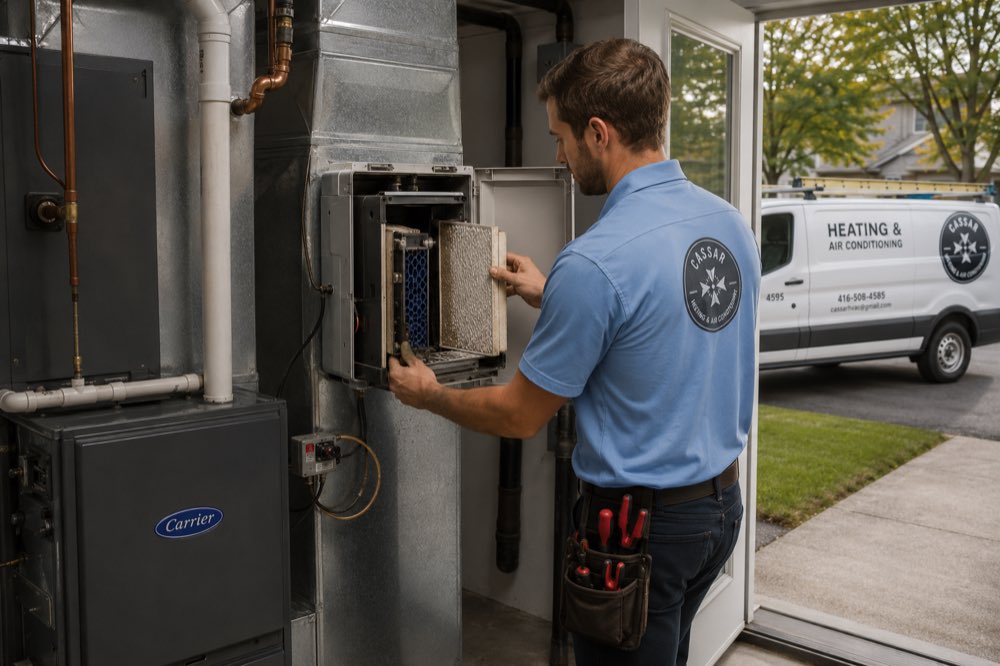
From a single air purifier to a full HRV installation, David handles every part of the job himself. Here’s what that looks like in practice.
Installing an HRV, ERV, whole-home air purifier, or UV air treatment system involves more than mounting a box, it means integrating properly with your existing ductwork and controls. David sizes the unit to your home’s square footage and existing ventilation, then connects it so fresh air distribution is balanced across every room. A poorly sized or incorrectly piped HRV won’t move enough air to make a difference.
HRVs and ERVs develop specific failure points: the heat exchanger core gets clogged, the defrost cycle stops working in cold weather, or the controls lose communication with the thermostat. David diagnoses the actual fault before recommending any parts. Many Durham Region homeowners have been told they need a new unit when a core cleaning or control board repair would’ve resolved the problem at a fraction of the cost.
When an HRV or air treatment unit reaches the end of its life, David’ll walk you through replacement options that match your home and budget, not whatever carries the highest margin. He’ll remove the old unit, handle the ductwork modifications if needed, and commission the new one so it’s running at the correct airflow rates before he leaves. You’ll get documentation of the final settings.
A yearly service on your HRV or ERV includes cleaning the heat exchanger core, washing the filters, checking the drain, testing airflow on both the fresh-air and exhaust sides, and verifying the defrost cycle is working correctly. Skipping this maintenance in Ontario’s climate means the core progressively loses efficiency, by year three of no service, most HRVs are moving significantly less air than their rated capacity.
If your HRV shuts down mid-winter and condensation starts forming on your windows, or you’re smelling something you can’t identify through the vents, call David directly. He covers all of Durham Region and responds same-day for emergency situations, you won’t wait three days for a technician who’s never seen your system. David answers his phone, not a dispatcher.
Moving from a basic one-speed HRV to a variable-speed unit with demand-controlled ventilation can cut energy use while improving air quality noticeably, especially in Pickering and Ajax homes built in the 2000s that have undersized original units. David can also add whole-home HEPA filtration or UV-C air treatment to an existing forced-air system without a full equipment replacement. He’ll tell you which upgrade will actually make a measurable difference for your specific home.
Four straightforward steps from your first call to clean, comfortable air.
David answers the phone directly, you’re talking to the person who’ll do the work, not a call centre. He’ll ask a few quick questions about your symptoms: stuffiness, condensation, dust levels, any smells coming through the vents.
On-site, David checks your existing ventilation equipment, measures humidity levels, inspects your ductwork connections, and assesses how your HVAC system is currently moving air. You get a clear diagnosis and a firm quote before any work starts.
Whether it’s cleaning and rebalancing your HRV, installing a new air purifier, or running ductwork for a new ERV, David completes the work himself. He tests airflow rates and verifies the system is delivering fresh air correctly before wrapping up.
David walks you through what was done, shows you how to maintain any filters or settings, and leaves your home the way he found it. If anything isn’t right after the job, he’s one call away.
David has been assessing and improving air quality in Durham Region homes since 2011. He’s seen every variation of HRV installation, ductwork problem, and humidity issue this region produces, and he gives you his honest read on what’s worth fixing and what isn’t.
David started Cassar Heating & Air Conditioning in 2011 because he’d seen too many homeowners taken advantage of by large contracting companies, replaced equipment that could’ve been repaired, inflated quotes on work that took two hours. He wanted to run a business where the person you called was the person who showed up, knew the work, and gave you a straight answer.
On every indoor air quality job, David doesn’t just swap parts. He checks how your home actually breathes: where fresh air is entering, where stale air is escaping, whether your HRV is genuinely balanced, and whether your ductwork is helping or hurting the situation. In newer Durham Region homes, particularly the tightly sealed builds in Whitby and Pickering from the last 15 years, the ventilation system is almost always the root cause of persistent stuffiness and humidity problems.
Local homeowners call David back because he leaves things better than he found them and doesn’t talk down to anyone. He’ll explain what he did, why it matters, and what to watch for going forward. That approach has built most of his business on referrals since 2011.
“Our HRV had been making a grinding noise for months and the air in the house felt stale no matter what we did. David found a worn bearing and a clogged core, fixed both on the spot. The difference in air quality was noticeable that same evening.”
“I called David about persistent condensation on our windows every winter, we’d had it since we moved in three years ago. He came out, tested the airflow on our HRV, and showed me that one of the ducts had been connected backwards at installation. He reconfigured it, rebalanced the system, and explained exactly what had been wrong. No upsell, no drama, just the fix.”
“Quoted me $650 for a UV air treatment installation. That’s exactly what I paid. He was in and out in under two hours, wore boot covers the whole time, and vacuumed the area around the furnace before he left. Pricing was clear from the start and nothing changed.”
Seven questions David hears from Durham Region homeowners, answered straight, without the sales pitch.
The most reliable signs aren’t dramatic. Look for condensation forming on your windows in winter, that’s excess humidity that has nowhere to go. Notice whether allergy or sinus symptoms ease up when you spend time outside or in a different building. Check your window sills and the corners of exterior walls for any black spotting that reappears after cleaning. If your home feels stuffy within a few hours of opening it up, your ventilation isn’t exchanging air fast enough. In Durham Region’s newer builds, these symptoms almost always point to an HRV that’s undersized, misconfigured, or hasn’t been serviced. In older homes it’s often just leaky or missing ventilation equipment entirely.
Ontario’s building codes have tightened significantly since the 1990s, and newer homes are considerably more airtight than older ones. That’s good for energy efficiency but it means stale air, moisture, CO2, and pollutants from cooking, cleaning products, and off-gassing materials have fewer natural escape routes. Attached garages are a specific problem in Durham Region subdivisions, combustion products from vehicles and stored gas equipment migrate into living spaces through unsealed walls. Older homes with oil or wood heating systems carry their own risks around combustion byproducts. Humidity is the most common complaint: either too dry in winter because the HRV is dumping too much heat, or too humid year-round because ventilation is insufficient.
They solve different problems, and confusing them is expensive. An air purifier, whether HEPA, activated carbon, or UV-C, treats the air already inside your home. It removes particles, allergens, or biological contaminants but doesn’t bring in fresh outdoor air or control humidity. An HRV (Heat Recovery Ventilator) continuously exhausts stale indoor air and draws in fresh outdoor air, recovering most of the heat in the process. It solves stuffiness and CO2 buildup. An ERV (Energy Recovery Ventilator) does the same but also transfers moisture between the air streams, which helps maintain humidity balance in more extreme climates. For most Ontario homes that run too dry in winter, an HRV is the right choice. If you’re also dealing with airborne allergens, adding filtration on top of an HRV is a much more effective strategy than using an air purifier alone.
A whole-home UV air treatment system or electronic air cleaner installed on your existing furnace typically runs $600 to $1,000, depending on the unit. A standalone HEPA filtration system integrated into the ductwork runs $800 to $1,400. An HRV unit, including installation, all ductwork connections, and balancing, generally falls between $1,500 and $3,000. The main variables are your home’s size, how complex the ductwork connection is, whether exterior wall penetrations are needed, and the specific unit you choose. An ERV in the same configuration costs slightly more. Combination setups, for example an HRV plus whole-home HEPA, will obviously be higher. The best way to know what your specific job will cost is to get a free quote from David, no pressure, no obligation.
Both, and often at the same time. A forced-air furnace is the distribution engine for whatever air quality equipment you install, an HRV, UV system, or air cleaner all tie into the same duct network. That’s an advantage: one system can treat the whole house. But it also means problems compound. Leaky return ducts pull unconditioned air from crawlspaces and attics. An oversized furnace that short-cycles doesn’t run long enough for filtration to be effective. A dirty blower wheel moves less air than rated, which means your HRV isn’t balanced. David checks the broader HVAC picture when diagnosing air quality problems because the equipment doesn’t operate in isolation.
The most effective combination for allergy sufferers is controlled ventilation plus high-efficiency filtration. An HRV with a MERV-13 or better filter on the incoming air stream removes pollen, mold spores, and fine particulate from outdoor air before it enters the house. During peak pollen season in Durham Region, typically April through June for tree pollen and August through September for ragweed, running the HRV on a lower ventilation rate and relying on filtration reduces the allergen load significantly. UV-C systems are effective against mold and bacteria growing on the coil and in the drain pan of your air conditioner or air handler. Standalone HEPA purifiers help in specific rooms but can’t treat the whole house as effectively as a ducted solution. David’ll assess which combination makes sense for your specific triggers and your home’s existing setup.
If your home was built after roughly 2005 and is well-insulated, the answer is almost certainly yes, and you may already have one that’s been ignored or improperly commissioned. Ontario’s building code has required mechanical ventilation in new construction for years, but “installed” and “working correctly” aren’t the same thing. David regularly services HRVs in newer Durham Region homes that were plumbed backwards, set to run at the wrong speeds, or have never been cleaned since the build. If you don’t have an HRV and your home is tight, you’ll know it from the stuffy feeling, elevated CO2 causing afternoon fatigue, and humidity that climbs every time you cook or shower. An ERV makes more sense if you’re in a climate where retaining indoor humidity in winter is a priority, for most Ontario homes, an HRV is the right tool.
What you should do, and when, to keep your home’s air in good shape year-round.
September and October are the right time to get your HRV serviced before heating season starts. David’ll clean the heat exchanger core, verify the defrost cycle is functioning, and check that your airflow rates are balanced. An HRV going into a Durham Region winter without a service is going to struggle, the core loads up with dust over summer and the defrost function gets tested hard once temperatures drop below -5°C. Book it before the fall rush fills up the schedule.
If condensation is forming on your windows in January, your HRV isn’t running enough or isn’t balanced, excess moisture has nowhere to go. If the unit is icing up or shutting down on cold nights, the defrost cycle has a problem. A musty smell through the vents in winter often means the heat exchanger core is overdue for cleaning. None of these fix themselves; call David before the moisture causes secondary damage to your walls or window frames.
Spring is when HRV installs and air quality upgrades are easiest to schedule, before summer’s AC demand picks up. It’s also when allergy season starts, which makes it a natural prompt to add whole-home filtration or a UV system ahead of peak pollen. If you’ve been thinking about upgrading an aging unit or adding HEPA filtration to your existing system, March through May is the window where David has the most availability and the work can be done without urgency.
Your HRV runs year-round but its summer role is often overlooked. In humid Durham Region summers, a properly functioning HRV set to the right speed helps manage indoor humidity alongside your air conditioner, reducing the load on the AC and preventing that clammy feeling that persists even with the cooling running. Summer is also a good time to check your UV air treatment lamp, which typically needs replacement every 12 months regardless of visible condition. The UV output degrades before the lamp fails visually.
The signs are usually gradual, which is why they get ignored. Persistent stuffiness even after you’ve opened windows for a while is the most common one. Condensation on your windows during winter means moisture is building up faster than your ventilation can remove it. If you or your family notice headaches or fatigue in the afternoon that ease up once you’re outside, CO2 is likely building up from insufficient fresh air exchange. Dust that reappears two or three days after a thorough cleaning suggests your filtration isn’t catching fine particles. Visible mold near vents, in bathroom corners, or along exterior walls is the most serious indicator. In Durham Region’s newer sealed homes, all of these problems are common, and they’re fixable. David’ll assess your humidity levels, ventilation rates, and ductwork to give you a clear answer on what’s actually driving the problem in your specific home.
An HRV, or Heat Recovery Ventilator, continuously exhausts stale air from your home and draws in fresh outdoor air, recovering most of the heat from the outgoing air so you’re not losing your heating energy. It doesn’t transfer moisture between the two air streams, which means it also helps dry out a home that’s running too humid in winter. An ERV, or Energy Recovery Ventilator, does the same thing but does transfer moisture, so it retains more indoor humidity while still bringing in fresh air. For the majority of Durham Region homes, an HRV is the right choice. Ontario winters are cold enough that indoor humidity tends to drop significantly without any help, and an HRV’s moisture-removing effect is actually beneficial. An ERV makes more sense in climates where humidity retention is important year-round, or in very specific situations where a home is running extremely dry even with an HRV. David’ll look at your home’s actual humidity readings and construction before making a call, he doesn’t recommend the same unit for every house.
The range is wide because the solutions are different. A UV-C air treatment system installed on your existing furnace coil runs roughly $600 to $900 installed. A whole-home electronic air cleaner or high-efficiency media filter housing installed in your ductwork is typically $700 to $1,200. An HRV unit with full installation, including exterior wall penetrations, all ductwork connections, and airflow balancing, generally runs $1,500 to $2,800, depending on your home’s size and how straightforward the ductwork tie-in is. ERVs cost slightly more than comparable HRV models. If you’re combining an HRV with a whole-home filtration system, expect to add $700 to $1,000 on top of the HRV cost. What drives the variation is primarily ductwork complexity, the unit you choose, and the number of penetrations needed. The best way to know what your specific job will cost is to get a free quote from David, no pressure, no obligation.
Yes, and it’s one of the most common root causes David finds in Durham Region homes with persistent air quality complaints. Ductwork that’s leaking on the return side pulls air from wherever it can find it, attic spaces, wall cavities, crawlspaces, the space between floors. That air carries whatever’s living in those spaces: fiberglass particles, mold spores, rodent dander, and in older homes, potentially asbestos from insulation disturbed over years of renovation. Return ducts that run through an attached garage are a specific concern: combustion products from vehicles and stored gas cans get pulled into the living space every time the furnace runs. Ducts that have physically disconnected inside finished walls are impossible to spot without inspection. If your air quality problems are room-specific or seem to correlate with the furnace running, ductwork is worth examining before adding filtration equipment on top of a compromised delivery system.
The most effective approach combines controlled ventilation with high-efficiency filtration. An HRV fitted with a MERV-13 or better filter on the incoming air stream removes a significant portion of pollen, mold spores, and fine particulate before that air enters the house. During Durham Region’s peak allergy seasons, tree pollen from April through June, grass pollen through July, and ragweed from mid-August through October, running the HRV on a lower ventilation speed during peak outdoor counts and relying on recirculation through a high-efficiency filter is a practical strategy. UV-C systems installed on the evaporator coil of your air conditioner or air handler are effective at killing mold and bacteria that would otherwise colonize the coil and drain pan and circulate through the home. For asthma sufferers who are sensitive to particulate specifically, a ducted whole-home HEPA filtration bypass is more effective than room-unit purifiers because it treats every cubic foot of air in the house. David’ll look at your specific sensitivities and your existing equipment before recommending a path, not every allergy sufferer needs the same setup.
David covers every community in Durham Region. Select your area for local pricing, availability, and service details specific to your neighbourhood.
Your air quality equipment works alongside your heating and cooling system. If you need help with any of these, David’s one call away.
Same-day service available across all of Durham Region. TSSA certified. Honest pricing. No surprises.