
When you call about your air conditioner, you’re talking directly to David Cassar, the person who’ll show up, diagnose the problem, and do the work himself. David’s been servicing central air conditioners across Oshawa, Whitby, Ajax, Pickering, and Clarington since 2011.
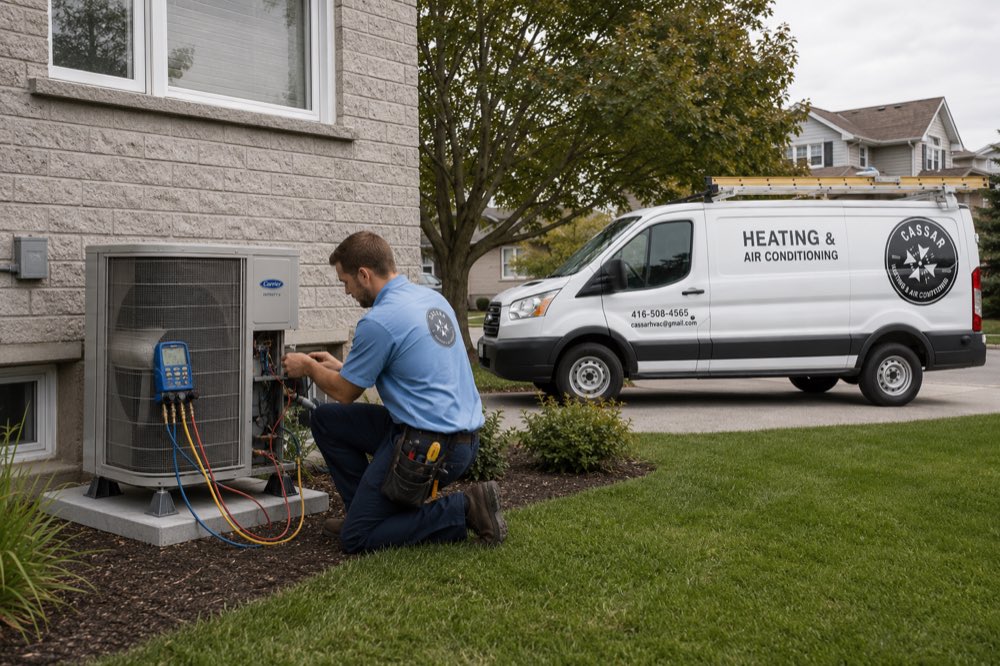
Every job below is something David handles personally, from the first phone call to the final startup check.
A new central AC installation means sizing the unit correctly for your home’s actual load, not just matching what was there before. David calculates the cooling load, selects a unit that fits your ductwork, and commissions the system properly so it performs at its rated efficiency from day one. Installing the wrong size unit is the most common mistake he sees when homeowners call him to fix a job someone else rushed.
When the system stops cooling mid-summer, David diagnoses the cause rather than guessing. He checks refrigerant charge, electrical connections, capacitors, contactors, and coil condition before quoting a fix. Most repairs across Durham Region happen the same day he diagnoses them because he stocks the components that fail most often on the van.
Replacing an aging central AC involves more than swapping the condenser on the pad outside. David checks the refrigerant line set, the evaporator coil, the condensate drain, and the electrical supply before recommending what carries over and what needs to go. He won’t quote a replacement without being honest about whether repair is still a reasonable option.
A proper AC tune-up covers refrigerant pressure, coil cleaning, drain line flush, blower motor amp draw, electrical tightening, and a thermostat calibration check. David completes the full list on every maintenance visit, not a shortened version with an upsell attached. A well-maintained 10-year-old system can run reliably for several more seasons without a major repair.
A failed AC on a Durham Region heat advisory isn’t just uncomfortable, it’s a health concern for elderly residents and young kids. David offers emergency service across Oshawa, Whitby, Ajax, Pickering, and Clarington for situations that can’t wait until Monday. When you call, you reach David directly so you know immediately whether he can get there that day.
Moving from a 13 SEER unit to a 18 or 20 SEER model cuts your summer cooling costs noticeably on a typical Durham Region semi or detached home. David walks you through the real payback period based on your current utility costs, so you’re making the upgrade decision with numbers rather than marketing language. He carries premium-efficiency models from multiple brands and isn’t locked to one supplier.
David answers the phone personally, so you can describe what the system is doing and he’ll tell you right away whether it sounds urgent or whether it can wait for a scheduled visit. There’s no hold queue, no call centre, and no intake form to fill out before someone calls you back.
David runs a full diagnostic on arrival, he checks refrigerant pressures, electrical components, airflow, and the condition of both the indoor and outdoor units before quoting anything. The price you get after diagnosis is the price you pay, with no add-ons discovered mid-job.
David does the work himself on the same visit in most cases, whether that’s a repair, a refrigerant recharge, or a full unit replacement. He protects the work area and leaves the space the same way he found it, including clearing the pad area after an outdoor unit swap.
Before he leaves, David runs the system through a full startup cycle and confirms it’s hitting the target temperatures at the thermostat. He’ll walk you through what he did and what to watch for, so you’re not left guessing whether the job is actually finished.
David has been doing AC work in Durham Region since 2011, and most of his customers have his number in their phone from the last time he was there. He runs a one-person operation by design, which means you get the same person every visit, someone who already knows your equipment and your home.
David started Cassar Heating & Air Conditioning in 2011 because he wanted to do the work himself, without the overhead of a large company pushing technicians to sell service plans or recommend replacements on equipment that still had years of life in it. He’d seen enough of that approach working for others, and he figured homeowners in Durham Region deserved something different.
On every AC call, he starts with the assumption that repair is the right answer until the numbers say otherwise. He checks refrigerant, electrical, airflow, and coil condition before drawing any conclusions, and he explains what he found in plain terms. A lot of his customers tell him the quote he gave them was half what another contractor had suggested for the same job.
He takes his shoes off at the door. He cleans up after himself. He doesn’t leave a mess around the outdoor unit after a replacement. Those things matter when someone’s letting a stranger into their home, and David knows it. That’s why the same homeowners in Whitby and Pickering have been calling him back since 2011.
“AC stopped blowing cold on a Friday afternoon. David had it diagnosed and repaired the same day, turned out to be a failed capacitor. Took about 45 minutes and the price was exactly what he quoted on the phone.”
“I called David because my AC was short-cycling every 10 minutes and I was worried it needed to be replaced. He came out, found the system was low on refrigerant and had a small leak at a fitting he could fix on the spot. He told me the unit was in good shape otherwise and that I’d get several more years out of it. He could’ve pushed me toward a new system and I wouldn’t have known the difference. He didn’t.”
“Got three quotes for a new central AC. David’s was the middle price but he was the only one who actually measured up properly and explained why I didn’t need the bigger unit the other guys were pushing. Install was clean, he was gone in under five hours, and the pad area outside was tidier than before he started.”
Sizing is calculated using a Manual J heat gain calculation, which accounts for your home’s square footage, ceiling height, insulation values, window area, orientation, and local design temperatures. A rule-of-thumb “one ton per 400 square feet” gets it wrong more often than not, especially in Durham Region homes where older builds have uninsulated rim joists or large south-facing windows. Too small and the system runs constantly but never reaches setpoint on hot days. Too large and it short-cycles, leaving the house humid and clammy even when the temperature is technically right. David calculates the load before recommending a unit size, and if the existing ductwork was sized for a different unit, he’ll tell you that upfront rather than let it become a performance problem after install.
Most central air conditioners installed in Ontario last between 15 and 20 years when they’ve been maintained annually. Systems that have gone years without a tune-up, or that were installed oversized and have been short-cycling for most of their life, often show serious wear by year 12 or 13. The compressor is the most expensive component to fail, and it’s often a signal that the rest of the system is near the end of its useful life too. If your unit is over 15 years old and needing a compressor, replacement is almost always the better financial decision. David checks compressor health during every maintenance visit so you’re not caught off guard.
The answer depends on three things: the age of the unit, the cost of the repair as a percentage of replacement cost, and the current SEER efficiency rating. A 7-year-old unit needing a $300 capacitor repair is a straightforward fix. A 16-year-old unit needing a compressor at $1,400 on a 10 SEER system, when a new 18 SEER unit is $3,800 installed, points clearly to replacement. The utility savings from moving to a higher-efficiency unit can meaningfully offset the cost difference over the next five summers. David gives you the honest comparison when he’s on site, including a realistic estimate of remaining useful life on the current system, so you’re deciding with actual numbers in front of you.
A complete central air conditioner replacement in Durham Region, including the condenser unit, evaporator coil, installation labour, and refrigerant, typically runs between $3,200 and $6,500 depending on the efficiency tier, the size of the unit, and whether any ancillary work is needed like replacing the line set or upgrading the electrical disconnect. A standard 2-ton 14 SEER installation on a home with existing infrastructure in good condition sits at the lower end of that range. A 3-ton 18 SEER unit on a larger home where the line set and coil also need replacing sits toward the upper end. Premium variable-speed systems can go higher. The best way to know what your specific job will cost is to get a free quote from David, no pressure, no obligation.
Ontario has had various rebate programs over the years for high-efficiency HVAC equipment, typically tied to SEER ratings above a certain threshold. The Canada Greener Homes Grant offered rebates for qualifying high-efficiency systems, and Enbridge and local utilities have run their own programs at various points. Availability, eligibility criteria, and amounts change regularly and often require pre-approval before the work is done. David stays current on what’s active when you’re booking and can tell you whether your planned upgrade qualifies before you commit to a specific model. Don’t assume a rebate applies without checking first, and never let a contractor use a rebate to justify a higher-priced system if the numbers don’t work without it.
Ontario’s climate runs hot and humid from roughly late June through August, with milder shoulder seasons on either side. The federal minimum standard in Canada is 13 SEER for new equipment, but that’s a floor, not a target. A 16 to 18 SEER unit hits the sweet spot for most Durham Region homes where the system runs hard for two to three months and sits largely idle the rest of the year. The payback period on a 20 SEER unit versus a 17 SEER unit can stretch to 12 or 15 years given Ontario’s cooling season length, so David won’t push the highest efficiency tier unless the numbers genuinely support it for your situation. Variable-speed units in the 18 to 20 SEER range also do a better job controlling humidity on those muggy August nights, which matters as much as the temperature number on the thermostat.
No, you don’t have to replace them together, but there are real reasons to consider it depending on the age of both units. The furnace’s blower motor and indoor air handler are shared components between heating and cooling. If the blower on your furnace is undersized or worn, your new AC won’t move air efficiently no matter how good the outdoor unit is. A 15-year-old furnace paired with a brand-new high-efficiency AC is going to underperform the spec sheet. David checks the blower output and static pressure during an AC quote so you know whether the furnace will be a limiting factor. If both units are within a few years of each other in age, replacing both at the same time typically saves on labour costs and sets both systems up to run well together for the next 15 years.
April and May are the best months to book an AC tune-up in Durham Region, before the first heat wave hits and every HVAC company’s schedule fills up. David cleans the condenser coil, checks refrigerant charge, and confirms the system is drawing the correct amps before it’s running daily. If you’ve been thinking about upgrading to a higher-efficiency unit, spring installations avoid the summer premium on labour and equipment availability.
If your AC is running constantly but the house isn’t reaching setpoint, or if you’re noticing ice forming on the refrigerant lines, those are signs of low refrigerant or restricted airflow and the system needs attention before the compressor takes damage. Warm air from the supply registers with the system running is usually an electrical issue, a tripped breaker, or a failed capacitor. Call David before the problem gets more expensive.
When the cooling season ends, turn the AC circuit breaker off before the outdoor temperature drops below 10°C. Running the compressor in cold weather without a crankcase heater can damage it. Clear leaves and debris from around the condenser so moisture doesn’t sit against the coil fins over winter. If you’ve had any performance issues during the summer, fall is the right time to book a diagnosis while the system still has refrigerant pressure and can be tested properly.
Winter is the right time to replace an aging system if you want the best price and scheduling flexibility. Contractors aren’t slammed in January, equipment is available, and you’ll have the new unit installed and commissioned before you need it in June. If your current unit is 13 or more years old and you’ve been putting off the replacement conversation, booking a winter consultation with David costs nothing and gives you time to make the decision without summer deadline pressure.
David covers all of Durham Region for air conditioner installation, repair, and maintenance. Select your community for local details.
Same-day service available across all of Durham Region. TSSA certified. Honest pricing. No surprises.